The Yield Clears at 5.8%. NSW's Frozen Land Tax Threshold, Strata Defect Crisis, and 66W Cooling-Off Trap Will Correct That.
You found a Western Sydney unit projecting 5.8% gross yield. Or an Eastern Suburbs house where scarcity value and constrained supply have delivered 6% to 10% annualised capital growth over the past five years. Or a regional Hunter Valley property where entry costs are half of metro Sydney and the vacancy rate sits below 1.5%. The numbers clear. Sydney's vacancy is 1.3% against a balanced-market benchmark of 3.0%. Net overseas migration flows disproportionately into Sydney. International student enrolments at UNSW, USyd, UTS, and Macquarie compress adjacent vacancy rates to historic lows. You're ready to move.
Then NSW's regulatory reality arrives. The 2024-25 State Budget froze the land tax threshold at $1,075,000 — permanently. As unimproved land values appreciate, investors whose aggregate holdings previously sat safely below the exemption are mechanically pushed into the taxable bracket, despite acquiring no new assets. Economists project this silent bracket creep will generate an additional $1.5 billion in revenue over four years, pulling thousands of previously exempt investors into the tax net. But the threshold is only the start. You hold your investment property in a standard discretionary family trust for asset protection — and discover that non-fixed trusts are entirely disqualified from claiming the NSW land tax threshold. Your asset is taxed from the first dollar of its land value. That structural mistake can cost upwards of $17,200 annually. Rectifying it by transferring to a fixed unit trust triggers both Capital Gains Tax and full stamp duty. The error is effectively uncorrectable. That apartment in Mascot? Twenty-five percent of NSW strata buildings have Capital Works Fund adequacy ratios below 50%. A special levy — a sudden capital injection from all lot owners — is structurally inevitable. Special levies on defective buildings routinely reach six figures per lot. The selling agent pushes you to sign a Section 66W certificate to waive your 5-business-day cooling-off period. On a $750,000 unit, defaulting on an unconditional contract forfeits your entire 10% deposit — $75,000 gone, with no recourse.
Here's what no single free resource explains: NSW combines Australia's deepest capital growth market with a land tax regime where the frozen $1,075,000 threshold engineers automatic bracket creep and discretionary trusts lose the threshold entirely, against a strata defect crisis where the Building Commissioner issues binding rectification orders and 25% of buildings have severely underfunded Capital Works Funds, against conveyancing mechanics where a 66W certificate makes your purchase immediately unconditional and the standard contract omits the 10.7(5) planning certificate that reveals tree disputes, contamination, and infrastructure corridor plans, against APRA lending rules that stress-test your aggregate debt at 3 percentage points above the actual rate and a new DTI cap that limits bank lending at 6x to 20% of new volume, against STRA regulations that cap non-hosted rentals at 180 days in Greater Sydney and 60 days in Byron Shire, against freshly abolished no-grounds evictions and tenants' presumed pet rights. Each of these has cost real investors five to six figures because the information existed — scattered across Revenue NSW calculators, Building Commissioner registers, and Reddit threads — but nobody had assembled it into a single underwriting system calibrated to New South Wales.
The New South Wales Investment Property Guide is an NSW Investor Due Diligence System — not a motivational overview of Australian real estate, but a structured risk-assessment framework that maps every NSW-specific financial trap, regulatory restriction, and tax structuring mechanic into a process you work through before you commit capital. It replaces months of cross-referencing Revenue NSW rate tables, Building Commissioner registers, planning certificate forms, and forum posts with a single reference that tells you exactly what to verify, exactly what the numbers should look like, and exactly where deals go wrong in this state.
What's Inside the NSW Investor Due Diligence System
A comprehensive 13-chapter guide, an 18-item quick-start checklist, and 7 standalone printable tools — covering every stage from submarket selection through post-purchase operations, built specifically for the regulatory mechanics and tax structures that make New South Wales different from every other Australian state:
Land Tax Calculation, Threshold Freeze, and Entity Structuring
NSW's land tax system has transitioned from a manageable holding cost to a primary threat to portfolio cash flow. The general threshold is frozen at $1,075,000 on aggregate unimproved land value, assessed using a three-year rolling average. The premium threshold locks at $6,571,000. The guide walks through every rate tier, the aggregation rules that catch multi-property investors who thought each asset was assessed separately, worked examples showing exactly when a second or third property pushes you over the threshold, the devastating consequences of holding in a discretionary trust (land tax from the first dollar at 1.6% plus $100 — no threshold), fixed unit trust structures that preserve the threshold, the tightened PPR exemption requiring 25% ownership from the 2026 tax year, the 5% foreign buyer surcharge, and the Section 47 Land Tax Clearance Certificate you must verify before settlement. You model your portfolio's land tax trajectory before you sign — not when the Revenue NSW assessment arrives.
Stamp Duty — The Largest Upfront Cost
Transfer duty on a $750,000 investment property costs approximately $28,747. On a $2,000,000 Eastern Suburbs house, duty reaches $92,012. Properties above $3,721,000 trigger premium duty at $7.00 per $100 over the threshold. Foreign purchasers add a 9% surcharge on top of standard duty — on a $1,000,000 property, that is $90,000 in surcharge alone. The guide covers the full progressive rate schedule with worked examples at every price point investors typically target, the premium property threshold, the foreign purchaser surcharge, the off-the-plan rules (no concession for pure investors since July 2023), and the interaction between stamp duty and entity structuring decisions.
Strata Forensics and the Building Defect Crisis
High-profile failures at Opal Tower and Mascot Towers permanently scarred buyer psychology, and for good reason. The Building Commissioner issues binding rectification orders under the Residential Apartment Buildings Act 2020. If the developer is insolvent, the owners' corporation — and each individual investor — holds the liability. The guide teaches the Capital Works Fund adequacy ratio calculation (current fund balance divided by forecasted 10-year requirement), the critical 50% threshold below which special levies become structurally inevitable, how to read strata committee minutes for hidden litigation, active rectification orders, and deferred maintenance, the new April 2026 strata legislation requiring standardised government-issued forms for maintenance schedules, and how to verify whether a new build carries Decennial Liability Insurance — the 10-year coverage that lets owners remediate critical defects without years of litigation against an insolvent developer.
Conveyancing Traps — 66W Certificates and 10.7 Planning Certificates
Two traps catch more amateur NSW investors than any other conveyancing issue. The Section 66W certificate waives your 5-business-day statutory cooling-off period, making the contract immediately unconditional — default forfeits the entire 10% deposit. The standard contract includes only the basic Section 10.7(2) planning certificate, which covers zoning and high-level hazards. The critical intelligence — tree disputes under the Trees Act 2006, unrecorded land contamination, interim development controls in infrastructure corridors — sits in the 10.7(5) certificate, which costs an additional fee and must be independently ordered. If you are buying for dual-occupancy development or subdivision potential, the 10.7(5) is the difference between an asset with expansion value and a structurally sterile purchase.
APRA Lending Restrictions and the DTI Cap
APRA mandates that lenders stress-test every loan application at 3 percentage points above the proposed rate. If you secure 6.2%, the bank calculates your repayment capacity at 9.2% — applied across your aggregate debt, not per property. From February 2026, APRA enforces a debt-to-income cap limiting banks to 20% of new lending at a DTI of 6x or greater. The guide covers how the serviceability buffer disproportionately impacts existing investors holding multiple properties, the DTI cap mechanics and the strategic pivot toward non-bank lenders (currently exempt but at higher rates), SMSF lending via Limited Recourse Borrowing Arrangements, and how to restructure existing debt to restore borrowing capacity for your next acquisition.
Short-Term Rental Regulations
Non-hosted STRA in Greater Sydney is capped at 180 days per year. Byron Shire enforces the tightest regulations in the nation — 60 days per year. But bookings of 21 consecutive days or more do not count toward either cap. The guide maps every STRA zone with its specific cap, the hosted versus non-hosted distinction (hosted properties face no cap), the 21-day exception strategy for mid-term corporate leasing, mandatory registration via the NSW Planning Portal ($65 initial, $25 annual renewal), and how to model STRA revenue realistically against the day caps.
Tenancy Law — The 2025 Reforms
No-grounds evictions are illegal as of May 2025. You must provide a legally valid reason with documentary evidence. Tenants have a presumed right to keep pets — if you don't respond to a pet request within 21 days, consent is automatically granted. Rent increases are limited to once per 12 months with 60 days' notice. The guide covers every reform from the 2025 Residential Tenancies Act amendments, the 6-month re-letting restriction after landlord-initiated evictions, NCAT dispute resolution mechanics, and the minimum standards that apply to rental properties.
Submarket Analysis and Value-Add Strategies
The guide analyses NSW's three primary acquisition strategies: Western Sydney yield corridors (Harris Park, Granville, Auburn — 5.6% to 6.2% gross at $450,000 to $500,000), Eastern Suburbs and Northern Beaches growth plays (Randwick, Dee Why — $2.3M to $3.4M with capital appreciation above 5%), and regional NSW (Hunter Valley, Central Coast, Wollongong — balanced yields with lower entry costs and lighter land tax exposure). Each corridor is mapped with current medians, vacancy rates, rental yields, and infrastructure catalysts. The value-add chapter covers dual-occupancy and secondary dwelling strategies, Complying Development Certificate pathways, and density opportunities under current planning frameworks.
7 Standalone Printable Tools
In addition to the guide and checklist, your download includes standalone PDFs you can print and bring to meetings with your solicitor, tax adviser, or property manager:
- Land Tax Calculator — Fillable worksheet for modelling your portfolio's aggregate land tax liability across up to three properties, with the 3-year rolling average calculation, entity comparison (individual vs trust vs company vs SMSF), bracket creep projection, and foreign owner surcharge
- Entity Structuring Comparison — Landscape reference card comparing 7 ownership structures across 8 dimensions (land tax threshold, CGT discount, negative gearing, asset protection, setup cost) with the discretionary trust trap highlighted and an investor profile decision guide
- Strata Audit Worksheet — Per-property worksheet for calculating Capital Works Fund adequacy ratios, reviewing strata minutes for defect litigation, checking Building Commissioner registers, verifying Decennial Liability Insurance, and recording a proceed/walk-away decision
- Stamp Duty Reference Card — The full progressive rate schedule with worked examples at 5 price points ($480K through $2M), foreign purchaser surcharge calculations, and a total acquisition cost breakdown
- Due Diligence Checklist — Comprehensive 14-item per-deal checklist organised across 3 stages (Before Making an Offer, At Exchange, Before Settlement), with NSW-specific items including Section 10.7(5) certificates, Building Commissioner registers, and the 66W decision
- Conveyancing Timeline — The full exchange-to-settlement timeline with the Section 66W cooling-off decision point highlighted, critical deadlines for VOI, mortgage discharge, and final inspection, plus common settlement delay warnings
- Compliance Calendar — Annual compliance obligations (land tax, insurance, STRA registration, tenancy rules, council rates, strata AGM) with a fillable date tracker for your specific property
Who This Guide Is For
This guide is for property investors targeting New South Wales markets who:
- Are building a Sydney rental portfolio and need to model how the frozen $1,075,000 land tax threshold, the three-year rolling average assessment, and the aggregation rules across all NSW holdings will affect their actual net yield — not the yield that appeared on the agent's advertisement
- Are interstate investors from Victoria or Queensland viewing Sydney's structural undersupply and institutional demand as a long-term capital allocation thesis — but need to understand the 66W cooling-off trap, Section 10.7(5) planning certificates, and PEXA settlement mechanics before deploying capital in an unfamiliar jurisdiction
- Are evaluating Sydney apartments and need a strata forensics framework that calculates Capital Works Fund adequacy, identifies buildings with active rectification orders, checks for Decennial Liability Insurance on new builds, and catches six-figure special levy exposure before they inherit it
- Are first-time or second-time investors who know they should hold in a trust for asset protection — but don't yet understand that a discretionary trust eliminates the entire $1,075,000 land tax threshold and that restructuring post-settlement costs more in stamp duty and CGT than the tax it was meant to save
- Are SMSF buyers who need to verify that a target property has no strata defect exposure, no pending special levies, and no compliance obligations that would breach the fund's investment strategy — because an SMSF acquisition with undisclosed liabilities can trigger ATO scrutiny
- Want every NSW-specific regulation, tax calculation, and due diligence requirement in one reference — instead of assembling it from Revenue NSW calculators, Building Commissioner registers, Section 10.7 guides, and Reddit threads that may predate the 2025 tenancy reforms or the 2026 land tax threshold freeze
Why Not Free Tools and Forums?
Free information on NSW property investing exists. Here's what it actually delivers:
- Revenue NSW calculators and documentation give you the land tax rate tables and the three-year rolling average methodology. They don't explain how the aggregation rules catch multi-property investors, don't compare the dollar impact of individual versus trust ownership at different portfolio values, and don't flag the devastating cost of the discretionary trust disqualification until you've already settled in the wrong structure. You get the rate schedule without the structuring strategy that makes it useable.
- Government strata guides tell you that a strata report exists and that you should get one. They don't teach you how to calculate the Capital Works Fund adequacy ratio, don't explain what a ratio below 50% means for your special levy exposure, don't show you how to read strata committee minutes for hidden defect litigation, and don't cover the new April 2026 standardised maintenance schedule requirements or Decennial Liability Insurance as a filter for off-the-plan purchases.
- Corporate educational content (mortgage brokers, buyer's agents, property managers) highlights Sydney's population growth, low vacancy rates, and the "borderless investing" opportunity. It minimises the land tax bracket creep, strata defect risk, 66W cooling-off trap, and APRA serviceability restrictions — because that content is designed to generate leads for mortgage products, not to help you identify reasons not to buy. The guide covers both sides.
- Reddit threads (r/AusPropertyChat, r/AusFinance) and PropertyChat forums contain genuinely useful investor experience reports mixed with advice that predates the 2025 tenancy reforms, the 2026 land tax threshold freeze, the APRA DTI cap, and the April 2026 strata legislation. A 2024 thread about trust structures may not reflect the tightened PPR exemption rules. Sorting current from outdated takes longer than reading a guide that has already done it.
This guide fills the NSW-specific gap — the space between knowing how to analyse a rental property in general and knowing how to underwrite one in a state where the land tax threshold is frozen at $1,075,000 (engineering automatic bracket creep), where discretionary trusts lose the threshold entirely (a $17,200+ annual penalty), where 25% of strata buildings have critically underfunded Capital Works Funds, where a 66W certificate makes your contract unconditional with no recourse, and where APRA's serviceability buffer stress-tests your aggregate debt at 3 percentage points above the actual rate. It's the analysis that would take an NSW property solicitor, a specialist tax adviser, and a strata forensics consultant to assemble — structured as a reference you own permanently.
— Less Than a Strata Report
A single strata report in NSW runs $250 to $400. Stamp duty on a $750,000 investment property is $28,747. A discretionary trust that eliminates the $1,075,000 land tax threshold can cost $17,200+ annually — and restructuring post-settlement triggers both CGT and full stamp duty. A special levy on a defective strata building can exceed six figures per lot. Signing a 66W certificate prematurely and defaulting on an unconditional contract forfeits 10% of the purchase price — $75,000 on a $750,000 unit.
This guide doesn't replace your conveyancer or your tax adviser. But it gives you the land tax structuring model, the strata forensics framework, the 10.7(5) planning certificate checklist, the entity comparison, and 7 standalone printable tools you can bring to every meeting and every deal — ensuring you identify every NSW-specific risk before you're contractually committed, instead of discovering them on your first Revenue NSW assessment, your first special levy, or the day you try to restructure a discretionary trust.
If it catches a single land tax structuring mistake, prevents a single defective strata purchase, or stops you from signing a 66W certificate before your finance is unconditional, it pays for itself before you've finished reading it.
Money-back guarantee, no time limit. If the guide doesn't sharpen your underwriting and protect your capital in NSW's regulatory environment, you pay nothing.
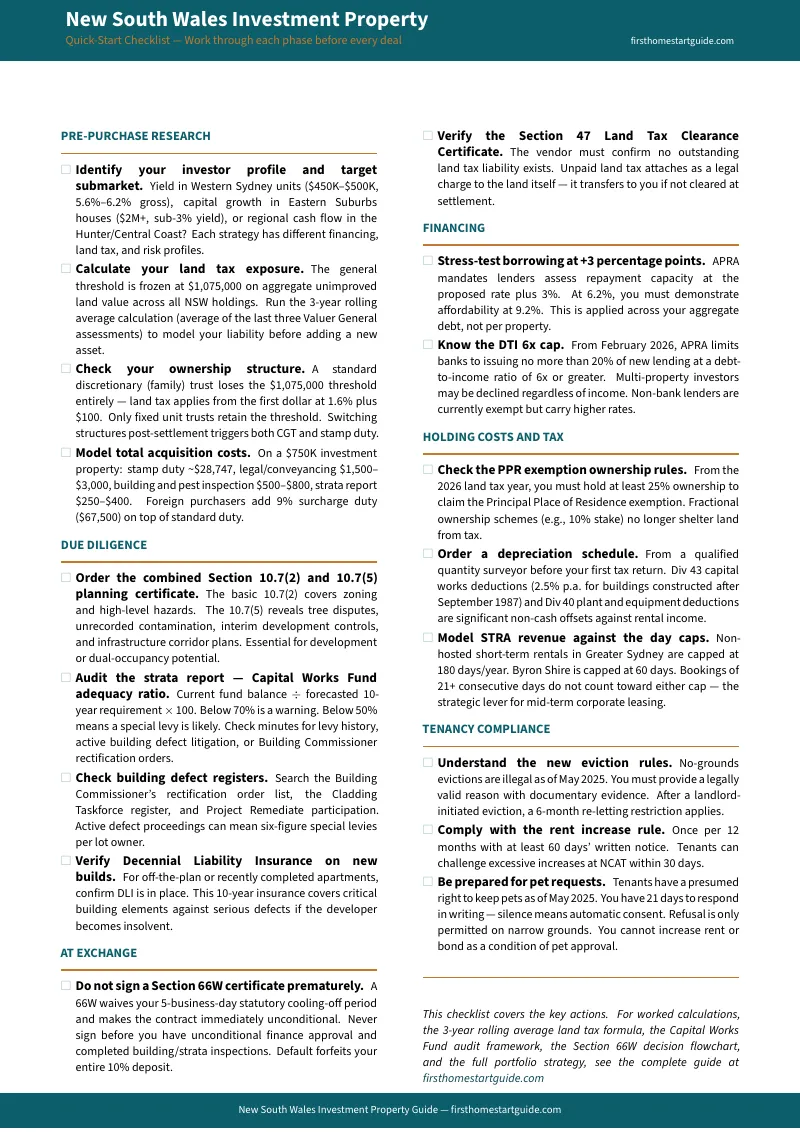
Download the free New South Wales Quick-Start Investment Property Checklist to see the due diligence framework covering pre-purchase research, land tax modelling, strata forensics, conveyancing traps, and post-purchase compliance. When you're ready for the full land tax structuring model, strata adequacy calculations, 10.7(5) analysis, and submarket strategy, the complete guide is here.
The yield clears at 5.8%. This guide tells you whether NSW agrees.