Your Savings Account Is Losing You Money. Every Month You Wait, the House Gets More Expensive.
You have been saving for a house. You have been disciplined. You cut the subscriptions, brought lunch to work, moved money into savings every payday. And then you checked Zillow --- the house you were targeting six months ago now costs $12,000 more. Your savings grew by $8,000. The gap got wider.
This is the math that breaks people. You are not failing because you lack willpower. You are failing because your money is sitting in the wrong place, earning the wrong rate, structured the wrong way. A standard bank savings account pays 0.01% to 0.5% while inflation runs at 3%. Your down payment fund is shrinking in real terms every single month. Meanwhile, the same dollars parked in the right vehicle --- a Treasury ETF, a high-yield savings account, or a tax-advantaged government scheme --- would be generating $50 to $150 a month in additional yield on a $30,000 balance. That is money you are leaving on the table because no one showed you where to put it.
The problem is not that you are bad with money. The problem is that the free calculators tell you how much house you can afford today, but nobody gives you a month-by-month system for actually getting there --- a system that tells you exactly which accounts to open, how to split your money across them based on your timeline, how to capture government matching funds you probably do not know exist, and how to automate the entire process so discipline becomes irrelevant.
The Down Payment Savings Plan & Strategy Guide is a Yield Optimization System --- a structured financial playbook that replaces guesswork with a precise savings architecture built for a 1-to-4-year buying timeline. It covers the United States, the United Kingdom, Canada, and Australia --- with localized savings vehicles, tax strategies, government programs, and worked scenarios for each market.
What's Inside the Yield Optimization System
A 10-chapter guide, a quick-start checklist, and 10 standalone printable worksheets and reference cards --- organized around the specific financial decisions that determine whether you reach your down payment target on time or fall short:
Your Real Savings Target (Not the Number You Guessed)
The internet says "save 20%." That number is wrong for most buyers. The guide calculates your actual target --- the one that accounts for minimum down payments by loan type (0% VA, 3% conventional, 3.5% FHA, 5% standard), closing costs (2-5% of purchase price), due diligence fees, and a post-move emergency reserve. It projects forward using an inflation-adjusted formula so you are saving toward what the house will cost when you actually buy it, not what it costs today. Three worked scenarios --- median income, high-cost city, and accelerated timeline --- give you a template to build your own numbers.
The Yield Optimization Matrix
Where you park your money matters more than most people realize. Leaving $40,000 in a checking account at 0.01% versus a Treasury ETF at 5% costs you roughly $2,000 a year in lost yield. The guide breaks down every capital preservation vehicle --- high-yield savings accounts, certificates of deposit, CD ladders, Treasury bills, Treasury ETFs (SGOV, USFR, VUSXX), Series I Bonds, and money market funds --- with the exact risk profile, liquidity constraints, and yield characteristics of each. A decision matrix maps the right vehicle to your specific timeline: 0-6 months out gets different treatment than 2-3 years out.
The State Tax Loophole Most Buyers Miss
If you live in a state with income tax (California, New York, Connecticut, and 38 others), interest earned on Treasury ETFs like SGOV is exempt from state and local taxes --- but your brokerage does not separate this on your 1099-DIV. The guide walks you through the exact steps to claim the exemption, the specific lines on your state return, and the dollar amounts at stake. On a $40,000 balance in an 8% tax state, this single optimization saves $160 to $240 per year. Most buyers never claim it because they do not know it exists.
Government Programs That Hand You Free Money
Every major English-speaking market has tax-advantaged savings vehicles specifically for first-time buyers, and most buyers either do not know about them or misunderstand the rules badly enough to trigger penalties. The guide covers the Canada First Home Savings Account (FHSA) --- $8,000/year tax-deductible with tax-free growth and withdrawal, plus the carry-forward trap that caps catch-up contributions at $16,000 in any single year. The UK Lifetime ISA (LISA) --- 25% government bonus on up to £4,000/year, but with a £450,000 property cap that means London buyers can lose 6.25% of their own capital if they exceed it. The Australia First Home Super Saver Scheme (FHSS) --- voluntary super contributions with a 30% tax offset on withdrawal, but with arcane ATO calculation rules that most buyers cannot navigate. And US Down Payment Assistance programs --- state-level grants, the Chenoa Fund, and GSFA Platinum programs offering up to 5.5% assistance that mainstream banking sites rarely mention.
Savings Automation Architecture
Discipline fails over a three-year timeline. Automation does not. The guide provides an exact bank account structure --- a dedicated down payment HYSA, a separate emergency fund, a separate closing costs silo --- with automatic transfer schedules, recommended dollar amounts based on your income, and the behavioral psychology behind why physical separation of funds prevents the most common savings failure: accidentally spending your down payment on an emergency that was not actually an emergency.
Acceleration Strategies That Actually Work
Beyond automated transfers, the guide covers concrete income acceleration methods --- the side income allocation framework (how to direct irregular income into the highest-yield vehicle), the tax refund redirect, the windfall protocol for bonuses and gifts, the subscription audit with a realistic savings estimate, and the rent arbitrage calculation that shows exactly when moving to a cheaper rental for 12-18 months generates more net savings than staying put. Each strategy includes the specific dollar impact so you can rank them by ROI.
Gift Fund Rules and Documentation
In Canada, 41% of first-time buyers receive a financial gift toward their down payment. In the US, lenders require specific gift letter documentation or they will reject the funds at underwriting. The guide provides the exact gift letter requirements by loan type (FHA, conventional, VA), the documentation your lender will demand, the rules around gift sourcing and seasoning, and the template language that satisfies underwriting on the first submission --- because having a gift rejected three weeks before closing is a crisis that a two-paragraph letter could have prevented.
Progress Tracking and Milestone System
A three-year savings plan without regular checkpoints turns into a vague intention that drifts. The guide includes a monthly tracking framework with yield monitoring, milestone celebrations, and recalibration triggers --- the specific moments when you should reassess your target price, adjust your vehicle allocation, or accelerate your timeline because you are ahead of schedule.
The PMI Decision Framework
Should you wait three more years to hit 20% and avoid PMI, or buy now at 5% down and absorb the insurance? The guide runs the exact math --- comparing the wealth accumulated by buying sooner (with PMI) versus renting longer (without PMI) under realistic appreciation and interest rate assumptions. In most markets appreciating at 3-5% annually, buying sooner wins. The guide shows you exactly when it does and when it does not.
Common Mistakes That Cost Thousands
Investing the down payment in stocks on a 2-year timeline. Co-mingling emergency and down payment funds. Forgetting to account for closing costs. Draining every dollar to close and becoming house-poor. The guide catalogs the ten most expensive mistakes first-time savers make, explains the behavioral psychology behind each one, and provides the specific structural fix that prevents it.
Who This Guide Is For
- Future buyers 1-3 years from purchase who need a structured savings plan that accounts for their specific timeline, target price, and local market --- not a generic "save more money" article that tells them nothing they do not already know
- Couples saving together who have different risk tolerances and spending habits, and need a neutral system that aligns their finances around a shared target without arguments about who spent what
- Buyers sitting on $20,000+ in a low-yield account who know they are losing money to inflation but are paralyzed by the choice between HYSAs, CDs, Treasury ETFs, and government schemes --- and need someone to map the decision based on their specific timeline
- Canadian buyers who want to maximize the FHSA but are confused by the carry-forward rules, contribution limits, and the interaction with the Home Buyers' Plan (HBP)
- UK buyers who are terrified of the LISA penalty trap and need someone to calculate whether the 25% bonus is worth the risk given their local property prices
- Australian buyers who have heard of the FHSS but cannot decipher the ATO's withdrawal tax offset calculations
- US buyers in high-tax states who want to capture the Treasury ETF state tax exemption but have never adjusted a state return and do not know where to start
Why Not Free Resources?
- Mortgage calculators (Bankrate, NerdWallet, SmartAsset) tell you how much house you can afford today. They do not tell you how to get from your current savings balance to that number over 36 months, which accounts to use, or how to optimize yield along the way. They exist to generate mortgage leads, not to build a savings plan.
- Reddit threads (r/personalfinance, r/FirstTimeHomeBuyer) are where anxious savers go at midnight to ask "HYSA or T-Bills?" The advice is genuine but contradictory, geographically inconsistent, and scattered across hundreds of posts. You get fragments of strategy from anonymous strangers, not a complete system you can execute from day one.
- Etsy and Gumroad planners are aesthetic checklists focused on house-hunting ("rate the neighborhood," "paint color ideas"). They cover the fun part. They do not cover yield optimization, tax-advantaged vehicles, or the specific math that determines whether you reach your target on time.
- Government websites (CRA, HMRC, ATO) describe their programs in statutory legalese that takes hours to decode. They tell you the rules but not the strategy --- the FHSA page does not tell you to front-load contributions in January, the LISA page does not warn you about the £450k trap in London, and the FHSS page does not walk you through the withdrawal tax offset calculation.
- Savings apps (Qapital, Oportun, Digit) automate round-ups and small transfers, which is useful for building an initial habit. But they charge $3 to $15/month in subscription fees that erode your balance, and many hold your funds at 0.10% APY. For a $40,000+ savings target, the yield difference between an app and a properly structured HYSA/Treasury ladder is hundreds of dollars a year.
This guide fills the gap between knowing you need to save and having a precise, month-by-month system that tells you exactly where every dollar goes and why.
--- Less Than One Month of Lost Yield on a Poorly Parked Savings Balance
If you have $20,000 sitting in a standard bank account earning 0.5%, moving it into an optimized HYSA or Treasury ladder earning 5% generates an additional $75 per month in yield. The guide costs less than one month of the money you are currently leaving on the table. If you are in a high-tax state and use the Treasury ETF state tax exemption, the tax savings alone cover the cost of the guide in the first quarter.
The guide includes 10 chapters covering every financial decision between now and closing day, a quick-start checklist you can execute in one evening, and 10 standalone printable worksheets and reference cards --- including the Yield Optimization Matrix, Savings Target Worksheet, Monthly Readiness Worksheet, Government Programs Reference, Gift Letter Documentation Kit, PMI Decision Worksheet, Rent vs. Buy Calculator, Savings Automation Setup, Common Mistakes Reference, and Key Contacts directory. 12 PDFs total, covering US, UK, Canadian, and Australian markets.
If it helps you capture even one month of optimized yield or one government program you would have missed, it pays for itself before you finish the first chapter.
Money-back guarantee, no time limit. If the savings plan does not give you a clear, actionable path to your down payment target, you pay nothing.
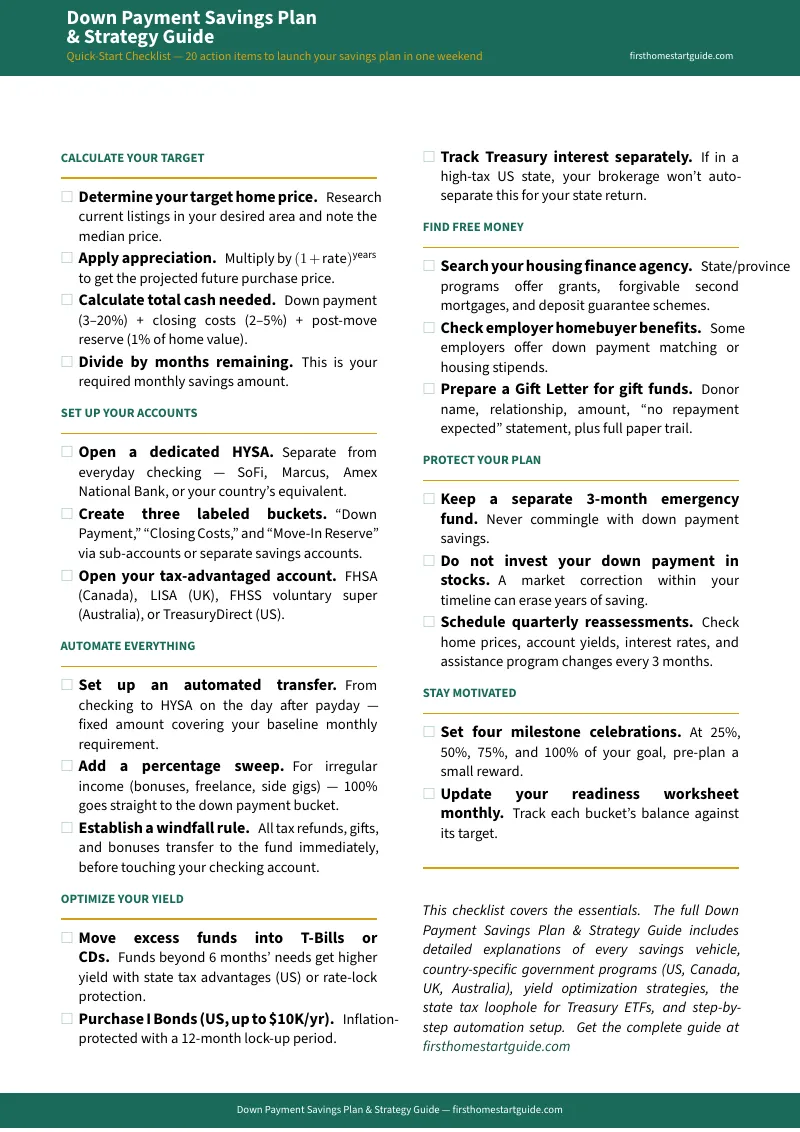
Download the free Down Payment Quick-Start Checklist to see the 20 essential steps --- from calculating your real target to opening the right accounts to automating your first transfer. When you are ready for the full yield optimization matrix, government program breakdowns, and month-by-month savings architecture, the complete guide is here.
Every month your savings sit in the wrong account is a month of yield you never get back. The house is not getting cheaper. Your plan should be getting smarter.
Frequently Asked Questions
What if the rules change after I buy?
We update the guide when the rules change. Email us any time, even years later, and we'll send you the current edition free.