You Lost the Bid. Your Agent Said "Offer More Next Time." Here's What They Should Have Said.
You toured the house twice. You made an offer at asking price — maybe above it. Your agent called it a "strong offer." And then you got the call: someone else was chosen. No feedback. No second chance. Just silence, and the quiet panic of knowing you'll have to do this all over again.
So you do it again. And again. Three, four, five bids. Each time your agent tells you to come in higher, drop the inspection contingency, waive the appraisal, offer a faster closing date. Each time you stretch a little further. Each time, the fear of losing eclipses the fear of overpaying — until you can't tell the difference anymore.
This is bid fatigue. And it's not a character flaw — it's a predictable psychological pattern that causes rational buyers to make catastrophic financial decisions. Buyers in multiple-offer situations routinely waive structural inspections (absorbing potential $50,000+ in hidden liabilities), submit uncapped escalation clauses (handing the seller a blank check), and abandon comparable sales analysis entirely — bidding on what the home feels worth rather than what the data says.
Your agent isn't going to stop this. They earn a percentage commission on the final sale price. The higher you bid, the more they make. They get paid when you buy, not when you walk away. Every piece of "stretch your budget" advice from a commission-driven agent is structurally conflicted.
The Bidding War Strategy Playbook is a Walk-Away Defense System — a mathematical framework that replaces emotional bidding with a calculated ceiling you set before the adrenaline kicks in, backed by jurisdiction-specific tactics for the US, Canada, UK, and Australia. It doesn't help you "win at all costs." It helps you win within a strict financial envelope — or walk away with your financial footing intact, which is the only kind of winning that matters.
What's Inside the Walk-Away Defense System
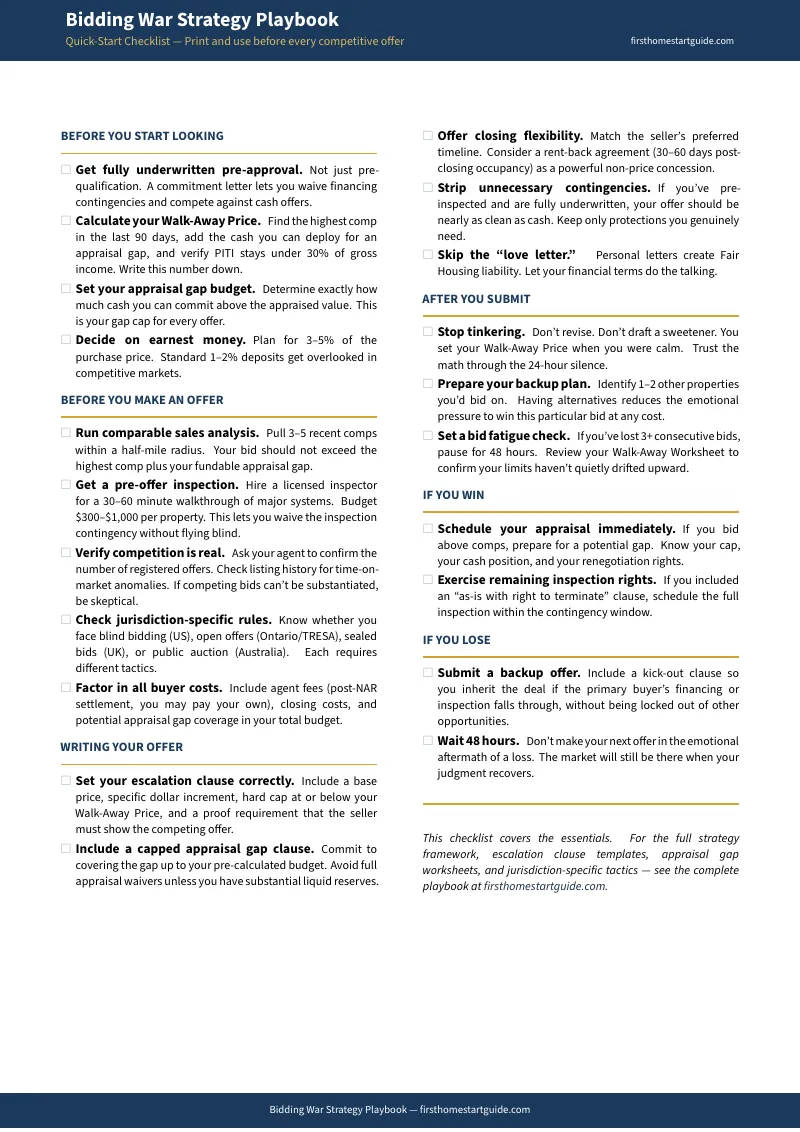
An 8-chapter strategy guide, a quick-start checklist with 18 pre-bid actions, and 3 standalone printable worksheets — covering every phase from calculating your ceiling through post-bid recovery, built for buyers who want to compete aggressively without destroying their financial stability:
The Walk-Away Framework — Your Price Before Your Emotions
Three inputs, one formula, zero ambiguity. You calculate your comp ceiling (the highest verified comparable sale in 90 days), your fundable appraisal gap (the liquid cash beyond your down payment), and your affordability cap (the price where monthly PITI hits 30% of gross income). The lowest of these three numbers is your walk-away price. You write it down. You give it to someone you trust. And when your agent whispers "just one more bump should do it," the card is your anchor to reality — not their commission.
Escalation Clause Construction — Four Elements or It's a Liability
Most buyers either guess a round number and lose, or panic and submit an uncapped escalation clause that lets the seller manufacture a price. The playbook gives you the four-element structure: base price, increment, hard cap at your walk-away number, and a proof requirement that forces the seller to show the competing offer that triggered your escalation. Without all four, you're not competing — you're being exploited.
Capped Appraisal Gap Strategy — Stop Writing Blank Checks
When you bid above comps, the bank's appraisal may fall short. Waiving the appraisal contingency entirely makes you liable for 100% of the gap in cash. The playbook shows you how to structure a capped gap clause — committing to a fixed dollar amount from your Walk-Away Calculation — and when to deploy the down-payment pivot (reducing your down payment from 20% to 15% to free up gap coverage cash, accepting temporary PMI to keep the deal alive).
Pre-Offer Inspection Strategy — Waive the Contingency, Not the Knowledge
Including a standard inspection contingency in a competitive market is a dealbreaker. Waiving the inspection entirely is reckless. The playbook walks you through the middle ground: pre-offer inspections ($300-$1,000, completed before you bid) that let you submit a clean offer with zero inspection contingency and the confidence that you're not buying a money pit. Plus the "As-Is with Right to Terminate" fallback that preserves your exit from catastrophic defects while keeping your offer competitive.
Bidding War Psychology — The Science of Why You Overbid
Competitive arousal. Anchoring bias. The winner's curse. Bid fatigue. These aren't abstract psychology terms — they're the exact mechanisms that cause intelligent people to offer $60,000 over what a property is demonstrably worth. The playbook explains the research, identifies the triggers, and gives you concrete countermeasures: bid limits per month, 48-hour cooling periods after losses, and a structured debrief process that turns each defeat into tactical calibration instead of escalating desperation.
Four Jurisdiction Playbooks — Because US Tactics Can Get You Sued in London
The strategy that works in a blind US "highest and best" scenario is wrong for an Ontario open-offer night, dangerous in a UK sealed-bid situation, and irrelevant at a Sydney street auction. The playbook covers all four: US blind bidding with NAR settlement implications and appraisal gap tactics. Canadian TRESA open-bidding strategy with bully offers and confidentiality clauses. UK sealed bids with gazumping insurance and lock-out agreements. Australian public auctions with knockout bids, underquoting defenses, and the critical fact that there is no cooling-off period after the hammer falls.
Red Flags and Fake Competition — Stop Bidding Against Phantoms
Not every bidding war is real. Listing agents manufacture urgency with deferred open houses, vague escalation demands, and stale listings that suddenly attract "multiple offers." The playbook shows you how to verify competition, spot the tells of artificial demand, and refuse to bid against phantoms — because your walk-away number doesn't change because someone claims there's competition without proving it.
Offer Strength Scorecard — Rate Your Bid Before You Submit It
A six-factor diagnostic that scores your offer across financing, earnest money, inspection strategy, appraisal coverage, closing timeline, and flexibility. If you score "Weak" on more than two factors in a competitive market, your offer will be eliminated before the seller reads your price. The scorecard tells you exactly where to strengthen before you submit.
Who This Playbook Is For
- Buyers who have lost multiple bids and feel the pull of bid fatigue — the creeping willingness to waive protections, exceed limits, and "just end the search" at any cost
- First-time buyers facing their first multiple-offer situation whose agent just said "it's competitive" and is advising them to "come in strong" without explaining what that costs
- Anyone buying in a competitive metro — San Francisco, Austin, Toronto, Vancouver, London, Sydney, Melbourne — where 5-15+ simultaneous bids are a structural feature, not a freak event
- Buyers navigating the post-NAR settlement US market who now pay their own agent's fee and need to recalculate how much cash is actually available for escalation and gap coverage
- UK buyers terrified of gazumping — 37% of UK buyers experience it, and 59% suffer direct financial losses averaging £2,400 in wasted conveyancing and survey fees
- Australian buyers entering their first public auction who need to understand that there is no cooling-off period, no inspection contingency, and no second chance once the hammer falls
Why Not Free Advice?
Free guides on bidding wars exist. Here's what they actually deliver:
- Zillow, Redfin, and Realtor.com publish polished articles telling you to "get pre-approved," "be flexible on closing dates," and "write a clean offer." Technically correct. Completely useless. They describe the same generic tactics every other buyer is using — which is exactly why those tactics don't work when you're up against a dozen people following the same script.
- Agent blogs and brokerage content come from people paid on commission. They tell you to stretch your budget and waive contingencies because that's what closes deals — their deals, at your risk. They are structurally silent on the math of walking away because advising you to walk away delays their paycheck.
- Reddit and forum threads mix legitimate buyer experiences with advice from agents in different states, investors with different risk tolerances, and people who waived their inspection and happened to get lucky. Sorting applicable strategy from anecdote takes longer than reading a guide that's already done it.
This playbook fills the gap: the space between knowing you should have a walk-away price and having the three-input formula to calculate it. Between knowing escalation clauses exist and having the four-element structure that prevents the seller from triggering yours with a phantom bid. Between understanding that bidding wars operate differently across countries and having the jurisdiction-specific tactics for US, Canada, UK, and Australia in a single reference.
— Less Than One Hour With the Real Estate Attorney You Should Have Called
A single uncapped escalation clause can cost you tens of thousands. A waived inspection on a home with foundation damage can cost $50,000-$100,000. An appraisal gap with no dollar limit can drain your cash reserves the week before closing. A gazumped UK transaction costs an average of £2,400 in wasted professional fees.
This playbook doesn't replace your attorney or your agent. But it gives you the quantitative framework, the tactical alternatives, and the psychological armor to enter a bidding war with a calculated ceiling instead of a blank check — and to walk away when walking away is the smartest financial decision you'll make all year.
Frequently Asked Questions
What if the rules change after I buy?
We update the guide when the rules change. Email us any time, even years later, and we'll send you the current edition free.