Your Title Company Sent You Wiring Instructions by Email. You Have No Way to Know if Those Instructions Are Real.
In 2025, the FBI reported $275 million stolen through real estate wire fraud in the United States alone. The UK lost $11.7 million to conveyancing fraud. Australia lost $166.8 million to payment redirection scams. The victims were not careless people. They were buyers who received professionally formatted emails from what appeared to be their title company, solicitor, or settlement agent --- and followed the instructions exactly as written.
The scam is called Business Email Compromise. A criminal gets into your title agent's email account and watches your transaction for weeks --- learning names, timelines, and dollar amounts. Hours before closing, they send you "updated" wiring instructions. The email matches the tone, the formatting, the logo, and the email signature you have seen throughout your entire transaction. In one-third of cases, the money is never recovered.
Meanwhile, your Closing Disclosure arrived with numbers that do not match what you were quoted. Your agent told you to "sign it anyway to start the clock." Your title company sent a PDF with account numbers and no verification protocol. And you are expected to wire the largest sum of money you have ever transferred based on an email you cannot independently verify.
The free checklists from Zillow and NerdWallet tell you to "wire the funds" and "review the closing statement." They do not explain how wire fraud actually works, how to verify instructions before you press send, which lines on the Closing Disclosure are commonly wrong and why, or what to do when your walk-through reveals damage the seller caused while moving out.
The Closing Day Checklist & Wire Fraud Prevention guide is a Settlement Security Protocol --- a structured system that protects your money, verifies your documents, and gives you a room-by-room walk-through checklist that covers the gap between what your agent tells you and what you actually need to do to close safely.
What's Inside the Settlement Security Protocol
An 8-chapter guide, a quick-start checklist, 6 standalone printable worksheets, and 3 appendices --- organized by the order you need them, from the final week through your first night in the house:
Three-Step Wire Fraud Verification Protocol
The exact process for independently verifying wiring instructions before you transfer a cent. How to source the settlement agent's phone number from a trusted origin that you obtained early in the transaction --- not the phone number in the email containing wiring instructions, which may route to a co-conspirator. How to conduct digit-by-digit verbal authentication of routing and account numbers. How to confirm receipt after wiring. Plus the emergency Financial Fraud Kill Chain --- the minute-by-minute steps to freeze funds if you realize the wire went to the wrong account, including country-specific reporting channels for the US (FBI IC3), UK (Action Fraud), Canada (CAFC), and Australia (Scamwatch).
Line-by-Line Closing Disclosure Review Matrix
Why your initial Closing Disclosure will almost certainly contain errors --- and why your lender tells you to sign it anyway. Your lender issues a preliminary CD to start a mandatory three-day compliance clock, often before figures have been balanced with the title company. The result: your "cash to close" figure may be inflated by thousands of dollars, seller credits may be missing entirely, and property tax prorations may use the wrong annual amount. The matrix walks you through the 11 specific line items to compare against your original Loan Estimate --- interest rate, monthly payment, APR tolerance, cash-to-close variance, missing seller credits, incorrect tax prorations, and misspelled names that can halt the recording of your deed. Covers the US Closing Disclosure, Canadian Statement of Adjustments, UK Completion Statement, and Australian Settlement Statement.
Forensic Final Walk-Through Protocol
A room-by-room checklist that goes beyond "flush the toilets and check the lights." How to test every electrical outlet with a phone charger to find dead receptacles the seller's furniture was covering. How to run HVAC in both heating and cooling modes regardless of season. How to check under every sink during a simultaneous-fixture drainage test. How to verify that negotiated repairs were actually completed --- not just promised --- with contractor receipts. What to do when the seller has not fully vacated: negotiation scripts for escrow hold-backs, financial credits, and delayed closings. You have leverage because your money has not been disbursed yet --- the protocol shows you exactly how to use it.
What-to-Bring Packing List
The exact documents, identification, and financial instruments required at the closing table. Why two forms of unexpired government-issued photo ID are standard and why the names must match your purchase contract letter-for-letter. Which banks reject cashier's checks over $5,000 and why you must confirm your title company's policy weeks in advance. The financial and career moves to avoid in the weeks before closing --- opening new credit cards, making large purchases, changing jobs, moving large sums between accounts --- any of which can trigger a credit re-pull and delay or cancel your loan.
One-Week Countdown Timeline
Day-by-day checklist from seven days before closing through the moment you sign. When to request the draft settlement document. When to send the insurance declaration page to your lender. When to schedule the walk-through. When to wire. What to pack the morning of closing. Each day has specific, concrete tasks --- not "get ready for closing" but "call your bank and confirm wire transfer lead time for the exact cash-to-close amount."
What Happens at the Closing Table
Who will be there (and why it varies by state). The documents you will sign and what each one means --- the Promissory Note (your personal liability for the debt), the Deed of Trust (the lender's foreclosure rights), and the Deed (the transfer of ownership). Your rights during the signing: to ask questions, request clarification, refuse to sign incorrect numbers, and take breaks. How recording works and why you may not receive keys until hours after signing. Attorney states vs. escrow states and what that means for legal guidance at the table.
Post-Closing Security Setup
The actions required within 24 hours of receiving your keys. Why you must rekey every exterior lock on Day 1 --- during the listing and sale, keys were distributed to agents, inspectors, appraisers, contractors, and anyone the seller shared spares with over the years. How to factory-reset smart locks, doorbell cameras, thermostats, and security systems to revoke the seller's app-level access. Utility transfers, address changes, automatic mortgage payment setup, and document storage for tax filings, insurance claims, and future resale.
Country-Specific Guidance
Wire fraud mechanics and settlement document formats for four markets: the United States (TRID Closing Disclosure, attorney vs. escrow states, Remote Online Notarization), Canada (Statement of Adjustments, provincial tax prorations, heating oil adjustments), the United Kingdom (CHAPS transfers, Friday Afternoon Fraud targeting conveyancing solicitors on completion day), and Australia (PEXA electronic settlement, PEXA Key encrypted communications, mirrored settlement statements).
The Free Checklist: 20 Items That Cover the Critical Path
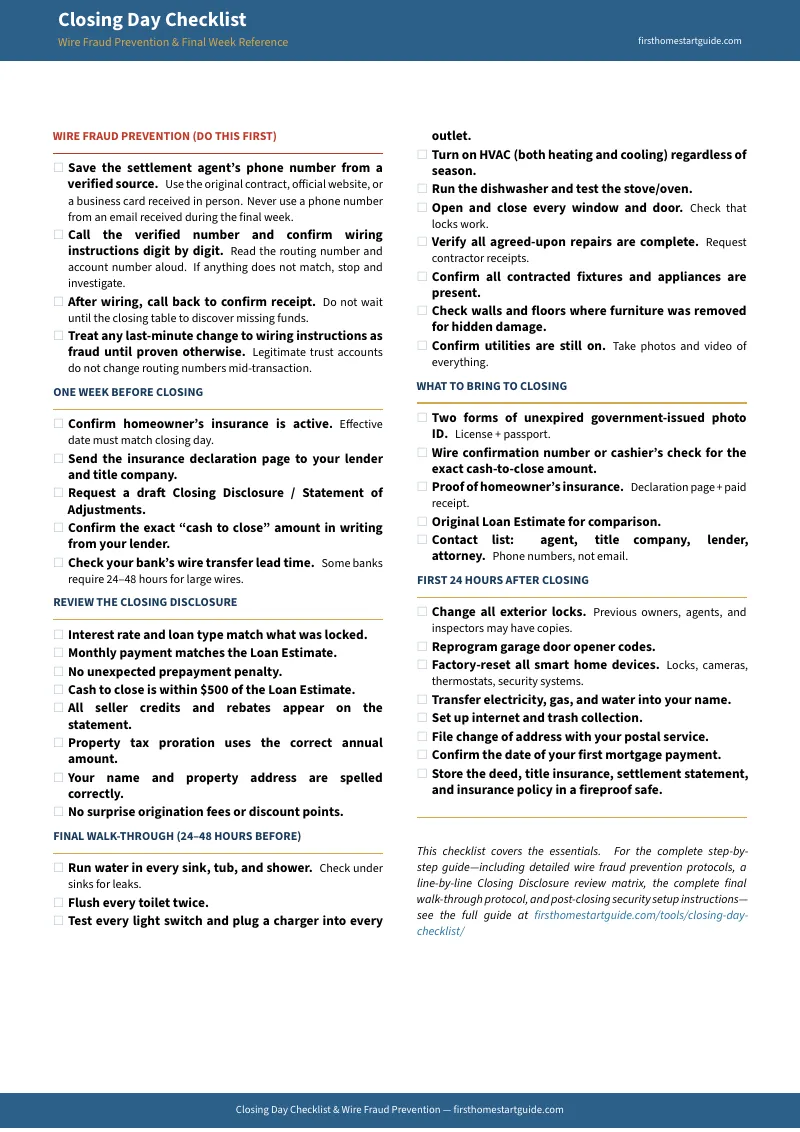
The Closing Day Quick-Start Checklist is a free, printable one-page reference covering the 20 highest-priority items across wire safety, document review, walk-through verification, and post-closing security. It includes the core wire fraud red flags, the Closing Disclosure lines to verify before wiring, the walk-through essentials for plumbing, electrical, and HVAC, and the first-24-hours security and utility checklist. Print it and take it with you.
Who This Guide Is For
- First-time buyers approaching closing who have never wired a large sum of money, never reviewed a Closing Disclosure, and are relying on scattered advice and their agent's assurance that "everything is standard" --- while the FBI reports $275 million stolen from buyers in their exact position last year
- Repeat buyers who know enough to be skeptical of the process and want an independent verification system they control --- not one that depends on their title company's cybersecurity practices or their agent's attention to detail
- International buyers closing in any of the four major English-speaking markets (US, Canada, UK, Australia) who need country-specific settlement document guidance, wire transfer protocols, and fraud prevention steps adapted to their local system
- Remote or out-of-state buyers navigating wire transfers, document reviews, and closing logistics entirely through email and phone --- the exact scenario where Business Email Compromise thrives
Why Not Free Resources?
- Free closing checklists say "wire your funds." This guide gives you the three-step verification protocol: how to independently source the settlement agent's phone number, how to verbally authenticate routing and account numbers digit by digit, and how to confirm receipt after wiring. The difference between "wire your funds" and a structured verification protocol is the difference between trusting an email you cannot verify and knowing the money went where it was supposed to go.
- Free resources explain the Closing Disclosure exists. This guide explains why the initial CD is almost always wrong, why your lender tells you to sign it anyway, and which 11 line items to cross-reference against your Loan Estimate before you wire a dollar. Free articles define the document. This guide teaches you how to audit it.
- Reddit threads give you contradictory advice from strangers. "Wire transfer" vs. "cashier's check" threads on r/FirstTimeHomeBuyer and r/RealEstate produce equal numbers of confident answers on both sides, from people who cannot see your transaction and are not liable for their advice. This guide lays out the trade-offs, the title company acceptance policies you need to confirm in advance, and the verification protocol for whichever method you choose.
- Your agent wants the deal to close. That is not a character flaw --- it is the structure of the commission model. Agents are incentivized to maintain momentum, not to walk you through wire fraud mechanics or challenge the numbers on your Closing Disclosure. The guide is your independent audit layer --- the reference that protects your interests regardless of who else is at the table.
This guide fills the gap between what your agent tells you and what you actually need to do to protect your money. It is the kind of protocol that would normally require a cybersecurity analyst, a mortgage compliance officer, and a real estate attorney in the same room --- organized so you can follow it in sequence from the final week through your first night in the house.
--- Less Than One Wire Transfer Fee
Your bank charges $25 to $50 to send the wire. Your title company charges $25 to $35 for the CHAPS transfer. The guide that ensures the wire goes to the right account and the settlement document has the right numbers costs less than the transfer fees you are already paying.
The average wire fraud loss in the United States is $70,000 per victim. The average Closing Disclosure error adds hundreds to thousands to your cash-to-close. A single missed walk-through item --- a dead outlet, a broken appliance, an incomplete repair --- costs you the leverage to negotiate before your money is disbursed.
This guide gives you the verification protocol, the document review system, and the walk-through checklist that transform closing day from a high-stakes trust exercise into a structured process you control.
If it helps you catch one Closing Disclosure error, verify one set of wiring instructions, or negotiate one repair credit before your funds are disbursed, it pays for itself before you reach the closing table.
Money-back guarantee, no time limit. If the guide does not give you the clarity and confidence to verify your wire, review your settlement documents, and close with your money protected, you pay nothing.
Download the free Closing Day Quick-Start Checklist to see the 20 highest-priority items across wire safety, document review, walk-through, and post-closing security. When you are ready for the complete Settlement Security Protocol --- with the three-step wire verification, the line-by-line Closing Disclosure matrix, the forensic walk-through protocol, and the post-closing security setup --- the full guide is here.
Your closing day does not have to be the most dangerous day in your home purchase. It just has to be the most prepared.
Frequently Asked Questions
What if the rules change after I buy?
We update the guide when the rules change. Email us any time, even years later, and we'll send you the current edition free.