
The Yield Clears at 7%. Darwin's Postcode Blacklists, 16.5% DHA Fee, and Cyclone Section 40 Trap Will Correct That.
You found a Palmerston house projecting 6.7% gross yield. Or a Karama unit where the entry price is $310,000 and the vacancy rate sits at 0.3% --- the tightest rental market in Australia, with just 75 dwellings available across the entire city. Or a Berrimah property clearing 7.6% gross while Melbourne apartments deliver 4.5% and charge you thousands annually in land tax on top. The Northern Territory charges zero land tax. Not a threshold. Not a concession. Zero dollars, every year, regardless of portfolio size. The numbers clear. You're ready to move.
Then the Territory's operational reality arrives. Your Sydney-based broker runs the postcode through the lender's internal matrix and your pre-approval evaporates --- your target suburb is classified Category 2, LVR is capped at 70%, and you need a 30% cash deposit instead of the 10% you budgeted. You find a DHA-leased property near Robertson Barracks with guaranteed rent and zero vacancy risk. The marketing material doesn't mention the 16.5% management fee that compounds across a 9-year lease to erode thousands more than a standard 9.4% property manager would cost in a 0.3% vacancy market. Your conveyancer requests the Section 40 Certificate of Compliance. The vendor can't produce one. Without it, the insurer loads your premium by 40% or refuses coverage entirely --- and you've already gone unconditional. You model your returns based on southern insurance benchmarks of $1,350 per year. The actual Northern Australia average is $2,370 for a house and $7,740 for strata. Your 7% gross yield is now 4.8% net and falling.
Here's what no single free resource explains: The Northern Territory layers zero land tax and Australia's highest rental yields against a postcode lending system where banks maintain unpublished internal risk matrices that cap your LVR at 60--80% across most of the Territory, against a DHA leasing model where the 16.5% management fee and unilateral 3-year lease extensions are buried in contractual fine print that most interstate buyers never scrutinise, against cyclone insurance mechanics where a missing Section 40 certificate can render a property uninsurable and the 72-hour exclusion clause on new policies leaves you completely exposed if you settle during wet season, against a boom-bust cycle that produced 31.5% capital destruction over 69 consecutive months after the last major resource project wound down. Each of these has cost real investors five to six figures because the information existed --- scattered across REINT quarterly reports, bank postcode matrices that aren't published, DHA marketing brochures, ARPC reinsurance pool data, and PropertyChat threads --- but nobody had assembled it into a single underwriting system calibrated to the Northern Territory.
The Northern Territory Investment Property Guide is a Top End Cash-Flow System --- not a motivational overview of Darwin real estate, but a structured due diligence framework that maps every NT-specific financial trap, lending restriction, cyclone compliance requirement, and tax structuring mechanic into a process you work through before you commit capital. It replaces months of cross-referencing REINT market data, unpublished bank postcode lists, DHA lease contracts, Section 40 building certifier reports, and forum posts with a single reference that tells you exactly what to verify, exactly what the numbers should look like, and exactly where deals go wrong in this jurisdiction.
What's Inside the Top End Cash-Flow System
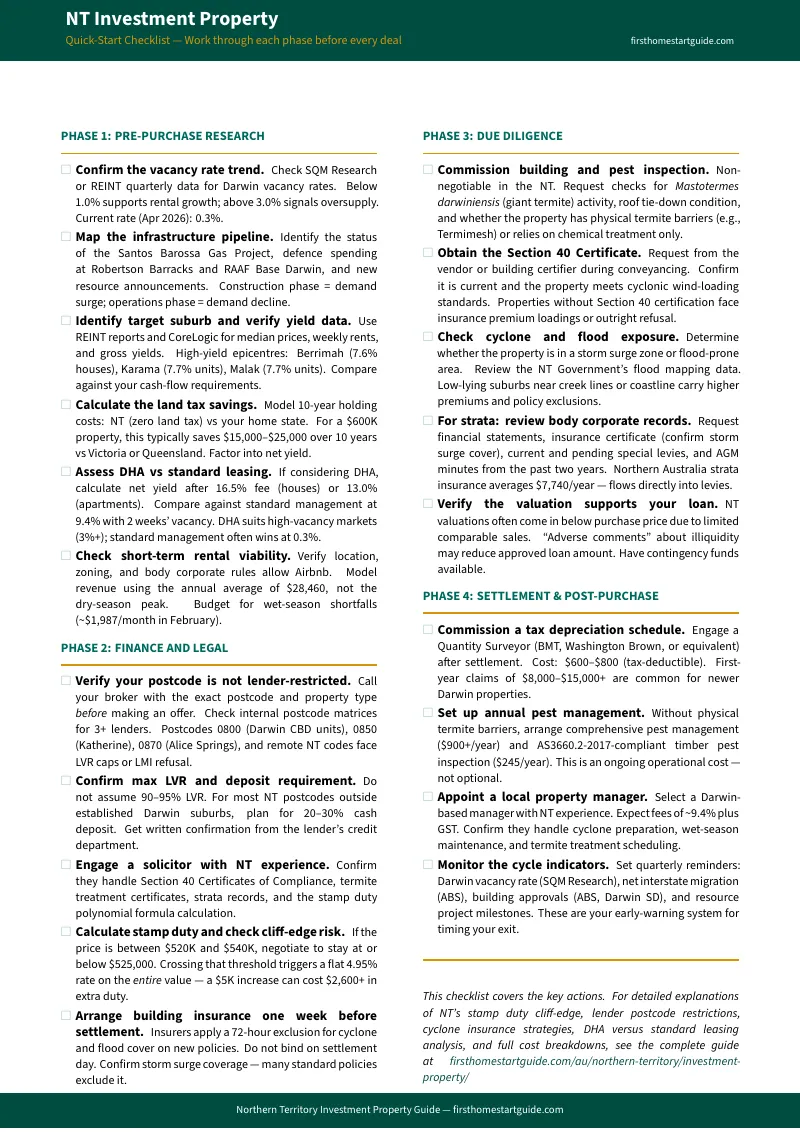
A comprehensive 11-chapter guide and a quick-start checklist --- covering every stage from market selection through post-settlement compliance and portfolio scaling, built specifically for the regulatory mechanics, lending restrictions, and cyclone realities that make the Northern Territory different from every other Australian jurisdiction:
Stamp Duty and the $525,000 Cliff Edge
The Northern Territory applies a flat-rate threshold system for properties valued above $525,000 --- once you cross the threshold, a single percentage rate applies to the entire value, not just the marginal amount above it. A property at $525,000 incurs approximately $23,624 in stamp duty (effective rate 4.50%). A property at $530,000 --- just $5,000 more --- triggers the 4.95% flat rate on the entire value: $26,235. That is over $2,600 in extra duty for a $5,000 price difference. The guide walks through every rate tier, the polynomial formula for sub-$525,000 properties with worked examples, the $3,000,000 second cliff edge, the zero foreign buyer surcharge (saving $48,000 to $90,000 versus eastern states on a $600,000 property), the comparison with progressive stamp duty systems in NSW, Victoria, and Queensland, and the council rates UCV calculation that replaces land tax. You model the total acquisition cost before you negotiate --- not after you've already signed.
The Boom-Bust Cycle and Counter-Cyclical Entry Timing
Darwin median dwelling values fell 31.5% over 69 consecutive months after the Inpex Ichthys LNG project transitioned from construction to operations in 2014. That was the most protracted and severe property market crash in modern Australian history --- worse than Perth's post-mining bust. The guide dissects the mechanics of the cycle: how net overseas arrivals spiked to 5,000 during the Inpex construction phase then collapsed to 600, how vacancy rates blew out from below 1% to 6.9%, how investors who bought at the 2014 peak faced negative equity for a decade. It then maps the current recovery drivers --- the $5 billion Santos Barossa gas project, multi-billion-dollar defence spending at Robertson Barracks and RAAF Base Darwin, the expanding US Marines rotation --- and gives you the four leading indicators to monitor (vacancy rate direction, construction project timelines, interstate migration data, building approvals) so you can time your entry into the current cycle and plan your exit before the next downturn.
Defence Housing Australia: The 16.5% Fee Reality
DHA charges 16.5% of gross rent (including GST) for freestanding houses and 13.0% for body corporate properties. Standard Darwin property managers charge 9.4%. On a $600,000 house renting at $650 per week, DHA delivers $28,223 in net operating rent versus $29,271 from a standard property manager --- in a 0.3% vacancy market, the standard manager actually outperforms DHA. The guide runs the full net yield comparison across multiple vacancy scenarios, models the point at which DHA's guaranteed rent becomes more valuable than conventional management (above 3--4% vacancy), explains the title-registered lease that restricts your buyer pool to investors only and suppresses capital growth at resale, covers the unilateral 3-year extension clauses that trap you in below-market arrangements, and maps the specific NT scenarios where DHA makes strategic sense (SMSF compliance, pre-bust hedging, zero-involvement interstate portfolios) versus where it destroys value.
Cyclone Insurance, Section 40 Compliance, and the ARPC Pool
Northern Australia residential insurance averages $2,370 per year (houses) and $7,740 per year (strata) --- roughly 75% and 163% above national averages respectively. The guide covers the ARPC Cyclone Reinsurance Pool that has reduced the highest-risk premiums by up to 37% since 2022, the Section 40 Certificate of Compliance that proves cyclonic wind-loading standards are met (and without which insurers load premiums or refuse coverage), the storm surge exclusion that most standard policies either cap at $50,000 or exclude entirely, the 72-hour exclusion clause that leaves you uninsured if a cyclone strikes within three days of binding a new policy, and the achievable premium range of $2,100 to $2,700 per year when due diligence is done correctly. You learn what to demand from your conveyancer before settlement and how to verify storm surge exposure by suburb elevation.
Postcode Lending Restrictions and the Valuation Problem
Banks and LMI providers maintain unpublished internal postcode classification systems that cap LVR at 60--80% across most of the Territory. Darwin City (0800) faces restrictions on high-density units. Katherine (0850) and Alice Springs (0870) sit at Category 2--3. Remote postcodes (0860, 0873, 0875, 0886) face outright LMI refusal or lender declines. An investor holding a pre-approval from Sydney at 90% LVR discovers at valuation that the bank caps lending at 70% and they need an additional $120,000 in cash they don't have. The guide provides the commonly affected postcode list, explains the valuation problem (NT valuers struggle to find three comparable sales within six months and include adverse comments that trigger credit overrides), and gives you the four-step process: check the postcode before making an offer, use a specialist NT broker with localised lending panels, make contracts conditional on finance with 21-day minimum approval periods, and plan for a 20--30% cash deposit outside established Darwin suburbs.
Suburb-Level Market Analysis
The guide analyses every major investment zone across Greater Darwin with current medians, yield data, sales volumes, and tenant demographics. The inner suburbs (Larrakeyah, Stuart Park, The Gardens) where average prices decreased 9.81% with a 24.24% drop in sales volumes. The northern coastal corridor (Nightcliff, Rapid Creek, Coconut Grove, Casuarina) where prices held stable at $650,000 with sales volumes up 25.8% --- the healthiest market signal in the Territory. Palmerston and satellite suburbs (Zuccoli, Johnston, Farrar) where sales volumes surged 63.6% and 55% of all NT buyers are interstate investors. The suburb yield comparison table covers Berrimah (7.6% houses), Karama (7.7% units), Malak (7.7% units), Zuccoli (5.5--6.0% houses), and Nightcliff (5.0--5.5% houses). It also covers Alice Springs and remote NT --- why Category 3 postcode restrictions, severe illiquidity, and narrow single-employer economies make these markets unsuitable unless you have deep local knowledge.
Tenancy Law and the Six-Month Rent Increase Cycle
The NT's Residential Tenancies Act 1999 permits rent increases every six months --- twice as frequently as the 12-month minimum in Victoria, NSW, and Queensland. In a 0.3% vacancy market with rents rising 11.3% year-on-year, that six-month cycle captures rental growth far more rapidly than southern frameworks allow. The guide covers the procedural requirements (30 days' written notice on Form RT010, explicit lease clause required for fixed-term increases), the security deposit rules, the termination notice periods (14 days for fixed-term end, 42 days for periodic no-grounds), the sequential rent arrears process with Form RT03 timelines, NTCAT dispute resolution with filing fees and absolute deadlines, property management fee benchmarks (9.4% plus GST), and the short-term rental opportunity (637 active listings, $28,460 average revenue, zero STR levies versus Victoria's 7.5%) with the brutal wet season revenue trough that halves occupancy.
SMSF, Depreciation, and Tax Strategy
The NT's combination of zero land tax and high construction costs creates a powerful tax position for investors. SMSF trustees benefit from yields exceeding 6% that make properties cash-flow positive from day one in accumulation phase --- versus Melbourne apartments at 4.5% with $1,500+ in annual land tax that require external top-ups. Division 43 depreciation is amplified by NT building costs exceeding $2,042 to $2,286 per square metre (cyclone-rated concrete block construction), producing first-year depreciation claims of $8,000 to $15,000+ on newer properties. The guide covers LRBA requirements, the sole purpose test, Division 40 plant and equipment rules (post-May 2017 restrictions for established properties), body corporate levy deductibility splits, and the positive gearing versus negative gearing strategic question for a market where many properties are cash-flow positive from settlement.
Portfolio Strategy, Exit Planning, and the 10-Year Hold Model
The guide models a 10-year hold on a $550,000 Palmerston house: $32,240 gross annual rent (year 1), $12,400 in total holding costs (excluding debt service), 5.9% gross yield, 3.6% net operating yield --- with the 10-year cumulative cash-flow advantage over holding an equivalent Victorian property reaching $18,000 to $25,000 from the land tax saving alone. It covers optimal holding periods (enter during recovery, hold through expansion, exit before the next bust), the four-stage cycle timing framework, diversification across Darwin's three distinct micro-markets (inner-city/corporate, Palmerston/defence, northern coastal/public sector), dry season listing timing, DHA resale discount considerations, and CGT planning including the 12-month threshold for the 50% discount.
Who This Guide Is For
This guide is for property investors targeting Northern Territory markets who:
- Are southern state yield-chasers from Victoria, NSW, or Queensland who are locked out of their local markets by prohibitive entry prices and crushing land tax regimes and see Darwin's 6--7% yields and zero land tax as a portfolio rebalancing play --- but need to understand the postcode lending restrictions, cyclone insurance costs, and boom-bust cycle timing before deploying capital from 3,000 kilometres away
- Are evaluating DHA-leased properties near Robertson Barracks or RAAF Base Darwin and need an unbiased, spreadsheet-level analysis of the 16.5% fee structure, the title-registered lease liquidity constraints, and the unilateral extension clauses --- not the glossy DHA marketing material that emphasises guaranteed rent without quantifying the yield erosion
- Are local Darwin portfolio builders leveraging existing equity from a primary residence into Palmerston or northern suburb investment properties and need the suburb-level yield data, postcode lending verification process, and Section 40 compliance framework consolidated in one reference
- Are foreign investors attracted by the NT's zero foreign buyer surcharge (saving $48,000 to $90,000 compared to eastern states on a $600,000 property) and need the full stamp duty comparison, lending pathway for non-residents, and cyclone insurance navigation system
- Are SMSF trustees targeting the NT's high yields and zero land tax to meet accumulation-phase cash-flow requirements or pension-phase income obligations and need the LRBA structuring rules, Division 43 depreciation modelling, and the positive gearing analysis mapped against SMSF compliance requirements
- Want every NT-specific regulation, tax calculation, lending restriction, and due diligence requirement in one reference --- instead of assembling it from REINT quarterly reports, unpublished bank postcode matrices, DHA contract fine print, ARPC reinsurance data, and PropertyChat threads that may predate the cyclone pool or the current market recovery
Why Not Free Tools and Forums?
Free information on Northern Territory property investing exists. Here's what it actually delivers:
- REINT quarterly reports and RELM data give you median prices, transaction volumes, and regional breakdowns with rigorous methodology. They don't model the 10-year compound holding cost advantage of zero land tax versus an equivalent Victorian or Queensland property at different portfolio values, don't tell you which suburbs are postcode-restricted by which lenders, and don't explain how to time your entry relative to the resource project cycle. You get the raw market data without the investment strategy that makes it actionable.
- Agency marketing material and buyers' agent content highlights Darwin's high yields, 0.3% vacancy rate, and the Santos Barossa project pipeline. It is inherently biased toward transaction completion. It routinely minimises the 31.5% crash history, downplays cyclone insurance costs by citing national averages, and presents DHA as a risk-free strategy without modelling the 16.5% fee erosion against standard property management in a tight market. Lead generation content is not due diligence.
- PropertyChat and Reddit threads (r/AusPropertyChat, r/AusFinance) contain genuinely useful experience reports mixed with deeply polarised opinions --- veteran investors warning to "never touch DHA" alongside others claiming it's the safest play in Australia, anecdotal postcode lending stories that may not reflect current bank matrices, and cyclone insurance cost estimates that predate the ARPC pool. Sorting current from outdated, and data-backed from anecdotal, takes longer than reading a guide that has already done it.
This guide fills the Northern Territory-specific gap --- the space between knowing how to analyse a rental property in general and knowing how to underwrite one in a jurisdiction where banks maintain unpublished postcode blacklists that cap your LVR at 60--70%, where DHA's 16.5% fee compounds across a 9-year lease to erode thousands more than a standard manager in a 0.3% vacancy market, where a missing Section 40 certificate can render a property uninsurable, and where the last resource boom-to-bust cycle destroyed 31.5% of capital over five years. It's the analysis that would take a Darwin-based conveyancer, a specialist mortgage broker with NT lending panels, and a property-focused accountant to assemble --- structured as a reference you own permanently.
--- Less Than One Building and Pest Inspection
A single building and pest inspection in the Northern Territory runs $500 to $900. Stamp duty on a $600,000 investment property is $29,700. A pre-approval that collapses at valuation because the lender flags the postcode as Category 2 can cost you a $10,000 deposit if you've already gone unconditional. An uninsured property in cyclone season is an unrecoverable loss. A DHA lease accepted without modelling the 16.5% fee across the full term can erode tens of thousands compared to standard management in a tight market.
This guide doesn't replace your conveyancer or your mortgage broker. But it gives you the postcode lending verification system, the DHA fee comparison model, the Section 40 compliance framework, and the boom-bust cycle timing indicators that ensure you identify every NT-specific risk before you're contractually committed --- instead of discovering them at valuation, at insurance binding, or when the next resource project winds down.
If it catches a single postcode lending trap, prevents a single uninsured settlement, or saves you from buying at the peak of a resource boom, it pays for itself before you've finished reading it.
Money-back guarantee, no time limit. If the guide doesn't sharpen your underwriting and protect your capital in the Northern Territory's cyclical market, you pay nothing.
Download the free Northern Territory Quick-Start Investment Property Checklist to see the due diligence framework covering pre-purchase research, postcode lending checks, Section 40 verification, and cyclone insurance requirements. When you're ready for the full DHA fee analysis, suburb-level yield data, boom-bust cycle timing model, and portfolio construction strategy, the complete guide is here.
The yield clears at 7%. This guide tells you whether the Territory agrees.
Frequently Asked Questions
What if the rules change after I buy?
We update the guide when the rules change. Email us any time, even years later, and we'll send you the current edition free.