
You Have Read the State Revenue Office Page Three Times and Still Cannot Work Out Whether to Claim the Stamp Duty Exemption or the $20,000 Grant
You found a three-bedroom cottage in Moonah for $620,000. Your broker confirmed you qualify for the 100% stamp duty exemption on established homes up to $750,000 --- saving you roughly $21,000. Then you saw a new townhouse development in Kingston for $595,000 and learned about the $20,000 First Home Owner Grant for new builds in 2026-2027. Your parents said the FHOG used to be $30,000 and assumed it still is. Your colleague mentioned a "50% stamp duty discount" that actually expired in 2020. Nobody explained that these two policies are strictly mutually exclusive --- claim the FHOG and you lose the duty exemption entirely, or claim the exemption and you are ineligible for the grant --- and that the mathematics of which one saves you more money changes at every price point.
Then you discovered the settlement deadline. The stamp duty exemption does not expire when you sign a contract. It expires when the property settles --- titles officially exchanged --- and that hard cutoff is 30 June 2026. With standard Tasmanian settlement periods running 30 to 42 days, your real deadline to have a signed contract was mid-May 2026. If you are using the MyHome shared equity scheme through Bank of us, your settlement routinely blows out to 120 days because of the tripartite approval process between you, the bank, and Homes Tasmania. You saw a thread on r/tasmania about a buyer whose MyHome application took so long that the vendor sold to a mainland cash buyer offering a 30-day close instead.
The problem is not that Tasmania is unaffordable. The problem is that Tasmania layers a stamp duty exemption with a hard settlement deadline and no announced replacement, a $20,000 cash grant that cannot be combined with the exemption, a shared equity scheme that introduces a 120-day settlement disadvantage against cash-ready mainland and investor buyers, heritage planning overlays that can permanently restrict what you do with your own property, standard real estate contracts with no statutory cooling-off period, a blind bidding system that removes all pricing transparency, century-old housing stock in a cold damp climate that hides structural problems a fifteen-minute open home cannot reveal, and an interstate migration surge that pushed mainland buyer transactions up 43% year-on-year while investors jumped 46% --- and no single resource explains how these interact or what each one costs you when you make the wrong call.
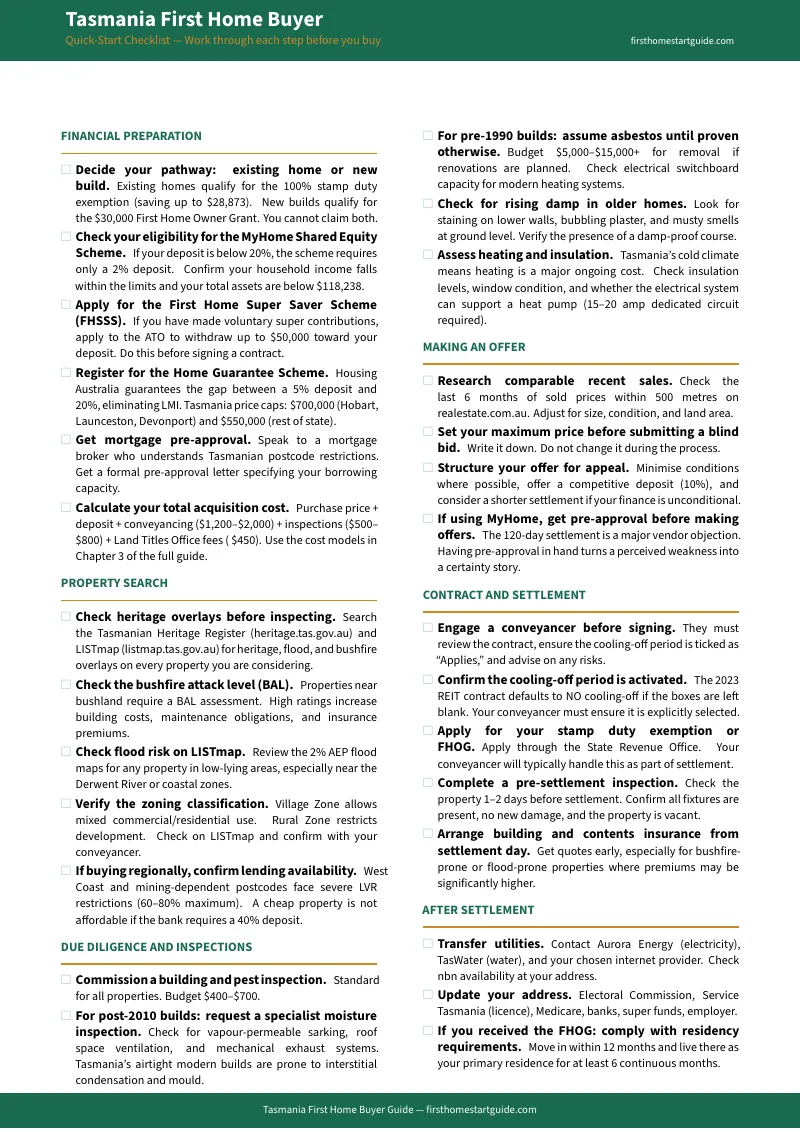
The Tasmania First Home Buyer Guide is a Tasmanian Policy Navigation System --- a structured walkthrough of every Tasmania-specific financial incentive, heritage risk, structural hazard, and negotiation tactic that determines whether your purchase builds wealth or quietly traps you in costs that the SRO website, your lender, and real estate agents never mapped in one place. It replaces months of cross-referencing the State Revenue Office, Homes Tasmania, the Heritage Council, Bank of us application forms, local council planning schemes, and conflicting Reddit threads about stamp duty deadlines and MyHome delays with a single reference that tells you exactly which pathway saves you more money, exactly when you must act, and exactly what to verify before you sign a contract you cannot escape.
The complete guide, a quick-start checklist, and printable worksheets --- a stamp duty versus FHOG comparison calculator, a heritage overlay verification protocol, a cold-climate open home inspection checklist, a blind bidding strike price worksheet, and a backwards settlement timeline planner. Everything you need to print and bring to broker meetings, open homes, and contract signings.
What's Inside the Tasmanian Policy Navigation System
A comprehensive 12-chapter guide with a quick-start checklist --- covering every stage from financial preparation through post-settlement monitoring, built specifically for the tax structures, heritage regulations, climate risks, and market dynamics that make buying in Tasmania different from every other Australian state:
Stamp Duty Exemption vs. FHOG Decision Framework
The SRO website explains each policy in isolation. It does not explain that they are mutually exclusive, that the mathematics of which one saves you more changes at every price point, or that the FHOG's value has fluctuated between $10,000 and $30,000 over five years and is currently at a temporary $20,000 for 2026-2027 only. The guide gives you a side-by-side financial comparison at $450,000, $550,000, $650,000, and $750,000 --- showing the exact dollar difference between Pathway A (established home with full stamp duty exemption) and Pathway B (new build with $20,000 grant but standard duty rates) --- so you can see which pathway delivers a better financial outcome at your specific budget, not which one sounds better in a brochure.
The 30 June 2026 Settlement Deadline and Backwards Timeline
This is a settlement deadline, not a contract signing deadline. If your property transfer does not fully settle by 30 June 2026, you owe the full stamp duty --- potentially $18,000 to $28,935 depending on purchase price. Given standard settlement periods of 30 to 42 days, and up to 120 days for MyHome buyers, your effective operational deadline to secure a signed contract varies dramatically based on your financial pathway. The guide includes a backwards timeline calculator that works from the 30 June cliff back to the latest safe date to make an offer, factoring in your specific settlement period, so you know exactly how much runway you have left.
MyHome Shared Equity Scheme Survival Strategy
The official MyHome literature explains the 2% deposit, the $150,000 government equity contribution, and the income thresholds ($97,797 for a single applicant up to $157,544 for a couple with two children). What it does not tell you is that the tripartite approval process routinely extends settlement to 120 days, that vendors in a competitive market will reject a four-month settlement when investors offer 30-day cash closes, and that many MyHome buyers end up offering above asking price simply to compensate for the timeline disadvantage. The guide provides specific conversational scripts for explaining the settlement period to agents, offer-structuring tactics that make a longer timeline palatable to vendors, and the financial calculus for deciding how much above asking price the scheme's benefits still justify.
Heritage Overlay Verification Protocol
Driven by high inner-city prices, first home buyers frequently target affordable unrenovated older homes in suburbs like North Hobart, West Hobart, and Launceston's inner ring --- without checking whether the property carries a Heritage Overlay under the Tasmanian Planning Scheme or a listing on the state Heritage Register under the Historic Cultural Heritage Act 1995. A Heritage Overlay creates a presumption against demolition, strictly regulates exterior modifications including windows and solar panels, requires heritage-appropriate materials for all repairs, and can block a simple rear extension for over twelve months. Maintenance costs on heritage properties run 40% or more above standard homes because you need specialist tradespeople for lime-based mortars, lath and plaster, and sandstock bricks. The guide gives you the step-by-step process for checking overlay status before you sign a contract --- because Tasmania has no mandatory statutory cooling-off period, and discovering a Heritage Overlay after signing means you cannot exit without forfeiting your entire deposit.
Cold-Climate Open Home Inspection Checklist
Tasmania's cold, damp climate exposes structural weaknesses in older housing stock that mainland buyers and first-time inspectors routinely miss. The guide covers exactly what to look for during a fifteen-minute open home walk-through: rising damp indicators (salt deposits on lower walls from absent damp-proof courses), penetrating damp (failed gutters, porous external fabric), condensation damage (mould behind furniture from warm air against uninsulated freezing walls), sub-floor rot from poor ventilation, and degraded electrical wiring in pre-war homes. If you plan to install a heat pump, the guide explains why you must check switchboard capacity --- pre-1980s homes often cannot support the 15 to 20 amp dedicated circuits modern split-systems require without a multi-thousand dollar upgrade --- and why heritage regulations restrict where you can place external compressor units.
Blind Bidding and Best-and-Final-Offer Tactics
Many Tasmanian properties sell via sealed bids with no price transparency. Listings use "offers over" or "contact agent" instead of concrete guides, and you submit your best offer with zero knowledge of competing bids. First home buyers either overbid from desperation or chronically underbid and lose property after property to buyer fatigue. For MyHome users, the disadvantage compounds because you must show your full financial capacity upfront while hoping the vendor tolerates your settlement timeline. The guide covers how to research comparable sales to establish a realistic value range, how to strengthen the non-price elements of your offer (settlement flexibility, fewer conditions), how to set a walk-away ceiling that prevents emotional overbidding, and specific strategies for competing against mainland and investor buyers who can offer faster, cleaner settlements.
Regional Market Breakdown
Where your money goes depends entirely on which part of Tasmania you target. Greater Hobart ($730,000 median) is constrained by geography and dominated by interstate buyers. Launceston ($550,000) offers northern access with lower entry points. The North West Coast ($502,000) provides the most affordable regional option. Peripheral Hobart suburbs --- Gagebrook ($382,750), Bridgewater ($430,000), New Norfolk ($451,000) --- give you capital proximity at regional prices. The guide maps each area's median prices, employment proximity, commute trade-offs, and which government schemes apply in each price bracket, so you can see where your budget genuinely stretches rather than where the glossy listings tell you to look.
Conveyancing, Contracts, and the No Cooling-Off Reality
Tasmanian real estate contracts do not include a mandatory statutory cooling-off period. Once you sign, you are bound --- and discovering a Heritage Overlay, a structural defect your inspection missed, or a financial miscalculation after signing means forfeiting your deposit to exit. The guide covers the role of your conveyancer, which contract conditions to include and which to never waive, how building and pest inspections work for older Tasmanian housing stock, the specific documents you must review before signing, and how the absence of cooling-off protection changes your entire pre-contract due diligence timeline.
Post-Settlement Financial Planning
Insurance setup including the dramatically higher reinstatement premiums for heritage properties, council rates and land tax obligations, annual maintenance budgets calibrated for cold-climate housing stock, first-year heating and insulation costs, and the ongoing financial realities of homeownership in Tasmania that the purchase price alone does not reveal.
Who This Guide Is For
- Hobart renters paying $500 to $600 per week who are ready to buy but cannot determine whether the stamp duty exemption or the $20,000 FHOG saves them more money at their target price point, and need to know whether they can realistically settle before the 30 June 2026 deadline
- Buyers choosing between an established character home and a new build who need the actual dollar comparison --- stamp duty exemption versus FHOG, deposit requirements, hidden maintenance costs on older stock --- not a generic "new is simpler" recommendation
- First home buyers near the $750,000 stamp duty exemption cap who need to understand exactly how much they lose if the dutiable value exceeds the threshold, and how to structure a purchase to stay within it
- Anyone relying on the MyHome shared equity scheme who needs tactical strategies for making a 120-day settlement competitive in a blind bidding market against investors offering 30-day cash closes
- Buyers targeting older homes in heritage-rich suburbs like Battery Point, North Hobart, West Hobart, or inner Launceston who need to verify Heritage Overlay status before signing a contract that has no statutory cooling-off period
- Mainland movers from Sydney, Melbourne, or Brisbane who see Tasmania as affordable but do not understand the structural realities of century-old housing stock, cold-climate maintenance costs, and the specific Tasmanian conveyancing process
- Regional buyers in Launceston, Devonport, or Burnie who need to understand which government schemes apply at their price bracket and how far their budget genuinely stretches outside Hobart
Why Not Free Tools and Government Websites?
Free information on buying in Tasmania exists. Here is what it actually delivers:
- The State Revenue Office website publishes the stamp duty exemption rules and the FHOG eligibility criteria across separate, dense PDF documents. It does not explain that the two policies are mutually exclusive, does not compare the dollar outcomes at different price points, and does not mention that the June 2026 date is a settlement deadline rather than a contract signing deadline. You get the rules without the decision framework.
- Homes Tasmania and Bank of us literature describe the MyHome scheme's 2% deposit and income thresholds. They do not mention that the tripartite approval process routinely pushes settlement to 120 days, that vendors systematically reject these timelines in competitive markets, or that buyers frequently overpay to compensate. You get the product description without the market reality.
- Reddit threads (r/tasmania, r/hobart, r/AusPropertyChat) contain genuine warnings about MyHome delays and blind bidding frustration, but mixed with outdated grant amounts, expired stamp duty rules, and suburb advice based on one person's experience rather than market data. Sorting current from obsolete takes longer than reading a guide that already did it.
- Real estate agent blogs post "First Home Buyer Tips Tasmania" articles designed to capture search traffic and generate listing enquiries. They do not explain heritage overlay risks, the no cooling-off trap, cold-climate structural hazards, or how to compete in blind bidding when your settlement period is four times longer than the competition. You get marketing content, not the analysis that protects your deposit.
This guide fills the Tasmania-specific gap --- the space between knowing you want to buy a home and knowing how to navigate a state where a stamp duty exemption with a hard settlement deadline, a cash grant that cannot be combined with it, a shared equity scheme that creates a 120-day negotiation disadvantage, heritage overlays that restrict what you can do with your own property, no statutory cooling-off period on contracts, blind bidding that removes all price transparency, and century-old housing stock in a cold damp climate each independently determine whether your purchase builds wealth or slowly drowns you in costs nobody mapped in one place. It is the analysis that would take a Tasmanian conveyancer, a heritage planning consultant, a building inspector, and a mortgage broker to assemble --- structured as a reference you own permanently.
--- Less Than One Building Inspection Quote
A single building inspection in Tasmania runs $400 to $600. Missing the heritage overlay on a character cottage can lock you into 40% higher maintenance costs for the life of the property --- with no way to exit the contract once you have signed. Choosing the wrong pathway between the stamp duty exemption and the FHOG can mean leaving $10,000 or more on the table. Missing the 30 June 2026 settlement deadline by a single day can trigger $18,000 to $28,935 in stamp duty that you budgeted as zero. Misunderstanding the MyHome scheme's settlement reality can cost you property after property to faster buyers while you wonder why every vendor says no.
This guide does not replace your conveyancer, your broker, or your building inspector. But it gives you the stamp duty versus FHOG comparison, the backwards settlement timeline, the heritage overlay verification protocol, the cold-climate inspection checklist, and the blind bidding strategy that ensure you identify every Tasmania-specific cost, risk, and deadline before you are contractually committed --- instead of discovering them after you have signed a contract you cannot exit, missed a deadline you did not know was a settlement date, or bought a heritage home you cannot renovate.
If it catches a single heritage trap, prevents a single missed settlement deadline, or steers you to the right financial pathway, it pays for itself before you finish reading it.
Money-back guarantee, no time limit. If the guide does not sharpen your Tasmania home buying strategy and protect your investment, you pay nothing.
Download the free Tasmania Quick-Start Home Buying Checklist to see the step-by-step framework covering stamp duty vs. FHOG decision points, heritage overlay checks, cold-climate inspection items, and settlement timeline planning. When you are ready for the full financial comparison, MyHome survival strategy, blind bidding tactics, and the complete 12-chapter guide, the full toolkit is here.
Tasmania's character and affordability only work if you know what they actually cost. This guide makes sure you do.
Frequently Asked Questions
What if the rules change after I buy?
We update the guide when the rules change. Email us any time, even years later, and we'll send you the current edition free.