
The Yield Looks Strong on Paper. Tasmania's Caveat Emptor System, Land Tax Aggregation, and Hobart's 200% Short-Stay Rate Surcharge Will Correct That.
You found a detached house in Mowbray projecting 5.3% gross yield. Or a unit in East Devonport where the entry price is $327,600 and the vacancy rate is below 0.5%. Or a character cottage in Battery Point where heritage scarcity commands a valuation premium that compounds year on year. The numbers clear. The rental market is the tightest in Australia — Greater Hobart vacancy at 0.5%, Launceston at 0.5%, Devonport below 0.5% with building approvals at 1.4% of historical averages. You're ready to move.
Then Tasmania's procedural reality arrives. You submit an offer — except in Tasmania, offers are submitted as signed contracts of sale. No cooling-off period. No vendor disclosure statement like Victoria's Section 32. Under the state's strict caveat emptor system, the vendor has no obligation to tell you about heritage overlays, unapproved structural works, flood risk, or zoning restrictions. You sign, you're bound. Your conveyancer discovers the heritage overlay after exchange — but there's no statutory exit right. Your two investment properties, each with an assessed land value of $250,000 and $350,000, looked manageable individually. But the State Revenue Office aggregates them under Section 24 of the Land Tax Act 2000 to $600,000, pushing you into the top marginal bracket — annual land tax jumps from $1,675 to $3,237.50, a 93.3% increase you didn't model. Your Hobart short-stay property generates strong Airbnb income until the council's 200% differential rate surcharge doubles your rates bill, the $5,000 discretionary permit fee lands, and you discover Battery Point has banned new short-stay permits entirely.
Here's what no single free resource explains: Tasmania layers a buyer-beware transaction system with no cooling-off period and no vendor disclosure (meaning you must complete every investigation before you sign a binding contract), against a land tax regime that aggregates all your holdings under one assessment and pushes multi-property investors into progressive brackets they didn't budget for, against short-term rental regulations that vary by council — Hobart's 200% rate surcharge and Battery Point's complete STR ban are not mentioned in most investor guides — against a heritage framework under the Historic Cultural Heritage Act 1995 where even minor cosmetic changes to a registered property can require formal Heritage Council approval. Each of these has cost real investors five figures because the information existed — scattered across SRO calculators, Heritage Tasmania guidelines, council planning portals, and Reddit threads — but nobody had assembled it into a single due diligence system calibrated to Tasmania.
The Tasmania Investment Property Guide is a Caveat Emptor Underwriting System — not a motivational overview of island living, but a structured due diligence framework that maps every Tasmania-specific financial trap, regulatory restriction, and tax structuring mechanic into a process you work through before you sign a binding contract. It replaces months of cross-referencing SRO rate tables, Heritage Tasmania works guidelines, council planning maps, and forum posts with a single reference that tells you exactly what to verify, exactly what the numbers should look like, and exactly where deals go wrong in this state.
What's Inside the Caveat Emptor Underwriting System
A comprehensive guide, a quick-start checklist, and seven standalone printable tools (nine PDFs) — covering every stage from market selection through post-purchase compliance, built specifically for the regulatory mechanics and tax structures that make Tasmania different from every mainland state:
The Caveat Emptor Transaction Blueprint
Tasmania is the only Australian state with no statutory cooling-off period after contract execution and no mandatory vendor disclosure. In Victoria, a Section 32 statement reveals building defects, heritage overlays, and zoning restrictions before you sign. In Tasmania, you discover these on your own — or you don't discover them at all. The guide details the signed contract offer system (where your offer is a binding legal document from the moment you sign), the specific subject-to clauses your conveyancer must insert to protect you (building and pest, finance approval, heritage search, unapproved works), realistic condition timeframes (7-14 days for building inspections, 14-21 days for finance), and the complete due diligence checklist covering zoning verification, heritage overlay search, unapproved works search, flood and bushfire risk assessment, title search, and council rates review. If you're buying from interstate, this chapter alone prevents the single most expensive mistake investors make in Tasmania — signing before due diligence is complete.
Land Tax Aggregation Mechanics and Entity Structuring
Under Section 24 of the Land Tax Act 2000, the State Revenue Office aggregates the assessed land values of all taxable properties held under one entity. Two properties with land values of $250,000 and $350,000 individually cost $1,675 in combined land tax. Aggregated to $600,000, the bill becomes $3,237.50 — a 93.3% increase. With Tasmania's $125,000 tax-free threshold (the second-lowest in Australia — only Victoria's $50,000 is lower), almost every metropolitan investment property triggers land tax from day one. The guide walks through every rate tier, maps the aggregation crossover points where a second or third property changes your bracket, shows how to structure acquisitions across separate legal entities (discretionary trusts with different corporate trustees, or splitting between individual names) to prevent automatic SRO aggregation, and compares Tasmania's top marginal rate of 1.5% against NSW (2.0%), Victoria (2.65% plus COVID levies), and Queensland (2.75%) so you can evaluate where Tasmania sits in your interstate portfolio strategy.
Transfer Duty Calculations and Full Closing Cost Model
Tasmania charges transfer duty on a progressive scale up to 4.5% — lower than NSW, Victoria, and Queensland, but still a five-figure cash outlay. On a $500,000 investment property, duty runs $18,247.50 — an effective rate of 3.65%. On a $750,000 property, $28,935. Foreign buyers face an additional 8% surcharge, bringing the effective upfront tax rate to 11.65% on a $500,000 property. The guide breaks down every tier of the duty schedule, models the full closing cost stack — deposit, duty, conveyancing ($1,200-$2,500), building and pest ($500-$800), loan establishment fees — and provides a worked example showing the $121,197.50 in total upfront capital required for a $500,000 investment with a 20% deposit. Your pro-forma should match reality within a few hundred dollars before you sign.
Short-Term Rental Playbook: Hobart's 200% Rate Surcharge, Battery Point Ban, and the 5% Levy
Hobart's short-term rental regulations are the strictest in Tasmania and among the tightest in Australia. Whole-house visitor accommodation in residential zones faces a 200% differential rate surcharge — standard annual council rates of $2,400 become approximately $4,800. Battery Point has completely banned new short-stay permits. On 27 April 2026, the Hobart City Council voted to increase the discretionary permit fee from $435 to $5,000, effective 1 July 2026. The statewide 5% short-stay accommodation levy applies to all bookings under 28 days. After you layer in management fees of 15-25% of booking revenue, the adjusted net yield for short-term rental in central Hobart sits at 5.0-6.0% — compared to 3.0-4.0% for long-term rental. The yield premium has compressed to roughly 1-2 percentage points. The guide maps which properties qualify for the primary residence exemption, which have grandfathered permits under LUPAA Section 12, the specific zones where visitor accommodation is permitted versus discretionary, the one-year land tax exemption available when converting a short-stay property back to long-term rental, and a decision framework for whether the short-term rental premium justifies the operational complexity in the current regulatory environment.
Heritage Property Investment Under the Historic Cultural Heritage Act
Hobart has one of the highest densities of colonial, Georgian, Victorian, and Edwardian architecture in Australia. Heritage properties command scarcity premiums and attract above-market rents from professional tenants. But the Historic Cultural Heritage Act 1995 requires Heritage Council approval for any works to a registered place — even cosmetic changes that seem routine. Investors purchase heritage weatherboard homes planning renovations, then discover they need a formal Minor Works Approval for a simple repaint or a Discretionary Works Permit for a rear extension. The guide demystifies the two tiers of heritage protection (state-level Tasmanian Heritage Register versus local council heritage precincts), explains the approval process at each level (the Heritage Council has approved 97% of all works applications — the system is navigable, not a freeze), covers grant programs that offset specialised maintenance costs (City of Hobart Heritage Grants of $1,000-$25,000, State Built Heritage Grants up to $20,000), and shows how to budget for the 15-25% premium on maintenance costs that heritage compliance requires.
Suburb-by-Suburb Investment Analysis with Yield Data
Every suburb profile includes current median prices, gross yields, vacancy data, and the specific economic driver that sustains tenant demand in that location. Premium capital growth suburbs: Battery Point ($2,200,000 median, heritage scarcity premium), Kingston Beach ($1,225,000, coastal lifestyle), New Town (units at $466,500, 5.6% yield). Cash-flow suburbs: Mowbray ($450,000, 5.3-5.5% yield, UTAS student demand), Gagebrook ($382,750, 6.1% yield — 22% public housing in certain pockets, requires street-level selection), East Devonport ($327,600 units, 6.0% yield, constrained supply). Speculative plays: Zeehan ($175,000, 8.9% yield, mining cycle exposure). Launceston receives dedicated analysis as the strongest cash-flow market for interstate investors who want Tasmanian exposure without Hobart's entry prices. The comparison summary table maps every suburb's risk level, key driver, and recommended investment play.
Complete Cash-Flow Model with Stress Testing
A full worked example models a $500,000 house in South Launceston rented at $450 per week with an 80% LVR loan at 6.5% interest. Annual income, every holding cost (mortgage interest, management fees at 8% plus GST, council rates, TasWater, insurance, land tax, repairs), the pre-tax cash-flow loss ($13,097), and the after-tax cost after negative gearing and depreciation deductions ($5,661 — approximately $109 per week out of pocket). Then a stress test at current rate plus 2% (8.5%) shows the after-tax cost rising to approximately $230 per week. If your cash-flow model survives that stress test, you can hold through the next market cycle.
Portfolio Construction and the Barbell Strategy
The strongest Tasmanian portfolios pair a capital-growth asset in Hobart's inner ring alongside cash-flow generators in Launceston or Devonport — the regional yields service the holding costs of the capital city asset. The guide maps this barbell approach across Tasmania's five investment regions, provides the Opportunity-Friction Matrix showing each region's primary opportunity, its primary friction point, and the recommended play, and distils the framework into five rules for Tasmanian portfolio construction — starting with the aggregation mitigation that must be planned before your second purchase, not after.
Who This Guide Is For
This guide is for property investors targeting Tasmania who:
- Are investing from the mainland — Sydney, Melbourne, or Brisbane — executing a yield arbitrage strategy into Tasmania's lower entry prices and higher gross yields, but need to understand the caveat emptor transaction system, the signed contract offer process, and the absence of a cooling-off period before they sign a binding document 900 kilometres from home
- Are local Tasmanian portfolio builders leveraging home equity to acquire a second or third property and need to model exactly how Section 24 land tax aggregation changes the holding cost arithmetic as their portfolio grows — before the SRO assessment arrives, not after
- Want short-term rental exposure in Tasmania and need to verify whether their target property can legally operate as visitor accommodation, what Hobart's 200% rate surcharge and $5,000 permit fee actually cost after management fees and the 5% booking levy, and whether the adjusted net yield premium over long-term rental justifies the regulatory risk
- Are evaluating heritage properties in Hobart's inner ring and need to understand what the Historic Cultural Heritage Act actually permits (97% approval rate), what grants offset maintenance costs, and how to budget for heritage-compliant upkeep without eroding the rental yield that makes the purchase viable
- Want every Tasmania-specific regulation, tax calculation, and due diligence requirement in one reference — instead of assembling it from SRO calculators, Heritage Tasmania guidelines, council planning portals, REIT quarterly reports, and Reddit threads that may predate the July 2026 permit fee increase or Battery Point's STR ban
Why Not Free Tools and Forums?
Free information on Tasmania property investing exists. Here's what it actually delivers:
- SRO calculators and guides give you the land tax rate tables and single-property calculation tools. They don't explain how Section 24 aggregation catches multi-property investors who assumed each property was assessed individually, don't compare the dollar impact of individual versus trust versus company ownership at different portfolio values, and don't walk you through the structuring decisions that determine whether your land tax bill is manageable or corrosive. You get the rate schedule without the strategy that makes it useable.
- REIT quarterly reports provide median prices, historical growth percentages, and regional transaction volumes. They don't tell you which suburbs carry hidden socio-economic risk (Gagebrook's 22% public housing concentration), don't model how heritage overlay costs change the effective yield on an inner-ring character property, and don't connect macro data to individual purchase decisions. You get the market summary without the underwriting framework that turns it into action.
- Real estate agency and buyer's agent blogs highlight Tasmania's lifestyle appeal, tight vacancy rates, and infrastructure spending. They minimise the 200% short-stay rate surcharge, the Battery Point STR ban, the $5,000 permit fee, and the caveat emptor transaction risks — because that content is designed to generate leads, not to help you identify reasons not to buy. The guide covers both sides.
- Reddit threads (r/AusPropertyChat, r/Tasmania, r/hobart) and PropertyChat forums contain genuinely useful investor experience reports — interstate buyers sharing their surprise at the no-cooling-off-period system, the signed contract offer process, and the aggregated land tax bills. But advice from 2023 doesn't reflect the July 2026 permit fee increase, the latest SRO rate schedules, or the current vacancy data. Sorting current from outdated takes longer than reading a guide that has already done it.
This guide fills the Tasmania-specific gap — the space between knowing how to analyse a rental property in general and knowing how to underwrite one in a state where the buyer has no cooling-off period and no vendor disclosure, where land tax aggregation catches portfolio builders who didn't structure correctly, where Hobart's short-term rental costs have eroded the yield premium to 1-2 percentage points, and where heritage compliance can quietly drain cash flow if you haven't budgeted for it. It's the analysis that would take a Tasmanian conveyancer, a specialist tax adviser, and a local planning consultant to assemble — structured as a reference you own permanently.
— Less Than One Building and Pest Inspection
A single building and pest inspection in Tasmania runs $500 to $800. Transfer duty on a $500,000 investment property is $18,247.50. Land tax aggregation on two properties with a combined value of $600,000 costs $3,237.50 per year. Hobart's 200% rate surcharge on a short-stay property doubles your council rates bill. A heritage renovation without the correct Minor Works Approval can delay your project by months and trigger enforcement action.
This guide doesn't replace your conveyancer or your tax adviser. But it gives you the caveat emptor due diligence blueprint, land tax aggregation model, short-term rental compliance framework, heritage investment analysis, and suburb-level yield data that ensure you identify every Tasmania-specific risk before you sign a binding contract — instead of discovering them on your first SRO assessment, your first council rates notice, or your first Heritage Council enforcement letter.
If it catches a single land tax structuring mistake, prevents a single heritage compliance misstep, or saves you from signing a contract without adequate subject-to clauses, it pays for itself before you've finished reading it.
Money-back guarantee, no time limit. If the guide doesn't sharpen your underwriting and protect your capital in Tasmania's buyer-beware regulatory environment, you pay nothing.
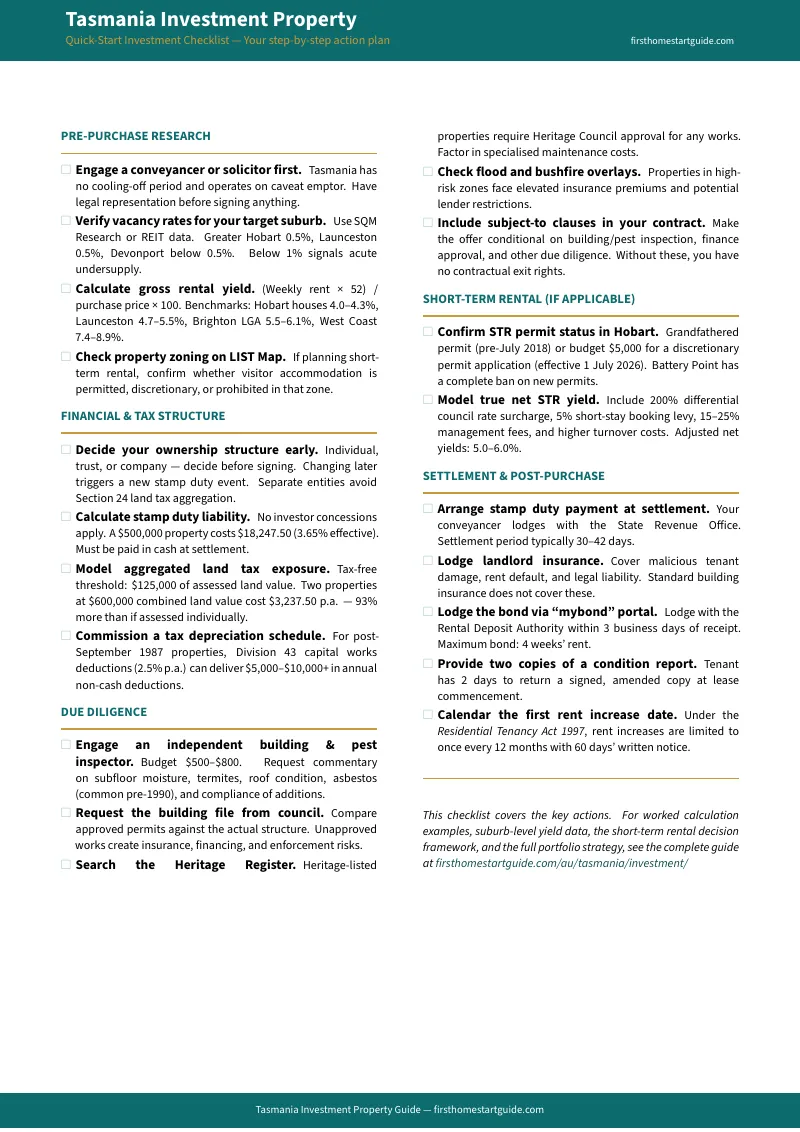
Download the free Tasmania Quick-Start Home Buying Checklist to see the due diligence framework covering pre-purchase research, financial analysis, heritage and zoning checks, closing, and post-purchase setup. When you're ready for the full land tax structuring model, short-term rental compliance playbook, heritage investment analysis, and suburb-by-suburb yield data, the complete guide is here.
The yield looks strong on the spreadsheet. This guide tells you whether Tasmania agrees.