You Have Run the SRO Stamp Duty Calculator, Checked the FHOG Eligibility Page, and Watched Twelve Saturday Auctions. You Still Cannot Work Out Whether That $615,000 Townhouse in Tarneit Will Cost You $1,045 in Duty or $11,356 — and Whether the Section 32 Your Conveyancer Has Not Reviewed Yet Is Hiding an Easement That Will Block the Extension You Are Planning.
You have looked at house-and-land packages in Pakenham and established apartments in Footscray. You have compared median prices in Geelong and Ballarat and tried to figure out whether an off-the-plan unit in Southbank saves you $28,000 in stamp duty or locks you into a building with combustible cladding and a $45,000 special levy. You may have seen the Reddit thread about a couple who overbid by $38,000 at a Reservoir auction because the auctioneer's vendor bids created a false sense of competition — and they could not back out because auction contracts in Victoria are unconditional. Or the r/AusPropertyChat post about a buyer who settled on a Brunswick apartment and received a notice three months later that the building's owners corporation had voted for a $62,000-per-unit cladding rectification that was mentioned once in a set of AGM minutes they never read.
The problem is not a lack of information. The State Revenue Office publishes the stamp duty thresholds. Housing Australia explains Help to Buy. Consumer Affairs Victoria describes auction rules. But no single resource maps how the $600,000 stamp duty exemption, the $750,000 concession ceiling, the $10,000 FHOG for new builds, the federal First Home Guarantee, and Help to Buy shared equity interact — where they stack, where they conflict, and at which exact price points you lose tens of thousands because you crossed the wrong threshold by $1,000. Nobody teaches you to triage a Section 32 yourself so you stop paying $400 per property for conveyancer reviews on homes you will never win. Nobody gives you an owners corporation interrogation checklist that separates a healthy building from one about to hit you with a cladding bill the size of a car.
The Victoria First Home Buyer Guide is an Auction-State Survival Protocol — a single reference that maps every grant threshold, stamp duty formula, Section 32 red flag, auction bidding tactic, cladding defence checkpoint, and the full Victorian buying process into a step-by-step system you work through before you raise your hand at any auction or sign any unconditional contract. It replaces weeks of cross-referencing government portals, Reddit warnings, conveyancer blogs, and mortgage broker marketing with a document that tells you exactly what to check, exactly what the numbers should look like, and exactly where Victoria-specific transactions fall apart.
What's Inside the Auction-State Survival Protocol
A 14-chapter guide, a quick-start checklist, and 8 standalone printable worksheets and reference cards (10 PDFs total) — covering every stage from calculating your real borrowing power through to collecting your keys, built specifically for the grants, stamp duty cliffs, auction mechanics, cladding risks, and Section 32 traps that make buying in Victoria fundamentally different from every other Australian state:
The Stamp Duty Cliff Calculator — Every Dollar Between $600,000 and $750,000
The Victorian first home buyer exemption saves you up to $31,070 at $600,000. Cross that threshold by $5,000 and you owe $1,045. At $650,000, you owe $11,356. At $750,000, the concession vanishes entirely and you pay the full $40,070. This guide includes a worked concession table at every major price point so you can see exactly what each extra $5,000 in purchase price costs in stamp duty — before you set your auction limit. Then it layers the off-the-plan concession on top: how a $620,000 apartment can have its dutiable value reduced to $155,000 by deducting construction costs, dropping your duty to near zero even though the purchase price is above the exemption threshold.
The Section 32 Triage Method — Filter Out Bad Properties Before Paying for a Conveyancer Review
A pre-auction Section 32 review costs $275 to $440 per property. If you bid on ten properties before winning — normal in Melbourne's auction market — that is $3,000 to $4,000 in conveyancing fees for properties you did not buy. The guide teaches you to triage a Vendor's Statement yourself: spot unapproved building works (visible renovations with no corresponding permits), restrictive easements that block future extensions, planning overlays (heritage, bushfire, flood) that kill development plans, outstanding council orders, and missing owners corporation documents. You filter out the obvious failures in twenty minutes and reserve your conveyancing budget for the two or three properties genuinely worth pursuing.
The Melbourne Auction Survival Guide — Bidding Strategy for an Unconditional Market
At auction in Victoria, there is no cooling-off period. No finance clause. No building inspection condition. If the hammer falls on your bid, you hand over 10% and you are contractually locked in. This extends to any private sale signed within three business days of a scheduled auction. The guide covers the sunk-cost trap that causes first home buyers to overbid after spending thousands on inspections and conveyancing, how auctioneers use vendor bids and anchoring to manufacture momentum, how to set a maximum bid based on independent comparable sales research rather than the agent's price guide, and when to walk away. The psychological preparation is just as important as the financial — this chapter covers both.
The Cladding Defence Checklist — Screening Apartment Buildings Before You Buy Into a Liability
Between 2000 and 2018, thousands of Victorian apartment buildings were clad in combustible materials. Cladding Safety Victoria funds rectification only for the highest-risk buildings. If your building is rated moderate or lower, the owners corporation pays — and that cost hits every owner through special levies that can reach tens of thousands of dollars per unit. There is no public register of affected buildings. The guide gives you a step-by-step process for interrogating owners corporation documents: what to look for in AGM minutes (cladding audit mentions, BPC notices, essential services breaches), how to assess sinking fund adequacy against the building's age and upcoming capital works, how to identify active litigation, and the insurance red flags that signal a building in financial distress.
The Underquoting Detection Playbook
Consumer Affairs Victoria has issued over $520,000 in fines and penalised agencies up to $600,000 for deliberately advertising properties below the vendor's reserve. The practice remains endemic. Buyers spend thousands on inspections and conveyancing for properties the vendor would never sell at the advertised range. The guide teaches you to research comparable sales independently on Domain and realestate.com.au, interpret the Statement of Information correctly, identify when the agent's price guide is 10-20% below comparable sold prices, and decide whether to walk away or bid strategically with full knowledge of the property's true market value.
Every Government Scheme Mapped — FHOG, First Home Guarantee, Help to Buy, Off-the-Plan Concession
The $10,000 FHOG applies only to new homes under $750,000. The First Home Guarantee eliminates LMI with a 5% deposit — unlimited places, no income cap since October 2025, property caps of $950,000 for Melbourne and Geelong, $650,000 for regional Victoria. Help to Buy shared equity requires just a 2% deposit but comes with income caps ($100,000 individual, $160,000 couple) and the government takes 30-40% of your future equity growth. The Victorian Homebuyer Fund closed permanently in September 2025. The guide explains how these programs stack, where they conflict, and which combination produces the lowest cash-to-close at your specific price point — with worked examples at $580,000 (established home, full exemption), $680,000 (house-and-land, concession zone + FHOG), and $620,000 (off-the-plan apartment with construction cost deduction).
New Build vs. Established Home Decision Framework
House-and-land packages in Craigieburn, Werribee, and Officer sit under the $750,000 FHOG cap and sell via private treaty — no auction trauma. But you inherit land titling delays (six to eighteen months), volume builder contracts weighted against you, and infrastructure that has not caught up with demand. Established homes give you mature suburbs and visible condition, but throw you into the auction machine. Off-the-plan apartments offer the most powerful stamp duty savings but carry sunset clause risk and cladding exposure. The guide lays out the financial mathematics of each path so you choose based on numbers, not anxiety.
Full Cost Worksheet with Three Worked Scenarios
A fillable worksheet covering deposit, stamp duty (with the concession formula applied), LMI, conveyancing fees, building inspections, loan establishment fees, and moving costs. Three pre-worked scenarios: a $580,000 established home in Ballarat with full duty exemption, a $680,000 house-and-land package in the concession zone with the FHOG, and a $620,000 off-the-plan apartment showing how the construction cost deduction slashes duty. Plus a blank worksheet for your own target property. Your budget is not what the bank will lend you — it is the total cash you need on settlement day.
Who This Guide Is For
- Melbourne renters earning $80,000 to $250,000 who cannot work out whether a $580,000 established home in Ballarat, a $680,000 house-and-land in Officer, or a $620,000 off-the-plan apartment in Footscray leaves them with more cash after stacking every available scheme
- Anyone preparing to bid at a Melbourne auction for the first time who needs a concrete strategy for managing the no-cooling-off rule, the sunk-cost trap, and the psychological pressure of vendor bids and competition — before they are standing on a front lawn committing to a quarter-million-dollar decision in sixty seconds
- Apartment buyers who need to screen for combustible cladding before signing on a building that could hit them with a special levy that wipes out their savings within months of settlement
- Buyers trying to stay under the $600,000 stamp duty exemption threshold or navigate the concession zone between $600,001 and $750,000 — who need to see the exact dollar impact of every $5,000 increment
- First home buyers comparing house-and-land packages in growth corridors (Pakenham, Craigieburn, Werribee, Tarneit, Mickleham) with established homes and off-the-plan apartments — who need the FHOG, stamp duty, and risk trade-offs laid out side by side
- Anyone confused by the overlap between FHOG, First Home Guarantee, Help to Buy, and the off-the-plan concession and unsure which combinations they qualify for and which produce the lowest cash requirement
- Interstate or international migrants who assume other states' property rules apply in Victoria — and do not realise that Melbourne's auction culture, Section 32 requirements, and stamp duty thresholds are fundamentally different
- Couples relying on parental financial help who need to structure the arrangement correctly — cash gift, guarantor, or living at home rent-free — so their lender accepts the deposit and the arrangement does not create hidden financial stress for either generation
Why Not Free Resources?
Free information on buying your first home in Victoria exists across a dozen government websites. Here is what it actually delivers:
- The State Revenue Office publishes the stamp duty thresholds and exemption rules. It does not provide worked concession calculations showing the exact duty at $605,000, $650,000, and $700,000. It does not explain how the off-the-plan construction cost deduction interacts with the first home buyer exemption to produce zero duty on a $620,000 apartment. You get the rules without the financial planning that makes the rules actionable.
- Housing Australia explains the First Home Guarantee and Help to Buy eligibility. It does not model whether the 2% deposit with Help to Buy's 30-40% equity share costs you more in lost capital gains over ten years than paying LMI upfront and owning 100% of the property. You get the brochure without the trade-off analysis.
- Consumer Affairs Victoria defines auction rules and the cooling-off framework. It does not teach you how to counter the sunk-cost fallacy after spending $3,000 on conveyancing and inspections, how to read an auctioneer's momentum, or how to set a walk-away number based on independent comparable sales instead of the agent's deliberately low price guide. You get the legal framework without the tactical survival guide.
- Reddit, Whirlpool, and Facebook groups contain real buyer experiences — but advice from 2024 does not reflect the October 2025 First Home Guarantee expansion, posts about the Victorian Homebuyer Fund reference a scheme that closed in September 2025, and New South Wales-based users describe 66W certificates and cooling-off rules that do not apply in Victoria. Sorting current from outdated, Victoria-specific from interstate, takes longer than reading a guide that has already done it.
This guide fills the Victoria-specific gap — the space between knowing you want to buy a first home and knowing how to survive a state where auctions are unconditional, stamp duty cliffs can cost you $31,000 for crossing a threshold by $1,000, cladding liabilities are hidden behind owners corporation documents most buyers never read, and the most powerful stamp duty saving requires buying into the exact apartment market where those cladding risks are concentrated.
— Less Than a Single Pre-Auction Conveyancer Review
A pre-auction Section 32 review costs $275 to $440 — and you will need multiple reviews across the properties you lose before you win. A building inspection costs $400 to $700. Full conveyancing runs $660 to $2,200. Crossing the $600,000 stamp duty exemption threshold by $5,000 costs you $1,045 in duty. Crossing it by $50,000 costs $11,356. Buying an apartment with a pending cladding rectification you did not spot in the OC documents can cost $30,000 to $60,000+ in special levies. Overbidding at auction by $20,000 because you did not set a walk-away number based on comparable sales costs exactly $20,000.
This guide does not replace your conveyancer. But it gives you the stamp duty cliff calculator, the Section 32 triage method, the auction survival playbook, the cladding defence checklist, and the complete cost worksheets that ensure you identify every Victoria-specific risk before you bid — not when the SRO assessment arrives, the auctioneer's hammer falls on a number you cannot afford, or the special levy notice lands in your letterbox.
If it saves you from a single stamp duty cliff you would not have calculated, a single auction overbid you would not have caught, or a single cladding risk you would not have spotted, it pays for itself before you finish reading it.
Money-back guarantee, no time limit. If the guide does not sharpen your due diligence and protect your deposit in Victoria's auction-dominated property market, you pay nothing.
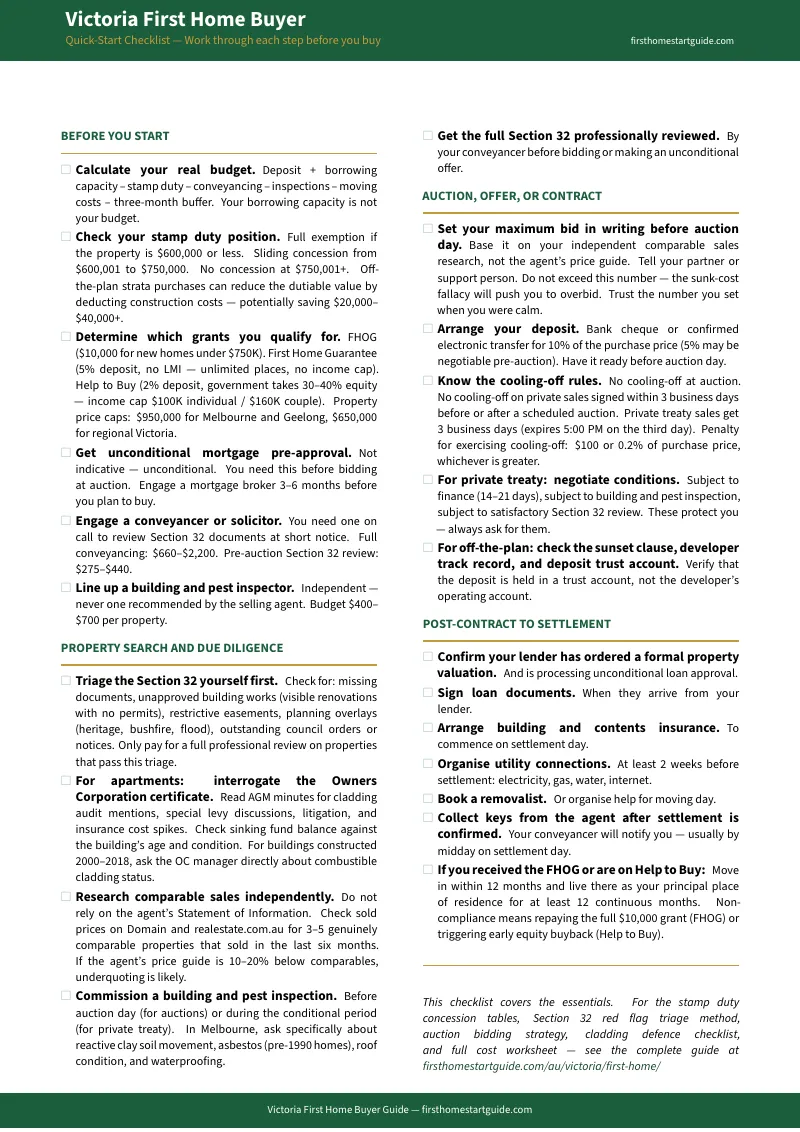
Download the free Victoria Quick-Start Home Buying Checklist to see the step-by-step framework covering pre-approval, Section 32 triage, auction preparation, and settlement. When you are ready for the full stamp duty cliff calculator, auction survival guide, cladding defence checklist, and complete acquisition cost breakdowns, the complete guide is here.
The schemes are generous. The auction market is ruthless. This guide makes sure you claim the first without being destroyed by the second.
Frequently Asked Questions
What if the rules change after I buy?
We update the guide when the rules change. Email us any time, even years later, and we'll send you the current edition free.