
The Yield Clears at 4.7%. Victoria's Land Tax Labyrinth, Cladding Traps, and No-Grounds Eviction Ban Will Correct That.
You found a middle-ring apartment projecting 4.7% gross yield. Or a Geelong townhouse where the entry price is half of what you'd pay in Sydney and the vacancy rate sits below 2%. Or a growth corridor house near the Suburban Rail Loop where Monash University's 42,500 students create permanent rental demand. The numbers clear. Melbourne's population growth is adding 88,000 people per year through net overseas migration alone. The construction pipeline can't keep up. Vacancy is at 1.5%. You're ready to move.
Then Victoria's regulatory reality arrives. Your investment property's site value is $280,000 — safely under the old $300,000 land tax threshold. But the COVID-19 Debt Repayment Plan slashed that threshold to $50,000, and now you owe $975 in land tax you didn't budget for. Buy a second property and the State Revenue Office aggregates both site values — pushing you into progressive rates that can add $4,650+ annually before you've collected a single rent cheque. Hold through a discretionary trust? The threshold drops further to $25,000, with punitive trust surcharge rates that activate at even lower portfolio values. Your inner-city apartment looks undervalued until you discover the Owners Corporation has a pending $85,000 special levy for combustible cladding rectification that wasn't disclosed in the listing — and Cladding Safety Victoria won't fund it because the building was rated lower priority. Your tenant's fixed-term lease expires and you want to renovate. Under the no-grounds eviction ban effective November 2025, you can't simply issue a notice to vacate — you need 90 days' notice with building permits or contractor quotes in hand at the time you serve notice. Miss a biennial gas and electrical safety check? That's $450 to $665 every two years, and non-compliance carries severe penalties.
Here's what no single free resource explains: Victoria layers a land tax system that dropped the tax-free threshold from $300,000 to $50,000 (capturing 360,000 previously exempt landowners) and imposes a separate trust surcharge starting at $25,000, against a combustible cladding crisis where buildings rated "lower risk" by Cladding Safety Victoria still leave owners with six-figure rectification costs, against tenancy reforms that have created Australia's most prescriptive rental regulations — 14 mandatory minimum standards, no-grounds eviction ban, biennial safety checks, and phased energy efficiency requirements arriving in 2027 — against a Windfall Gains Tax that can capture 50% of any value uplift from government rezoning. Each of these has cost real investors five to six figures because the information existed — scattered across SRO calculators, Consumer Affairs Victoria guides, Cladding Safety Victoria portals, and Reddit threads — but nobody had assembled it into a single underwriting system calibrated to Victoria.
The Victoria Investment Property Guide is a Victorian Investor Compliance System — not a motivational overview of Australian real estate, but a structured due diligence framework that maps every Victoria-specific financial trap, regulatory restriction, and tax structuring mechanic into a process you work through before you commit capital. It replaces months of cross-referencing SRO rate tables, Consumer Affairs minimum standards, cladding registers, and forum posts with a single reference that tells you exactly what to verify, exactly what the numbers should look like, and exactly where deals go wrong in this state.
What's Inside the Victorian Investor Compliance System
A comprehensive 14-chapter guide, a quick-start checklist, and six standalone printable tools — covering every stage from market selection through post-purchase compliance and portfolio scaling, built specifically for the regulatory mechanics and tax structures that make Victoria different from every other Australian state:
Land Tax Calculation, COVID Debt Levy, and Entity Structuring
Victoria's land tax system is universally regarded as Australia's most punitive for portfolio investors. The COVID-19 Debt Repayment Plan slashed the tax-free threshold from $300,000 to $50,000 and added aggressive surcharges legislated through 2033. A single property with a site value of $280,000 now triggers a $975 flat surcharge. Two properties with combined site values of $500,000 trigger $1,350 plus 0.3% of the amount above $300,000. The guide walks through every rate tier, the SRO's proportional tax formula for calculating liability across multiple properties, worked examples for portfolios of one, two, and three properties, trust surcharge rates (which activate at $25,000 — half the individual threshold), the corporate grouping rules, the Absentee Owner Surcharge for non-residents, and the interstate comparison showing exactly how Victoria's land tax compares to NSW and Queensland at equivalent portfolio values. You model the impact of your next acquisition before you sign — not when the SRO assessment arrives.
Land Transfer Duty and the $960,000 Cliff
Victoria charges investors the full general stamp duty rate with no concessional discounts. The rate schedule is progressive up to $960,000, then switches abruptly to a flat 5.5% on the entire value — creating a cliff where a property at $960,001 pays almost the same duty as one at $960,000 despite being only one dollar more expensive. A $700,000 investment property costs $37,070 in duty. The guide covers every tier of the progressive schedule, the $960,000 cliff and how to negotiate around it, the Foreign Purchaser Additional Duty (8% surcharge for non-residents), the SRO's DA-070 ruling on settlement adjustments that count as dutiable consideration from February 2026, and the extended off-the-plan strata concession that can save $20,000 to $40,000+ on apartment purchases through April 2027.
Combustible Cladding Due Diligence
Thousands of Victorian buildings use flammable Aluminium Composite Panels or Expanded Polystyrene. Cladding Safety Victoria manages a rectification program, but funding is strictly prioritised for higher-risk buildings. Buildings rated lower risk but still non-compliant leave the entire financial burden on apartment owners via the Owners Corporation — special levies regularly exceed $100,000 per apartment. The guide provides a forensic Section 32 checklist for spotting cladding exposure: how to read Owners Corporation AGM minutes for deferred special levies, pending rectification correspondence, litigation against developers, fire safety audit reports, and the specific document requests that real estate agents are unlikely to volunteer. It also covers non-cladding defects like water ingress that similarly generate ruinous OC special levies.
Residential Tenancy Reforms and the Minimum Standards CapEx Matrix
Victoria's 2021 renter reforms created Australia's most prescriptive residential tenancy environment. The guide consolidates every obligation into a single reference: the 14 mandatory minimum standards (electrical safety switchboards, fixed heating, blind cord anchors, and the phased energy efficiency requirements arriving March 2027 including R5.0 ceiling insulation, 4-star showerheads, and draughtproofing), the biennial gas and electrical safety checks ($450 to $665 every two years), the no-grounds eviction ban effective November 2025, rent increase limits (once every 12 months with 60 days' notice), and the advertising compliance rule requiring all 14 standards to be met at the time of advertising, not just before move-in. The CapEx matrix translates every standard into dollar amounts so you can calculate the upgrade cost of a non-compliant property before you make an offer — switchboard upgrades ($1,500 to $3,000), fixed heating installation ($1,800 to $3,500), and full compliance for a non-compliant older property ($6,000 to $12,000+).
Windfall Gains Tax Exposure
Victoria's Windfall Gains Tax, effective from July 2023, targets landowners who benefit from government-led rezoning. If a planning scheme amendment lifts a property's Capital Improved Value by more than $100,000, uplifts between $100,000 and $499,999 incur a 62.5% tax on the excess, while an uplift of $500,000 or more triggers a flat 50% tax on the total uplift. The guide explains how this affects land banking on the urban fringe, how to assess WGT exposure before purchasing properties in areas subject to rezoning, and the interaction between WGT and capital gains tax on eventual sale.
Auction Strategy and the No Cooling-Off Rule
Melbourne's auction culture is unique in Australia — the majority of investment-grade properties transact under the hammer, and there is no cooling-off period at auction. Once the hammer falls, you own the property. The guide covers bidding strategy, the critical importance of having a conveyancer or solicitor review the Section 32 before auction day, what happens when a property passes in (and the negotiation dynamics that follow), and the specific traps that catch interstate investors unfamiliar with Victoria's auction mechanics.
Owners Corporation Analysis and Special Levy Risk
For strata investors, Owners Corporation fees and special levies can transform a profitable acquisition into a cash-flow disaster. The guide provides fee benchmarks by building type (low-rise versus high-rise, inner city versus suburban), the red flags in OC records that signal upcoming special levies, how to read OC financial statements and meeting minutes for hidden liabilities, and the dispute resolution pathway through the VBA, DBDRV, and VCAT.
Tax Deductions, Depreciation, and Portfolio Construction
The guide covers negative gearing mechanics, depreciation schedules (Division 43 capital works deductions at 2.5% annually can deliver $5,000 to $10,000+ in non-cash deductions), deductible expenses, capital gains tax on sale, and the ownership structures available for portfolio construction — individual, joint, discretionary trust, unit trust, company, and SMSF — with the land tax implications of each structure modelled at different portfolio values so you can choose the right entity before you sign a contract rather than triggering a new stamp duty event to restructure later.
Growth Corridors and Strategic Asset Selection
The guide analyses Victoria's three primary acquisition strategies: middle-ring strata assets for yield (4.7% gross in the 10-20km ring from CBD), National Employment and Innovation Cluster properties for capital growth (Monash/Clayton, Sunshine, Parkville, La Trobe — all receiving Suburban Rail Loop investment), and regional Victoria (Geelong, Ballarat, Bendigo) for balanced returns with lower entry costs and lighter land tax burdens. Each corridor is mapped with current medians, vacancy rates, rental yields, and infrastructure catalysts.
Six Standalone Printable Tools
In addition to the guide and checklist, your download includes six standalone PDFs you can print and take to inspections, conveyancer meetings, and accountant appointments:
- Land Tax Calculator Worksheet — individual and trust rate tables, worked examples, the SRO proportional tax formula, interstate comparison, and a fillable portfolio calculation section
- Forensic Section 32 Cladding Checklist — step-by-step due diligence for spotting combustible cladding exposure in apartment purchases, with OC AGM deep dive items and water ingress checks
- Minimum Standards CapEx Matrix — all 14 mandatory rental standards with compliance dates, cost estimates, 2027 energy efficiency requirements, and a fillable per-property calculator
- Entity Structuring Comparison Card — six ownership structures compared across land tax thresholds, CGT discounts, asset protection, and administration costs
- Due Diligence Checklist — six-stage per-property evaluation covering Section 32 review, title search, building inspection, planning overlays, body corporate records, and rental appraisal
- Compliance Calendar Reference Card — recurring obligations with frequencies and costs, key compliance deadlines through 2033, no-grounds eviction quick reference, and property manager fee benchmarks
Who This Guide Is For
This guide is for property investors targeting Victorian markets who:
- Are building a Melbourne rental portfolio and need to model how the COVID-19 land tax threshold reduction from $300,000 to $50,000, the trust surcharge starting at $25,000, and the SRO's proportional tax formula across multiple properties will affect their actual net yield — not the yield that appeared on the agent's advertisement
- Are interstate investors from NSW or Queensland viewing Victoria as a contrarian play — attracted by suppressed asset prices and strong population fundamentals — but need to understand the cladding risk, land tax regime, and tenancy reform obligations before deploying capital 800 kilometres from home
- Are evaluating Melbourne apartments and need a forensic Section 32 checklist that catches combustible cladding exposure, pending OC special levies, and water ingress defects before they inherit a six-figure liability that the listing agent didn't mention
- Are self-managing landlords navigating the no-grounds eviction ban, 14 mandatory minimum standards, biennial safety checks, and the phased energy efficiency requirements arriving in 2027 — and need every obligation, deadline, and penalty consolidated in one reference rather than scattered across Consumer Affairs Victoria PDFs and VCAT rulings
- Are SMSF buyers who need to verify that a target property has no cladding exposure, no pending special levies, and no compliance obligations that would breach the fund's investment strategy — because an SMSF acquisition with undisclosed liabilities can trigger ATO scrutiny and potential penalties
- Want every Victoria-specific regulation, tax calculation, and due diligence requirement in one reference — instead of assembling it from SRO calculators, Consumer Affairs checklists, Cladding Safety Victoria portals, planning authority maps, and Reddit threads that may predate the November 2025 eviction ban or the 2027 energy efficiency requirements
Why Not Free Tools and Forums?
Free information on Victorian property investing exists. Here's what it actually delivers:
- SRO calculators and documentation give you the land tax rate tables, the COVID-19 Debt Repayment Plan details, and trust surcharge rates. They don't explain how the proportional tax formula catches multi-property investors who thought each property was assessed separately, don't compare the dollar impact of individual versus trust versus company ownership at different portfolio values, and don't model the compounding effect of the COVID debt levy across a growing portfolio through 2033. You get the rate schedule without the structuring strategy that makes it useable.
- Consumer Affairs Victoria guides list all 14 minimum standards, the safety check requirements, and the no-grounds eviction ban rules. They don't translate those standards into a CapEx estimation matrix that tells you how much it will cost to bring a non-compliant property up to code before you submit an offer, and they don't model how those compliance costs affect your net yield at different purchase prices. The guides enforce the law — they don't help you financially model it.
- Corporate educational content (mortgage brokers, property managers, buyer's agents) highlights Melbourne's population growth, low vacancy rates, and the "contrarian opportunity" created by the landlord exodus. It minimises the land tax escalation, cladding risk, minimum standards CapEx, and WGT exposure — because that content is designed to generate leads, not to help you identify reasons not to buy. The guide covers both sides.
- Reddit threads (r/AusPropertyChat, r/AusFinance, r/melbourne) and PropertyChat forums contain genuinely useful investor experience reports mixed with advice that predates the November 2025 no-grounds eviction ban, the 2027 energy efficiency requirements, and the latest SRO rate schedules. A 2023 thread explaining cladding due diligence may not reflect CSV's current prioritisation framework. Sorting current from outdated takes longer than reading a guide that has already done it.
This guide fills the Victoria-specific gap — the space between knowing how to analyse a rental property in general and knowing how to underwrite one in a state where the land tax threshold dropped to $50,000 (capturing 360,000 new taxpayers), where combustible cladding can generate six-figure special levies on buildings the government won't fund, where 14 mandatory minimum standards force immediate CapEx on non-compliant properties, and where a no-grounds eviction ban has fundamentally changed the calculus of tenant management. It's the analysis that would take a Victorian property solicitor, a specialist tax adviser, and a building defect consultant to assemble — structured as a reference you own permanently.
— Less Than One Gas and Electrical Safety Check
A single biennial gas and electrical safety check in Victoria runs $450 to $665. Land transfer duty on a $700,000 investment property is $37,070. A trust structure that triggers the $25,000 land tax threshold instead of the $50,000 individual threshold can cost thousands more annually. A combustible cladding special levy can exceed $100,000 per apartment. Upgrading a non-compliant older property to meet the 14 minimum standards can cost $6,000 to $12,000+.
This guide doesn't replace your conveyancer or your tax adviser. But it gives you the land tax calculation model, the forensic Section 32 cladding checklist, the minimum standards CapEx matrix, the WGT exposure framework, and the entity structuring comparison that ensure you identify every Victoria-specific risk before you're contractually committed — instead of discovering them on your first SRO assessment, your first OC special levy, or your first Consumer Affairs compliance notice.
If it catches a single land tax structuring mistake, prevents a single cladding-affected apartment purchase, or saves you from a $6,000+ minimum standards surprise on an older property, it pays for itself before you've finished reading it.
Money-back guarantee, no time limit. If the guide doesn't sharpen your underwriting and protect your capital in Victoria's regulatory environment, you pay nothing.
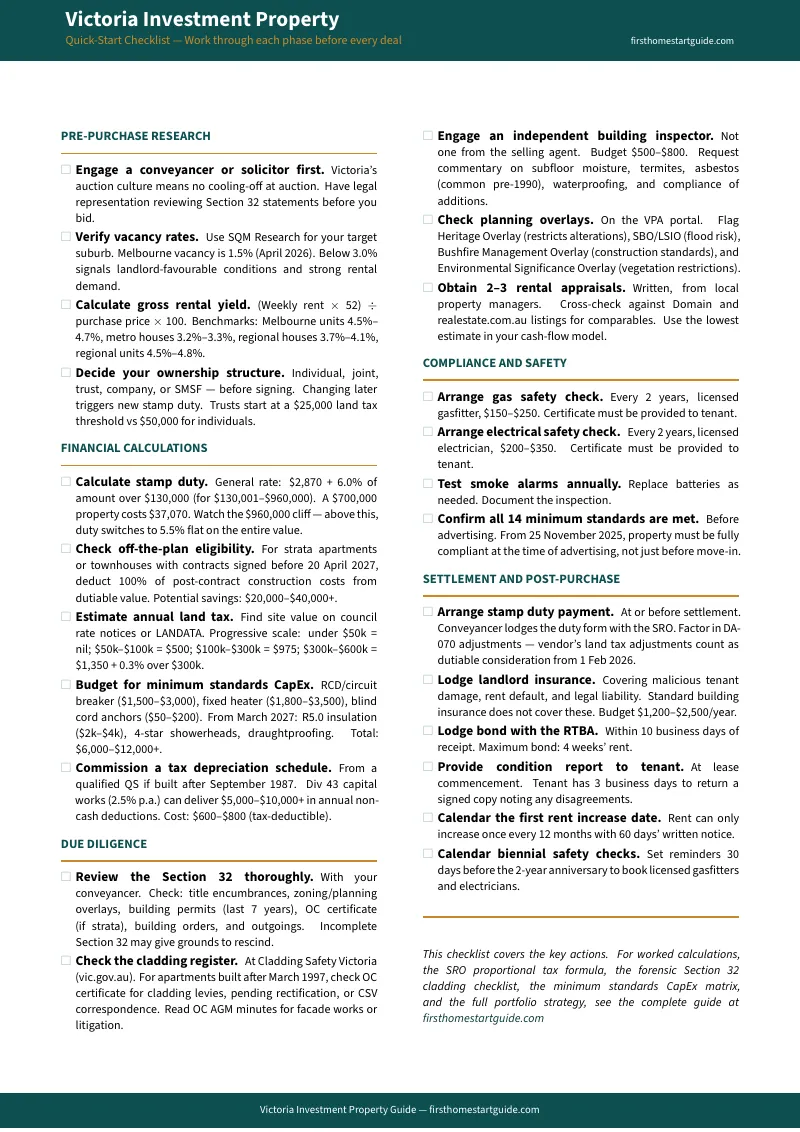
Download the free Victoria Quick-Start Investment Property Checklist to see the due diligence framework covering pre-purchase research, financial calculations, Section 32 review, compliance requirements, and post-purchase setup. When you're ready for the full land tax structuring model, forensic cladding checklist, minimum standards CapEx matrix, and portfolio construction strategy, the complete guide is here.
The yield clears at 4.7%. This guide tells you whether Victoria agrees.