
The Yield Clears at 4.8%. Western Australia's $300,000 Land Tax Threshold, Settlement Agent Who Can't Give Legal Advice, and Postcode Lending Blacklist Will Correct That.
You found a Baldivis house projecting 4.8% gross yield at $710,000 — less than a one-bedroom unit in Parramatta. Or a Karratha property where corporate leases are paying $900 a week and the gross yield exceeds 10%. Or an Armadale investment at $605,500 where the entry price is the lowest in any Perth growth corridor and the vacancy rate sits below 1%. The numbers clear. Perth is absorbing population faster than it can build housing. Stock is tracking 45% below its five-year average. Properties lease within 16 days. You're ready to move.
Then Western Australia's operational reality arrives. You sign the Offer and Acceptance — and discover there is no cooling-off period. The contract was binding the moment the seller countersigned. Your settlement agent can execute the transfer, lodge title documents, and calculate stamp duty, but they are legally prohibited from advising you on the contractual implications of the Special Conditions you forgot to insert. You need a solicitor for that — a separate professional you didn't know you needed because in NSW and Victoria your conveyancer handles both. Your bank declines the loan on the Karratha property because postcode 6714 is restricted: LVR capped at 65%, no Lenders Mortgage Insurance available, and you need $150,000 in cash instead of the $50,000 you budgeted. Your $300,000 land tax threshold sounded generous until you bought a second property and the aggregation formula combined both unimproved values — pushing you into the $420,001–$1,000,000 bracket where you owe $300 plus 0.25% on every dollar above $420,000, plus the Metropolitan Region Improvement Tax at 0.14% on everything above $300,000.
Here's what no single free resource explains: Western Australia layers a settlement system where the Offer and Acceptance contract is binding on signature with no statutory cooling-off period and the settlement agent who handles your transfer is legally prohibited from providing the legal advice you need on contract terms and SMSF structures, against a postcode lending regime where banks cap LVRs at 65% to 80% in Pilbara and Goldfields postcodes and refuse Lenders Mortgage Insurance entirely — collapsing transactions for buyers who signed unconditional contracts without checking their bank's blacklist, against a land tax aggregation system where the $300,000 threshold applies to your combined unimproved values across all investment properties and the Metropolitan Region Improvement Tax adds a second layer at 0.14% on every dollar above the threshold, against tenancy reforms that banned rent bidding and capped rent increases to once per 12 months and gave tenants statutory pet rights and imposed a 90-night cap on unhosted short-term rentals in the Perth metro area, against a Pilbara mining town market where Karratha's median crashed 44% from $740,000 to $415,000 between 2012 and 2015 and weekly rents collapsed from $2,000 to below $400 — trapping thousands of leveraged investors in negative equity they couldn't refinance out of because the same postcode restrictions that should have warned them also prevented their banks from revaluing the asset. Each of these has cost real investors five to six figures because the information existed — scattered across Revenue WA calculators, REIWA suburb profiles, Landgate title searches, and PropertyChat threads — but nobody had assembled it into a single underwriting system calibrated to Western Australia.
The Western Australia Investment Property Guide is a Settlement & Yield Intelligence System — not a motivational overview of Perth real estate, but a structured due diligence framework that maps every WA-specific financial trap, regulatory restriction, lending barrier, and tax structuring mechanic into a process you work through before you commit capital. It replaces months of cross-referencing Revenue WA rate tables, REIWA vacancy data, Landgate title records, and forum posts with a single reference that tells you exactly what to verify, exactly what the numbers should look like, and exactly where deals go wrong in this state.
What's Inside the Settlement & Yield Intelligence System
A comprehensive 19-chapter guide, a quick-start checklist, and six standalone printable references — eight PDFs covering every stage from market selection through post-settlement compliance and portfolio scaling, built specifically for the regulatory mechanics and tax structures that make Western Australia different from every other Australian state:
Land Tax Calculation, Aggregation, and Cross-State Comparison
Western Australia's $300,000 land tax threshold sounds generous — and it is, for a single property. But the tax is calculated on the aggregated Unimproved Value of all investment properties held by the same owner, not on each property individually. A Baldivis house sitting on land worth $340,000 and a Bayswater unit with $280,000 in land value produce an aggregate of $620,000 — placing you in the $420,001–$1,000,000 bracket where you owe $300 plus 0.25% on the $200,000 excess ($800 in base land tax). Properties in the Perth metropolitan area also attract the Metropolitan Region Improvement Tax (MRIT) at 0.14% on every dollar above $300,000 — adding $448 on a $620,000 aggregate. The guide walks through every rate tier, worked examples for two-property and four-property portfolios, the MRIT calculation, and a direct interstate comparison showing that the same $1,500,000 in aggregated land value produces $7,930 in WA versus approximately $8,775 in Victoria. WA's single most powerful competitive advantage for foreign investors is also covered: Western Australia does not impose an annual foreign land tax surcharge, unlike Victoria (4%), NSW (5%), and Queensland (3%) — saving an offshore investor holding $500,000 in unimproved value $20,000 to $25,000 per year compared to the eastern seaboard.
Transfer Duty Rate Schedule and Foreign Buyer Surcharge
Transfer duty in WA is assessed on the greater of market value or purchase price, using a progressive scale that tops out at 5.15% above $725,000. A $710,000 house in an outer growth corridor costs $27,740 in duty. A $806,000 Karratha house costs $32,625. Foreign persons, foreign corporations, and foreign trusts pay an additional 7% surcharge on the entire dutiable value — a $710,000 purchase by a foreign buyer incurs $77,440 in total duty (10.9% of the purchase price consumed before settlement agent fees, loan establishment, or insurance). The guide covers the full rate schedule with worked examples at multiple price points, the foreign surcharge mechanics, total acquisition cost summaries showing the 4.4% to 4.6% capital deficit at entry for domestic investors, and the absence of any first-home buyer concessions for investment purchases — the First Home Owner Rate of Duty applies exclusively to owner-occupiers who reside in the property for six continuous months.
The Pilbara: Boom-Bust History, Corporate Leases, and Defence Housing
Karratha, Port Hedland, and Newman advertise gross yields of 10% to 12% — the highest in Australia. The guide provides a forensic financial autopsy of why those numbers are real and why they regularly destroy capital. The Karratha case study documents the full cycle: median prices peaking at $740,000 in 2012 during the Pluto LNG construction boom, crashing 44% to $415,000 by 2015 as projects transitioned to automated operations, rents collapsing from $2,000+ per week to below $400, and a 14-year timeline from peak to recovery ($806,000 by 2026). Hidden holding costs are quantified: cyclone insurance premiums two to four times higher than Perth ($4,000–$6,000 versus $1,200–$1,800), maintenance trades costing $3,000–$4,000 for a hot water system replacement that runs $1,500 in Perth, and property management fees of 10%–12% plus GST against the metro benchmark of 7%–8.5%. Corporate leases — mining company or government agency tenants providing guaranteed rent, zero vacancy, and corporate-standard maintenance for two to five years — are covered as the sophisticated Pilbara strategy. Defence Housing Australia (DHA) properties near HMAS Stirling in Rockingham and Naval Communication Station Harold E. Holt in Exmouth are covered separately: 9-to-12-year government-backed leases with guaranteed rent between postings, funded by billions in AUKUS submarine program infrastructure that provides treaty-backed, multi-generational tenant demand.
Postcode Lending Restrictions and the Cash Trap
Australian banks and LMI providers (Helia, QBE) maintain proprietary risk matrices that classify postcodes based on default probability, population size, economic concentration, and historical loss data. In Western Australia, these restrictions dominate the Pilbara, Goldfields, and Kimberley regions. Postcodes 6714 (Karratha), 6721–6722 (Port Hedland/South Hedland), and 6753 (Newman) are classified as high risk with LVRs capped at 65%–80% and LMI generally unavailable. Kalgoorlie-Boulder postcodes (6429, 6430, 6432) face moderate restrictions with LMI often refused. Remote Pilbara postcodes (6713, 6718, 6720, 6728) carry extreme restrictions with some lenders refusing to lend entirely. The guide works through the cash trap arithmetic: a $500,000 Karratha house capped at 70% LVR requires $150,000 in cash plus $17,765 in transfer duty — roughly $170,000 total outlay — and if values decline 20% (as they did in 2013–2015), your equity halves from $150,000 to $50,000 with no ability to refinance because the new LVR exceeds the bank's cap. This is the barrier that collapses deals for interstate buyers who sign unconditional contracts before confirming their lender's postcode classification.
Perth Growth Corridors: Suburbs, Medians, Yields, and Infrastructure
The guide analyses Perth's outer and middle suburban corridors with current median prices, gross yields, vacancy rates, tenant demographics, and infrastructure catalysts. The northern corridor — Alkimos ($760,000 median, 4.6% yield), Yanchep, and Two Rocks — was structurally transformed by the Yanchep Rail Extension under METRONET. The north-east corridor — Ellenbrook ($788,000) — gained its first rail connection via the METRONET Ellenbrook line, converting a car-dependent estate into a self-sufficient commuter hub. The southern corridor — Baldivis ($710,000, 4.8%) and Armadale ($605,500, 5.3%) — offers the best combination of accessible entry price, strong yield, and proximity to the Kwinana employment hub. Regional lifestyle hubs — Mandurah (5%–6% yields, existing rail connection), Bunbury (diversified economy, lower median), Geraldton ($559,941 median, 1.11% vacancy) — are covered as a third investment pathway. The South West — Busselton ($795,000, 16.9% annual growth), Margaret River, Dunsborough — is analysed through the lens of the extreme STRA-to-residential imbalance: 1,295 active Airbnbs versus 31 long-term rentals in Busselton, with the WA Government's $10,000 transition incentive signalling clear policy preference for long-term leasing.
Tenancy Law Reforms (2024) and the STRA 90-Night Cap
Western Australia's tenancy reforms reshape landlord operations across four dimensions. Rent bidding is banned — you must advertise a fixed weekly rent and cannot solicit or accept offers above the listed price. Rent increases are capped at once every 12 months with 60 days' written notice (no cap on quantum, but tenants can challenge excessive increases through the Consumer Protection Commissioner). Tenants have statutory pet rights — written requests must be responded to within 14 days, refusal is permitted only on specific limited grounds, and disputes bypass the Magistrates Court for a faster Commissioner determination. Minor modifications (picture hooks, curtain brackets, water-saving fixtures) require landlord permission with refusal limited to safety or structural grounds. No-grounds evictions remain legal in WA (unlike Victoria and the ACT) but abolition is flagged as Phase 2 of the reform agenda. The Short-Term Rental Accommodation Act 2024 imposes a mandatory registration requirement for all STRA properties, a 90-night annual cap on unhosted STRA in the Perth metro area (exceeding the cap requires formal planning approval for a change of use), and delegated cap-setting authority to regional councils in areas like Busselton and Margaret River. The guide consolidates every obligation, notice period, bond cap (four weeks' rent), and dispute resolution pathway into a single reference.
The Offer and Acceptance Process and Settlement Agent System
WA property acquisition works differently from the eastern seaboard. The Offer and Acceptance (O&A) contract — a standardised document drafted jointly by REIWA and the Law Society of WA — is binding the moment the seller countersigns and communicates acceptance. There is no statutory cooling-off period. All protective clauses (Subject to Finance, Subject to Building and Pest Inspection, Subject to Existing Tenancy) must be inserted as Special Conditions before signing — verbal assurances from the agent provide no legal protection. The default under Clause 18 of the Joint Form of General Conditions is vacant possession at settlement — if you are buying a tenanted property and want to retain the tenant, a Special Condition must explicitly override this default, specify the existing lease details, address rent apportionment, and provide for bond transfer. The settlement agent — licensed under the Settlement Agents Act 1981 — handles title searches, duty calculation, PEXA lodgement, and settlement adjustments, but is legally prohibited from providing legal advice on contract terms, SMSF bare trust structures, boundary disputes, or contractual disputes. If your situation involves anything beyond a standard residential transfer, you need a property solicitor ($1,500–$3,500) in addition to your settlement agent ($1,200–$2,000).
Due Diligence, Landgate Searches, and Post-Settlement Operations
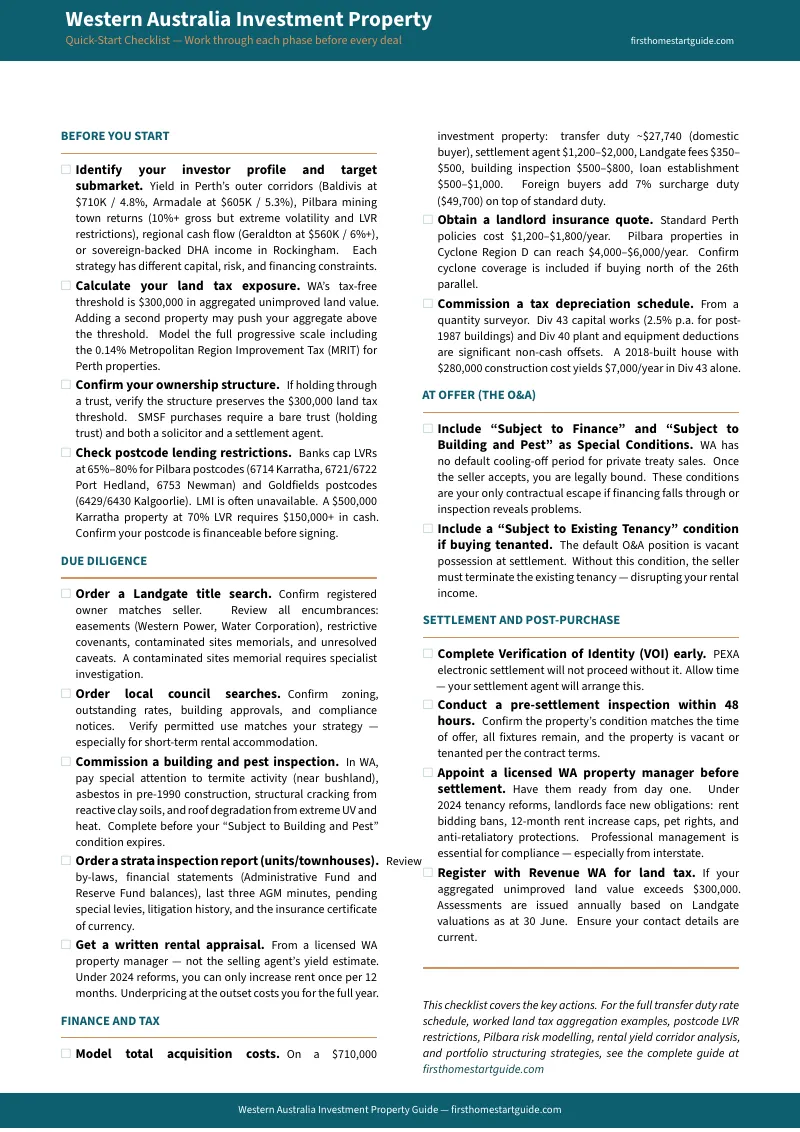
The guide includes a complete due diligence checklist covering every stage of a WA investment purchase: Landgate title searches (encumbrances, easements, restrictive covenants, contaminated sites memorials, caveats), local council searches (zoning, outstanding rates, compliance notices), land tax clearance (unpaid land tax in WA attaches to the land and transfers to the buyer), building and pest inspection (WA-specific attention to termites near bushland, asbestos in pre-1990 construction, structural cracking from reactive clay soils, roof degradation from extreme UV), strata inspection reports (by-laws, financial statements, Reserve Fund adequacy, pending special levies, insurance certificates), postcode lending verification before signing the O&A, and rental appraisals from licensed WA property managers. Post-settlement operations cover property manager selection criteria, landlord insurance requirements (with explicit cyclone coverage verification for Pilbara properties), depreciation schedule commissioning, rent setting under the 12-month cap regime, and Revenue WA land tax registration.
Who This Guide Is For
This guide is for property investors targeting Western Australian markets who:
- Are eastern seaboard investors fleeing Sydney's 3.1% gross yields and Victoria's $50,000 land tax threshold — attracted by Perth's 4.3%–5.3% yields, $300,000 land tax threshold, and the price arbitrage where a Baldivis house costs less than a Parramatta unit — but need to understand the Offer and Acceptance contract, settlement agent limitations, and tenancy reform obligations before deploying capital from 3,000 kilometres away
- Are local Perth portfolio expanders who have built equity during the recent capital growth cycle and need to model how the land tax aggregation formula will affect their total holding cost when they add a second or third property — not just the new property's individual numbers, but the portfolio-wide impact on every rate tier and the MRIT
- Are evaluating Pilbara mining town yields and need a documented risk assessment — not the agent's headline 10% yield, but the normalised net return after cyclone insurance ($4,000–$6,000), remote trades (double Perth prices), elevated property management (10%–12%), postcode lending restrictions (65%–80% LVR caps), and the historical reality that Karratha's median crashed 44% in three years
- Are SMSF trustees navigating the dual-professional requirement — settlement agent for the transfer plus solicitor for the bare trust structure — and need to understand the WA-specific implications for LRBA documentation, title registration, transfer duty, and the postcode restrictions that make most SMSF lenders refuse to finance Pilbara or Goldfields properties entirely
- Are foreign buyers who need to calculate the 7% transfer duty surcharge ($49,700 on a $710,000 property) alongside the structural advantage of WA's absence of an annual foreign land tax surcharge — a saving of $20,000 to $25,000 per year compared to holding the same asset in NSW or Victoria
- Want every WA-specific regulation, tax calculation, lending restriction, and due diligence requirement in one reference — instead of assembling it from Revenue WA calculators, REIWA suburb profiles, Landgate title records, DMIRS tenancy guides, and PropertyChat threads that may predate the 2024 tenancy reforms or the STRA 90-night cap
Why Not Free Tools and Forums?
Free information on Western Australian property investing exists. Here's what it actually delivers:
- Revenue WA calculators and documentation give you the land tax rate tables, the $300,000 threshold, and the MRIT rate. They don't explain how the aggregation formula catches portfolio builders who assumed each property was assessed separately, don't model the MRIT impact on a growing metro portfolio, don't compare the dollar-for-dollar advantage of WA versus Victoria or NSW at equivalent aggregate values, and don't cover entity structuring strategies. You get the rate schedule without the portfolio modelling that makes it useable.
- REIWA market data and suburb profiles provide excellent median price movements, vacancy rates, and leasing velocity statistics. They don't tell you which growth corridor suburbs offer the best risk-adjusted yield after land tax and insurance, don't model the hidden holding costs that erode Pilbara yields from 10% gross to 4% net, don't cover the postcode lending restrictions that make certain regions uninvestable without large cash reserves, and don't assess the STRA regulations that constrain short-term rental strategies. Market data without operational due diligence is a partial picture.
- PropertyChat and Reddit threads (r/AusPropertyChat, r/Perth) contain genuinely useful investor experience reports mixed with advice that predates the 2024 tenancy reforms, the STRA 90-night cap, and current postcode restriction classifications. Interstate investors routinely exchange incorrect advice about the settlement agent's role, the O&A cooling-off period (there isn't one), and Pilbara yield sustainability. A 2023 thread recommending trust structures may not account for the land tax aggregation implications of the entity they recommend. Sorting current from outdated takes longer than reading a guide that has already done it.
This guide fills the Western Australia-specific gap — the space between knowing how to analyse a rental property in general and knowing how to underwrite one in a state where the Offer and Acceptance is binding on signature with no cooling-off period, where the settlement agent cannot give legal advice, where postcode lending restrictions can collapse a transaction after you've committed, where land tax aggregation catches the second property you didn't model, and where a 44% median price crash in the Pilbara is not theoretical history but documented fact from the last decade. It's the analysis that would take a WA property solicitor, a specialist tax adviser, a mortgage broker with postcode restriction experience, and a Pilbara-experienced property manager to assemble — structured as a reference you own permanently.
— Less Than One Building and Pest Inspection
A single building and pest inspection in Western Australia runs $500 to $800. Transfer duty on a $710,000 investment property is $27,740. A Pilbara property purchased without checking postcode lending restrictions can require $100,000 more in cash than you budgeted. A second investment property that pushes your aggregated unimproved value from $280,000 to $620,000 triggers $1,248 in annual land tax that did not exist on the first property alone. A foreign buyer who doesn't model the 7% duty surcharge discovers $49,700 in additional upfront costs after signing an unconditional contract.
This guide doesn't replace your settlement agent, your solicitor, or your mortgage broker. But it gives you the land tax aggregation model, the postcode lending verification system, the O&A Special Conditions framework, the Pilbara risk assessment, and the tenancy reform compliance reference that ensure you identify every WA-specific risk before you're contractually committed — instead of discovering them when your bank declines the loan, your first Revenue WA assessment arrives, or your settlement agent tells you they can't advise on the problem you just created.
If it catches a single postcode lending restriction before you sign an unconditional contract, prevents a single land tax aggregation surprise, or saves you from a Pilbara investment sized on gross yield instead of net cash flow, it pays for itself before you've finished reading it.
Money-back guarantee, no time limit. If the guide doesn't sharpen your underwriting and protect your capital in Western Australia's regulatory environment, you pay nothing.
Download the free Western Australia Quick-Start Investment Property Checklist to see the due diligence framework covering pre-purchase research, financial calculations, O&A Special Conditions, postcode lending verification, and post-purchase setup. When you're ready for the full land tax aggregation model, Pilbara risk assessment, growth corridor analysis, and portfolio construction strategy, the complete guide is here.
The yield clears at 4.8%. This guide tells you whether Western Australia agrees.
Frequently Asked Questions
What if the rules change after I buy?
We update the guide when the rules change. Email us any time, even years later, and we'll send you the current edition free.