
The Numbers Work on the Spreadsheet. Alberta's Hidden Rules Will Make Sure They Don't in Practice.
You found a detached home in Calgary with basement suite potential that projects 6% gross yield. Or a townhouse in Fort McMurray listed at $243,000 where apartments are up 36.7% year-over-year. Or a duplex in Edmonton where you plan to run both units as furnished rentals on Airbnb. The cap rate clears. The price-to-rent ratio is half of what you'd pay in Toronto. You've heard Alberta has no land transfer tax, no PST, no rent control. You're ready to move.
Then the province-specific reality arrives. Your Calgary basement suite needs two separate permits — a Development Permit and a Building Permit — running $1,300 to $2,200 in municipal fees alone, with a build cost of $75,000 to $130,000, and four mandatory inspections that must pass in sequence before the city issues an Occupancy Certificate. Your Edmonton Airbnb triggers a $500 fine on the first offense if you don't hold a valid business license, the city uses automated web-scraping software to flag unlicensed listings, and the Provincial Tourism Levy applies to every booking under 30 days whether the platform remits it or not. Your corporate holdco pays 46.67% on passive rental income — the lowest in Canada, but a number that still surprises investors who assumed the small business rate of 11% applied. And that "Alberta tax advantage" you keep hearing about? A single T4 filer earning $120,000 actually pays $2,400 more in provincial income tax in Alberta than in British Columbia.
Here's what no single resource explains: Alberta layers a zero-LTT advantage against municipality-specific permitting complexity (Calgary's dual DP+BP system, Edmonton's Sound Separation Declaration requirement, different ceiling height standards), a rapidly tightening short-term rental regulatory environment (Calgary's 180-day definition that now captures furnished executive rentals, vacancy-rate freezes that can halt new licenses overnight), corporate-personal tax integration mechanics that most investors misunderstand (the RDTOH refund system, the $50,000 passive income trap that grinds your operating company's small business deduction to zero), and resource-market volatility in Fort McMurray where 36.7% apartment price surges exist alongside a history of boom-and-bust cycles tied to oil prices. Each of these has cost real investors five to six figures because the information existed — scattered across City of Calgary permit portals, CRA technical interpretations, CMHC vacancy reports, and Reddit threads on r/PersonalFinanceCanada — but nobody had assembled it into a single underwriting system calibrated to Alberta.
The Alberta Investment Property Guide is an Alberta Investor Underwriting System — not a motivational overview of Canadian real estate, but a structured due diligence framework that maps every Alberta-specific financial trap, regulatory restriction, and tax integration mechanic into a process you work through before you commit capital. It replaces months of cross-referencing municipal permit portals, CRA bulletins, provincial tenancy legislation, and forum posts with a single reference that tells you exactly what to verify, exactly what the numbers should look like, and exactly where deals go wrong in this province.
What's Inside the Alberta Investor Underwriting System
A comprehensive guide, a standalone due diligence checklist, and seven printable worksheets and reference cards — covering every stage from market selection through post-purchase setup, built specifically for the regulatory mechanics and tax structures that make Alberta different from every other province:
Zero-LTT Capital Advantage Analysis
Alberta's biggest structural edge is what you don't pay at closing. Purchasing a $500,000 property with a $400,000 mortgage in Calgary costs $420 in Land Titles registration fees — compared to $32,950 in land transfer taxes for the same purchase in Toronto, or $8,000 in BC's Property Transfer Tax. The guide quantifies exactly how much capital this frees up per deal, how to redeploy it into value-add improvements that directly increase rental yield, and why this advantage compounds across a multi-property portfolio. But the guide also covers what Alberta charges instead — title insurance, legal fees, property tax adjustments on closing — so your closing cost model reflects reality, not just the marketing line.
Secondary Suite Permitting Playbook (Calgary and Edmonton)
Adding a legal basement suite is the single most effective yield booster in Alberta — and the most technically complex. In Calgary, you navigate two separate approval tracks: a Development Permit (4-8 weeks, $800-$1,200) that evaluates zoning and parking, then a Building Permit (2-6 weeks, $500-$1,000) that evaluates Alberta Building Code compliance. The guide walks through every technical standard that determines pass or fail: egress window minimums (3.77 square feet with no dimension under 15 inches), fire barrier requirements (Type X drywall on shared walls and ceilings), independent heating systems, minimum ceiling heights (1.95 metres in living areas, 1.85 metres under beams), and the four mandatory inspection milestones — framing, electrical rough-in, plumbing/HVAC rough-in, and final — that must clear in sequence before you receive an Occupancy Certificate. In Edmonton, the standards differ: 9-foot foundation walls recommended, 0.9-metre hard-surfaced exterior pathway required, mandatory Sound Separation Declaration, and a two-dwelling-unit cap per property under the National Building Code. Budget $75,000 to $130,000 for a standard legal suite, with Calgary's SSIP rebate covering up to $10,000 plus $6,250 for energy efficiency and accessibility upgrades.
Short-Term Rental Regulatory Matrix
Calgary expanded its STR definition to stays up to 180 consecutive days in April 2025, pulling furnished executive rentals and mid-term lets under the licensing umbrella overnight. The guide maps the current two-tier system: Primary Residence licenses (must be your principal residence, one booking at a time, 2 guests per room) versus Non-Primary Residence licenses (requires full commercial fire inspection, subject to vacancy-rate freezes). When Calgary's purpose-built rental vacancy drops below 2.5%, the city can halt all new non-primary STR licenses — the current rate of 4.8% gives you runway, but this is a policy lever that can shut the door with no warning. The guide covers fire safety plan requirements, $2,000,000 commercial liability insurance, condo board compliance risks, guest record-keeping obligations, and the Edmonton contrast: $99 annual Tier 2 license, automated web-scraping enforcement, $500 first-offense fines, and the Provincial Tourism Levy that applies regardless of whether the platform remits it.
Corporate and Personal Tax Integration
This is where most Alberta investors make their most expensive mistake. Net rental income in a Canadian holdco is classified as passive investment income — taxed at 46.67% in Alberta (50.17% in Ontario, 50.67% in BC), not the 11-12% small business rate. The guide explains the RDTOH mechanism that tracks 30.67% of passive income as refundable tax, how the 38.33% dividend refund works when you distribute earnings, and why the total effective rate on corporate rental income still lands between 53% and 54% after personal tax on dividends. More critically, it covers the $50,000 passive income trap: exceed this threshold in associated corporate investment income and your operating company's $500,000 small business deduction limit starts grinding to zero on a straight line, hitting zero at $150,000. This single provision can cost a business owner tens of thousands in additional OpCo taxes — and most accountants don't flag it until the T2 is filed.
The "Alberta Tax Advantage" — What It Actually Means
Alberta is widely marketed as Canada's low-tax haven. The guide shows when that is true and when it is not. A single T4 earner at $120,000 pays approximately $2,400 more in provincial income tax in Alberta than in British Columbia. The crossover where Alberta's flat 10% middle bracket actually beats BC's graduated rates doesn't occur until roughly $175,000 in taxable income. For investors holding rental properties personally — especially those with T4 income under $175,000 — this means the "tax advantage" may not exist at all. The guide runs the comparison across Alberta, BC, and Ontario at multiple income levels so you can structure your holdings based on your actual marginal rate, not a marketing claim.
Market-by-Market Investment Analysis
Four distinct Alberta markets dissected with current pricing, rental yields, vacancy trends, and demand drivers: Calgary ($506,685 average, 0.618% mill rate, balanced commercial tax base), Edmonton ($400,000-range entry, 1.01% mill rate — 63% higher than Calgary due to a smaller commercial tax cushion), Fort McMurray ($390,375 average, 2.53 months of supply, apartment prices up 36.7% driven by contractor localization policies and 536 acres of Crown land release), and Alberta's secondary markets. The guide explains why Edmonton's mill rate runs nearly double Calgary's, why Fort McMurray's stabilization is structural rather than cyclical, and which property segments in each market align with long-term rental, short-term rental, and value-add strategies.
Landlord-Tenant Law and No-Rent-Control Framework
Alberta does not cap annual rent increases — landlords can adjust to market rates with proper notice, unlike Ontario and BC where rent increases are capped at inflation-linked percentages. The guide covers notice periods, lease termination rules, security deposit regulations, the Residential Tenancy Dispute Resolution Service process, and how this rent flexibility changes your long-term cash flow modelling compared to rent-controlled provinces. It also covers the operational realities: tenant screening, property management cost structures in each market, and the insurance requirements that differ for owner-occupied versus non-owner-occupied investment properties.
Standalone Worksheets and Reference Cards
Seven printable tools you can use independently — fill in during due diligence, bring to your planning office, or share with your accountant:
- Closing Cost Worksheet — estimate every dollar you need to close on an Alberta investment property, from Land Titles registration fees through insurance and closing adjustments
- Secondary Suite Permitting Checklist — the complete Calgary and Edmonton dual-permit pathway with pre-application feasibility checks, building code requirements, four inspection milestones, cost model, and SSIP rebate details
- Short-Term Rental Compliance Reference — Calgary's two-tier licensing versus Edmonton's flat licensing side by side, with tax obligations and a pre-listing checklist
- Tax Comparison Worksheet — personal versus corporate ownership analysis including the $50,000 passive income trap calculator and the Alberta-BC provincial tax tipping point
- Market Comparison Card — Calgary, Edmonton, Fort McMurray, and secondary markets compared by price, mill rate, cap rate, vacancy, and strategy match
- Landlord Compliance Reference — Residential Tenancies Act key rules: security deposits, rent increases, eviction notice periods, emergency notices, and RTDRS dispute resolution
- Property Tax Reference — Calgary and Edmonton mill rate breakdowns, the commercial tax base gap explanation, and a fillable calculator for your specific property
Who This Guide Is For
This guide is for real estate investors targeting Alberta markets who:
- Are based in Ontario or British Columbia and evaluating Alberta's price gap — where you can acquire two cash-flowing properties for the cost of one in Toronto — but need to understand the province-specific closing costs, tax structures, and municipal regulations before you deploy capital 2,000 kilometres from home
- Are local Alberta earners in energy, engineering, or technology using high T4 income to build a rental portfolio and need to determine whether a personal holdco structure actually saves tax at your income level, or whether the $50,000 passive income threshold makes it counterproductive
- Plan to add a legal basement suite in Calgary or Edmonton and need the complete permit pathway — dual DP and BP applications, technical inspection standards, build cost budgets, and SSIP rebate eligibility — before committing $75,000 to $130,000 to a project that requires an Occupancy Certificate to generate legal rental income
- Want to operate short-term rentals on investment properties and need to verify which licensing tier applies, whether Calgary's vacancy-rate freeze mechanism could halt new licenses, what insurance and fire safety documentation you need, and how Edmonton's automated enforcement works
- Are considering Fort McMurray's high-yield opportunity and need an honest, data-backed assessment of contractor localization trends, segment-specific price movements, and the structural changes that differentiate the current market from the boom-and-bust cycles of 2014-2016
- Want every Alberta-specific regulation, tax calculation, and due diligence requirement in one reference — instead of assembling it from City of Calgary permit portals, CRA technical interpretations, CMHC reports, and Reddit threads that may predate Calgary's April 2025 STR overhaul
Why Not Free Tools and Forums?
Free information on Alberta real estate investing exists. Here's what it actually delivers:
- Reddit forums (r/PersonalFinanceCanada, r/RealEstateCanada) are where someone in a 2022 thread says Alberta's personal tax rates are the lowest in Canada, someone in 2024 shows they're actually higher than BC's for earners under $175,000, and a third poster links to a tax bracket table that's been updated since. You'll find genuinely useful experience reports mixed with advice that predates Calgary's April 2025 STR regulation expansion, the current SSIP rebate structure, and this year's mill rate adjustments. Sorting current from outdated takes longer than reading a guide that has already done it.
- Municipal permit portals give you application forms and fee schedules. They don't walk you through the dual-permit sequence, don't explain which technical standards cause the most inspection failures (egress window dimensions, fire barrier continuity, HVAC separation), and don't tell you that Edmonton's Sound Separation Declaration requirement is a common stumbling block that Calgary doesn't have. You get the bureaucratic inputs without the practical construction knowledge that determines whether your $100,000 basement build passes final inspection.
- National investing books and courses teach cap rate, DSCR, and 1031 exchange mechanics that apply everywhere. They don't cover Alberta's dual-permit suite process, the RDTOH refund mechanism, the $50,000 passive income trap, Calgary's vacancy-rate freeze for STR licenses, Edmonton's automated web-scraping enforcement, or the mill rate gap between Calgary and Edmonton. Applying national frameworks to Alberta-specific structures is how investors model the wrong tax rate on their first holdco filing.
- CMHC and provincial tools provide vacancy data, rental rate tracking, and mortgage calculators. They don't integrate those numbers into an underwriting framework that accounts for municipal-level property tax differences, suite permitting costs, STR regulatory risk, and the corporate-personal tax integration that determines how much of your rental income you actually keep. You get the data points without the system that connects them.
This guide fills the Alberta-specific gap — the space between knowing how to analyze a rental property in general and knowing how to underwrite one in a province where secondary suite permitting complexity, municipality-specific STR regulations, corporate tax integration mechanics, and a personal tax structure that contradicts its own marketing can each independently turn a profitable deal into a losing one. It's the analysis that would take an Alberta real estate lawyer, a cross-provincial tax accountant, and a Calgary permit consultant to assemble — structured as a reference you own permanently.
— Less Than One Permit Application Fee
A single Development Permit application in Calgary runs $800 to $1,200. A basement suite build that fails its framing inspection because the egress windows are undersized means ripping out finished walls — $5,000 to $15,000 in rework. A holdco structured without accounting for the $50,000 passive income threshold can cost your operating company its entire small business deduction — tens of thousands in additional tax. An STR license application submitted without understanding Calgary's vacancy-rate freeze mechanism might arrive the week the city halts new non-primary residence licenses.
This guide doesn't replace your real estate lawyer or your CPA. But it gives you the suite permitting playbook, STR regulatory matrix, tax integration analysis, and market-by-market breakdown that ensure you identify every Alberta-specific risk before you're contractually committed — instead of discovering them on your first permit rejection, your first CRA assessment, or your first STR enforcement notice.
If it catches a single permit compliance issue, prevents a single holdco structuring mistake, or saves you from modelling the wrong tax rate on a six-figure acquisition, it pays for itself before you've finished reading it.
Money-back guarantee, no time limit. If the guide doesn't sharpen your underwriting and protect your capital in Alberta's regulatory environment, you pay nothing.
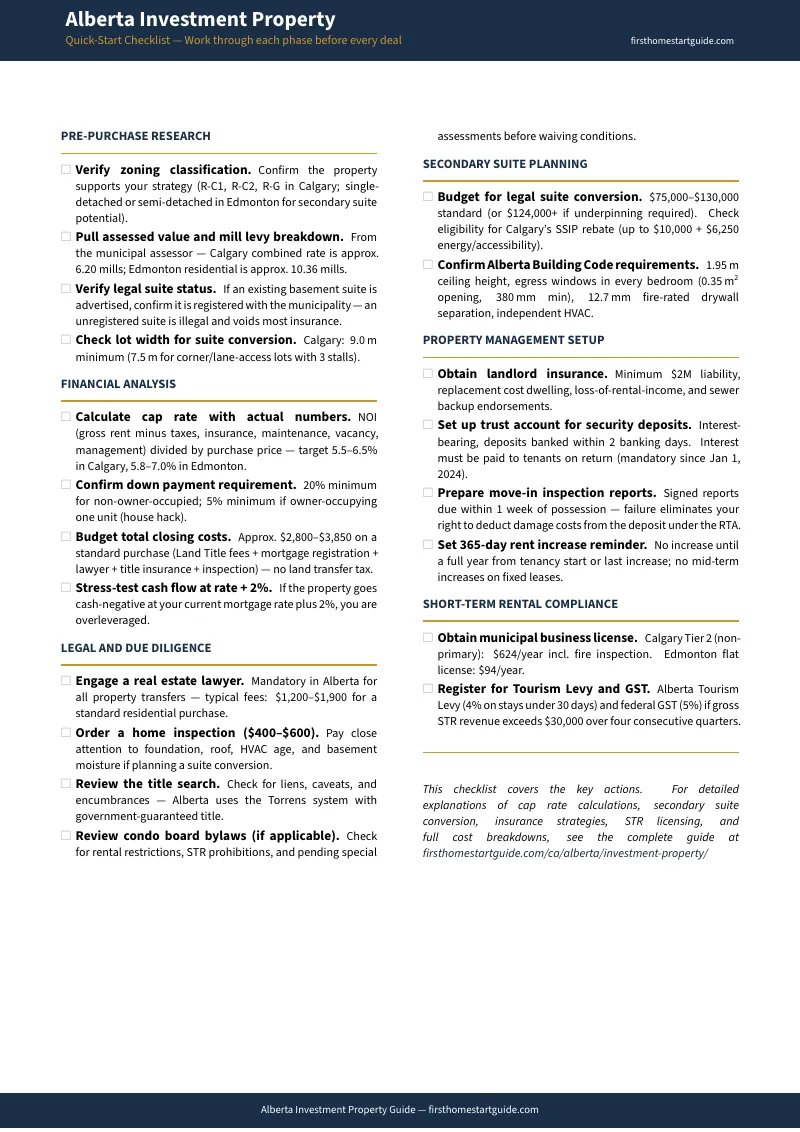
Download the free Alberta Quick-Start Home Buying Checklist to see the due diligence framework covering pre-purchase research, financial analysis, property inspections, closing, and post-purchase setup. When you're ready for the full suite permitting playbook, STR regulatory matrix, tax integration analysis, and market-by-market investment system, the complete guide is here.
The deal looks good on the spreadsheet. This guide tells you whether Alberta agrees.