You Qualified for the Mortgage. You Didn't Qualify for the PTT Exemption, the SVT Declaration, the Strata Special Levy, and the Pre-Sale Assignment Tax.
You found a one-bedroom condo near the SkyTrain in Burnaby listed at $720,000. Or a townhouse in Surrey where the monthly payment fits your budget. Or a pre-sale in Coquitlam where the developer promises completion in three years and the price locks in today's market. Your mortgage broker says you qualify. Your realtor says it's a great deal. You're ready to remove subjects.
Then you look at the closing costs. The Burnaby condo is $725,000 — just above the $720,000 PTT full-exemption threshold — which means you now owe $4,300 in Property Transfer Tax instead of zero. If you'd negotiated $5,000 lower, you'd have saved $4,300 in tax. The Surrey townhouse is in an SVT-designated community, and nobody mentioned that you need to file an annual declaration by March 31 even though you live there — miss it and BC auto-assesses the tax at $3,750 on an assessed value of $750,000. The Coquitlam pre-sale looks perfect until you learn that if your circumstances change and you assign the contract within 365 days, the province charges a flat 20% flipping tax on the profit, the CRA may classify the gain as 100% taxable business income, and you owe 5% GST on the assignment premium.
Here's the problem: British Columbia layers a Property Transfer Tax with a full exemption that vanishes at $835,000 and a partial exemption that phases out on a sliding scale above $860,000, a Newly Built Home Exemption with a completely different threshold of $1,100,000, a Speculation and Vacancy Tax that requires annual filing even from owner-occupiers, a Home Flipping Tax on any sale within 730 days, a federal GST rebate under Bill C-4 that phases out between $1 million and $1.5 million on new builds, strata governance rules under the Strata Property Act where a single Form B certificate reveals special levies and insurance deductibles that can add five figures to your first year, a mandatory depreciation report deadline hitting Metro Vancouver stratas by July 2026, REDMA cooling-off rights for pre-sales and HBRP cooling-off penalties for resales, and an OSFI stress test that qualifies you at contract rate plus 2% — into a regulatory environment where every decision carries a tax consequence that no mortgage calculator will show you. Every one of these has cost real first-time buyers thousands of dollars because the rules existed on different government websites, in different pieces of legislation, with different deadlines and different eligibility criteria, and nobody had assembled them into a single decision framework.
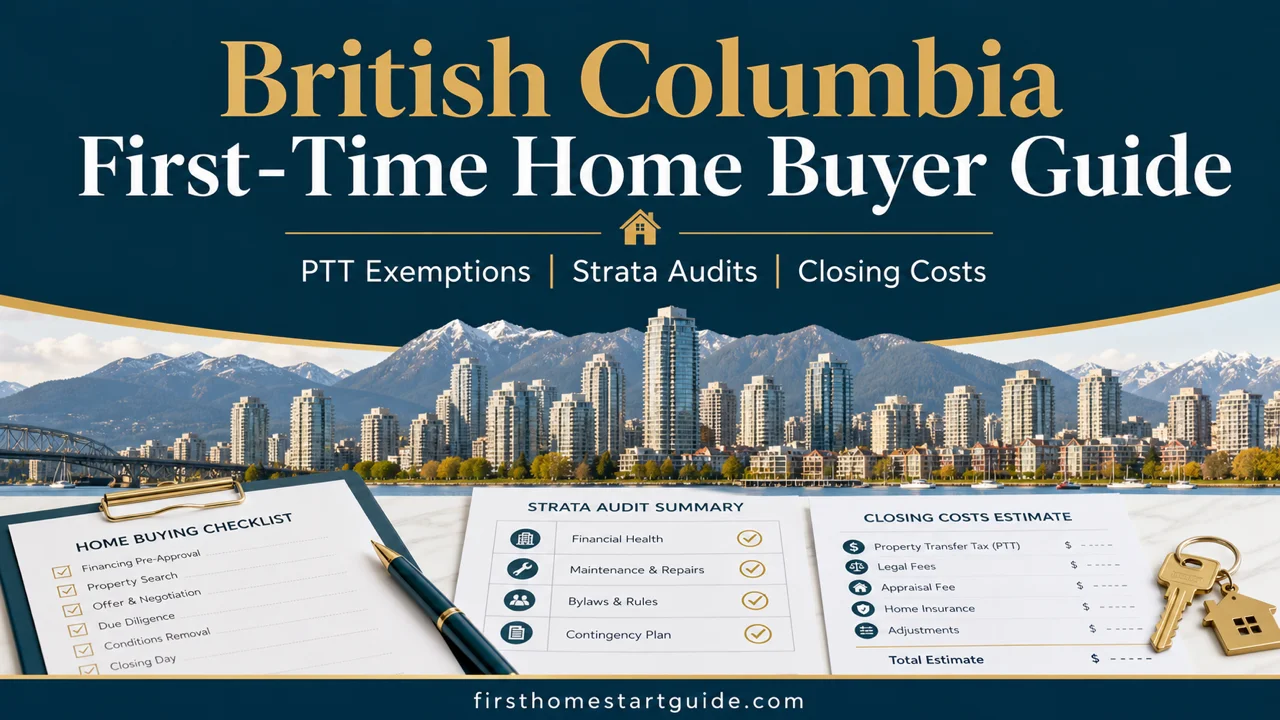
The British Columbia First-Time Home Buyer Guide is a BC Buyer Tax Shield — not a motivational overview of Canadian homeownership, but a structured system that maps every BC-specific tax exemption, every strata risk signal, and every closing cost formula into a process you work through before you sign anything. It replaces months of cross-referencing the PTT calculator on gov.bc.ca, the SVT declaration portal, the CMHC stress test rules, the Strata Property Act requirements, the Bill C-4 GST rebate thresholds, and conflicting advice on r/PersonalFinanceCanada with a single reference that tells you exactly what you qualify for, exactly what you owe, and exactly where first-time buyers lose money in BC.
What's Inside the BC Buyer Tax Shield
A 10-chapter guide, a printable step-by-step checklist, and 7 standalone worksheets — covering every stage from financial readiness through post-purchase filing, built specifically for the regulatory complexity that makes British Columbia different from every other province:
Property Transfer Tax — The Threshold Trap That Costs Buyers Thousands
The PTT exemption isn't a simple cutoff. Below $835,000 on a resale home, you pay zero. Between $835,000 and $860,000, the exemption phases out on a sliding linear scale where a $25,000 increase in purchase price adds $14,700 in tax — an effective 59% marginal rate on that narrow band. The guide walks through the tiered PTT calculation (1% on the first $200,000, 2% on $200,001 to $2,000,000, 3% above that), the full exemption, the phase-out formula, and the three edge cases — properties larger than 0.5 hectares, mixed-use properties with commercial improvements, and multiple buyers where only one qualifies — that government calculators don't explain. You'll know exactly how to position your offer to maximize tax savings before you negotiate.
The Newly Built Home Exemption — A Separate System with Higher Thresholds
If you're buying new construction, you qualify for a completely different exemption with a full threshold of $1,100,000 — $265,000 higher than the resale threshold. Combined with the federal Bill C-4 GST rebate (100% of the 5% GST on new homes under $1 million, phasing out to $1.5 million), a first-time buyer purchasing a new townhouse under $950,000 can eliminate their entire transactional tax liability. The guide calculates the combined tax shield at every price point and shows you when buying new saves more than buying resale — even at a higher purchase price.
The FHSA, HBP, and HBTC — Stacking Tax-Sheltered Programs
The First Home Savings Account lets you contribute $8,000/year with a $40,000 lifetime cap — tax-deductible going in and tax-free coming out. The Home Buyers' Plan lets you withdraw $60,000 from your RRSP tax-free. A couple using both programs can accumulate up to $200,000 in tax-sheltered down payment capital. But the interaction rules matter: you can transfer FHSA to RRSP if you don't buy, but you can't contribute to an FHSA after your first purchase, and the HBP has a 90-day seasoning requirement that catches buyers who make last-minute RRSP deposits. The guide maps each program's eligibility criteria, deadlines, and the optimal sequencing so you capture every dollar of available tax relief.
Speculation, Vacancy, and Flipping Taxes — The Compliance Calendar
The SVT applies to all residential property owners in designated urban areas — including first-time buyers who use their home as a principal residence. You're exempt, but only if you file your annual declaration by March 31. Miss the deadline and BC auto-assesses at 0.5% of assessed value. The guide covers the SVT, the Vancouver Empty Homes Tax (a separate municipal tax with separate filing), the federal Underused Housing Tax (effectively eliminated for 2025+ by Bill C-15 but still required for 2022-2024), and the provincial Home Flipping Tax (20% on sales within 365 days, declining to 0% by day 730). One calendar. Every deadline. Every exemption pathway.
Strata Due Diligence — Reading What the Summary Page Won't Tell You
Most first-time buyers in BC buy into a strata. The Form B Information Certificate is a legally binding snapshot of the strata's financial health — but only if you know what to look for. Monthly fees significantly below comparable buildings signal deferred maintenance. A Contingency Reserve Fund below 25% of the annual budget signals future special levies. Water damage deductibles of $50,000 to $100,000+ mean a single pipe leak in your unit could cost you the full deductible. Buildings from the late 1980s through early 2000s carry "leaky condo" risk where envelope remediation exceeds $30,000 per unit. The guide provides a line-by-line Form B audit checklist, explains the mandatory July 2026 depreciation report deadline, and shows you which red flags to walk away from and which to negotiate around.
Pre-Sale Condos and Contract Assignments — The Tax Trap Nobody Explains Clearly
Pre-sale buyers get a non-waivable 7-day REDMA cooling-off period — zero penalty, full deposit refund, absolute walkaway right. But if you hold the contract and later assign it, the tax exposure stacks: the provincial Home Flipping Tax (up to 20%), CRA income tax (100% inclusion if classified as business income, 50% if capital gains), GST on the assignment premium (5%), and the assignee's PTT is calculated on the total consideration including your premium — not just the developer's original price. The CSAIR registry tracks every assignment and feeds directly to CRA audit teams. The guide models total tax exposure at multiple price points and identifies the narrow exemptions that apply.
The Buying Process, Closing Costs, and the 3-Day Cooling-Off Period
BC's resale cooling-off period (HBRP) gives you 3 business days after the seller accepts your offer to cancel — but it costs 0.25% of the purchase price ($2,000 on an $800,000 home). It's a safety net for pressured bidding situations, not a substitute for subject clauses on financing and inspection. The guide walks through the complete buying process from pre-approval through possession day, breaks down closing costs by line item (notary/lawyer fees, title insurance, property tax adjustment, strata move-in fees), and explains why a 5-to-7-day financing subject clause and a home inspection clause are non-negotiable in BC's market — even when your agent says "every other offer is subject-free."
Who This Guide Is For
This guide is for first-time home buyers in British Columbia who:
- Are buying a condo or townhouse in Metro Vancouver or the Fraser Valley and need to understand exactly where the PTT exemption thresholds fall, how the stress test limits their purchasing power, and how to audit a strata before removing subjects — not after they've already committed
- Are weighing a new-build or pre-sale against a resale property and need to compare the PTT exemption thresholds, the GST rebate under Bill C-4, the depreciation report requirements, and the REDMA vs. HBRP cooling-off rules to determine which purchase type actually saves more after tax
- Are relocating to Victoria or the Okanagan from the Lower Mainland and need to know how regional pricing, SVT-designated areas, and market dynamics differ from the markets they've been researching
- Are a couple coordinating FHSA, RRSP HBP, and down payment timing and need to understand the contribution limits, withdrawal sequencing, and tax implications before they commit to a purchase timeline
- Are feeling pressure to submit subject-free offers and need to understand the HBRP cooling-off penalty, the cost of waiving a financing subject on a high-ratio mortgage, and what protections actually exist under BC law
Why Not Free Tools and Government Websites?
Free information on BC home buying exists across dozens of sources. Here's what it actually delivers:
- The BC government PTT calculator tells you how much tax you owe. It does not tell you that negotiating the purchase price from $840,000 to $835,000 saves you $4,300 in tax, that the newly built home exemption has a completely different threshold, or that buying a property larger than 0.5 hectares triggers an apportionment calculation that can eliminate most of the exemption. You get a number without the strategy that reduces it.
- CMHC and bank websites explain the stress test and the HBP in isolation. They don't explain how to sequence FHSA contributions with HBP withdrawals, how the 90-day RRSP seasoning requirement affects your closing timeline, or how the stress test interacts with strata fees and property taxes to shrink your purchasing power further than you expected. You get program descriptions without the coordination that maximizes them.
- Reddit threads on r/PersonalFinanceCanada and r/vancouverhousing are where buyers share real experiences with PTT surprises, strata special levies, and pre-sale regrets — mixed with advice that predates the 2024 PTT threshold increases, the Bill C-4 GST rebate, and the 2026 depreciation report mandate. Sorting current from outdated requires cross-referencing every claim against legislation that changes annually.
- Realtor-produced buyer guides cover the general purchase process and market conditions. They rarely explain PTT calculation edge cases, strata financial red flags that should make you walk away, pre-sale assignment tax exposure, or the compliance filings (SVT declaration, Home Owner Grant application, HBTC claim) that cost you money if you miss them — because realtors earn commissions when you buy, not when you decide not to.
This guide fills the BC-specific gap — the space between knowing you want to buy a home and knowing how to buy one without leaving money on the table or walking into a strata liability, a tax surprise, or a compliance deadline you didn't know existed. It's the analysis that would take a real estate lawyer, a tax accountant, a mortgage broker, and a strata specialist to assemble — structured as a reference you own permanently.
— Less Than One PTT Miscalculation
A single pricing mistake near the $835,000 PTT threshold costs $4,300 to $14,700 in unnecessary tax. A missed SVT declaration auto-assesses at 0.5% of your home's assessed value. A strata special levy for deferred envelope work runs $9,000 to $30,000+ per unit. A pre-sale assignment within 365 days triggers a 20% provincial flipping tax before the CRA even classifies the gain. An unused FHSA is $8,000 per year in tax deductions you never claimed.
This guide doesn't replace your notary or your mortgage broker. But it gives you the PTT optimization framework, the strata audit checklist, the program stacking strategy, and the compliance calendar that ensure you claim every exemption, avoid every threshold trap, and spot every strata red flag before you sign — instead of discovering them at the lawyer's office, on your first property tax bill, or at your first strata AGM.
If it catches a single PTT threshold mistake, prevents a single underfunded strata purchase, or captures a single tax credit you would have missed, it pays for itself before you finish reading it.
Money-back guarantee, no time limit. If the guide doesn't sharpen your buying strategy and protect your closing costs in BC's regulatory environment, you pay nothing.
Your download includes 9 PDFs: the full 10-chapter guide, the quick-start checklist, plus 7 standalone worksheets you can print and use independently — the PTT Threshold Worksheet, Strata Form B Audit Checklist, Program Stacking Worksheet (FHSA + HBP + HBTC), Pre-Sale Assignment Tax Calculator, BC Homeowner Compliance Calendar, New Build vs. Resale Tax Comparison, and Closing Cost Worksheet.
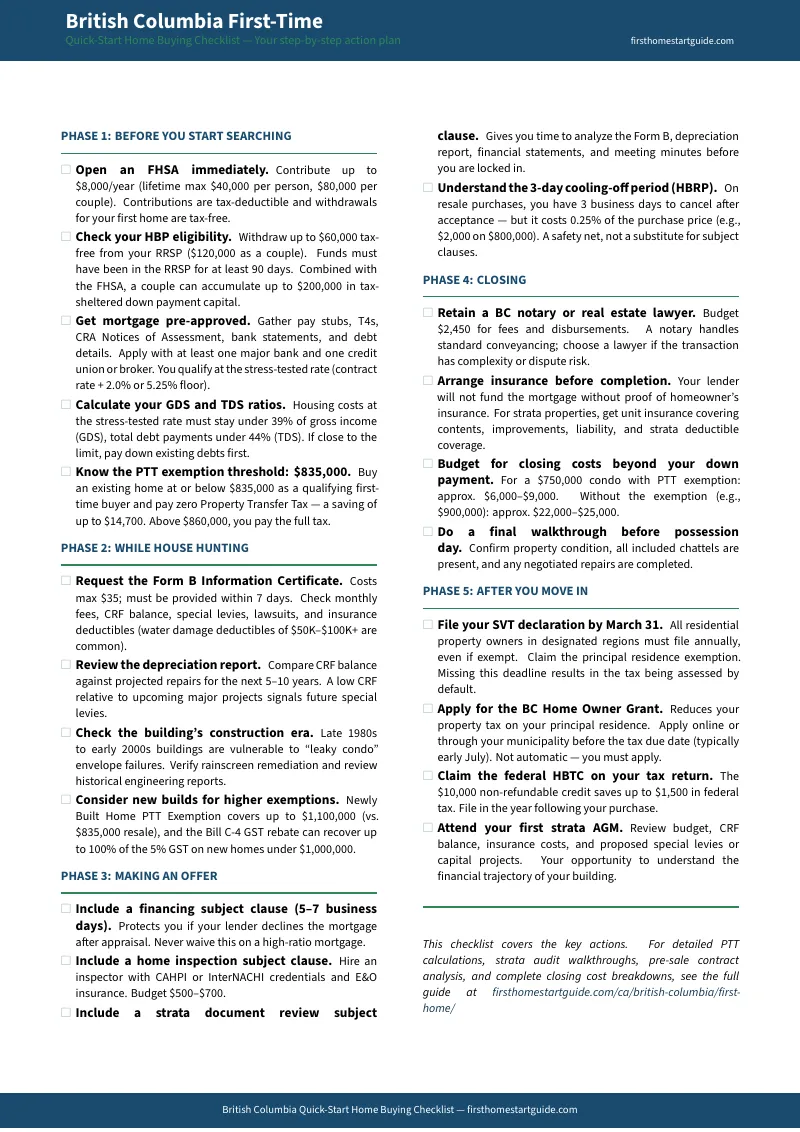
Download the free British Columbia Quick-Start Home Buying Checklist to see the step-by-step action plan covering pre-purchase preparation, strata review, offer strategy, closing, and post-purchase compliance. When you're ready for the full PTT optimization system, strata audit framework, and all 9 printable tools, the complete toolkit is here.
The mortgage calculator says you can afford the home. This guide tells you what the home will actually cost.