The Listing Says Positive Cash Flow. Your SVT Declaration, PTT Bill, Strata Special Levy, and RTB Dispute Say Otherwise.
You found a one-bedroom condo in Burnaby near the SkyTrain renting for $2,400/month. Or a townhouse in Langley where the rent-to-price ratio looks strong. Or a vacation cabin in the Kootenays that a property manager says will throw off $45,000 in short-term rental revenue. The cap rate works. The realtor sends you comparable sales. You're ready to remove subjects.
Then you run the real numbers. The Burnaby condo is in a strata with a Contingency Reserve Fund sitting at 15% of what the depreciation report recommends. The council minutes show three consecutive votes to defer the $480,000 envelope remediation. When that vote finally fails, your unit's share of the special levy is $9,500 -- on top of your mortgage, strata fees, and property taxes. The Langley townhouse sits in an SVT-designated community, and your adult child attending UBC doesn't earn three times the annual fair market rent, so renting to them doesn't qualify for the SVT exemption. That's a 1% annual tax on the assessed value -- $7,600 -- that you didn't budget for. The Kootenay cabin works, until you discover that the municipality two kilometres closer to Kelowna is STRAA-regulated and daily fines for unlicensed short-term rentals hit $3,000 per violation.
Here's what no single resource explains: British Columbia layers a provincial Speculation and Vacancy Tax with separate co-owner filing requirements and a satellite family classification trap, a tiered Property Transfer Tax with a 20% foreign buyer surcharge in designated regions, a provincial Home Flipping Tax on any sale within 730 days, short-term rental restrictions under STRAA that vary by municipality and population threshold, strata governance rules that let underfunded buildings defer maintenance for years before hitting you with a special levy, a Residential Tenancy Act that reverses the burden of proof in eviction hearings, and an OSFI stress test that forces you to qualify at your contract rate plus 2% -- into a regulatory environment that punishes investors who apply assumptions from Alberta, Ontario, or the United States to BC-specific problems. Every one of these has cost real investors five to six figures because the information existed -- scattered across provincial SVT portals, municipal STR bylaws, CRA audit bulletins, strata depreciation reports, and Reddit threads -- but nobody had assembled it into a single underwriting system.
The British Columbia Investment Property Guide is a BC Investor Regulatory Navigator -- not a motivational overview of Canadian real estate investing, but a structured due diligence framework that maps every BC-specific tax trap, regulatory restriction, and strata risk into a process you work through before you remove subjects. It replaces months of cross-referencing provincial SVT guidelines, STRAA municipality lists, Residential Tenancy Branch forms, strata depreciation reports, and OSFI qualification calculators with a single reference that tells you exactly what to verify, exactly what the numbers should look like, and exactly where deals go wrong.
What's Inside the BC Investor Regulatory Navigator
A 12-chapter guide, a standalone due diligence checklist, and 7 printable worksheets and reference cards -- covering every stage from market selection through post-purchase compliance, built specifically for the regulatory complexity that makes British Columbia different from every other province:
Speculation and Vacancy Tax -- The Filing Trap That Catches Compliant Owners
The SVT isn't just about vacant properties. It's an annual declaration system where every co-owner on a title must file separately by March 31 -- one spouse misses the deadline and you owe the tax on their 50% share regardless of your own filing. The rental exemption requires a qualifying tenant for at least six months in 30-day increments, but renting to a family member triggers an income test where their provincial earnings must equal three times the annual fair market rent. Cross-border Canadian earners with families in BC can be classified as "satellite families" and assessed at the maximum rate. The guide walks through the 2026 rate increases, the 2027 Budget escalations, every exemption pathway with mathematical examples, and the real scenarios from Kelowna and Metro Vancouver where compliant landlords still received five-figure assessments -- including the landlord whose tenant vacated in April and who owed $19,000 despite documenting every re-rental attempt.
Strata Due Diligence -- Reading What the Depreciation Report Won't Tell You
A standard strata package exceeds 200 pages, and the critical information isn't in the summary. The Contingency Reserve Fund balance tells you how much cash the strata has; the depreciation report tells you how much it needs over 30 years; but only the council meeting minutes reveal whether the strata has been systematically deferring the maintenance the report recommends. A building operating under a "partial funding" model with a $500,000 roofing project due in two years and a CRF balance of $80,000 will hit every unit owner with a $9,000-$10,000 special levy. The guide provides a step-by-step strata audit process: what to request, what to read first, which red flags signal deferred maintenance, how to evaluate master insurance deductibles, and how to identify restrictive bylaws that limit your tenant pool and rental income before you remove your strata review subject.
Property Transfer Tax and Acquisition Cost Planning
The tiered PTT structure -- 1% on the first $200,000, 2% on $200,001 to $2,000,000, 3% on $2,000,001 to $3,000,000 -- means a standard Metro Vancouver purchase at $1,139,000 generates $20,780 in PTT alone. Investment properties do not qualify for the first-time home buyer exemption or the newly built home exemption (those require owner occupancy). Foreign buyers in designated regional districts pay an additional 20% surcharge. Budget 2026 added a new 7% PST on property management, strata management, and real estate trading services effective October 2026, and increased the school tax on properties assessed above $3 million. The guide calculates acquisition costs at every price point and maps every exemption you are and are not eligible for as an investor.
Short-Term Rental Compliance Under STRAA
In 65+ communities with populations over 10,000, short-term rentals are restricted to the host's principal residence plus one secondary suite or ADU. Daily fines reach $3,000 per violation with maximums of $50,000. But established resort municipalities -- Whistler, Sun Peaks, Big White, Apex -- and small communities under 10,000 population located more than 15 km from larger centres are completely exempt. Kelowna has removed the principal residence requirement in designated tourism zones effective June 2026. The guide maps every exempt region, explains the municipal opt-out process for communities with 3%+ vacancy rates, and walks through the verification steps so you know whether your target property can legally host short-term guests before you make an offer.
The Flipping Tax and Pre-Sale Assignment Trap
The provincial Home Flipping Tax applies a flat 20% rate on profits from properties sold within 365 days, declining to 0% by day 730. Pre-sale condo assignments are explicitly ineligible for the provincial primary residence deduction. On top of the provincial tax, the CRA maintains dedicated audit teams targeting BC real estate -- if they determine your intent was resale, the entire profit is taxed as business income at 100% inclusion rather than capital gains at 50%. Since May 2022, a 5% GST applies to all assignment fees on new construction. The guide models the total tax exposure across all three layers and identifies the narrow exemptions that apply.
OSFI Stress Testing and Financing Strategies
Non-owner-occupied investment properties require a minimum 20% down payment with no CMHC insurance available for single investment units. The OSFI stress test qualifies you at your contract rate plus 2% or the benchmark rate, whichever is higher -- creating a massive gap between what you can afford and what you qualify for. The guide covers conventional financing, HELOC strategies, private lending alternatives, and CMHC MLI Select eligibility for 5+ unit buildings (up to 95% LTV with 50-year amortization). It also covers the corporate holding structure question: why passive rental income inside a corporation is taxed at approximately 52%, why annual corporate filings add $1,500 to $3,500 in overhead, and at what portfolio scale the benefits of incorporation finally outweigh the costs.
Regional Market Analysis Across Five Investment Corridors
Metro Vancouver, Fraser Valley, Okanagan, Vancouver Island and the Capital Region, and the Kootenays -- each analysed with median prices, cap rates, vacancy trends, employer concentration, and regulatory exposure. The arbitrage between SVT-designated zones (where you must maintain a qualifying tenant) and exempt resort areas (where you can operate vacation rentals freely) is the most important geographic decision in BC investing. The Kootenays have micro-regions where Albertan buyers own 47-70% of properties, and the Okanagan's 6.9% vacancy rate has doubled rental supply and pushed rents downward. Know which risk-reward profile matches your capital and strategy.
Landlord Operations Under the Residential Tenancy Act
BC has some of the most tenant-protective laws in North America. When a tenant disputes an eviction, the burden of proof reverses -- the landlord must present documented evidence to an RTB arbitrator. The guide covers the new 3-month personal use notice period (reduced from 4 months), the 30-day abandoned property storage rule (reduced from 60 days), the public database of RTB monetary orders for tenant screening, the 2.3% annual rent increase cap, security deposit limits (50% of first month's rent), the mandatory Condition Inspection Report on possession day, and realistic dispute resolution timelines (unpaid rent hearings in roughly one month, standard disputes in nine weeks).
Who This Guide Is For
This guide is for real estate investors targeting British Columbia who:
- Are purchasing their first rental condo or townhouse in Metro Vancouver or the Fraser Valley and need to understand OSFI qualification, PTT costs, strata risk assessment, and SVT compliance from day one -- not after receiving their first declaration letter
- Are an out-of-province Canadian buyer from Alberta or Ontario evaluating vacation properties in the Okanagan or Kootenays and need to know which regions are SVT-exempt, which allow short-term rentals under STRAA, and how recreational property taxation differs from primary-residence markets
- Are scaling from one or two units to a multi-property portfolio and need to evaluate the corporate holding structure question -- including the 52% passive income tax rate, annual filing overhead, and the PTT triggered by transferring personally held properties into a corporation
- Are evaluating a pre-sale condo assignment and need to model the interaction between the provincial flipping tax, CRA business income classification, GST on the assignment fee, and PTT on completion -- before committing to a purchase contract that becomes increasingly expensive to exit
- Are targeting short-term rental income in resort or tourism-zoned properties and need to verify STRAA exemption status, municipal licensing requirements, and SVT exposure for the specific community where your property is located
Why Not Free Tools and Forums?
Free information on BC real estate investing exists across dozens of sources. Here's what it actually delivers:
- Provincial government portals are legally accurate but siloed. The SVT rules are on one site, the RTB tenancy forms on another, the PTT calculator on a third, and the STRAA municipality list on a fourth. None of them cross-reference each other, none of them explain how the SVT rental exemption interacts with the RTA tenancy requirements, and none of them show you what happens when a non-arm's-length tenant fails the income test during an SVT audit. You get compliance documents without the investment analysis that connects them.
- Reddit threads on r/PersonalFinanceCanada and r/vancouver are where investors share real experiences with SVT spousal declaration failures, satellite family penalties, and the Kelowna rental glut -- mixed with advice that predates the 2026 rate increases, the STRAA opt-out timeline changes, and the Budget 2026 school tax expansions. Sorting current from outdated requires cross-referencing every claim against legislation that changes annually.
- CondoDoc Report and StrataReports use AI to flag strata financial red flags, which is genuinely useful. But they analyse documents after you've already requested them -- they don't teach you what to look for in council minutes that the software doesn't parse, how to evaluate a depreciation report's funding model against the actual CRF balance, or how to connect strata financial health to your investment underwriting. You get red-flag detection without the investment decision framework.
- National Canadian real estate books teach portfolio building, mortgage mechanics, and tax strategy that apply coast to coast. They don't cover the SVT, the provincial flipping tax, the STRAA, the Budget 2026 PST expansion to property management services, or the CRA's dedicated BC real estate audit teams. Applying national frameworks to BC-specific problems is how investors lose five figures on their first deal.
This guide fills the BC-specific gap -- the space between knowing how to analyse a rental property in general and knowing how to underwrite one in a province where the SVT, the PTT, the flipping tax, STRAA, strata governance, and the RTA can each independently turn a profitable deal into a losing one. It's the analysis that would take a BC real estate lawyer, a tax accountant, a strata specialist, and an insurance broker to assemble -- structured as a reference you own permanently.
-- Less Than One SVT Declaration Mistake
A single missed SVT declaration auto-assesses your property at the maximum rate -- thousands of dollars annually on a standard Metro Vancouver property. A strata special levy for deferred envelope remediation runs $9,000 to $10,000 per unit. An unlicensed short-term rental in a STRAA-regulated community generates daily fines of $3,000. A pre-sale assignment within 365 days triggers a flat 20% provincial flipping tax before the CRA even classifies the gain. A PTT bill on a $1,139,000 Metro Vancouver purchase is $20,780 -- a closing cost that surprises investors from provinces with flat-rate transfer taxes.
This guide doesn't replace your real estate lawyer or your accountant. But it gives you the SVT compliance framework, strata audit process, acquisition cost model, and STR verification checklist that ensure you identify every BC-specific risk before you remove subjects -- instead of discovering them on your first March 31 declaration, your first strata AGM, or your first RTB dispute hearing.
If it catches a single SVT filing trap, prevents a single underfunded strata purchase, or saves you from a single STRAA violation, it pays for itself before you've finished reading it.
Money-back guarantee, no time limit. If the guide doesn't sharpen your underwriting and protect your capital in BC's regulatory environment, you pay nothing.
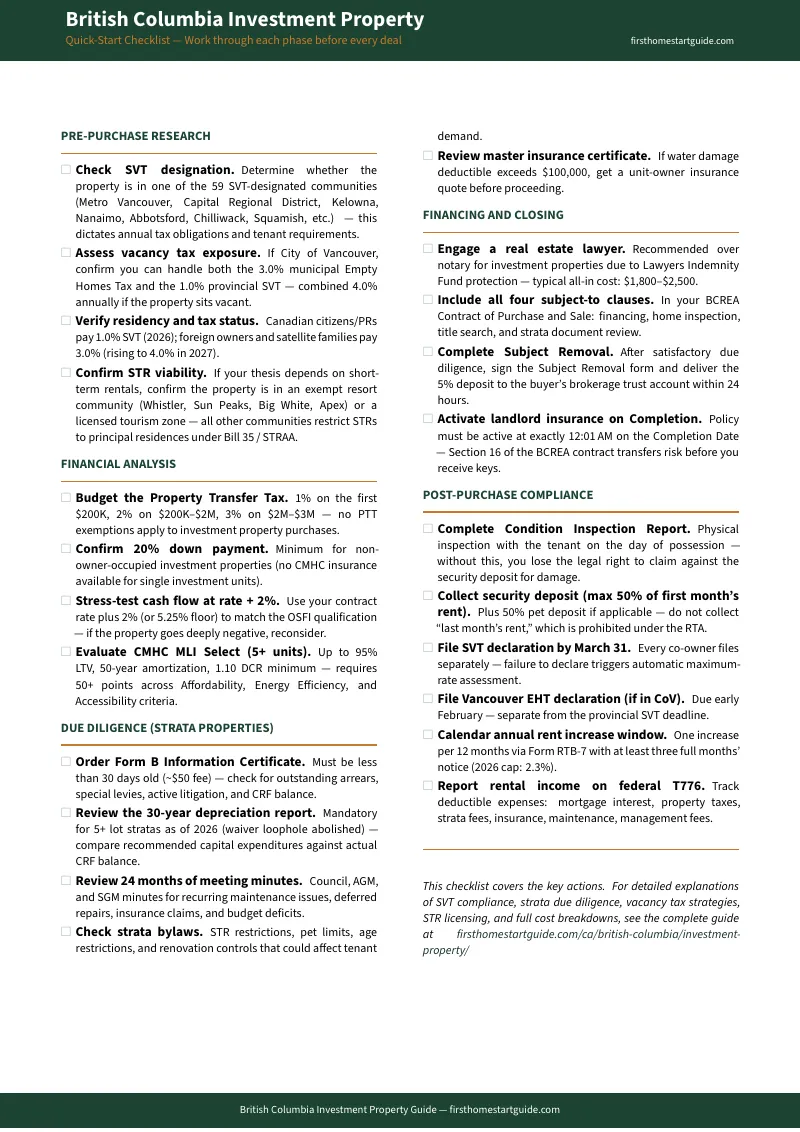
Download the free British Columbia Quick-Start Checklist to see the due diligence framework covering pre-purchase research, financial analysis, strata review, financing, and post-purchase compliance. When you're ready for the full SVT compliance system, strata audit process, and 12-chapter investment guide, the complete toolkit is here.
The deal looks good on the spreadsheet. This guide tells you whether British Columbia agrees.