The Duplex Cash Flows on the Spreadsheet. Manitoba's Aging Stock, Rent Cap, and STR Ban Will Make Sure It Doesn't in Practice.
You found a side-by-side duplex in Wolseley listed at $320,000. Both units are rented at $1,500 a month. The gross yield clears 5.5%. Winnipeg's vacancy rate sits at 1.7% according to CMHC. There's no speculation tax, no non-resident surcharge, and you've heard investors from Ontario are buying two Winnipeg duplexes for the price of one Toronto teardown. You're ready to wire the deposit.
Then Manitoba's province-specific reality arrives. Your inspector reports "updated electrical throughout" based on the breaker panel, but behind the drywall in Unit B, the original knob-and-tube wiring is still live — previous owners spliced modern copper into hidden junction boxes, giving the illusion of a full rewire while retaining the fire hazard inside the walls. Your insurer refuses to underwrite the property. A complete rewire costs $10,000 to $15,000 and requires tearing into original lath and plaster. The duplex sits on Winnipeg's reactive clay soil, and the horizontal crack running along the east basement wall means lateral soil pressure has been pushing inward for decades — structural push piers start at $15,000, and full foundation wall replacement can reach $75,000. Your sewer scope reveals root intrusion in the clay drain tiles: $8,000 to $20,000 to replace, and the standard home inspection you already paid for didn't include this.
And those are just the physical risks. Manitoba's Residential Tenancies Act caps rent increases at 1.7% for 2025 and 1.8% for 2026. Your inherited tenants are paying $1,100 a month on units that should rent for $1,500. With 1.7% annual increases, it takes over a decade to close that gap. You planned to renovate and apply for an Above-Guideline Increase — but Bill 13 slashed the claimable portion of capital expenses by 50%, so your $60,000 renovation only counts as $30,000 in the RTB's calculation. And you must file the AGI application within 14 days of notifying the tenant, or you forfeit the claim entirely. Your fallback plan was to pivot one unit to Airbnb, but Winnipeg's April 2024 licensing crackdown prohibits all non-primary short-term rentals on properties acquired after February 23, 2023. Your exit strategy evaporated before you closed.
Here's what no single resource explains: Manitoba layers genuinely affordable entry prices and strong cash flow potential against a combination of aging housing stock with capital expenditure risks that can wipe out years of rental income overnight, one of Canada's strictest rent control regimes that traps below-market rents for a decade or more, an STR prohibition that eliminates the most common alternative revenue strategy for new acquisitions, a financing qualification gap between the Addback and Offset methods that can collapse a deal by requiring $14,000 more in personal income under the wrong method, and a progressive Land Transfer Tax with no first-time buyer rebate that catches every house-hacker who assumed one existed. Each of these has cost real investors five to six figures because the information existed — scattered across RTB forms, CMHC vacancy reports, City of Winnipeg licensing bylaws, and Reddit threads on r/PersonalFinanceCanada — but nobody had assembled it into a single underwriting system calibrated to Manitoba.
The Manitoba Investment Property Guide is a Manitoba Investor Underwriting System — not a motivational overview of Canadian real estate, but a structured due diligence framework that maps every Manitoba-specific financial trap, regulatory restriction, and tax integration mechanic into a process you work through before you commit capital. It replaces months of cross-referencing RTB legislation, CMHC reports, municipal licensing portals, and contradictory forum posts with a single reference that tells you exactly what to verify, exactly what the numbers should look like, and exactly where deals go wrong in this province.
What's Inside the Manitoba Investor Underwriting System
A comprehensive 13-chapter guide, a standalone 20-item due diligence checklist, and six printable tools (older-stock inspection checklist, fillable closing cost worksheet, LTT quick-reference card, landlord reference card, purchase process checklist, and key contacts reference) — covering every stage from financing qualification through post-purchase operations, built specifically for the regulatory mechanics, housing stock risks, and tenant protections that make Manitoba different from every other province:
Older Housing Stock Due Diligence Protocol
A substantial portion of Winnipeg's duplex and multi-family inventory predates 1950, and these properties harbor capital expenditure risks that generic inspection checklists miss entirely. The guide covers the knob-and-tube wiring trap in detail — including the most dangerous scenario where previous owners splice modern copper into hidden junction boxes behind drywall, making the breaker panel look fully updated while the original cloth-insulated wiring remains live inside the walls. It maps Winnipeg's reactive clay soil foundation risks with a cost table ranging from $500 epoxy crack injection to $75,000+ full wall replacement, explains what horizontal cracks versus stair-step cracks actually indicate about structural integrity, and covers why sewer scoping ($250 to $400) is non-negotiable for any pre-1970 property when replacement runs $8,000 to $20,000. The protocol includes insurance verification timing — call your insurer with the inspection report during the conditional period, not after closing, because knob-and-tube, galvanized plumbing, and flat roofs over 15 years old can trigger outright refusals.
Rent Control and Above-Guideline Increase Mechanics
Manitoba's rent cap — 1.7% for 2025, 1.8% for 2026 — is among the strictest in Canada. The guide explains which units are exempt (above $1,640/month, buildings first occupied after March 2005), how the three-month notice and 14-day RTB filing deadline work in practice, and why Bill 13's 50% capital expense reduction fundamentally changes the math on value-add acquisition strategies. If you spend $100,000 on qualifying renovations, the RTB recognizes only $50,000 when calculating your permitted Above-Guideline Increase — and the resulting increase may be phased over multiple years. The guide shows you how to underwrite a deal knowing that below-market rents will close slowly, not quickly, so your cash flow projections reflect Manitoba law rather than aspirational assumptions.
Addback vs. Offset Financing Qualification
This is the single most misunderstood financing concept in Canadian real estate investing, and getting it wrong collapses deals. The guide walks through a concrete example: a couple earning $100,000 applying for a $300,000 mortgage on a duplex generating $1,600/month in rent. Under the Addback method (most major banks' default), they need $110,000 in personal income — rejected. Under the Offset method, the threshold drops to $96,000 — approved. That $14,000 gap is the difference between owning an investment property and not owning one. The guide covers how to verify which method your broker uses, why Manitoba credit unions (Assiniboine, Cambrian, Access) offer DSCR-based alternatives that bypass this problem entirely, and how CMHC MLI Select financing with 40- to 50-year amortization works for investors scaling to 5+ unit commercial multi-family.
Short-Term Rental Prohibition for New Acquisitions
Winnipeg's April 2024 licensing crackdown drew a hard line: properties acquired after February 23, 2023 are prohibited from operating as non-primary short-term rentals. The guide maps the full regulatory framework — primary residence license fees ($260 to $520), non-primary residence fees ($780 to $1,560 per unit), the 6% Accommodation Tax on all bookings, fines of $500 to $1,000 per infraction, and the grandfathering rules for pre-February 2023 owners. The bottom line is clear: if you're buying a Manitoba investment property today, your financial model must be built on long-term rental income. The STR door is effectively closed.
Taxes, Transfer Costs, and Capital Gains
Manitoba's progressive Land Transfer Tax runs from 0% on the first $30,000 up to 2% above $200,000 — plus a $70 flat registration fee. On a $300,000 duplex, that's $3,720 in transfer costs. The guide includes a worked LTT calculation, explains why there's no first-time buyer rebate (unlike Ontario and BC), covers the anti-flipping rule that taxes any property sold within 12 months at 100% inclusion as business income, and walks through the capital gains inclusion rate change to 66.67% on gains exceeding $250,000. It covers CCA strategy (Class 1, 4% declining balance) including the recapture trap that creates a massive lump-sum tax liability on sale, the Smith Manoeuvre for converting non-deductible mortgage debt into tax-deductible investment debt, and Manitoba's provincial tax brackets where high earners face combined marginal rates exceeding 50%.
Market-by-Market Investment Analysis
Two distinct Manitoba markets dissected with current pricing, rental yields, vacancy trends, and demand drivers. Winnipeg's inner-city neighbourhoods mapped by investment profile: Exchange District and Osborne Village for high-density multi-family with capital-intensive pre-1960s building stock, Wolseley and Fort Rouge for university-driven demand with near-zero vacancy, St. Vital for suburban duplex stability with lower turnover costs. Brandon as a secondary market with lower entry prices, superior cap rates (6.5% to 9.0% on multi-family), and concentrated economic risk tied to agricultural processing employers. Gross yield tables for side-by-side duplexes, up-down duplexes, triplexes, fourplexes, and single-family rentals across all submarkets.
Costs Worksheet: Total Cash to Close
A line-by-line closing cost model for a $320,000 Winnipeg duplex at 20% down: $64,000 down payment, $4,050 Land Transfer Tax, $70 registration fee, $1,100 legal fees, $450 disbursements, $450 title insurance, $650 inspection with sewer scope, $1,600 property tax adjustment, minus rent and security deposit credits — total cash to close of $72,870. Plus the house-hack variant at 5% down with CMHC insurance: $38,905 total. These aren't estimates — they're the actual line items your lawyer will present on the Statement of Adjustments.
Landlord Operations Under the Residential Tenancies Act
Manitoba's landlord-tenant framework is heavily weighted toward tenant protection. The guide covers vacancy-tied eviction notice periods (5 months when vacancy is below 2.0%, 4 months at 2.0%–2.9%, 3 months above 3.0%), security deposit rules (maximum half a month's rent, held in trust at the provincial interest rate), the mandatory Condition of Premises report that makes or breaks your damage claims at move-out, RTB rent redirect that sends your rental income directly to Manitoba Hydro if utility accounts fall into arrears, and the single-meter utility splitting options (include in rent, separately meter for $2,000 to $5,000, or proportional split agreement) with RTB compliance considerations for each.
20-Item Due Diligence Checklist
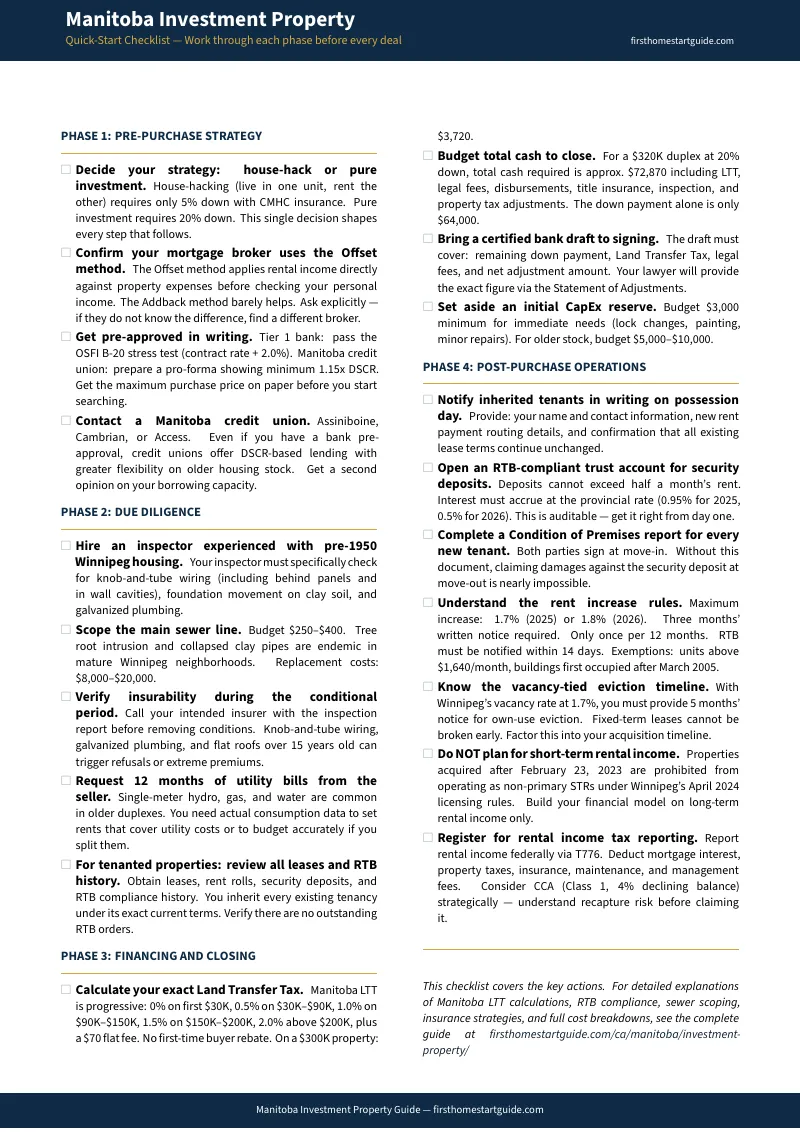
A standalone printable framework covering four phases — Pre-Purchase Strategy (house-hack vs. pure investment decision, Offset method broker verification, pre-approval, credit union contact), Due Diligence (pre-1950 inspector, sewer scoping, insurability verification, 12-month utility bills, lease review), Financing and Closing (LTT calculation, total cash to close budget, certified bank draft, CapEx reserve), and Post-Purchase Operations (tenant notification, RTB trust account, Condition of Premises report, rent increase rules, vacancy-tied eviction timeline, STR prohibition awareness, rental income tax reporting). Run it on every Manitoba deal.
Who This Guide Is For
This guide is for real estate investors targeting Manitoba markets who:
- Are based in Ontario or British Columbia and evaluating Winnipeg's price gap — where you can acquire two cash-flowing duplexes for the cost of one Toronto teardown, with no speculation tax and no non-resident surcharge — but need to understand the province-specific closing costs, rent control mechanics, and housing stock risks before you deploy capital from 2,000 kilometres away
- Are local Winnipeg earners looking to house-hack a first duplex with 5% down and need to determine whether your broker uses the Offset method (approved at $96,000 income) or the Addback method (rejected at $100,000 income), how much total cash you actually need beyond the down payment ($38,905 on a $320,000 duplex), and that Manitoba has no first-time buyer LTT rebate
- Are building a multi-unit portfolio and need to understand how Manitoba's rent cap constrains value-add strategies, how Bill 13's 50% CapEx reduction limits Above-Guideline Increase recovery, how DSCR lending through Manitoba credit unions works differently from Tier 1 bank qualification, and when CMHC MLI Select financing makes sense for scaling to 5+ units
- Are evaluating older Winnipeg housing stock and need the complete due diligence protocol for knob-and-tube wiring (including hidden splicing behind panels), reactive clay soil foundations ($5,000 to $75,000 remediation range), galvanized plumbing, and sewer line integrity — along with the insurance verification process that determines whether you can even close the deal
- Want to understand why Airbnb is not a viable strategy for new Manitoba acquisitions, how the April 2024 STR ban applies to properties purchased after February 23, 2023, and what the 6% Accommodation Tax and $500 to $1,000 fines mean for anyone who ignores the licensing requirement
- Want every Manitoba-specific regulation, tax calculation, and due diligence requirement in one reference — instead of assembling it from RTB forms, CMHC vacancy reports, City of Winnipeg licensing bylaws, CRA technical interpretations, and Reddit threads that may predate the April 2024 STR overhaul
Why Not Free Tools and Forums?
Free information on Manitoba real estate investing exists. Here's what it actually delivers:
- Reddit forums (r/PersonalFinanceCanada, r/RealEstateCanada) are where someone in a 2022 thread says Manitoba has no rent control, someone in 2024 corrects them with the 1.7% cap, and a third poster links to an RTB form that has since been updated. You'll find genuinely useful experience reports mixed with advice that predates Winnipeg's April 2024 STR licensing overhaul, the current Bill 13 AGI restrictions, and this year's rent control guideline. Sorting current from outdated takes longer than reading a guide that has already done it.
- Government and RTB resources give you the legislation and the forms. They don't walk you through the strategic implications — that the 14-day AGI filing deadline means a single missed calendar date forfeits your entire Above-Guideline Increase claim, that the vacancy-tied eviction timeline currently requires five months' notice in Winnipeg, or that the rent cap exemption threshold of $1,640/month creates a specific acquisition strategy around higher-rent units. You get the law without the investor playbook.
- National investing books and courses teach cap rate, DSCR, and portfolio scaling frameworks that apply everywhere. They don't cover Manitoba's knob-and-tube hidden splicing problem, the Addback vs. Offset financing gap that kills deals at the qualification stage, Bill 13's 50% CapEx reduction, the February 2023 STR grandfathering cutoff, or the reactive clay soil foundation risks specific to Winnipeg's geology. Applying national frameworks to Manitoba-specific structures is how investors model the wrong rent growth rate on a property trapped under a 1.7% cap.
- CMHC and provincial tools provide vacancy data, rental rate tracking, and mortgage calculators. They don't integrate those numbers into an underwriting framework that accounts for rent control constraints on income growth, aging housing stock capital expenditure risks, STR prohibition on new acquisitions, and the Addback vs. Offset financing distinction that determines whether you qualify at all. You get the data points without the system that connects them.
This guide fills the Manitoba-specific gap — the space between knowing how to analyze a rental property in general and knowing how to underwrite one in a province where aging housing stock can conceal $75,000 foundation repairs behind cosmetic renovations, rent control caps your income growth at 1.7% regardless of market conditions, Bill 13 cuts your renovation recovery in half, the STR exit strategy is legally closed for new acquisitions, and the wrong financing qualification method can collapse your deal before the inspection. It's the analysis that would take a Manitoba real estate lawyer, a mortgage broker who understands Offset vs. Addback, and a building inspector who knows pre-1950 Winnipeg housing to assemble — structured as a reference you own permanently.
— Less Than a Sewer Scope
A single sewer scope in Winnipeg runs $250 to $400. A knob-and-tube rewire that your home inspector missed because previous owners spliced modern wiring into hidden junction boxes costs $10,000 to $15,000 — plus the insurance refusal that prevents you from closing. A foundation repair on reactive clay soil ranges from $5,000 for crack injection to $75,000 for full wall replacement. A missed 14-day AGI filing deadline forfeits your entire Above-Guideline Increase claim on a $60,000 renovation. A financial model built on Airbnb revenue collapses on day one when you discover the STR prohibition applies to every property acquired after February 2023.
This guide doesn't replace your real estate lawyer or your mortgage broker. But it gives you the older-stock due diligence protocol, rent control mechanics, financing qualification analysis, and STR regulatory framework that ensure you identify every Manitoba-specific risk before you're contractually committed — instead of discovering them on your first insurance refusal, your first RTB filing deadline, or your first conversation with a licensing officer.
If it catches a single hidden wiring issue, prevents a single foundation surprise, or saves you from underwriting a deal under the wrong financing method, it pays for itself before you've finished reading it.
Money-back guarantee, no time limit. If the guide doesn't sharpen your underwriting and protect your capital in Manitoba's regulatory environment, you pay nothing.
Download the free Manitoba Quick-Start Home Buying Checklist to see the 20-item due diligence framework covering pre-purchase strategy, property inspections, financing and closing, and post-purchase operations. When you're ready for the full older-stock inspection protocol, rent control analysis, financing qualification breakdown, and market-by-market investment system, the complete guide is here.
The duplex looks good on the spreadsheet. This guide tells you whether Manitoba agrees.
Frequently Asked Questions
What if the rules change after I buy?
We update the guide when the rules change. Email us any time, even years later, and we'll send you the current edition free.