
You Found a $450,000 Home in Northlands on Wood Blocking. Nobody Mentioned the Permafrost Settling, the Single-Walled Oil Tank That Blocks Insurance, or the $10,000 Annual Operating Budget on Top of Your Mortgage.
You have been browsing MLS listings in Yellowknife — the only private real estate market in the Northwest Territories. You have run the mortgage calculator, received a pre-approval from one of six banks that serve the territory, and started budgeting for a down payment. You may have assumed that because the NWT charges no land transfer tax, the closing process must be simpler than buying in Ontario or British Columbia.
It is not. Yellowknife sits on discontinuous permafrost where ground temperatures hover between 0°C and −1°C. Entry-level homes sit on wood blocking that shifts seasonally, requiring professional leveling every two to three years. Insurance companies refuse to cover single-walled fuel oil tanks older than 10 to 15 years — and no insurance means no mortgage. Heating oil at $1.72 per litre costs $4,300 per year. Electricity runs two to three times the national average. Some homes use trucked water delivery where running out between scheduled fills triggers emergency call-out fees of $100 to $180. And if you are buying in Old Town, the soil may contain arsenic residue from 50 years of gold ore processing at the Giant Mine. The generic CMHC workbook does not cover any of this. Your agent's listing sheet mentions none of it. The r/Yellowknife threads mention pieces of it — scattered across years of posts with no way to tell which advice is current and which will cost you your deposit.
The core problem: Yellowknife's subarctic housing market combines permafrost engineering risks, extreme operating costs, and compressed manufactured-home financing rules that no standard Canadian home buying guide addresses — and every free resource covers one piece without connecting it to the rest. There is no single resource that explains why a home on steel piles is worth the premium over wood blocking, how a non-certified oil tank can kill your deal three days before closing, how to stack the FHSA, HBP, and Housing NWT forgivable loan to cover your down payment, or how to budget for $17,000 in annual operating costs before your first winter. Until now.
The Northwest Territories First-Time Home Buyer Guide is a Subarctic Property Intelligence System — a structured decision framework that connects every NWT-specific structural risk, financing constraint, and cost reality into a single step-by-step roadmap from pre-approval through possession day.
What's Inside the Subarctic Property Intelligence System
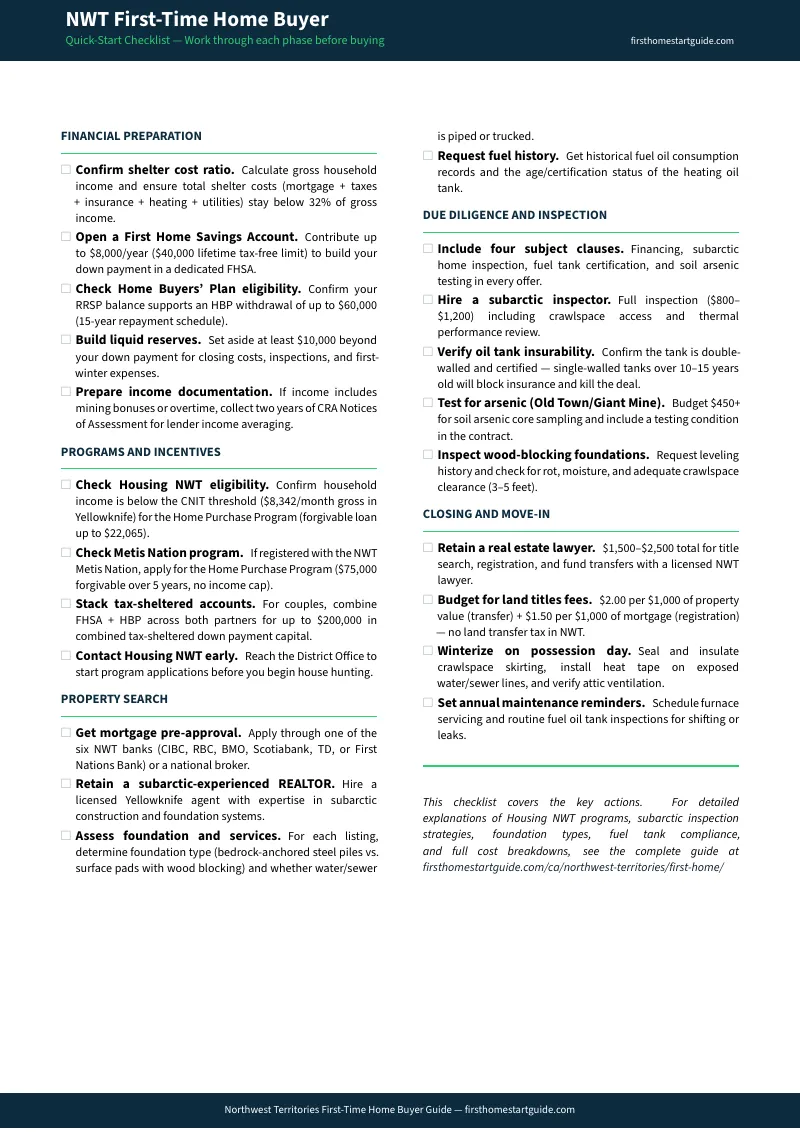
The complete guide, four standalone printable worksheets, and a quick-start checklist — covering every stage from calculating your true northern borrowing power through winterizing your first home, including the closing cost worksheet, foundation assessment checklist, oil tank certification checklist, operating cost budget, and the four subject clauses every NWT offer must include:
Subarctic Foundation Assessment
The structural decision that determines your maintenance costs for every year you own the home. Yellowknife properties sit on one of two foundation types, and the difference is not cosmetic. Deep steel or timber piles anchored to bedrock are geotechnically stable and require almost no structural maintenance — commanding a market premium for good reason. Surface pads with wood blocking float on the active soil layer, shifting with freeze-thaw cycles and requiring professional leveling every two to three years ($800 to $2,000 per cycle). The guide covers both foundation types with inspection protocols: crawlspace clearance requirements, moisture and rot indicators, leveling history records, and what to look for when a property advertises "steel piles" but the anchoring depth is unknown. It also includes the full foundation repair cost table, from $800 routine reshimming through $25,000+ major rebuilds after severe permafrost subsidence.
Heating Oil Tank Certification
The deal-killer nobody warns you about until closing week. Insurance underwriters will not issue a property insurance policy if the home has a single-walled steel fuel oil tank older than 10 to 15 years. No insurance means no mortgage. A non-compliant tank will stall or kill your transaction. Replacing a tank costs $3,000 to $5,000, and if a tank leaks, clean-up liability averages $65,000 and can exceed $200,000. The guide explains what to require in your offer, how to verify tank certification before conditions expire, and why the fuel tank clause should be in every NWT purchase agreement alongside financing and home inspection.
Northern Operating Cost Budget
The annual expense that turns an affordable mortgage into an unaffordable home. A typical Yellowknife home costs roughly $17,000 per year to operate — on top of your mortgage payment. Heating oil: $4,300. Electricity at two to three times the national rate: $2,800. Trucked water and sewer: $2,400. Property taxes: $5,000. Insurance: $1,800. Solid waste levy: $390. The guide breaks down each cost with current 2026 rates, explains how trucked water call-out fees work, and maps the 32% gross debt service rule with northern costs factored in — so you know your true affordability ceiling before you start searching.
FHSA, HBP, and Territorial Program Stacking
How to build a down payment in a market where the average home costs $542,000. A single buyer can access up to $100,000 in tax-sheltered capital through the FHSA ($40,000 lifetime, tax-free withdrawals) and HBP ($60,000 RRSP withdrawal, 15-year repayment). A couple can pool $200,000 — enough to hit 20% down on a mid-range Yellowknife property and eliminate CMHC insurance entirely. On top of that, the Housing NWT Home Purchase Program provides up to $22,065 in forgivable down payment assistance. If you are a registered citizen of the NWT Métis Nation, the Métis Nation Home Purchase Program provides $75,000 forgiven over five years with no income cap. The guide walks through eligibility, the CNIT income threshold, contribution sequencing, and the HBP repayment trap that adds missed payments directly to your taxable income.
Soil Arsenic and Environmental Testing
The legacy of 50 years of gold ore processing at the Giant Mine. The Giant Mine released arsenic trioxide into the atmosphere from 1948 to 1999, and much of it settled on surrounding soil within Yellowknife. If you are buying in Old Town or near the mine site, arsenic contamination is a real consideration. The guide covers where testing is warranted, what to include in your contract, and how to budget for core sampling ($450+) and potential remediation.
Manufactured Home Financing Rules
Why a $200,000 trailer can cost $2,120 per month. Lenders assign a maximum 40-year structural lifespan to manufactured and modular homes, compressing the amortization period based on the home's age. A 30-year-old home gets a maximum 10-year amortization. Over 40 years old, most banks refuse to underwrite a mortgage entirely. The guide explains how this compression works, which lenders (RBC, First Nations Bank of Canada) offer modernized terms for permanently affixed units, and how to calculate whether a low-priced manufactured home is actually affordable once the compressed payments are factored in.
NWT Closing Process and Land Titles Fees
No land transfer tax — but registration fees, legal costs, and fuel adjustments still add up. The NWT charges no land transfer tax, saving you thousands compared to Ontario or B.C. But land titles registration fees ($2.00 per $1,000 of property value for transfers, $1.50 per $1,000 for mortgage registration), legal fees ($1,500 to $2,500), title insurance ($300), and property tax and fuel oil adjustments still require roughly $6,500 to $7,500 in cash at closing on a mid-range home. The guide maps every line item with formulas and a worked example, so the final invoice holds no surprises.
Who This Guide Is For
This guide is for first-time buyers in the Northwest Territories who:
- Are relocating to Yellowknife for a GNWT, federal, or municipal position and transitioning from renting at $1,500 to $3,000 per month to building equity in a permanent home — but need to understand how subarctic operating costs, foundation types, and the limited lender landscape will shape your purchase
- Work in the mining, remediation, or resource sector and are establishing permanent roots in Yellowknife — with variable income that lenders will discount, requiring two years of CRA Notices of Assessment and a clear strategy for maximizing your pre-approval amount
- Are Indigenous NWT residents exploring the transition from public housing to private ownership through Housing NWT programs or the Métis Nation Home Purchase Program — and need a clear map of eligibility thresholds, application timelines, and how to stack territorial assistance with federal FHSA and HBP savings
- Are targeting manufactured or modular homes in neighbourhoods like Northlands as an affordable entry point — and need to understand how compressed amortization schedules, wood-blocking foundation maintenance, and insulated skirting requirements affect both your monthly payments and your long-term equity
- Are buying as a couple and want to maximise your combined FHSA and HBP withdrawals to reach a 20% down payment on a Yellowknife property — while understanding the contribution sequencing, repayment obligations, and CNIT income thresholds that determine which programs you actually qualify for
Why Not Free Resources?
Free information on buying a home in Yellowknife exists. Here is what each source actually delivers:
- CMHC "Homebuying Step by Step" workbook provides solid financial planning tools — debt ratio calculators, mortgage insurance tables, credit score explanations. What it does not do: mention permafrost and foundation types, explain why a fuel oil tank can block your insurance and kill your deal, address trucked water and sewer costs, or acknowledge that Yellowknife's six-bank lender landscape offers less rate competition than southern markets. The national framework is generic. The subarctic realities are absent.
- Housing NWT and GNWT websites publish program details for the Home Purchase Program, HELP, HIP, and STEP courses — buried in dense policy PDFs with bureaucratic eligibility language, separate web pages for each program, and no guidance on how to combine territorial assistance with federal FHSA and HBP programs. The programs are generous. Finding and navigating them is not.
- Local real estate agent websites offer neighbourhood overviews and listing alerts with genuine Yellowknife knowledge — from the perspective of professionals who earn a commission when you buy. They mention foundation types and northern inspections in passing. They do not explain why wood blocking costs you $800 to $2,000 every two to three years, why a 30-year-old trailer locks you into a 10-year amortization with $2,100 monthly payments, or why the $450,000 listing in Kam Lake sits on isolated permafrost that has been thawing for a decade.
- Reddit (r/Yellowknife, r/PersonalFinanceCanada) is where real northern buyers share unfiltered experiences — and where advice from 2020 sits next to advice from 2026, where one poster's positive trailer experience ignores the $25,000 foundation rebuild two years later, and where "the North is expensive but the salaries make up for it" is accepted wisdom by people who have never mapped the 32% GDS rule against $17,000 in annual operating costs.
This guide fills the navigation gap — the space between knowing Yellowknife has permafrost, high operating costs, and territorial assistance programs, and understanding how they all interact across a single home purchase. It is the analysis an independent advisor with no properties to sell would give you, structured as a permanent reference you own.
— Less Than a Single Fuel Tank Inspection
A subarctic home inspection costs $800 to $1,200. Soil arsenic testing runs $450. Replacing a non-compliant fuel oil tank costs $3,000 to $5,000. A fuel oil spill from a leaking tank averages $65,000 in clean-up liability. Foundation releveling costs $800 to $2,000 per cycle, and a major permafrost subsidence repair runs $25,000 or more.
This guide does not replace your real estate lawyer, your mortgage broker, or your home inspector. But it gives you the foundation assessment framework, the operating cost budget, the territorial program stacking strategy, and the four protective subject clauses that ensure you walk into every appointment knowing exactly what to ask, exactly what to budget, and exactly what to never skip — instead of discovering subarctic traps in real time.
If it catches a non-compliant fuel tank before your offer goes unconditional, identifies a foundation on organic soil that your agent described as "solid bedrock," or helps you stack the FHSA, HBP, and Housing NWT forgivable loan to cover your full down payment, it pays for itself before you have finished reading it.
Money-back guarantee, no time limit. If the guide does not make your NWT home buying process clearer and your financial position stronger, you pay nothing.
Download the free Northwest Territories Quick-Start Home Buying Checklist to see the step-by-step action plan covering financial preparation, territorial program eligibility, property screening protocols, and the four subject clauses every NWT offer must include. When you are ready for the full intelligence system — the complete guide with the closing cost worksheet, the foundation assessment checklist, the oil tank certification checklist, and the northern operating cost budget — the complete toolkit is here.
You are buying in one of the most unique housing markets in Canada. Make sure you understand it before you sign.