
You Ran the Cap Rate on a Yellowknife Triplex Pulling $5,500 a Month. Nobody Mentioned the $900 January Heating Bill, the Foundation That Needs Manual Re-Leveling Every Spring, or the 10-Day Deposit Rule That Forfeits Your Entire Claim if You Skip One Inspection.
You found a triplex on REALTOR.ca listed at $799,900 with combined rents of $5,500 a month. You checked the Land Titles fees — $1,600 total, not the $12,950 you would pay in Toronto. You looked at the vacancy rate: near zero. The tenants are GNWT employees on stable government salaries. You ran the numbers using your southern Canadian assumptions and started calling mortgage brokers.
Then the first broker told you they need 30% down on a non-owner-occupied northern property, not 20%. The second could not find an appraiser willing to value a manufactured home on a gravel pad because automated valuation models do not work in a market with 65 active listings. The third suggested you try a credit union in Yellowknife directly.
Or you got past financing and closed on a double-wide trailer marketed as a "solid rental performer." The previous owner's heating costs were not in the listing. Your first January bill arrived: $900 for heating oil alone at 1.723 CAD per litre. Electricity added $280 at 23.72¢/kWh. Municipal water, sewer, and waste added another $83. Your net operating income — the one built on Vancouver cost assumptions — was off by $14,000 a year.
Or you bought a condo on ice-rich clay near Niven Lake. By March, the doors were sticking. The floors had a visible slope. The building sits on adjustable surface foundations, not bedrock piles, and nobody told you that someone needs to manually re-level the jacks every spring after frost heave shifts the structure.
Or a tenant moved out, left damage, and you submitted the repair invoice three weeks later. You lost the entire deposit. The NWT Residential Tenancies Act gives you exactly 10 days — not Alberta's 30, not BC's 15 — and you had not completed a joint move-in inspection, so you forfeited the right to deduct anything regardless of the damage.
The core problem: Yellowknife delivers some of the highest rental yields in Canada with the lowest closing costs, but the sub-Arctic operating environment — heating fuel volatility, permafrost foundation engineering, diamond mine economic exposure, and tenant-friendly regulatory timelines — can erase a year of cash flow from a single winter, a single foundation type, or a single missed inspection. Every free resource covers one risk in isolation. None connects heating costs to NOI modelling, foundation type to insurance requirements, mine closures to vacancy projections, or deposit rules to your inspection documentation — in a single framework designed for investors. Until now.
The Northwest Territories Investment Property Guide is a Sub-Arctic Investment Operating System — a structured due diligence and operations framework that connects every territorial fee, utility cost, foundation hazard, economic exposure, and tenancy regulation into a single acquisition-to-management manual built for out-of-province and local investors entering the Yellowknife market.
What's Inside the Sub-Arctic Investment Operating System
The complete guide, four standalone printable worksheets, and a 20-item due diligence checklist — covering every stage from market analysis and financing through acquisition, tenant management, and ongoing sub-Arctic operations:
Rental Yields and Tenant Targeting Strategy
The premium rents that draw you in — and the tenant classes that keep the income stable. Single rooms at $1,200/month, two-to-three-bedroom units at $2,500–$3,000 plus utilities, detached homes at $4,000+, and legal triplexes pulling $5,500–$6,500 combined. The guide maps the three recession-proof tenant classes — GNWT employees, federal workers, and environmental consulting firms — and explains how to structure corporate tenancy agreements that insulate your income from diamond mine workforce fluctuations. Includes the two distinct investor profiles (local secondary-property buyers versus out-of-province cash-flow seekers from Vancouver, Toronto, and Calgary) and why capital appreciation (10% median price growth in 2025 to $538,022) is secondary to immediate yield in this market.
Land Titles Fee Advantage Calculator
The $1,600 closing versus the $12,950 you would pay in Toronto. The NWT charges a flat registration fee: $2.00 per $1,000 of property value up to $1,000,000, plus $1.50 per $1,000 of mortgage principal. On a $500,000 property with a $400,000 mortgage, your total is $1,600 — versus $8,000 in BC, $6,475 in Ontario, and $12,950 in Toronto with its double land transfer tax. The guide provides the complete September 2025 fee schedule and shows exactly how much additional capital you can allocate to operating reserves or property improvements compared to every major provincial market.
Sub-Arctic Utility Cost Modelling
The $14,000 annual gap between your southern spreadsheet and actual northern operating costs. Heating oil at 1.723 CAD/L (March 2026 data), annual consumption averaging 2,500 litres for older manufactured trailers, producing winter monthly bills of $700–$900. Electricity from Northland Utilities at 23.72¢/kWh, with typical winter bills of $200–$300 even with territorial subsidies. The full municipal billing breakdown: $10 access fee, $12.50 demand charge, $29.75 solid waste levy, $18.50 infrastructure levy, $12.50 insurance program, plus metered water. The guide includes cost mitigation strategies — propane conversions ($325/month winter average), wood pellet alternatives, and insulation upgrade ROI calculations — and a realistic NOI template that uses actual NWT utility data instead of southern assumptions.
Permafrost Foundation Assessment Protocol
The structural risk that does not show up in listing photos. Two foundation types with radically different investment implications. Surface foundations (adjustable pad-and-wedge or screw-jacks) on gravel pads: moderate acquisition cost, vulnerable to thaw settlement as climate change accelerates discontinuous permafrost degradation, requires annual manual re-leveling. Deep pile foundations (bedrock-anchored steel piles): higher acquisition cost, immune to surface shifting, standard on modern multi-family builds. The guide provides a foundation inspection protocol that covers adjustment history documentation, structural damage indicators (tilted floors, misaligned doors, drywall cracking, concrete failures), and the questions to ask before your offer goes unconditional.
Diamond Mine Economic Exposure Analysis
25% of GDP, 14% of the workforce — and the closure timeline every investor needs to model. Snap Lake closed in 2015 and doubled vacancy from 1.9% to 4.2%. Diavik is scheduled for early 2026. Ekati filed for creditor protection in May 2026, its workforce falling from 700 to 340. Gahcho Kué targets 2030. The guide walks through the historical Snap Lake precedent (vacancy, rent contraction, recovery timeline), the counter-evidence from Ekati's COVID closure (no measurable price impact due to chronic undersupply), and mining's 54% share of Indigenous Development Corporation output. Includes a monitoring framework for tracking how resource sector transitions affect your specific property's tenant pipeline and vacancy risk.
Financing and Appraisal Navigation
Why your mortgage broker does not know what to do with a manufactured home on a gravel pad. Major banks add 0.5%–0.87% to northern mortgage rates. Non-owner-occupied properties require 30% down, not 20%. Automated valuation models fail completely in a market with 65 active listings and no uniform housing types — appraisers must evaluate fuel tank compliance, foundation adjustment history, and permafrost zone exposure. The guide explains how to work with northern credit unions and mortgage brokers, what documentation to prepare for appraisals, and how the 2025 property reassessment (33% average valuation increase) affects your tax projections and financing ratios.
NWT Tenancy Compliance System
The 10-day rule that costs landlords their entire deposit claim. The NWT Residential Tenancies Act enforces a strict 10-day security deposit return and accounting deadline — tighter than Alberta's 10/30-day split and BC's 15-day window. You must return the deposit plus accrued regulated interest and provide an itemized deduction statement within 10 days. The catch: you cannot deduct any repair costs unless you completed a joint, signed move-in and move-out inspection. Skip either inspection and you forfeit the right to claim damages — the full deposit goes back regardless of property condition. The guide provides inspection templates, a deposit return calendar, interest calculation methods, and a compliance workflow for remote landlords operating through property managers.
Remote Management and Property Manager Selection
Your property manager is not a rent collector — they are your operational partner in a sub-Arctic environment. Yellowknife property management firms function as de facto investment advisors: property evaluation, foundation monitoring, annual leveling coordination, heating fuel contract management, tenant placement targeting government workers, and full regulatory compliance. The guide covers the selection criteria for northern property managers, how to structure corporate tenancy agreements, the preventative maintenance calendar for sub-Arctic properties, and how to ensure your manager handles the joint inspections and 10-day deposit timelines that protect your capital from regulatory forfeiture.
Who This Guide Is For
This guide is for real estate investors targeting the Northwest Territories who:
- Are buying from southern Canada — Vancouver, Toronto, Calgary, or any major metro — and have built their investment model using southern utility costs, standard 20% down payments, and AVM-based appraisals that do not apply to a sub-Arctic market with 65 active listings, heating oil at 1.723 CAD per litre, and manufactured homes on gravel pads that no automated system can value
- Are evaluating Yellowknife's premium rental yields ($2,500–$4,000+ per unit) and need to model realistic net operating income that accounts for winter heating bills of $700–$900 per month, electricity at 23.72¢/kWh, and structured municipal utility charges that collectively reduce gross yields by $12,000–$18,000 annually
- Are considering properties built on adjustable surface foundations rather than bedrock piles and need to understand the annual maintenance requirements, structural damage indicators, and long-term cost implications before committing capital to a property that requires manual re-leveling every spring
- Are concerned about diamond mine closures (Diavik 2026, Ekati creditor protection, Gahcho Kué 2030) and want a framework for assessing whether the chronic housing undersupply that has historically absorbed mine closure impacts will continue to support rental demand and property values
- Are managing — or planning to manage — a Yellowknife rental remotely and need the complete NWT tenancy compliance framework: the 10-day deposit rule, mandatory joint inspections, regulated interest on deposits, allowable deductions, and the property manager selection criteria that determine whether your capital is protected or exposed
Why Not Free Resources?
Free information on Yellowknife real estate is available. Here is what each source actually delivers:
- CMHC Northern Housing Reports provide territory-level vacancy rates, construction starts, and rent growth trends in standardised statistical tables. What they do not do: explain how to model NOI using actual NWT heating fuel prices, how foundation type determines your maintenance budget, how the 10-day deposit rule interacts with remote landlord operations, or how diamond mine closures affect your specific property's tenant class. The data is real. It is not an investment framework.
- The GNWT Permafrost Homeowner's Guide explains the science of frost heave, thaw settlement, and foundation types in clear language with diagrams. It does not connect foundation risk to property valuation, insurance requirements, or investment return calculations. It is a homeowner maintenance reference, not an investor due diligence protocol.
- The NWT Residential Tenancies Act website publishes the deposit rules, inspection requirements, and eviction procedures in precise legal text. It does not explain how a remote landlord in Vancouver structures a property management agreement to ensure the joint inspections happen, the 10-day timeline is met, and the regulated interest is calculated correctly. The law exists. The operational workflow does not.
- Real estate brokerage blogs in Yellowknife promote listings, highlight market trends, and emphasise the territory's high yields and low transfer fees. They do not quantify the winter utility costs that reduce those yields, the financing friction that limits your leverage, or the diamond mine economic exposure that introduces vacancy risk. They sell properties. They do not model returns.
- Reddit threads (r/yellowknife, r/PersonalFinanceCanada) contain genuinely useful anecdotal data — heating cost ranges, manufactured home price points, public sector employment stability. But forum posts are fragmented, contradictory, undated, and impossible to structure into an acquisition decision. Individual data points are valuable. A scattered collection of them is not a due diligence system.
The Northwest Territories Investment Property Guide connects territorial fees, sub-Arctic utility data, foundation engineering, mine closure economics, financing constraints, tenancy regulations, and remote management into a single structured framework. Every section links to the financial impact on your investment return — because understanding the 10-day deposit rule matters only when you also know how to structure inspections, and understanding heating costs matters only when the numbers feed into a realistic NOI model.
Start With the Free Checklist
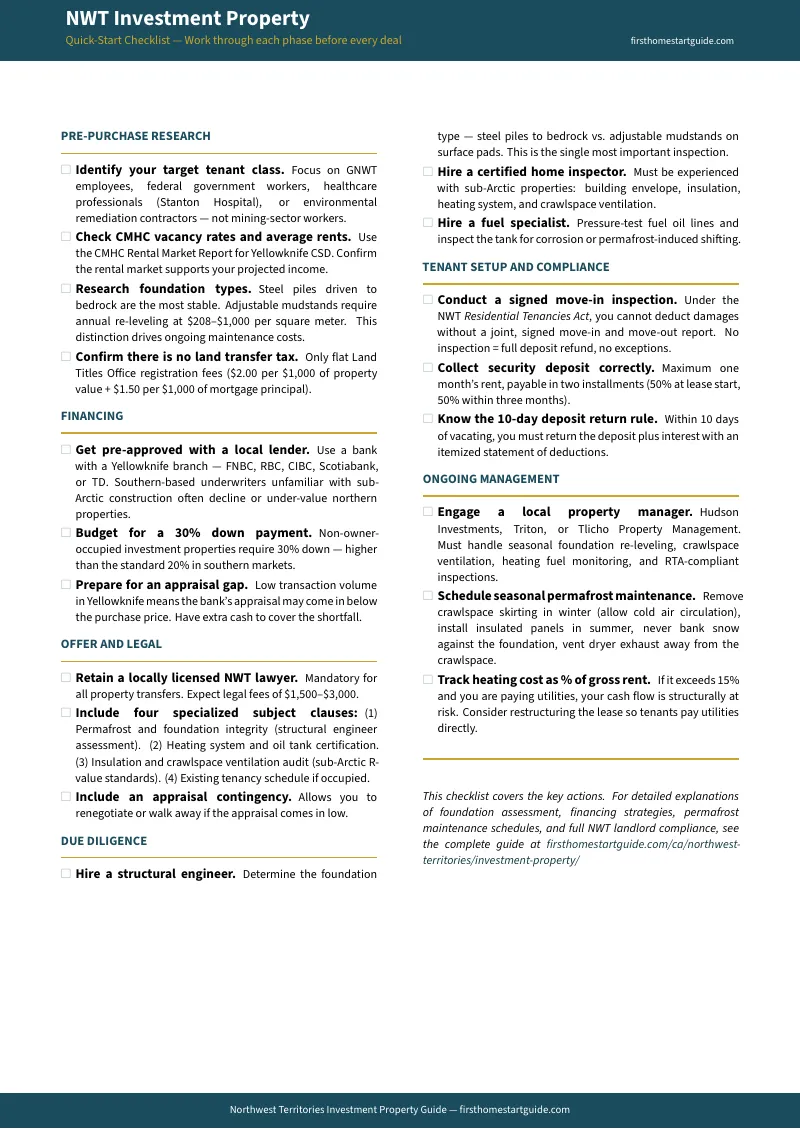
Download the Northwest Territories Quick-Start Home Buying Checklist — a 20-item due diligence checklist covering pre-acquisition foundation assessment, financial modelling with NWT-specific utility costs, closing process at the Land Titles Office, tenancy compliance setup, and ongoing sub-Arctic operations. It shows you what to verify. The full guide shows you how — with the data, calculations, templates, and regulatory frameworks behind every checklist item.
If the checklist confirms this is a market worth entering, the full Northwest Territories Investment Property Guide at gives you the complete Sub-Arctic Investment Operating System — the acquisition framework, the realistic financial models, the foundation assessment protocol, the tenancy compliance templates, and the remote management playbook that turns Yellowknife's premium yields into actual returns instead of spreadsheet projections.