
You Found a Duplex in Dartmouth for $480,000. Nobody Mentioned the $55,500 in Transfer Taxes, the Mandatory Landlord Registry, the 5% Rent Cap Through 2027, or the Aging Oil Tank That Could Cost You $40,000 in Cleanup.
You have been watching the Halifax market from Ontario or BC. You have seen the numbers: average two-bedroom rents at $2,310 per month, 47,000 university students competing for off-campus housing, and duplexes trading for what a studio condo costs in Toronto. You have run the cash-on-cash calculations, factored in 1.5% for the municipal deed transfer tax, and concluded that Nova Scotia is underpriced relative to the yields. You are about to make an offer.
Then you discover the 10% non-resident Provincial Deed Transfer Tax — doubled from 5% in April 2025 — which adds $48,000 on that $480,000 duplex before you collect a single month of rent. You learn that the province enforces a 5% annual rent cap through 2027 that applies to every existing tenancy, and that reducing any landlord-provided service — heat, parking, electricity — counts as a rent increase under the cap. You find out that Halifax requires every rental property to be registered under Bylaw R-400, with fines up to $10,000 for operating unregistered, and that Bylaw M-200 mandates you maintain a five-year maintenance plan available to inspectors on demand. You realise that the charming 1970s home with oil heat has a steel tank that Canadian insurers refuse to cover past 15 years — and that a leak triggers mandatory reporting to Nova Scotia Environment and cleanup costs that start at $10,000 and routinely exceed $40,000. And you learn all of this after you have already committed capital, because no single resource connects Nova Scotia's unique tax penalties, rental regulations, municipal compliance requirements, and environmental liabilities into a practical framework for investors.
The core problem: Nova Scotia's high-yield rental market hides the most punishing combination of non-resident transfer taxes, rent control, municipal compliance obligations, and physical property liabilities in Atlantic Canada — and every free resource covers one regulation without connecting it to your actual investment return. There is no single resource that calculates how the 10% PDTT changes your breakeven timeline, how the 5% rent cap interacts with the fixed-term lease loophole, how Halifax's landlord registry and short-term rental restrictions limit your exit strategies, or how to identify oil tank and coastal erosion liabilities before your offer goes unconditional. Until now.
The Nova Scotia Investment Property Guide is a Nova Scotia Investor Compliance System — a structured due diligence framework that connects every provincial tax, municipal bylaw, rental regulation, and physical hazard into a single acquisition-to-operation manual built specifically for out-of-province and local investors entering the Halifax market.
What's Inside the Nova Scotia Investor Compliance System
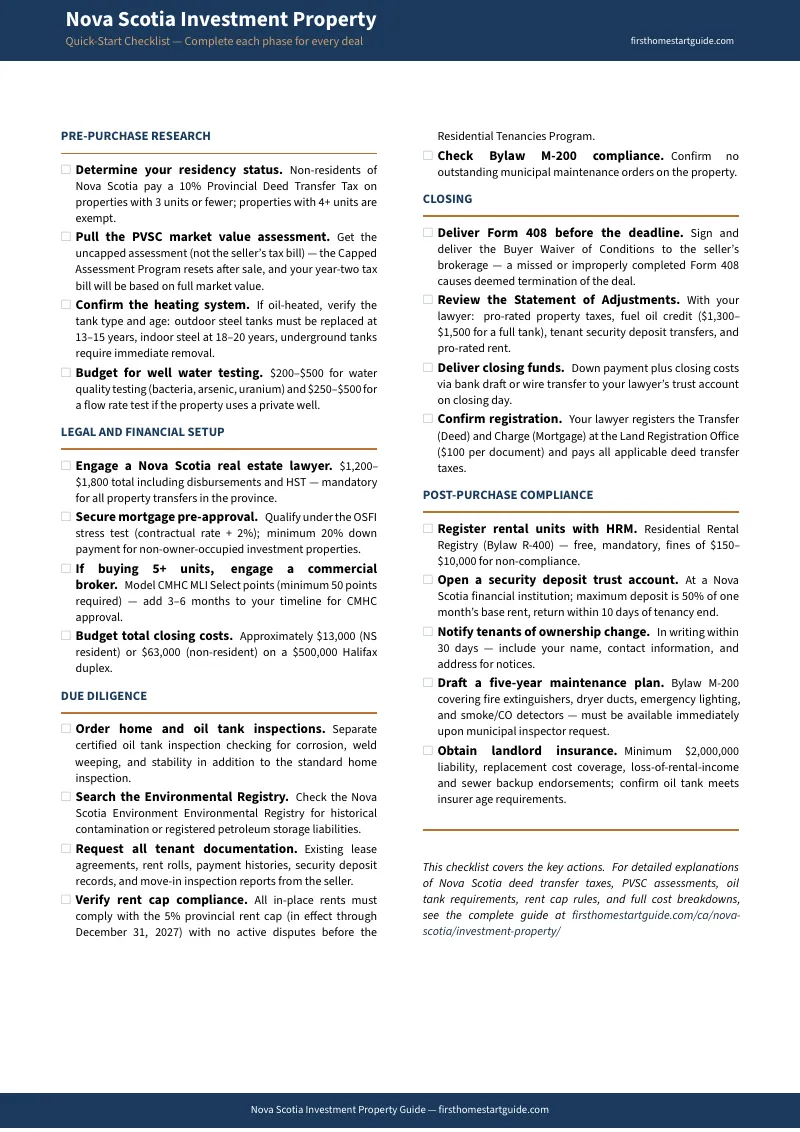
The complete guide plus standalone printable tools — covering every stage from market analysis and acquisition structure through tenant management and ongoing compliance, plus a closing cost worksheet, an investment property due diligence checklist, and a landlord compliance reference card you can bring to lawyer meetings, property inspections, and investor deal analysis sessions:
Non-Resident Tax Architecture
The $55,500 surprise that kills your first-year returns. Out-of-province buyers face the municipal Deed Transfer Tax (1.5% in Halifax) plus the Provincial Non-Resident Deed Transfer Tax (10% as of April 2025). On a $480,000 duplex, that is $7,200 plus $48,000 — a combined $55,200 in transfer taxes before legal fees. The guide maps the complete tax structure, explains the six-month residency refund pathway for the 10% PDTT (individuals only — corporations and trusts are permanently excluded), and calculates exactly how these upfront costs shift your breakeven timeline compared to provinces without non-resident penalties.
Rent Cap and Fixed-Term Lease Strategy
How to build positive cash flow under the 5% ceiling. Nova Scotia's rent cap (5% annually through December 2027) applies to all existing tenancies — month-to-month, year-to-year, and consecutive fixed-term leases for the same unit. The guide explains the turnover premium structure (13.9% on average, 20.9% for three-bedroom units), the fixed-term lease loophole that allows landlords to reset rents upon vacancy, the political risk of loophole closure, and how to underwrite a portfolio assuming both scenarios. It covers the four-month written notice requirement, the rule that service reductions count as rent increases, and the eviction framework under the Residential Tenancies Act.
HRM Landlord Registry and Municipal Compliance
The bylaws that fine you $10,000 for not knowing they exist. Halifax requires all rental properties to be registered under Bylaw R-400 — including single-family homes, apartments, backyard suites, and short-term rentals. Registration is free but mandatory, and unregistered properties face fines from $150 to $10,000 per violation. Bylaw M-200 requires a written five-year maintenance plan covering fire safety equipment, dryer duct cleaning, emergency lighting, and smoke and carbon monoxide detectors. The guide provides a complete compliance checklist covering both bylaws so you are inspection-ready from day one.
Student Rental Market Analysis
47,000 students, 80% competing for private housing — and the three-bedroom premium that changes your unit strategy. Universities prioritise first-year students for residence, and on-campus packages run $13,000 to $25,000 per year. That pushes the majority of upper-year, graduate, and international students into the private off-campus market. The guide maps the high-demand corridors near Dalhousie, Saint Mary's, and NSCC, explains the rental premium structure for multi-bedroom units (20.9% turnover premium on three-bedrooms versus 13.7% on one-bedrooms), and addresses the federal policy changes reducing international student intake that have cooled one segment of demand while leaving core student housing fundamentals intact.
Short-Term Rental Restrictions
Why your Airbnb exit strategy may not work in Halifax. Halifax restricts entire-home short-term rentals in residential zones to the operator's primary residence only. Secondary suites and backyard cottages can only be STRs if the suite itself is the host's primary residence. Commercial zones allow STRs but require zoning confirmation, higher registration fees ($150 to $300 annually), and commercial building code compliance. Operating an unregistered STR carries a $250-per-day fine. The guide explains exactly which zones permit investor-owned STRs, the provincial Tourist Accommodations Registry process, and the rural exceptions approved in December 2025.
Oil Tank and Environmental Due Diligence
The uninsurable liability hiding in the basement. Older Nova Scotia properties frequently rely on domestic heating oil — and insurers impose strict replacement timelines: 13 to 15 years for outdoor steel tanks, 18 to 20 years for indoor steel, up to 30 years for double-wall fibreglass. Underground tanks are virtually uninsurable and require immediate removal. A leak triggers mandatory reporting to Nova Scotia Environment and cleanup costs that routinely exceed $10,000 — with no insurance coverage if the tank was past its replacement window or lacked annual certified inspection. The guide provides an oil tank assessment protocol, replacement cost estimates, and the documentation trail that protects your insurance coverage.
Coastal Erosion and Climate Risk Assessment
Hurricane Fiona caused $385 million in insured damages in Nova Scotia alone. Approximately 70% of the province's population lives along 13,300 kilometres of coastline, and sea levels are projected to rise up to one metre by 2100. Standard property insurance excludes coastal erosion, gradual land loss, and storm-surge flooding. Overland flooding riders cost $100 to $1,000 annually where available — but insurers are increasingly refusing coverage in high-risk zones. The guide maps which coastal areas carry the highest risk, explains the insurance gap, and provides a climate due diligence checklist for any waterfront or near-coast acquisition.
Who This Guide Is For
This guide is for real estate investors targeting Nova Scotia who:
- Are buying from Ontario or British Columbia and have not yet factored the 10% non-resident Provincial Deed Transfer Tax into their acquisition cost — an upfront charge that adds $50,000 on a $500,000 property and fundamentally changes cash-on-cash return calculations for out-of-province capital
- Are evaluating the Halifax student rental market near Dalhousie, Saint Mary's, or NSCC campuses and need to understand how the 5% rent cap, the fixed-term lease loophole, and the 20.9% turnover premium on three-bedroom units interact to determine whether a co-living conversion actually pencils
- Are local Nova Scotia investors scaling from a single rental to a small portfolio and need the complete compliance framework — Bylaw R-400 registration, Bylaw M-200 maintenance plans, Residential Tenancies Act eviction procedures, and STR restrictions — before a complaint triggers a $10,000 municipal fine
- Are considering properties with oil heat, older steel tanks, or near-coast locations and need to understand the insurance exclusions, replacement timelines, and environmental reporting requirements that can turn a profitable investment into an uninsurable liability
- Are planning to relocate to Nova Scotia within six months of purchase and want to understand exactly how the PDTT refund process works — the documentation requirements, the timeline for application, and the strict exclusion of corporate and trust ownership structures
Why Not Free Resources?
Free information on Nova Scotia real estate investing is available from multiple sources. Here is what each one actually delivers:
- CMHC Rental Market Reports provide macroeconomic vacancy rates, rent growth trends, and construction start data for the Halifax CMA — essential context for institutional investors. What they do not do: explain how the 10% non-resident PDTT changes your acquisition cost, how the 5% rent cap constrains your income projections, how Halifax's R-400 landlord registry affects your compliance obligations, or how oil tank age determines whether your property is insurable. The CMHC data is real. It is not a deal analysis.
- Provincial government websites publish the Residential Tenancies Act, the PDTT regulations, and the rent cap fact sheets in precise legal language. They do not explain how these regulations interact across a single investment property. The rent cap page does not link to the fixed-term lease loophole. The PDTT page does not discuss the residency refund timeline. The oil tank regulations are on a completely separate department's site. The information exists. The connections do not.
- Halifax real estate agent blogs offer neighbourhood tours, property listings, and market commentary from the perspective of professionals who earn a commission when you buy. They mention the deed transfer tax as a closing cost line item. They do not quantify how the 10% PDTT reshapes your cash-on-cash returns, why the fixed-term lease strategy carries political risk, or how Bylaw M-200's five-year maintenance plan requirement affects your operating budget. They want you to buy. They do not tell you what buying will actually cost to operate.
- Reddit (r/Halifax, r/NovaScotia, r/PersonalFinanceCanada) is where current and prospective Nova Scotia investors share unfiltered experiences — and where a 2022 post about the non-resident tax sitting alongside 2025 regulatory changes makes it nearly impossible to tell which advice reflects current law. Users on r/Halifax actively celebrate the 10% PDTT as a measure to punish out-of-province speculators. The signal is real. So is the hostility and the outdated information.
- Nova Scotia law firms (DCL Law, Stewart McKelvey) publish excellent technical bulletins on the PDTT increase and the Residential Tenancies Act amendments. They do not provide acquisition strategy, yield analysis, neighbourhood selection, or physical property due diligence. They explain the law. They do not explain how to build a profitable portfolio under it.
This guide fills the integration gap — the space between knowing Nova Scotia has a non-resident tax, a rent cap, a landlord registry, and oil tank liabilities, and understanding how they all interact across a single investment acquisition. It is the analysis an independent advisor with no properties to sell would give you, structured as a permanent reference you own.
— Less Than One Hour of Your Real Estate Lawyer's Time
A real estate lawyer in Halifax charges $1,000 to $1,500 for a standard purchase. A professional property inspection costs $500 to $700. An oil tank replacement runs $3,000 to $5,500. Cleanup from a single oil tank leak can exceed $40,000. The 10% non-resident PDTT on a $500,000 property is $50,000 — a cost that many out-of-province investors do not discover until their lawyer presents the closing statement.
This guide does not replace your real estate lawyer, your property inspector, or your accountant. But it gives you the complete tax architecture, the rent cap strategy, the municipal compliance framework, and the environmental due diligence system that ensure you walk into every professional meeting knowing exactly what to ask, exactly what to budget, and exactly what liabilities to avoid — instead of discovering them in real time with capital already committed.
If it prevents a single non-resident tax miscalculation, catches an oil tank liability before closing, or helps you structure your first lease correctly under the rent cap, it pays for itself before you have finished reading it.
Money-back guarantee, no time limit. If the guide does not make your Nova Scotia investment analysis clearer and your regulatory compliance stronger, you pay nothing.
Download the free Nova Scotia Quick-Start Home Buying Checklist to see the step-by-step action plan covering non-resident tax calculations, landlord registry requirements, rent cap rules, and oil tank due diligence. When you are ready for the full compliance system — the complete guide plus the closing cost worksheet, the investment property due diligence checklist, and the landlord compliance reference card — the complete toolkit is here.
Nova Scotia's yields are real. So are the taxes, the regulations, and the liabilities. Make sure you know all three before you wire the deposit.