You Ran the Numbers on an Iqaluit Duplex. $4,500 a Month in Rent, 0.3% Vacancy, No Land Transfer Tax. Nobody Told You the Land Beneath the House Isn't for Sale, the Permafrost Is Shifting the Foundation, and Your Heating Oil Bill Will Be $7,000 a Year.
You found a half-duplex in Iqaluit listed at $600,000. You pulled the CMHC rental data and saw median rents above $2,800 for a one-bedroom, well over $4,000 for a detached home. You saw the vacancy rate: 0.3% — six empty units in the entire city. You divided gross annual rent by purchase price and got a cap rate that would make any southern Canadian investor salivate. You may have also noticed there's no land transfer tax, just a flat registration tariff. The spreadsheet looked spectacular.
Then Nunavut happened. Your spreadsheet didn't include the $5,000 to $8,000 annual heating bill because every building in the territory runs on imported diesel at $1.43 per litre, delivered by summer sealift. It didn't include the trucked water costs that tripled after the City of Iqaluit eliminated its residential subsidy. It didn't include the $1,500 you'd spend flying a specialized inspector from Yellowknife because there are practically no certified home inspectors in the territory. It didn't include the fact that you don't actually own the land — you hold a Commissioner's Land lease, because Nunavut voters decisively rejected freehold ownership in a 2016 territory-wide referendum. It didn't include the risk that thawing permafrost could shear your foundation pilings and rupture your exterior heating oil tank, triggering an environmental cleanup liability that insurance may refuse to cover. Your 8% gross yield is now negative cash flow, and that's before the Rental Officer takes six months to process your eviction because Nunavut's dispute resolution system has a backlog measured in seasons, not weeks.
Here is what no single free resource explains: Nunavut layers a Commissioner's Land leasehold system — where every property sits on a municipal lease capped at 99 years under Article 14.8 of the Nunavut Land Claims Agreement, with equity leases reducing annual rent to $1 after payoff but standard leases requiring conversion before the municipality will renew — against a financing environment where only three banks will underwrite an Arctic leasehold mortgage and all require the lease term to exceed your amortization by five years — against permafrost degradation that costs $208 per square metre to remediate on pile foundations and $1,000 per square metre on surface foundations — against operating costs where diesel heating, trucked water, and the scarcity of licensed trades consume $12,000 to $15,000 annually before debt service — against a rental market where 87% of housing stock is controlled by government, social housing, and corporate lessees, Northview REIT monopolizes 80% of multi-unit stock, and Atiilu Real Estate is the sole brokerage — and short-term rental regulations restrict Airbnb to primary residences with mandatory business licensing and $200-to-$750 daily fines for non-compliance. Each of these has destroyed real investors because the information existed — scattered across CMHC Northern Housing Reports, City of Iqaluit water bylaws, Nunavut Land Titles Office tariff schedules, obscure Rental Officer decisions, and Reddit threads in r/nunavut — but nobody assembled it into a single operational manual calibrated to how Arctic rental investing actually works.
The Nunavut Investment Property Guide is an Arctic Investment Operating System — not a motivational overview of Northern cap rates, but a structured reference that maps every Commissioner's Land lease mechanic, permafrost foundation risk, diesel heating cost model, leasehold mortgage requirement, tenant screening protocol, and exit strategy into a process you work through before your earnest money is at risk. It replaces months of cross-referencing CMHC data, municipal bylaws, Nunavut Land Claims Agreement provisions, Residential Tenancies Act procedures, and fragmented forum advice with a single guide that tells you exactly what to budget, exactly what to verify, and exactly where deals die in this territory.
What's Inside the Arctic Investment Operating System
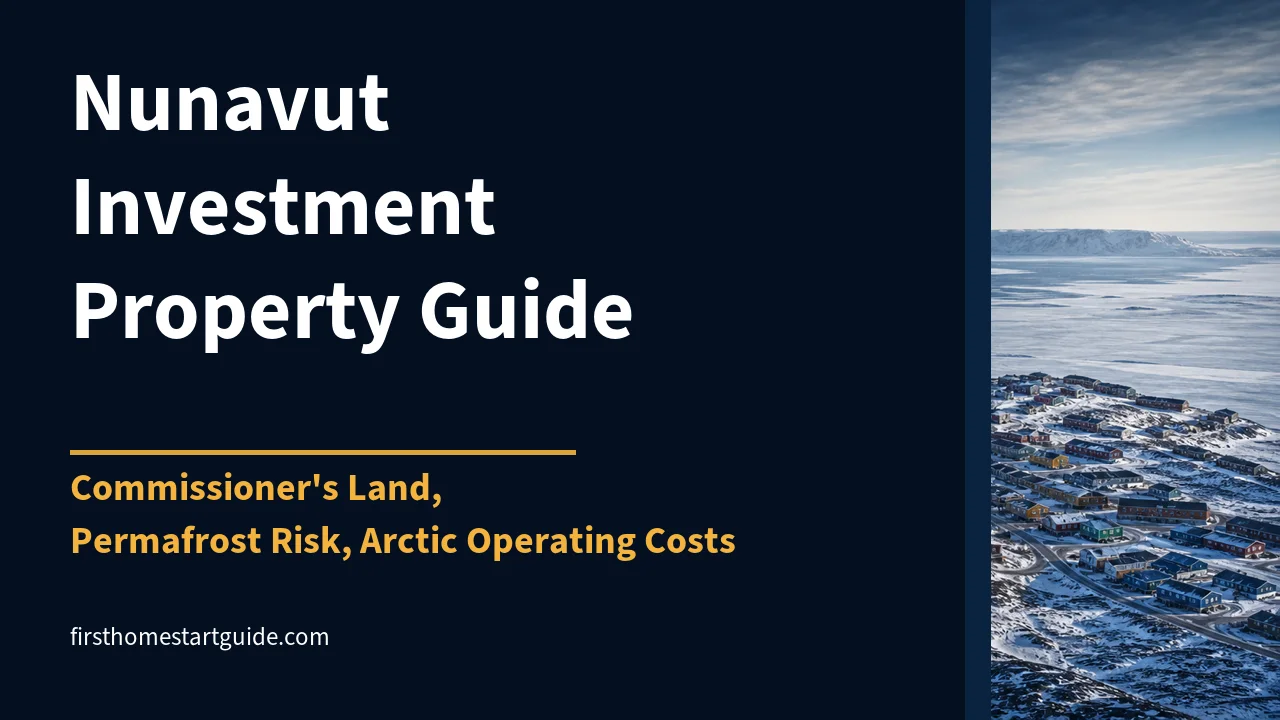
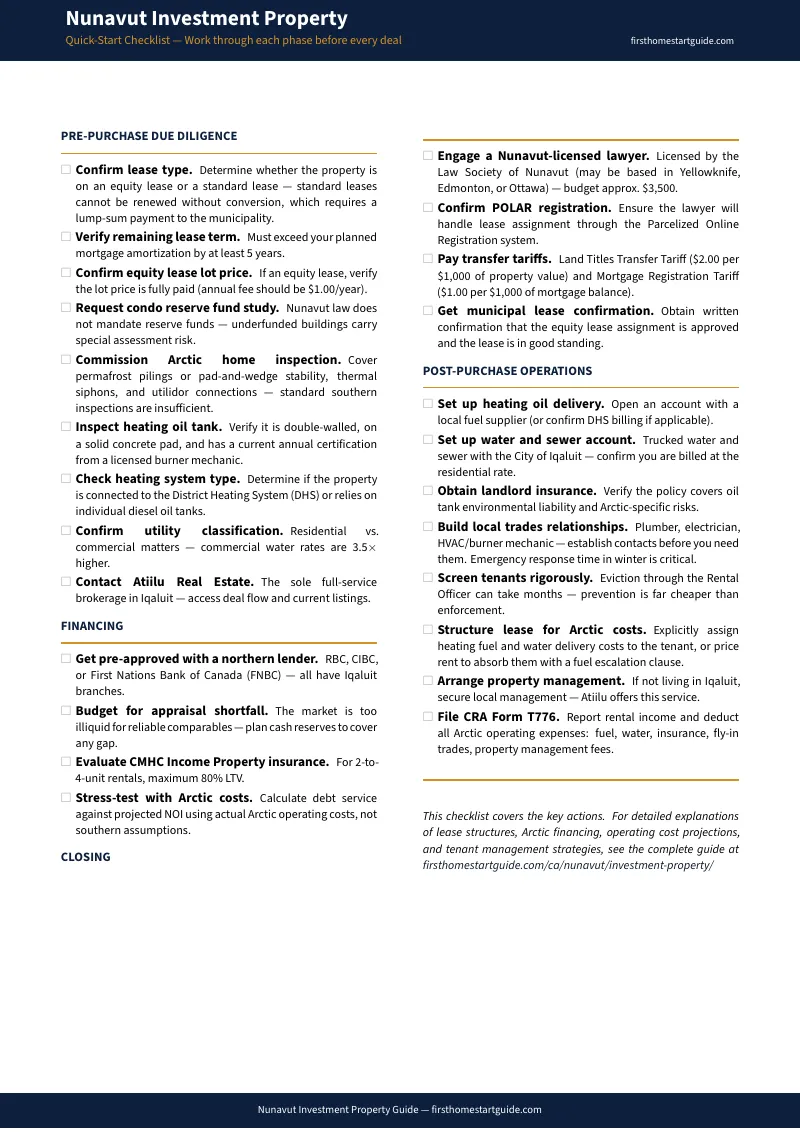
A comprehensive guide and a quick-start checklist (2 PDFs) — covering every stage from lease validation through exit strategy, built specifically for the land tenure system, environmental risks, and operating costs that make Nunavut unlike any other market in North America:
Commissioner's Land and Equity Lease Decoder
The single most disorienting aspect of Nunavut real estate for southern investors. You do not buy land here — you acquire a leasehold interest under the Commissioner's Land Act, governed by municipal bylaws and the Nunavut Land Claims Agreement. The 2016 referendum rejected freehold by margins of 69% in Iqaluit and 80-95% in smaller communities. The guide explains the two lease types in operational terms: standard leases carry annual fees of $500 to $1,000+ and build zero equity in the land, while equity leases let you pay off the municipality's lot development cost upfront and reduce annual rent to $1. It covers Iqaluit's By-Law 897, which prevents standard lease renewal without conversion to equity — a mandatory capital outlay that catches unprepared buyers at the worst possible time. It explains the 30-year lease terms, the Replacement Guarantee clause that protects your structural investment at renewal, and the Article 14.8 cap of 99 years that defines the outer boundary of your interest. Every lease assessment feeds directly into the financing chapter, because your bank will reject the mortgage if the lease term doesn't clear the amortization by five years.
Leasehold Mortgage Financing Playbook
Only three chartered banks actively underwrite residential mortgages in Nunavut: RBC, CIBC, and First Nations Bank of Canada. Each registers a charge against your leasehold interest rather than fee-simple land, and all require the remaining lease term to exceed your amortization period by at least five years — which means a property with 20 years left on its lease cannot carry a 25-year mortgage. The guide walks through the appraisal problem: with only 44 land-title transfers across all of Iqaluit in 2022, your appraiser may have zero recent comparables, forcing a cost-approach valuation inflated by sealift construction costs and creating appraisal gaps you must bridge with cash. It covers CMHC Income Property mortgage insurance for 2-to-4-unit rentals (premiums from 1.45% at 65% LTV to 2.90% at 80% LTV), the debt-service ratio mechanics that let Iqaluit's $4,000+ rents offset your qualification burden, and the Indigenous financial institutions — Atuqtuarvik Corporation and Kakivak Association — that provide alternative financing for Inuit beneficiaries and Inuit-owned businesses.
Operating Cost Model: Diesel, Water, Permafrost
This is where southern spreadsheets break. Nunavut is entirely off-grid — all 25 communities run on imported diesel for electricity and heating. At $1.43 per litre (2025 Petroleum Products Division rates), a typical home consuming 3,500 litres annually generates a $5,000 to $8,000 heating bill. The guide covers the Qulliq Energy Corporation's District Heating System as a cost-mitigation alternative, the lease structuring required to pass heating costs to tenants, and the federal carbon pricing overlay that increases fuel costs annually. For water: Iqaluit uses trucked delivery outside the downtown utilidor zone, at $0.01 per litre residential rate — but if your corporate holding company triggers commercial classification at $0.035 per litre, water costs triple instantly. The guide maps the utility classification rules, the municipal rate structure, and the insurance landscape where Arctic replacement costs and environmental hazards push premiums far beyond southern benchmarks.
Permafrost Foundation Risk Assessment
Climate change is accelerating permafrost thaw across the territory, creating differential settlement that distorts foundations, shears utilidor pipes, and ruptures exterior heating oil tanks. The guide covers the two foundation types you will encounter: adjustable pad-and-wedge systems (older homes requiring periodic manual re-leveling) and deep pile foundations (screw piles, thermopiles, adfreeze piles anchored into stable permafrost below the active layer). It includes the remediation cost data — $208 per square metre for pile foundation repair, up to $1,000 per square metre for surface foundations — and explains why a standard southern home inspection is worthless here. You need a civil engineer or specialized Northern inspector to assess piling integrity, thermal siphon function, and oil tank compliance before you sign anything. The guide tells you exactly what to commission and what the red flags look like.
Private Market Yield Analysis
Only 13% of Iqaluit's 1,923-unit rental stock serves private individual tenants. Government staff housing absorbs 44%, social housing takes 22%, and corporate leases claim 14%. Your tenant pool is strictly limited to dual-income professionals, GN employees using the $1,000/month Nunavut Household Allowance to opt out of staff housing, corporate relocations, and medical or legal locums on short-to-medium-term postings. The guide models the yield mechanics against actual 2023 median rents — $1,900 for a bachelor, $2,571 for a one-bedroom, $3,330 for a three-bedroom, $5,000 to $6,000+ for premium detached homes — and runs the full NOI calculation including diesel, water, insurance, maintenance, property tax escalation, and the vacancy risk that materializes when a departing GN tenant's replacement gets assigned to subsidized staff housing instead of renting privately.
Nunavut Residential Tenancies Act Compliance
The territory's landlord-tenant framework operates through the Residential Tenancies Act and is adjudicated by a Rental Officer rather than a tribunal system. There is no rent control — you can raise rent to market rate — but you must provide three months' written notice and can only increase once per 12-month period. Security deposits are capped at one month's rent, no pet deposits or last month's rent are permitted, and you must pay interest on the deposit (currently 0.01% annually) and return it within 10 days of lease termination. Self-help evictions are illegal. If a tenant defaults, you serve notice, and if they refuse to vacate, you file with the Rental Officer — where administrative backlogs can delay hearings for months. The guide includes the exact notice requirements, the dispute resolution process, and the QIA v. Kilabuk precedent where the Nunavut Court of Justice refused to hear an eviction because the landlord bypassed the Rental Officer. Rigorous tenant screening is your only real protection.
Short-Term Rental Regulatory Kill Zone
If your plan was to run an Airbnb in Iqaluit charging $250 to $350 per night to transient government consultants, the municipality has systematically closed that door. Zoning By-law 899 and Business License By-law 859 restrict short-term rentals to your primary residence, cap stays at 28 consecutive nights, and require a specific municipal business license. Operating without the license exposes you to fines of $200 to $750 per day. The guide explains exactly what this means for investment property owners: you must underwrite your acquisition against long-term residential lease income, not hospitality yields. The Airbnb model is dead in Iqaluit for anyone who doesn't live in the property.
Tax Architecture and Exit Strategy
Nunavut's combined top marginal tax rate of 44.5% is the lowest in Canada — 10 full percentage points below Nova Scotia. There is no land transfer tax, just flat registration tariffs ($2 per $1,000 of property value up to $1 million). The guide covers the four-bracket territorial income tax structure, the aggressive CRA deductibility of Arctic operating expenses (diesel, trucked water, fly-in inspectors) against gross rental income on Form T776, the federal residential property flipping rule that taxes profits as business income if you sell within 12 months, the capital gains inclusion rate mechanics, and the northern residency deduction ($22 per day for single households). It maps the exit strategy for a market where short-term flips are logistically unviable and the only rational approach is long-term buy-and-hold.
Who This Guide Is For
- GN and federal employees transitioning from staff housing to the private market, leveraging the $1,000/month Nunavut Household Allowance and northern tax deductions to build equity in a duplex or secondary-suite property while renting out the additional unit
- Local business owners who need to acquire residential property to house imported southern staff because institutional waitlists are years long and Northview's 80% market share leaves no alternative inventory
- Out-of-territory investors attracted by CMHC reports showing $4,000+ rents and near-zero vacancy who need the full operating cost model, leasehold mechanics, and permafrost risk assessment before they wire earnest money into a market they have never physically visited
- Inuit beneficiaries and NTI-affiliated investors with access to Indigenous financial institutions (FNBC, Atuqtuarvik, Kakivak) who want to deploy capital into the private rental market with a comprehensive understanding of the regulatory and environmental landscape
- Anyone considering Nunavut real estate who needs the complete picture — not the CMHC headline numbers, but the actual net operating income after diesel, water, permafrost maintenance, property tax escalation, and the structural vacancy risk that no institutional marketing material will disclose
Why Free Tools Won't Save You
The free information exists — scattered across CMHC Northern Housing Reports that publish rental medians without operating cost context, City of Iqaluit water bylaws buried in municipal archives, Nunavut Land Titles Office tariff schedules that don't explain the equity lease conversion process, Reddit threads in r/nunavut where residents debate the real cost of filling a heating oil tank, and BiggerPockets posts where someone asks about Iqaluit and gets told to invest in Ohio instead.
The problem is not that the information is hidden. The problem is that it's fragmented across dozens of sources that don't reference each other, written in legal and bureaucratic language that obscures the financial impact, and organized by issuing authority rather than by the investor's actual decision sequence. You need to know whether the property sits on a standard lease or an equity lease before you make an offer — not after closing when the municipality refuses to renew. You need the permafrost foundation assessment in your due diligence — not after you've closed and the heating oil tank ruptures into contaminated soil. You need the operating cost model in your underwriting — not six months into ownership when you realize diesel and water have consumed your entire gross margin.
The Nunavut Investment Property Guide compresses the land tenure analysis, the financing mechanics, the environmental risk assessment, the operating cost models, the tenancy law, and the tax strategy into a single reference organized around your investment timeline — from lease validation through exit. Every chapter exists because a real investor lost real money by not knowing what was in it.
100% Satisfaction Guarantee
If the guide doesn't give you a clearer picture of Nunavut's leasehold system, operating costs, and regulatory environment within the first 30 minutes of reading, email [email protected] for a full refund. No questions, no friction.
Get the Free Checklist — or Get the Full Guide
Download the Nunavut Quick-Start Home Buying Checklist for free — covering lease validation, financing prerequisites, inspection requirements, utility budgeting, and tenant screening essentials. It tells you what to do.
The full Nunavut Investment Property Guide tells you how — with the exact lease mechanics, worked financial models, permafrost risk protocols, and compliance procedures that turn the checklist items into executed results. For less than the cost of a single litre of trucked water delivery to a commercial-classified property, you get the operational manual that protects your investment from the Arctic's regulatory and environmental traps.
Frequently Asked Questions
What if the rules change after I buy?
We update the guide when the rules change. Email us any time, even years later, and we'll send you the current edition free.