You Qualified for a $700,000 Condo in Etobicoke. Then Your Lawyer Calculated the Toronto Municipal Land Transfer Tax, You Discovered You're $12,475 Short on Cash to Close, and Nobody Mentioned the "Tainted Spouse" Rule That Disqualified Your Rebate.
You found a one-bedroom-plus-den in a midrise near Kipling station listed at $689,000. Or a two-bedroom in a Mississauga square-one tower where the stress test at 6.89% compresses your borrowing power by 20%. Or a pre-construction unit in a Liberty Village high-rise where the developer wants $130,000 in staged deposits over three years and you'll pay $3,000 a month in "phantom rent" during interim occupancy before your mortgage even starts. You got pre-approved. You opened an FHSA. You made an offer.
Then Ontario happens. Your lawyer calculates the land transfer tax and discovers you owe $20,950 gross on the Toronto purchase --- provincial plus municipal --- and your first-time buyer rebates only cover $8,475 of it, leaving $12,475 in cash you didn't budget. Your partner owned a condo in Manila eight years ago, which permanently disqualifies both of you from the provincial rebate under the "tainted spouse" rule --- even though she sold it before you met. The Status Certificate on your target building runs 247 pages and your conditional period expires in 10 days, and buried on page 183 is a reserve fund study showing a $2.1 million shortfall that signals a special assessment of $15,000 to $40,000 per unit within two years. The maintenance fees launched at $0.58 per square foot --- suspiciously low --- because the developer lowballed the operating budget to make sales, and fees are now climbing 8% annually toward the $0.85 building-age average that will add $200 a month to your carrying costs by year three.
Here's what no single free resource explains: Ontario layers the only double land transfer tax in Canada --- where crossing from Mississauga into Etobicoke on the same street adds $6,000 to $12,000 in closing costs --- against an OSFI stress test that forces qualification at 6% to 7% when your actual rate is 4.5%, compressing purchasing power by 20% --- against a condo-dominant entry market where 200-page Status Certificates conceal reserve fund shortfalls, pending special assessments, and litigation histories that your 10-day conditional window barely gives you time to decode --- against an FHSA-plus-HBP optimization puzzle where getting the withdrawal sequence wrong costs you thousands in unnecessary tax --- against pre-construction deposit structures demanding 15% to 20% in staged cash over years, followed by interim occupancy fees of $3,000 a month that build zero equity --- against a property tax system frozen at 2016 assessments where your actual bill depends on MPAC valuations that bear no relationship to what you just paid. Each of these has cost real Ontario first-time buyers five figures because the information existed --- scattered across CMHC pages, Ratehub calculators, Reddit threads, realtor YouTube channels, and Section 80(4) of the Condominium Act --- but nobody had assembled it into a single decision system calibrated to how Ontario actually works.
The Ontario First-Time Home Buyer Guide is an Ontario Transaction Blueprint --- not a motivational overview of GTA homeownership, but a structured reference that maps every Ontario-specific tax mechanism, stress test constraint, condo due diligence trap, registered account optimization strategy, and closing cost variable into a process you work through before your deposit is at risk and your conditional period expires over a Status Certificate you couldn't finish reading.
What's Inside the Ontario Transaction Blueprint
A 60-page guide, a quick-start checklist, and printable worksheets --- covering every stage from financial readiness through post-closing tax management, built specifically for the tax structures, regulatory mechanisms, and market dynamics that make Ontario different from every other province:
Double Land Transfer Tax Decoded
Ontario's provincial LTT runs on a progressive marginal bracket system from 0.5% on the first $55,000 up to 2.5% above $2 million. Buy inside Toronto's municipal boundaries and you pay a second tax on top --- the Toronto MLTT --- that roughly doubles your bill. On a $700,000 property, the gross combined tax is $20,950. First-time buyer rebates cover $8,475, leaving $12,475 in cash required at closing. Buy the identical condo one kilometre west in Mississauga and the net bill drops by $6,000. The guide provides exact calculations at every Ontario price point from $500,000 to $1 million, maps which border municipalities fall inside versus outside the Toronto MLTT zone, explains the "tainted spouse" rule that permanently disqualifies your rebate if your partner ever owned property anywhere in the world during your relationship, and walks through the rebate application process your lawyer handles at closing --- so you know your exact cash obligation the moment your offer is accepted, not three days before closing day.
OSFI Stress Test Reality Check
The stress test requires qualification at your contract rate plus 2% or 5.25%, whichever is higher. With 5-year fixed rates between 4.09% and 4.89%, you're qualifying at 6.09% to 6.89% --- roughly 20% less borrowing power than your actual payment requires. The guide includes income-to-purchase-price tables showing exactly what household income buys you at Ontario price points (spoiler: $150,000 combined income qualifies for roughly $700,000), explains the GDS and TDS ratio calculations lenders actually run, and reveals the credit union workaround --- Meridian, Alterna, and DUCA are regulated by FSRA, not OSFI, and are not legally required to apply the same rigid stress test. If you fail at TD or RBC by a narrow margin, a provincial credit union may approve you at the actual contract rate. This is not a loophole. It is a structural feature of Canada's split federal-provincial banking regulation that most buyers never learn about.
FHSA + HBP + TFSA Optimization Strategy
The First Home Savings Account gives you tax-deductible contributions and tax-free withdrawals --- the only account in Canadian history that does both. The expanded Home Buyers' Plan now allows $60,000 per person ($120,000 per couple) in RRSP withdrawals. A couple maximizing both programs can accumulate $200,000 in down payment capital entirely within tax-advantaged vehicles. But the sequencing matters: FHSA withdrawals are permanent (no repayment), HBP withdrawals must be repaid over 15 years, and getting the order wrong creates unnecessary tax liability. The guide maps the optimal contribution and withdrawal sequence, shows you how to use the tax refunds from FHSA and RRSP contributions to top up your TFSA, and covers the gift letter requirements for parental help --- including the CMHC rule that insured-mortgage gifts must come from immediate family only, and the 90-day seasoning requirement that means a $100,000 deposit appearing in your account 10 days before closing triggers anti-money-laundering scrutiny.
Status Certificate Survival Guide
Most Ontario first-time buyers enter the condo market, which means navigating a document that routinely exceeds 200 pages of legal, financial, and engineering data --- under a 10-day conditional deadline. The guide translates every section of the Status Certificate into plain language: how to read the Reserve Fund Study for underfunding red flags, what a history of special assessments signals about the condo corporation's financial management, why a building with more than 50% rental units creates both governance and financing problems, how to identify pending litigation that could require unit owner funding, and why abnormally low maintenance fees are a red flag (the developer suppressed year-one costs to drive sales, and fees spike 15% to 30% in years two and three). You'll know exactly which questions to ask your lawyer during the 10-day review window --- and which answers should kill the deal.
Pre-Construction Condo Trap Navigator
The pre-construction market demands 15% to 20% of the purchase price in staged deposits over two to four years. On a $650,000 unit, that is $97,500 to $130,000 in locked-up capital earning no return. Then comes interim occupancy: you move in but don't receive legal title, paying the developer monthly fees --- estimated condo expenses, property taxes, and interest on the unpaid balance --- that commonly reach $3,000 to $4,000 a month. None of this builds equity. Not one dollar goes toward your mortgage principal. The guide covers Section 80(4) of the Condominium Act (developers cannot profit from occupancy fees), Tarion warranty timelines and claim windows, developer tricks including lowballed maintenance fees and delayed registration, and the assignment sale tax trap for buyers who need to exit a pre-construction contract.
Closing Cost Breakdown and Cash Planning
Your down payment is only part of the cash required at closing. A first-time buyer purchasing a $700,000 condo in Toronto with 10% down needs approximately $87,000 to $88,500 in liquid cash --- and the same condo in Mississauga drops that to $81,000 to $82,500. The guide itemizes every component: down payment tier calculations (the split formula where you need 5% on the first $500,000 and 10% on the remainder), CMHC insurance premiums, net land transfer tax after rebates, legal fees ($1,500 to $2,500), title insurance, property tax and condo fee adjustments, and the HST rebate on new builds that can save up to $130,000 on agreements signed between April 2026 and March 2027. Each line includes what drives the cost and where Toronto diverges from the rest of Ontario.
Rent vs. Buy: The Ontario Calculation
The cultural pressure to buy is enormous. The math is more nuanced. The guide runs the unrecoverable costs of a $700,000 GTA condo --- mortgage interest ($28,000 in year one alone), property taxes ($5,400 to $7,600 depending on municipality), maintenance fees ($6,000 to $8,400 annually), CMHC insurance, land transfer tax, legal fees, and the 4% to 5% real estate commission on eventual sale --- against the alternative of renting and investing the surplus in a diversified portfolio. In the first five to seven years, the renter's net worth frequently exceeds the homeowner's. The guide shows you exactly when buying wins (holding period over seven years, freehold property, forced savings discipline) and when renting wins (short hold, high maintenance fees, disciplined investor), using Ontario-specific numbers, not national averages.
Regional Market Comparison
Ontario is not one market. The guide breaks down pricing, first-time buyer entry points, and strategic trade-offs across the GTA (condos $500K to $700K), Ottawa (townhouses $450K to $600K), Hamilton (condos from $350K, freehold from $550K), Kitchener-Waterloo (townhouses $500K to $650K), and London (detached from $450K). If you work remotely, buying in Hamilton instead of Toronto saves $150,000 to $300,000 on purchase price, eliminates the municipal LTT, reduces your stress test burden, and can get you into freehold instead of condo --- a decision that materially alters your wealth trajectory over ten years.
Who This Guide Is For
This guide is for first-time home buyers in Ontario who:
- Are buying in the GTA and need to understand the double land transfer tax --- specifically, how crossing a municipal boundary between Etobicoke and Mississauga changes your closing cost by $6,000 to $12,000, how the "tainted spouse" rule works, and whether your FTHB rebate eligibility survives a partner's prior ownership history
- Are purchasing a condo and need a plain-language framework for reviewing a 200-page Status Certificate in 10 days --- reserve fund adequacy, special assessment history, litigation red flags, maintenance fee trajectory, and rental ratio risk --- without relying entirely on a lawyer who charges by the hour to tell you what you should already understand
- Are navigating the FHSA, HBP, and TFSA simultaneously and need the optimal contribution and withdrawal sequence to maximize tax-sheltered down payment capital without triggering unnecessary repayment obligations or losing carry-forward room
- Are considering pre-construction and need to understand the deposit structure, interim occupancy fee mechanics, Section 80(4) limitations, Tarion warranty claim windows, and the developer lowball strategy that produces 15% to 30% maintenance fee spikes in years two and three
- Are priced out of Toronto and weighing a move to Hamilton, Ottawa, Kitchener-Waterloo, or London --- and need the LTT savings math, stress test impact, freehold vs. condo trade-off analysis, and commuting cost calculation to make that decision with real numbers instead of anxiety
- Are receiving parental help and need to navigate CMHC gift letter rules, the 90-day seasoning requirement, co-signing risks (reduced parental borrowing capacity, matrimonial entanglement, removal difficulty), and the documentation your lender will demand
Why Not Free Resources?
Free information on buying a home in Ontario exists. Here's what it actually delivers:
- CMHC and Ontario.ca publish the letter of the law accurately. They will explain the mechanics of the HBP, the LTT bracket rates, and the FHSA contribution limits. They will not provide a strategic blueprint for sequencing FHSA withdrawals before HBP withdrawals to minimize repayment obligations. They will not counsel you on whether purchasing in Mississauga to avoid the double LTT is a viable lifestyle trade-off given your commuting costs. They will not tell you that your partner's prior ownership in another country permanently disqualifies your rebate under the tainted spouse rule. Government resources describe the rules. They do not help you play them.
- Ratehub, Wowa, and Zolo offer excellent calculators. A Ratehub LTT calculator will accurately output a $12,475 tax bill. It cannot counsel you on whether the $6,000 savings from buying in Mississauga instead of Etobicoke outweighs the transit cost difference. A mortgage affordability calculator cannot tell you that Meridian Credit Union is regulated by FSRA rather than OSFI and may qualify you at a lower stress test threshold. Calculators produce numbers. They do not produce decisions.
- Reddit threads on r/PersonalFinanceCanada and r/toronto contain real buyer stories --- the $40,000 special assessment, the phantom rent shock, the failed stress test at RBC that a credit union approved. These are genuine data points from real transactions. But they are scattered across years of posts, reflect conditions that may have changed, and are answered by anonymous strangers with varying qualifications. Reading them creates anxiety. The guide converts that scattered intelligence into a systematic decision framework.
- Realtor YouTube channels produce excellent video content on micro-market trends and deal mechanics. But video is an inherently poor medium for technical reference. You cannot search a YouTube video while simultaneously reading a 200-page Status Certificate. You cannot pull up a LTT bracket table from a 12-minute TikTok while your lawyer is on the phone asking whether you want to waive your condition. The guide is a reference document --- searchable, portable, built to sit next to you during the transaction, not to entertain you before it.
This guide fills the Ontario-specific gap --- the space between knowing how to buy a house in general and knowing how to buy one in the only province that layers a double land transfer tax, a condo-dominant market governed by the Condominium Act, an OSFI stress test that compresses purchasing power by 20%, and an FHSA/HBP optimization puzzle that most accountants don't fully understand, on top of a $700,000 median entry price that requires $87,000 in liquid cash to close. It is the analysis that would take a real estate lawyer, a mortgage broker, a financial planner, and a condo-specialist inspector to assemble --- structured as a reference you own permanently.
--- Less Than One Hour of Your Real Estate Lawyer's Time
A missed LTT rebate costs you $4,000 to $8,475 in cash you won't recover. Getting the FHSA withdrawal sequence wrong creates a repayment obligation that doesn't need to exist. A Status Certificate with a buried reserve fund shortfall signals a special assessment of $15,000 to $40,000 per unit. Buying inside Toronto city limits instead of one kilometre outside costs $6,000 to $12,000 in additional land transfer tax. A developer-lowballed maintenance fee that climbs 8% annually adds $2,400 a year to your carrying costs by year three. Interim occupancy fees on a pre-construction unit bleed $3,000 a month in pure carrying cost that builds zero equity.
This guide doesn't replace your real estate lawyer or your mortgage broker. But it gives you the double LTT calculator, the stress test reality check, the FHSA/HBP optimization sequence, the Status Certificate red-flag framework, the pre-construction trap navigator, the rent vs. buy Ontario calculation, and the regional market comparison that ensure you identify every Ontario-specific cost and risk before your deposit is committed --- instead of discovering them on a closing statement, a Status Certificate page you didn't have time to read, or a maintenance fee increase notice six months after you moved in.
If it catches a single LTT rebate disqualification, prevents a single Status Certificate blind spot, or saves you from a pre-construction occupancy fee you didn't anticipate, it pays for itself before you've finished reading it.
Money-back guarantee, no time limit. If the guide doesn't sharpen your decision-making and protect your budget in Ontario's double-taxed, stress-tested, condo-dominated housing market, you pay nothing.
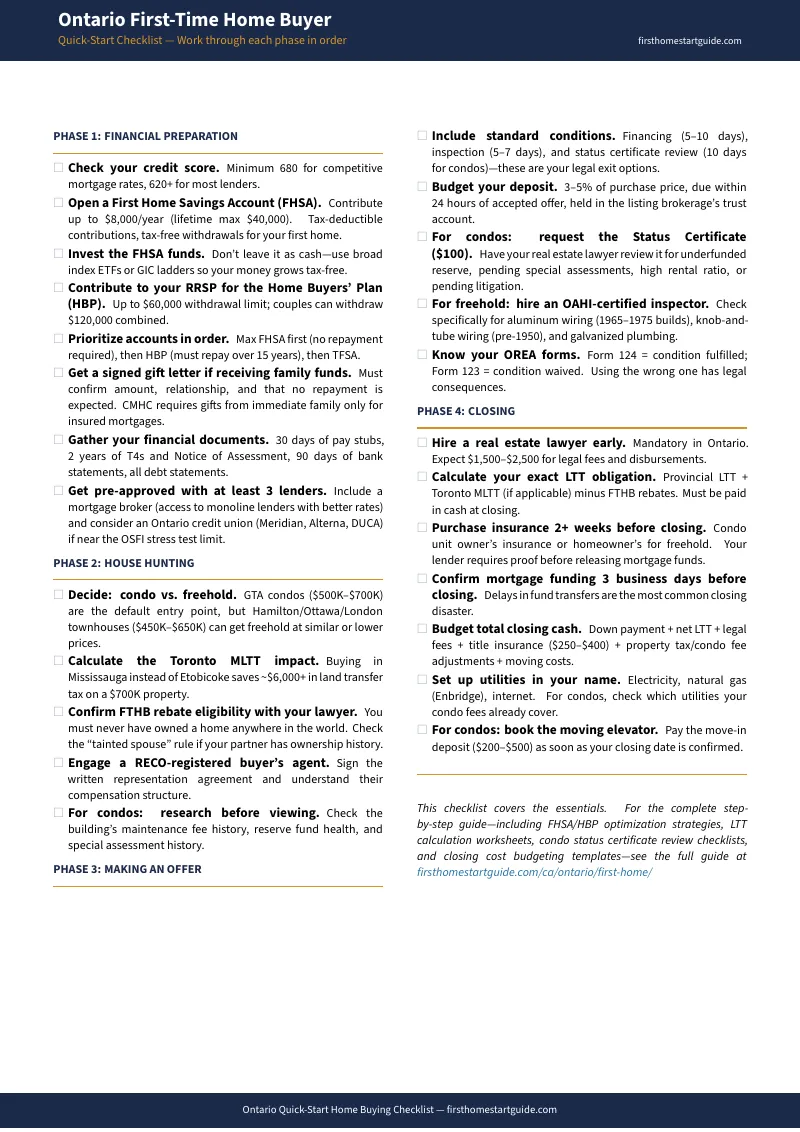
Download the free Ontario Quick-Start Home Buying Checklist to see the step-by-step action plan covering pre-approval, FHSA and HBP sequencing, LTT calculations, Status Certificate review, and closing cost budgeting. When you're ready for the full double LTT navigator, stress test workaround guide, Status Certificate survival framework, and pre-construction trap analysis, the complete guide is here.
The listing says "$689,000 plus HST." This guide tells you whether the closing costs are $81,000 or $88,500 --- and which side of Steeles Avenue makes the difference.
Frequently Asked Questions
What if the rules change after I buy?
We update the guide when the rules change. Email us any time, even years later, and we'll send you the current edition free.