You ran the numbers. The numbers don't work. And you're wondering if Ontario investing is dead.
Here's what the spreadsheet doesn't show you: 66% of Ontario landlords are breaking even or losing money right now. Not because real estate is a bad investment — because they bought without understanding the regulatory machinery that determines whether a property makes money or bleeds it.
The difference between a profitable Ontario investment property and a $1,000-per-month cash drain isn't luck or timing. It's knowing which units are exempt from the 2.1% rent cap. It's knowing that OSFI's new IPRRE classification means your next property must qualify on rental income alone. It's knowing that buying in Toronto costs $16,475 more in land transfer tax than the identical property in Mississauga — dead capital that permanently degrades your yield.
The Ontario Regulatory Yield System
This isn't a motivational guide about "building wealth through real estate." It's a technical operating manual for extracting positive cash flow from Ontario's uniquely complex regulatory environment — where rent control, the Landlord and Tenant Board, OSFI financing rules, and municipal taxation interact in ways that bankrupt the unprepared and reward the precise.
The guide maps every regulatory lever that affects your return: which properties are exempt from rent control (and how to prove it at the LTB), how Bill 60's new 50% upfront arrears rule has cut eviction timelines from 316 days to 90, how to structure acquisitions so rental income independently satisfies the bank's debt-service requirements under the new IPRRE regime, and where the $16,000+ land transfer tax arbitrage makes suburban properties mathematically superior.
What's Inside
Ontario's Tax Architecture — mapped and quantified
The graduated provincial Land Transfer Tax, Toronto's municipal double-tax, the 25% Non-Resident Speculation Tax (plus Toronto's additional 10%), and the new Vacant Home Tax. You'll know exactly what every property costs before you ever make an offer.
OSFI's IPRRE Rules — decoded for portfolio builders
The "double count" is dead. If more than 50% of qualifying income comes from rental revenue, your loan gets flagged as higher risk. The guide shows you how to structure acquisitions so each property stands on its own financial merits — the only path that works now.
Rent Control Exemptions — and how to prove them
Any unit first occupied after November 15, 2018 is completely exempt from the provincial rent guideline. But you need municipal proof — occupancy permits, building permits, new home warranty documents — not just a lease clause. The guide walks you through securing this documentation during due diligence, before the deal closes.
The LTB Operating Playbook — Bill 60 and beyond
The 12-month eviction myth is obsolete. L1/L9 non-payment applications now target 90-day resolution. Bill 60's 50% upfront arrears rule prevents tenants from raising retaliatory maintenance claims to delay proceedings. The guide gives you the exact procedural sequence, form numbers, and timelines.
Secondary Suite Conversion Economics
Ontario Regulation 462/24 plus 90% LTV refinancing with 30-year amortizations for secondary suites. The guide models the conversion math — acquisition cost, renovation budget, projected rent per unit — for bungalow-to-duplex and garden suite builds in Hamilton, Kitchener-Waterloo, and London.
Status Certificate Forensics
For condo investors: the four red flags that signal a toxic asset. Depleted reserve funds below 25% of projected repairs. Maintenance fees 20% above neighbourhood comparables. Active construction defect lawsuits. Current owner arrears that become your lien under Section 85.
The Standard Form Lease Compliance System
Miss the 21-day window after a tenant requests the Standard Lease, and they can legally withhold one month's rent — permanently. The guide includes the exact compliance sequence so this never happens to you.
Cash Flow Modeling Worksheets
Fillable worksheets that account for all Ontario-specific carrying costs: property tax, insurance, maintenance reserve, vacancy allowance, HELOC interest, mortgage payments, and the actual guideline-limited rent increase you can charge each year. Includes cap rate benchmarks by submarket and cash-on-cash return calculations.
The Toronto vs. Suburbs Decision Framework
When the municipal LTT alone costs $16,475 more than an equivalent suburban purchase, how much extra appreciation does Toronto need to deliver to justify the penalty? The framework gives you the breakeven math.
Short-Term Rental Reality Check
Toronto's principal residence mandate, the 180-night cap, the 8.5% Municipal Accommodation Tax, and API-enforced registration verification. If your business plan includes Airbnb revenue on an investment property, this chapter will save you from $100,000 fines.
NRST Exemption Pathways
Permanent residents are exempt. OINP nominees are exempt. Protected persons are exempt. The old student and worker rebate pathways are eliminated — only PR status within four years triggers a refund. Mapped clearly so you know exactly where you stand.
8 Standalone Printable Tools
Beyond the 14-chapter guide and quick-start checklist, your download includes 8 standalone PDFs — print them individually and bring them to property viewings, lawyer meetings, and broker appointments:
- Cash Flow Worksheet — fillable calculator with Ontario-specific carrying costs, cap rate benchmarks, and cash-on-cash return formulas
- Due Diligence Checklist — 33 items across 6 categories to verify before removing conditions
- Status Certificate Red Flag Checklist — the 5 forensic indicators of a toxic condo asset
- LTT Calculator — provincial brackets, Toronto MLTT, NRST rates, HST mechanics, and a fillable worksheet
- Rent Control Verification — controlled vs. exempt side-by-side comparison with the documents to request
- Standard Form Lease Compliance Checklist — the 21-day rule flowchart and tenant onboarding steps
- LTB Procedure Reference — application types, Bill 60 timelines, form numbers, and enforcement procedures
- OSFI Financing Worksheet — standalone qualification test under the 2026 IPRRE rules and Smith Manoeuvre setup
The Free Checklist
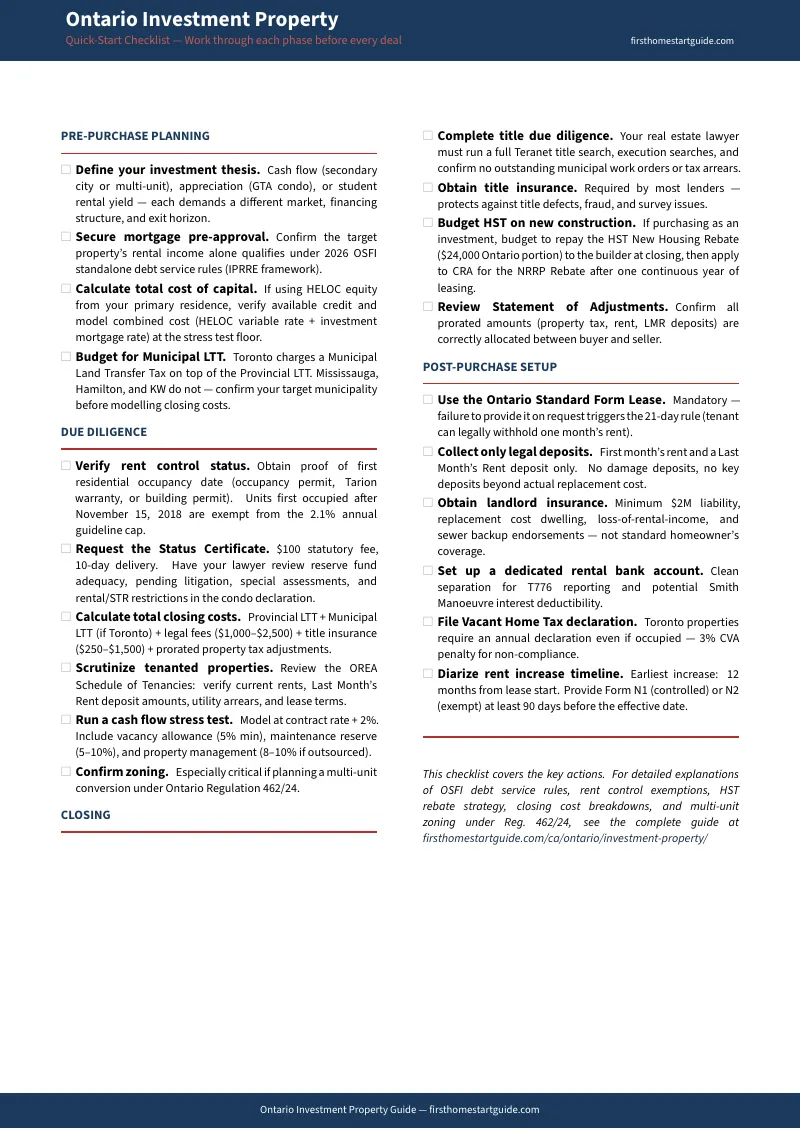
Download the Ontario Quick-Start Home Buying Checklist at no cost — a single-page reference covering the essential steps from property search through closing. It tells you what to do. The full guide tells you how, with the financial models, legal frameworks, and regulatory navigation that determine whether your investment generates wealth or drains it.
Who This Is For
- HELOC leveragers using home equity to fund investment acquisitions — you need to model the compounding cost of variable-rate capital against rental income under current OSFI rules
- GTA condo holders bleeding $800-$1,000/month in negative cash flow — you need a framework to decide whether to hold, sell, or restructure
- Secondary-city yield seekers targeting cash-flow-positive properties in Hamilton, KW, London, or Oshawa — you need the conversion economics and zoning compliance for multi-unit builds
- Student rental investors facing 39% drops in tenant demand — you need transition strategies for repositioning properties toward domestic long-term tenancies
Why Free Tools and YouTube Don't Cut It
Podcasts like The Canadian Real Estate Investor give you macro theory — interest rate predictions, market cycles, broad trends. Useful for dinner conversation. Useless when you're staring at a status certificate wondering if the reserve fund is adequate.
Reddit forums like r/OntarioLandlord give you anecdotes and emotional legal opinions from anonymous strangers. One thread says eviction takes 18 months. Another says 3 months. Neither cites the actual Tribunals Ontario 2024-2025 Annual Report data.
YouTube channels show you how to frame a basement suite. They don't show you how to prove rent control exemption status to the LTB, or how to calculate whether the 90% LTV refinancing on a secondary suite generates enough monthly cash flow to satisfy OSFI's standalone debt-service requirement.
The Ontario investment market punishes fragmented knowledge. The guide gives you the complete regulatory picture in one indexed reference — tax architecture, financing rules, tenant law, and cash flow modeling — so every decision is informed by the system, not by a Reddit thread.
100% Money-Back Guarantee
If the guide doesn't change how you evaluate Ontario investment properties, email us at any time for a full refund. No forms, no questions.
Get the Full Ontario Regulatory Yield System
For less than the cost of a single hour with a real estate lawyer — who won't walk you through OSFI modelling, secondary suite economics, or LTB procedural timelines anyway — you get the complete system. for the full 14-chapter guide, 8 standalone printable tools, and the quick-start checklist — 10 PDFs total. Or start with the free checklist above and decide later.