
You Found a Clean Bungalow in Regina for $310,000. Nobody Mentioned the Expansive Clay Pushing the Foundation Inward, the Radon Readings Three Times Over the Health Canada Guideline, or the $2,050 in ISC Registry Fees You Owe in Cash at Closing Despite "No Land Transfer Tax."
You have browsed MLS listings in Cathedral and Harbour Landing. You have run the CMHC mortgage calculator and received a pre-approval somewhere between $280,000 and $400,000 — a range that makes Saskatchewan feel like the promised land compared to the Ontario or British Columbia market you just left. You have read the headline that Saskatchewan charges no land transfer tax and assumed your closing costs would be trivial. You might have even heard about the Graduate Retention Program and assumed you could use it directly toward your down payment.
None of this works the way you think. Saskatchewan charges Information Services Corporation (ISC) registry fees of 0.4% of your property value plus tiered mortgage registration fees — adding $2,050 or more in unavoidable cash at closing on a typical first-time purchase. Regina sits on the remnants of a glacial lakebed composed of highly plastic clay that swells in spring and contracts in summer, cracking basement walls with enough hydrostatic pressure to require steel I-beam bracing at $250 per brace every four feet. Saskatchewan is a national hot spot for radon gas, with sub-slab concentrations high enough to require $1,500 to $3,500 mitigation systems. The old First Home Plan that let graduates borrow GRP credits as a down payment was cancelled in 2017 — yet buyers still search for it every month. And the finished basement you admired at the open house might be concealing active foundation cracking behind fresh drywall in soil that will never stop moving.
The core problem: Saskatchewan's genuine affordability disguises the most geology-dependent housing risk in Western Canada and a closing cost structure that punishes buyers who take "no land transfer tax" at face value. Every free resource covers one fragment — CMHC covers the national mortgage math but not Regina Clay, your agent's blog mentions the inspection but not the $3,500 radon system, Reddit threads debate GRP credits without confirming the First Home Plan is dead, and nobody connects the ISC fees, the foundation engineering, the radon mitigation budget, and the credit union mortgage advantages into a single decision framework. Until now.
The Saskatchewan First-Time Home Buyer Guide is a Saskatchewan Property Intelligence System — a structured decision framework that connects every Saskatchewan-specific closing cost trap, geological hazard, environmental risk, and federal-provincial program strategy into a single step-by-step roadmap from pre-approval through possession day.
What's Inside the Saskatchewan Property Intelligence System
The complete guide plus three standalone printable tools — covering every stage from calculating your true Saskatchewan borrowing power through collecting the keys, plus a fillable closing cost worksheet, a property hazard inspection checklist, and a closing timeline reference card you can bring to lawyer meetings, credit union appointments, open houses, and home inspections:
Saskatchewan Closing Cost Breakdown
The cash requirements hidden behind "no land transfer tax." Saskatchewan does not charge a traditional land transfer tax — but the Information Services Corporation (ISC) charges 0.4% of the property value to transfer the title ($1,800 on a $450,000 home) plus tiered mortgage registration fees ($250 for mortgages between $250,000 and $500,000). Add mandatory legal fees ($1,000 to $3,000), a home inspection ($300 to $600), an appraisal fee, property tax adjustments to reimburse the seller, and potential radon mitigation — and a first-time buyer targeting a $400,000 Saskatchewan home needs far more cash at closing than the "no LTT" headline suggests. The guide breaks down every line item with a fillable worksheet so you know the exact number before you make an offer.
FHSA, HBP, and GRP Sequencing Strategy
How to combine federal savings programs with Saskatchewan's unique tax credit. Saskatchewan has no provincial cash grant for general first-time buyers — instead, the Graduate Retention Program (GRP) provides up to $24,000 in tax credits distributed over seven years after purchase, not at closing. The old First Home Plan that let graduates borrow GRP credits as a down payment was cancelled in March 2017. The guide shows you how to build your upfront down payment through the First Home Savings Account ($8,000 annual limit, $40,000 lifetime, fully tax-deductible, completely tax-free withdrawals) and the Home Buyers' Plan ($60,000 RRSP withdrawal), while positioning the GRP to subsidize your mortgage payments post-purchase. For couples, it maps dual-FHSA and dual-HBP strategies to maximise combined savings power.
Regina Clay and Foundation Risk System
The geological reality underneath every older home in Regina and parts of Saskatoon. Regina is built on glacial lakebed deposits of highly plastic clay — locally known as "Regina Clay" or "gumbo" — that swells when saturated in spring and shrinks in summer. This cyclical movement exerts massive lateral pressure on concrete basement walls, causing cracking, inward bowing, and structural displacement. Remediation requires steel I-beam braces at approximately $250 per brace installed every four feet, with additional braces under windows and stairwells. Saskatoon's glacial till is more stable overall, but soil profiles can shift from stable sand to reactive clay within a few kilometres. The guide covers Property Condition Disclosure Statement (PCDS) analysis, why you need a structural engineer with laser levels instead of a generalist home inspector, and how to evaluate foundation bracing during open houses before your offer goes in.
Radon Gas Assessment and Mitigation
Saskatchewan is a national hot spot for radon — the leading cause of lung cancer in non-smokers. Radon is an invisible, odourless radioactive gas drawn upward through foundation cracks by the pressure differential between heated interiors and frozen soil. Health Canada recommends action above 200 Bq/m³. Installing a sub-slab depressurization system costs $1,500 to $3,500. Lung Saskatchewan offers a "Lungs Matter" mitigation reimbursement grant of up to $1,000 for qualifying households. The guide covers testing protocols (minimum three-month alpha track test during fall or winter), how to borrow a digital detector from Saskatoon's "Library of Things," interpreting Airthings Corentium readings, and how to factor potential mitigation costs into your closing budget.
Credit Union Mortgage Advantage
Why blindly trusting a Big Five bank in Saskatchewan leaves money on the table. Saskatchewan's credit union ecosystem — Conexus and Affinity — offers structural advantages that national banks rarely match. Affinity provides competitive 5-year fixed rates with a $500 First-Time Homebuyer Rebate and interest-only construction mortgages for new builds. Conexus offers Flex Feature Mortgages with skip-a-payment privileges and Mobile Mortgage Specialists who come to your home or workplace. The guide walks you through rate and feature comparison across both credit unions and the Big Five, showing how local underwriting flexibility can qualify you for properties that a national bank would decline.
30-Year Amortization and Stress Test Walkthrough
Why the December 2024 federal reforms changed everything for Saskatchewan buyers. First-time buyers can now qualify for 30-year amortizations on insured mortgages, reducing monthly payments and improving your debt service ratios. In a market like Saskatoon where benchmark prices are rising and inventory is tightening, this policy lets entry-level buyers qualify for larger loans without increasing their down payment. The guide walks through the GDS and TDS ratio formulas with Saskatchewan-specific examples, showing exactly how the extended amortization affects your borrowing power and total interest cost.
Saskatchewan Closing Process and Legal Requirements
What happens in the 30 to 40 days between an accepted offer and possession. Saskatchewan uses the Torrens land title system administered by ISC. Your lawyer handles title searches, mortgage registration, ISC fee collection, and trust account management following the Western Law Societies Conveyancing Protocol. The guide maps the complete timeline from accepted offer through key collection, explains the ISC title transfer and mortgage registration fee structure, covers the PST rebate for new home construction (up to 42% on homes under $450,000), and lists every disbursement your lawyer will charge so the final invoice holds no surprises.
Who This Guide Is For
This guide is for first-time buyers in Saskatchewan who:
- Are buying in Regina and worried about the expansive clay soils that crack foundations across the city — where a finished basement can conceal active structural damage, and remediation with steel I-beam bracing runs thousands of dollars depending on the extent of displacement
- Are interprovincial migrants from Ontario or British Columbia who chose Saskatchewan for its affordability but have zero local knowledge of ISC registry fees, clay soil risks, radon hot spots, or the credit union mortgage ecosystem that gives local buyers a structural advantage
- Are recent graduates planning to use the Graduate Retention Program toward homeownership but confused about whether the old First Home Plan still exists (it does not), how to claim GRP credits on their tax returns, and how to sequence GRP tax relief alongside FHSA and HBP contributions to maximise their total purchasing power
- Are buying in Saskatoon where inventory is tightening and benchmark prices are rising — and need to understand how the new 30-year amortization rules improve your qualifying power, how to compete in multiple-offer situations without waiving inspection conditions, and how soil profiles vary across the city
- Are renting at $1,400 to $1,500 per month and ready to transition to ownership but need to know exactly how much cash is required beyond the down payment — because "no land transfer tax" does not mean no closing costs, and the ISC fees, legal fees, and potential radon mitigation add up quickly
- Are Métis citizens eligible for the MN-S First-Time Home Buyers' Program ($15,000 forgivable loan plus $2,500 for closing costs) and need guidance on combining this grant with federal programs to maximise your total down payment
Why Not Free Resources?
Free information on buying your first home in Saskatchewan is everywhere. Here is what each source actually delivers:
- CMHC "Homebuying Step by Step" workbook provides national-level financial planning tools — debt ratio calculators, credit score explanations, mortgage insurance tables. What it does not do: mention Saskatchewan's ISC registry fee structure, explain the difference between "no land transfer tax" and "no closing costs," address Regina Clay and its effect on foundations, cover radon hot spots, or discuss the Graduate Retention Program. The federal framework is solid. The Saskatchewan-specific traps are completely absent.
- Local real estate agent blogs offer Saskatoon and Regina neighbourhood guides and step-by-step buying overviews with genuine local knowledge — from the perspective of professionals who earn a commission when you buy. They mention foundation issues as something your inspector should check. They do not explain the mechanics of hydrostatic pressure on glacial lakebed clay, the typical bracing cost per linear foot, why a generalist inspector misses what a structural engineer catches, or why that freshly finished basement should make you more worried, not less.
- Reddit (r/saskatoon, r/regina, r/PersonalFinanceCanada) is where real Saskatchewan buyers share unfiltered experiences — and where advice about the GRP from 2015 sits alongside current rules, where someone's $280,000 success story omits the $3,000 radon mitigation six months later, and where "Saskatchewan has no land transfer tax, just buy" is repeated by people who have never calculated the full ISC fee structure. The signal is real. So is the noise.
- Saskatchewan real estate law firms publish accurate breakdowns of ISC fees, conveyancing disbursements, and the closing process in precise legal language. They do not provide guidance on property search strategy, neighbourhood-level foundation risk, credit union mortgage comparison, or how to stack the FHSA, HBP, and GRP into a coherent savings timeline. They will tell you what closing costs exist. They will not tell you how to prepare for them nine months in advance.
- Mortgage broker blogs and credit union websites explain pre-approval, stress testing, and down payment minimums with some local market context. They do not cover the physical condition of the housing stock you will actually be buying with that mortgage — the clay foundations, the radon gas, the heating system liabilities in homes that face -30°C winters. They will qualify you to buy. They will not prepare you for what you are buying.
This guide fills the navigation gap — the space between knowing Saskatchewan has ISC fees instead of a land transfer tax, geological hazards unique to the Prairies, and a mix of federal and provincial programs, and understanding how they all interact across a single home purchase. It is the analysis an independent advisor with no properties to sell would give you, structured as a permanent reference you own.
— Less Than a Single ISC Title Transfer Fee
The ISC charges $1,800 just to transfer the title on a $450,000 home. A structural engineer's foundation assessment costs $500 to $800. A radon mitigation system runs $1,500 to $3,500. Steel I-beam foundation bracing on a compromised Regina basement costs thousands depending on the number of walls affected. A furnace replacement in a home that faces -30°C winters runs over $5,000.
This guide does not replace your real estate lawyer, your mortgage broker, or your home inspector. But it gives you the closing cost breakdown that exposes the "no LTT" myth, the clay soil and radon hazard identification system, the FHSA-HBP-GRP stacking strategy, and the credit union comparison framework that ensure you walk into every appointment knowing exactly what to ask, exactly what to budget, and exactly what to never skip — instead of discovering expensive traps in real time.
If it prevents a single foundation surprise, catches a radon reading you would have ignored, or helps you stack the FHSA and HBP to cover your full down payment and closing costs while positioning the GRP for post-purchase tax relief, it pays for itself before you have finished reading it.
Money-back guarantee, no time limit. If the guide does not make your Saskatchewan home buying process clearer and your financial position stronger, you pay nothing.
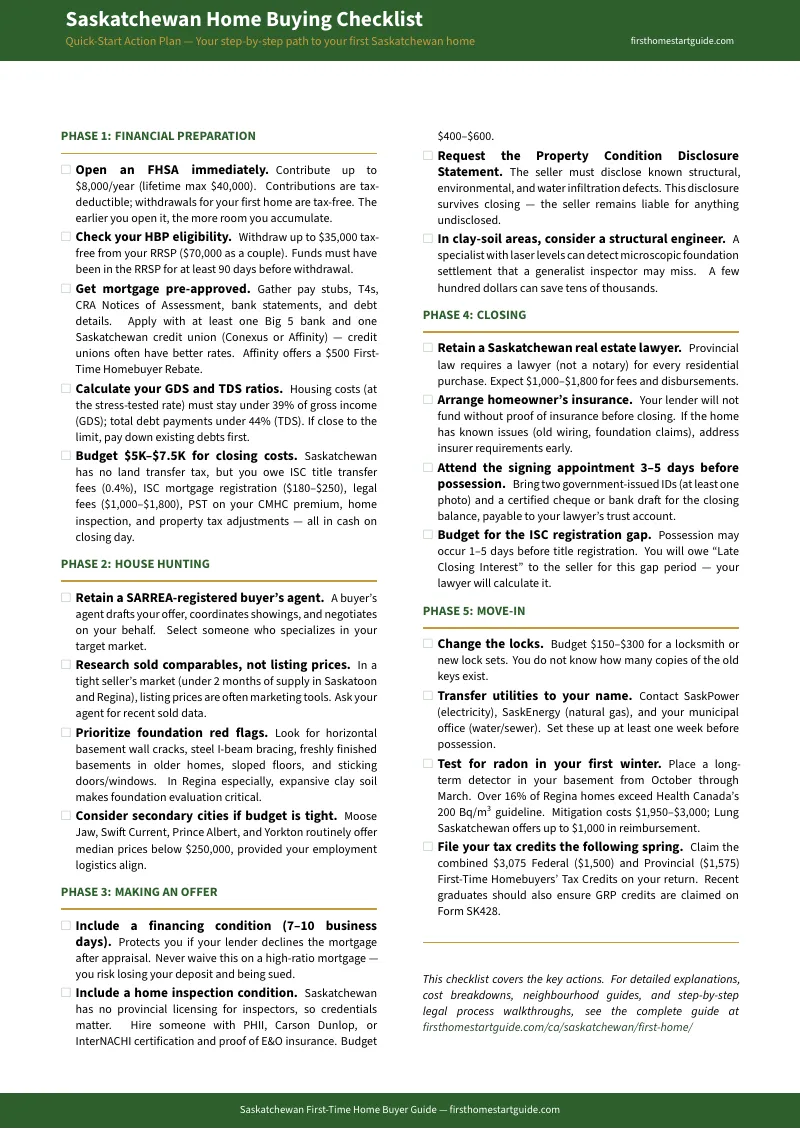
Download the free Saskatchewan Quick-Start Home Buying Checklist to see the step-by-step action plan covering ISC closing cost estimates, clay soil and radon hazard identification, FHSA and HBP eligibility, and the Torrens title closing process. When you are ready for the full intelligence system — the complete guide plus the fillable closing cost worksheet, the property hazard inspection checklist, and the closing timeline reference card — the complete toolkit is here.
You moved to Saskatchewan for the affordability. Now make sure the house you buy does not cost you twice.