You Ran the Numbers on a Saskatoon Duplex. You Forgot the $28,000 Foundation Repair the Listing Didn't Mention.
You found a fourplex in Regina listed at $340,000. Rents totalled $5,400/month. You calculated the cap rate, confirmed the cash flow, and told yourself you'd finally escaped the negative-yield grind of your Ontario portfolio. You put in an offer from Toronto, conditional on financing and inspection. The inspection came back with a single note buried on page four: "deflection observed on west basement wall, recommend structural assessment."
Your agent said it was "common in the area." Your lender's appraiser didn't flag it. You waived the structural condition because your mortgage broker said the deal would collapse if you delayed closing again. Six months later, an unseasonably wet spring forced the gumbo clay against the foundation and the wall bowed another two centimetres inward. You called three foundation companies. The cheapest quote for steel I-beam bracing on three walls plus exterior drainage correction: $28,000. Your first-year "cash flow" vanished in a single capital call.
Or maybe you did the due diligence on the foundation. You found a pre-braced property in Cathedral. You closed, hired a property manager from a Google search, and handed over the keys. Three months later, your tenant stopped paying. You called your PM — voicemail. You emailed — a form response about "following the process." You assumed Saskatchewan's pro-landlord reputation meant this would resolve quickly. What nobody explained was the exact ORT timeline: the 15-day arrears trigger, the Form 7 mechanics, the hearing application window, and the Sheriff enforcement sequence. By the time you figured it out yourself by reading the Residential Tenancies Act at midnight, you had lost four months of rent — $6,200 that your property management company was supposed to know how to recover.
The problem is not that Saskatchewan is risky. The problem is that Saskatchewan's investment math — no land transfer tax, no rent control, no speculation tax, 7-8% cap rates on properties you can actually buy — is so attractive that investors move fast and skip the operational knowledge that separates a cash-flowing asset from a capital-consuming liability.
The Saskatchewan Investment Property Guide is a Prairie Capital Deployment System — a structured operational framework that maps every Saskatchewan-specific financing vehicle, structural risk, tenant law mechanism, and tax structure into a single decision system. It replaces months of cross-referencing CMHC program portals, ORT legislation, Reddit threads about foundation bracing, and credit union rate sheets with one reference that tells you exactly how to acquire, finance, protect, and operate investment property in Saskatchewan without learning the expensive lessons remotely.
What's Inside the Prairie Capital Deployment System
A comprehensive guide, a quick-start checklist, and 8 standalone printable tools — 10 PDFs covering every stage from market selection through portfolio scaling, built specifically for the financing structures, geological risks, and landlord-tenant mechanics that make Saskatchewan unlike any other Canadian province:
Market Selection: Saskatoon vs. Regina vs. Secondary Markets
Every Saskatchewan investor answers the same question first: which city? The guide provides a complete head-to-head comparison — Saskatoon's $421,100 benchmark with tech-and-mining driven appreciation versus Regina's $330,600 benchmark with government-backed 7-8% cap rates. It breaks down vacancy rates by unit size (the 1.4% vacancy rate for 3+ bedroom units in Regina signals an acute shortage), identifies which neighbourhoods are experiencing new-supply softening, maps the secondary markets (Moose Jaw, Prince Albert, Swift Current) with their cap rate premiums and liquidity trade-offs, and shows you exactly which economic profile matches your investment thesis — growth, yield, or both.
Foundation Risk Decoded: The $15,000-$30,000 Question
Saskatchewan's expansive gumbo clay — specifically the sodium bentonite layer beneath Regina — causes foundation bowing that terrifies every out-of-province investor. The guide strips the fear out of this reality by explaining exactly what to look for during inspections (horizontal cracking patterns, inward deflection measurements, heaving on floor slabs), how to interpret structural engineer reports versus general home inspection notes, why pre-braced properties are a positive acquisition signal rather than a red flag, how to price remediation into your offer ($15,000-$30,000 for I-beam bracing plus drainage correction), and how exterior drainage management prevents future movement. This section turns the single biggest fear of out-of-province capital into a quantifiable, manageable cost line in your acquisition spreadsheet.
Financing Architecture: Credit Unions, DSCR, and MLI Select
The guide maps Saskatchewan's entire financing ecosystem. It starts with provincial credit unions (Conexus, Affinity, Innovation) that bypass the federal OSFI stress test and offer more flexible underwriting for investment properties. It covers DSCR loan mechanics — qualifying based exclusively on the property's rental income versus debt obligations, bypassing personal TDS ratios entirely — including the minimum 1.10x-1.30x ratio requirements that determine how many properties you can scale to. For 5+ unit buildings, it walks through the CMHC MLI Select point system: how to earn 100 points to unlock 95% LTV, 50-year amortization, and reduced DSCR requirements. It covers blanket (portfolio) mortgages for consolidating multiple properties under a single facility, and the ISC collateral registration nuances that can push you into higher fee brackets.
The ORT Eviction Framework: 15 Days to Form 7
Saskatchewan's Office of Residential Tenancies provides a structured, enforceable eviction timeline that is dramatically faster than Ontario's LTB or B.C.'s RTB. The guide walks through the exact procedural mechanics: the 15-day arrears trigger for serving Form 7 (Immediate Notice to Vacate), the Form 8 timeline for non-monetary breaches, the hearing application process, the Order of Possession, the Writ of Possession, and the Sheriff enforcement sequence. It includes the timeline for tenant appeals to the Court of King's Bench and explains why partnering with a property management company that understands these mechanics is non-negotiable for out-of-province investors. This is not a general overview — it is a step-by-step operational playbook for protecting your cash flow when a tenant defaults.
Short-Term Rental Zoning: Municipal Licensing by City
For investors modelling Airbnb or VRBO revenue streams, the guide breaks down the regulatory thicket city by city. In Saskatoon: Homestay versus Short-Term Rental Property classifications, the 6-guest limit for detached homes (only 2 guests for duplexes and apartments), parking minimums by zoning district, and which zones require Discretionary Use Approval. In Regina: the $100 Principal Residence licence versus $300 Secondary Property licence, mandatory Fire Inspection for non-owner-occupied properties, 6-guest occupancy cap, and corporate registry requirements for corporate-held assets. The guide tells you exactly which property types and zones support STR revenue — and which ones will strand your investment model on a zoning denial.
Tax Structuring: Personal vs. Corporate Ownership
The guide decodes Saskatchewan's tax landscape for real estate investors. It covers the personal marginal rate structure (25.5% on the first $50,000 scaling to 47.5% above $220,000), the corporate passive income rate (~50% on rental income with refundable mechanism), the small business deduction rate (11.5% on active income), capital gains treatment under both structures, and the practical decision framework: personal ownership is simpler for 1-3 properties, but corporate structuring provides liability protection, estate planning flexibility, income splitting, and preserved personal borrowing capacity for portfolio scaling. It includes the $2,000-$5,000 annual compliance cost reality and helps you determine the inflection point where incorporation makes mathematical sense.
Closing Cost Worksheet
Saskatchewan's closing costs are lower than any other major province — but they are not zero. The guide includes a complete fillable worksheet covering: ISC title transfer fee (0.4% of property value), mortgage registration fees ($180-$1,000 tiered by mortgage amount), title search and insurance, conveyancing lawyer fees (~$1,200), property tax adjustments on the Statement of Adjustments, and security deposit transfers for tenanted acquisitions. No land transfer tax. No speculation tax. No foreign buyer tax. The worksheet shows you the exact capital required beyond your down payment so you never underfund an acquisition.
Property Management Due Diligence
For out-of-province investors, hiring the wrong property manager is the difference between a cash-flowing portfolio and a management nightmare. The guide provides a structured interview framework: 4-point tenant screening verification (credit, employment, landlord references, income), ORT procedural knowledge testing, vacancy turnaround benchmarks, maintenance response protocols, and the fee structure breakdown (8-10% of gross rent monthly is standard). It includes red flags that indicate a PM will not protect your investment, and the specific operational capabilities that matter for Saskatchewan's unique challenges — foundation monitoring, winter maintenance coordination, and eviction timeline execution.
Who This Guide Is For
- Ontario and B.C. investors fleeing negative cash flow who are drawn by Saskatchewan's no-LTT, no-rent-control, no-speculation-tax environment but need the operational framework to actually execute acquisitions remotely without learning every lesson at their own expense
- Local Saskatchewan homeowners leveraging primary residence equity to buy their first rental property and wanting to understand DSCR financing, corporate structuring, and property management delegation before they scale
- Portfolio scalers seeking CMHC MLI Select financing who need to understand exactly how the 100-point system works, which social outcomes to commit to, and how 95% LTV with 50-year amortization transforms the math on 5+ unit buildings
- Investors terrified of "gumbo clay" who have read horror stories about foundation failures on Reddit and need the actual technical framework — what to inspect, how to price remediation, and why pre-braced properties are opportunities rather than red flags
- Anyone modelling short-term rental income in Saskatchewan who needs to verify that their target property's zoning supports STR use before acquisition — not after the purchase closes and a licensing application gets denied
- Canadian investors hitting personal borrowing ceilings who need to understand DSCR loans, blanket mortgages, and corporate structuring as mechanisms to bypass OSFI stress test limits and continue scaling without personal debt-to-income constraints
Why Not Free Tools and Forums?
Free information about investing in Saskatchewan exists. Here is what it actually gives you:
- Brokerage market reports give you average prices and sales volumes. They do not tell you which neighbourhoods are experiencing new-supply softening, what the foundation remediation costs are in each area, or how to structure your offer to account for geological risk.
- Reddit threads give you anonymous opinions from investors who may or may not own property in the province. They do not give you the procedural mechanics of Form 7, the exact ISC fee tiers, or a structured comparison of DSCR versus conventional financing for your specific portfolio size.
- Credit union websites list their products but do not explain how provincial regulation exempts them from the federal stress test, why that matters for your fifth property, or how collateral charge registration amounts affect your ISC fees.
- Foundation repair company blogs explain what gumbo clay is. They do not tell you how to identify pre-braced properties, how to negotiate remediation costs into your acquisition price, or how to distinguish "settling" (benign) from "active structural failure" (expensive) in an inspection report.
- Property management listings exist on every platform. None of them tell you which interview questions reveal whether a PM actually knows the ORT eviction timeline, which screening protocols protect against delinquent tenants, or what turnaround benchmarks indicate professional versus amateur operations.
The Saskatchewan Investment Property Guide unifies everything that free tools scatter across twenty tabs into a single operational system. It maps the financing, the risks, the procedures, and the tax structures into one decision framework — built specifically for the investor deploying capital into Saskatchewan from anywhere in Canada.
Satisfaction Guarantee
If the guide does not give you a clearer framework for evaluating, financing, and operating Saskatchewan investment property than anything you have found for free, email us for a full refund. No time limit, no questions.
— Less Than One Month of the Cash Flow This Guide Helps You Protect
A single foundation surprise costs $15,000-$30,000. A single mismanaged eviction costs four months of lost rent. A single missed DSCR qualification costs you the property entirely. The guide costs a fraction of any one of these mistakes — and it covers all of them.
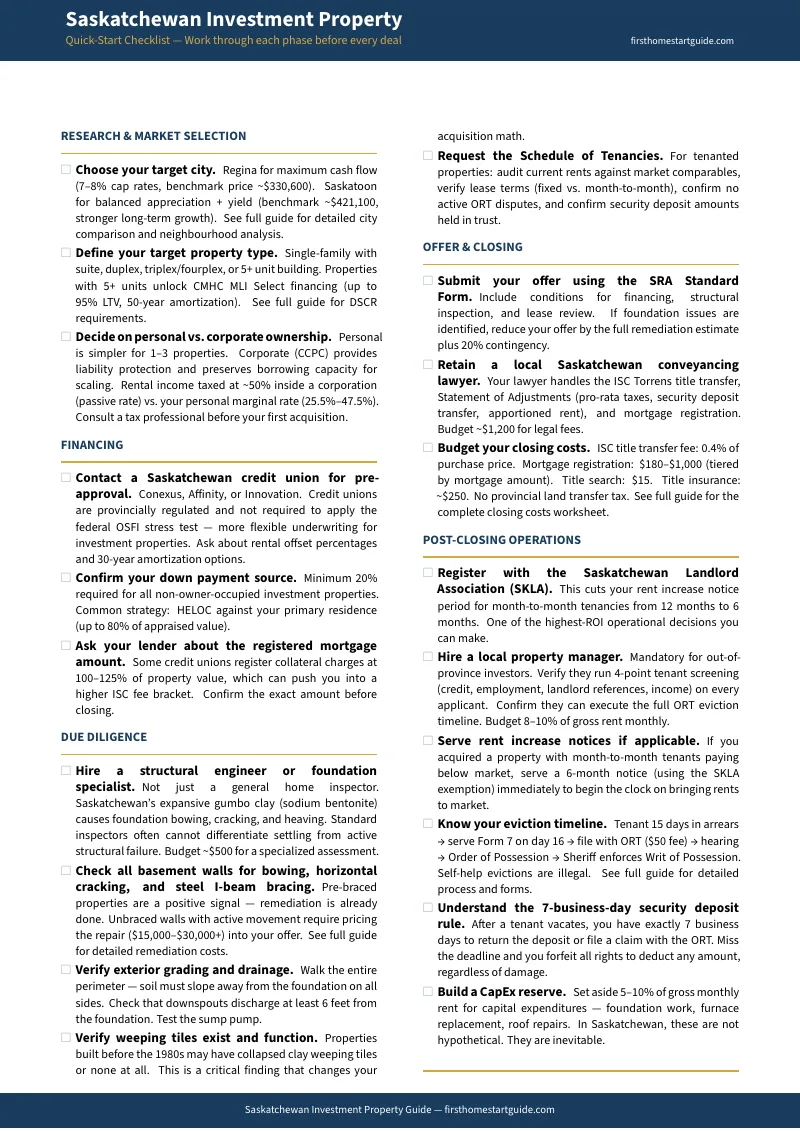
Download the free Saskatchewan Quick-Start Checklist to see the 20-step framework, or get the full Saskatchewan Investment Property Guide for the complete operational system: financing architecture, foundation risk framework, ORT procedural playbook, tax structuring analysis, and closing cost worksheets.