The Listing Said $530,000. The Appraisal Came In $35,000 Lower. The Foundation Had Screw Jacks You Didn't Know Existed. The Heating Bill Was $1,200 a Month.
You found a row house in Whistle Bend listed at $530,000. Or a condo in downtown Whitehorse for $460,000. Or a mobile home in the Hillcrest area for $350,000 that felt like the only realistic option after watching single-detached homes blow past $789,000 and never come back. Your mortgage broker says you qualify. The Yukoner First Home Program says you're eligible for down payment help. You're ready to make an offer.
Then the layers start peeling back. You bid $545,000 to beat three competing offers in a market where homes sell at 103.6% of list price and close in 26 days. The lender orders an appraisal. The appraiser, working from comparable sales data that lags behind real-time demand in a low-volume market, values the home at $510,000. The bank will only finance based on the appraised value. You now need $35,000 in cash you didn't budget for — on top of your down payment, your closing costs, and the CMHC insurance premium. Then your inspector discovers the home sits on adjustable screw jacks over discontinuous permafrost. The foundation is designed to be physically relevelled every season as the ground heaves in winter and settles during thaw. Nobody mentioned this. The inspector points out tilting spruce trees behind the property — "drunken forest," which signals active permafrost degradation. They recommend a geotechnical engineer assessment: $3,000 to $5,000. Your mortgage broker in southern Canada has never seen a screw jack in their career. The file gets flagged. Underwriting delays stretch past your financing condition deadline. Meanwhile, your first heating bill arrives for the rental you're leaving — $1,200 for a single month on furnace oil at $2.02 per litre — and you realize nobody has explained what the home you're buying will actually cost to heat through a sub-arctic winter.
Here's the problem: The Yukon layers a government-controlled land supply where residential lots are distributed by public lottery with 244 applicants competing for 55 parcels, a Yukoner First Home Program that requires you to already possess 50% of your minimum down payment plus 100% of closing costs before it covers the other half, discontinuous warm permafrost that can destroy foundations through differential settlement requiring homes built on adjustable screw jacks that must be manually relevelled every season, a heating fuel matrix where furnace oil spikes to $2.02 per litre and a compromised thermal envelope can push annual heating costs past $15,000, an appraisal gap problem driven by chronic inventory shortages where a $30,000 cash demand can kill a deal after you've already beaten four other bidders, an unregulated home inspection industry with no licensing requirements, and mortgage underwriting routed to southern offices that have never seen a Permanent Wood Foundation or a First Nations leasehold — into a market where the average single-detached home costs $789,200 and condominiums just dropped 22.5% year-over-year creating a narrow window that will not stay open. Every one of these has cost real first-time buyers thousands or tens of thousands of dollars because the information existed across different government PDFs, different Yukon Housing Corporation application forms, different Reddit threads on r/whitehorse, and different municipal engineering reports — and nobody had assembled it into a single decision framework.
The Yukon First-Time Home Buyer Guide is a Northern Ownership System — not a motivational overview of sub-arctic homeownership, but a structured process that maps every Yukon-specific financial program, every foundation risk signal, every heating cost calculation, and every legal requirement into a framework you work through before you sign anything. It replaces months of cross-referencing Yukon Housing Corporation policies, Land Management Branch lottery documents, CMHC default insurance tables, City of Whitehorse building codes, and contradictory advice on r/whitehorse with a single reference that tells you exactly what you qualify for, exactly what can go wrong beneath the foundation, and exactly what the home will cost to own through a Yukon winter.
What's Inside the Northern Ownership System
A 12-chapter guide and a quick-start checklist — covering every stage from financial preparation through your first winter of ownership, built specifically for the sub-arctic engineering, government land control, and extreme heating costs that make the Yukon fundamentally different from any market in southern Canada:
The Yukoner First Home Program — How the Down Payment Math Actually Works
The YHC provides a subordinate loan covering up to 50% of your minimum down payment, capped at 5% of the purchase price, at a fixed 2.5% interest rate with deferred repayment. This is not a grant. It is not free money. And the prerequisite trips up nearly every first-time applicant: you must already have verifiable funds covering the other 50% of your down payment plus 100% of all anticipated closing costs, documented with three months of bank statements and a current CRA Notice of Assessment. The guide walks through the exact eligibility requirements, the documentation you need before you apply, the property price ceiling that restricts purchases to at-or-below average sale prices, and a worked example at every common Whitehorse price point so you know precisely how much cash you need before the YHC will cover the rest.
The Federal Program Stack — FHSA, HBP, and HBTC Optimization
The First Home Savings Account lets you contribute $8,000 per year (up to $16,000 in a catch-up year) toward a $40,000 lifetime maximum — tax-deductible going in, tax-free coming out. The Home Buyers' Plan lets you withdraw $60,000 from your RRSP per person ($120,000 as a couple) tax-free. The Home Buyers' Tax Credit gives you $1,500 back on your first return after closing. The guide covers the timing rules, the 90-day RRSP seasoning requirement, the 15-year HBP repayment schedule, and the advanced RRSP-to-HBP strategy that lets a couple mobilize up to $200,000 in tax-sheltered capital for a down payment.
Permafrost, Foundations, and the Inspection That Actually Matters
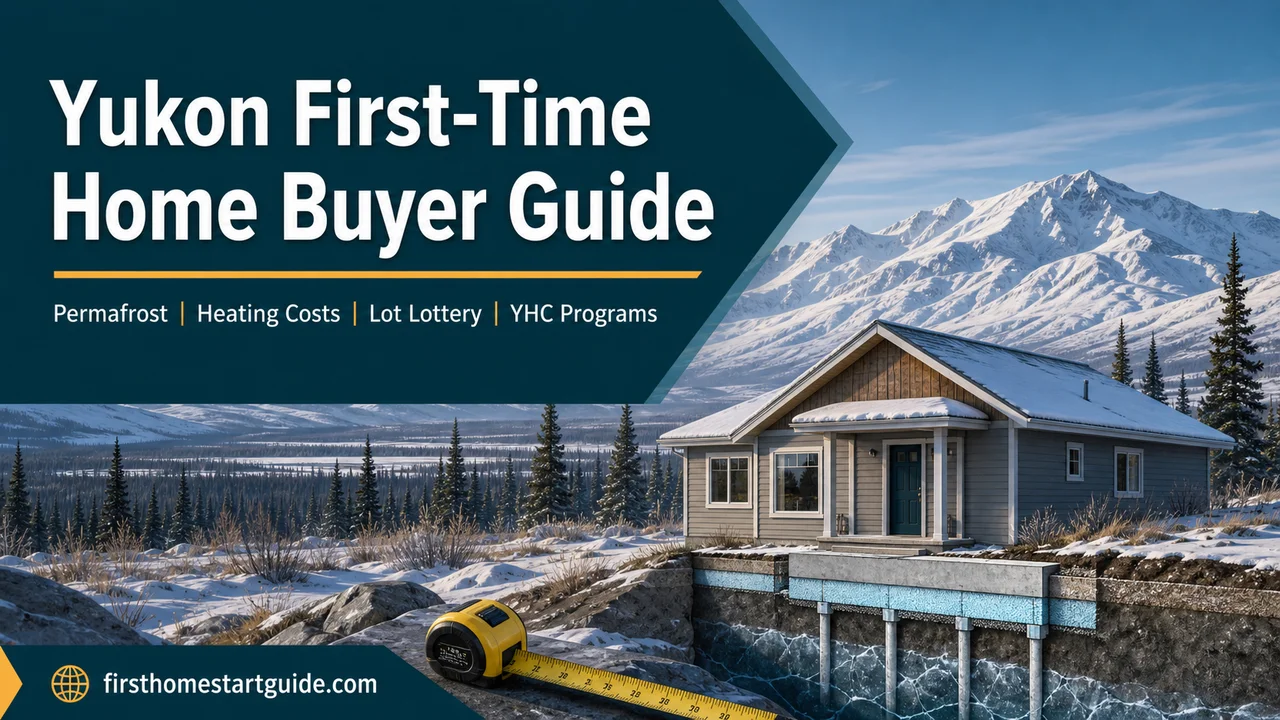
Whitehorse sits on discontinuous warm permafrost — ground that hovers at -0.13 degrees Celsius and is actively degrading. When permafrost thaws, it settles. When it settles under a house, the foundation cracks, walls split, and the building sinks. The guide covers how to identify permafrost indicators before you enter a home (drunken trees, thermokarsts, standing marsh water), how to evaluate the three northern foundation types (Permanent Wood Foundations, driven steel pilings, and adjustable screw jacks on granular pads), when to demand a geotechnical engineer assessment, and what it means when your inspector says "this home needs seasonal relevelling." In the Yukon, a standard home inspection is not enough. The inspection industry is completely unregulated — no territorial licensing exists. The guide explains which credentials to require (InterNACHI, PHII), why thermal imaging is mandatory before purchasing any older home, and what southern inspectors routinely miss in northern properties.
Heating Costs — The Ongoing Expense That Breaks Budgets
A standard Whitehorse home uses approximately 164 gigajoules of energy per year. Furnace oil fluctuates between $1.87 and $2.02 per litre. Electricity is billed on tiers starting at $0.163/kWh and rising to $0.216/kWh above 2500 kWh. Wood pellets cost $394 per ton at 70% appliance efficiency. The guide compares every fuel source by cost per useful gigajoule, explains the City of Whitehorse building standards (R28 walls, R60 ceilings, 1.5 ACH50 blower door test), walks through the energy retrofit rebate program (up to $10,000), and gives you a worksheet to calculate the true annual heating cost of any home based on its thermal envelope rating — so a $350,000 mobile home with a compromised building envelope does not become a $15,000-per-year heating trap.
The Lot Lottery — Mechanics, Odds, and Financial Reality
When existing inventory is priced out of reach, the Government of Yukon releases residential lots through public lottery. Whistle Bend alone has released approximately 1,200 lots across eight phases. The process sounds simple: pay $25 to apply, rank your preferred parcels, hope your ticket gets drawn. The reality: 244 applicants for 55 single-family lots. If you win, you have 24 hours to accept and forfeit a $300 deposit if you decline. You then pay a 20% lot down payment immediately (over $20,000 for a typical lot), face a punitive interest rate of 5% or Bank of Canada rate plus 2.5% on the balance, and must build within a strict three-year compliance window. The guide explains the full application process, the financial requirements after winning, the construction timeline mandate, and why the lot lottery should be understood as a secondary strategy — not a primary path to homeownership.
The Zero Land Transfer Tax Advantage — And What You Pay Instead
Ontario and BC buyers pay $8,000 to $15,000 or more in land transfer taxes at closing. In the Yukon, this tax does not exist. You pay only nominal Land Titles registration fees — a $29.25 base plus $0.25 per $1,000 of property value above $25,000, and $42.00 plus $0.25 per $1,000 of mortgage principal above $50,000. Total fees on a $500,000 purchase with a $400,000 mortgage: approximately $600. The guide covers the exact fee calculations, the Assurance Fund Fee for properties above $500,000, and how this structural tax advantage lets you redirect thousands of dollars toward your YHC prerequisite, an appraisal gap reserve, or critical energy upgrades.
First Nations Settlement Land Housing
For Kwanlin Dun First Nation and Ta'an Kwach'an Council citizens, settlement land housing operates under a completely separate framework. Traditional fee-simple mortgages are legally impossible on collectively held settlement land. The guide covers the KDFN Market-Based Housing Policy, how leasehold mortgages work, the $300,000 loan cap at 5% minimum down payment with 25-year amortization, the allocation and lease process, and the Housing Accelerator Fund injection of $7.2 million for 107 new units by 2027. It also covers the Rural Home Ownership Program for buyers building outside Whitehorse — 2.5% down payment loans for those who cannot secure bank financing.
Appraisal Gaps, Bidding Wars, and the Northern Mortgage Ecosystem
In a 26-day market with chronic inventory shortages, you will likely bid above asking price. The bank will likely appraise the home below what you offered. The difference must be covered in cash. The guide explains how appraisal gaps form in low-volume markets, how to structure a cash reserve of $10,000 to $15,000 specifically for gap coverage, why southern underwriters flag PWF foundations and screw jacks as risk factors, and why retaining a local Whitehorse mortgage broker who can explain northern construction to southern risk assessors is not optional — it is the difference between a funded mortgage and a collapsed deal.
Who This Guide Is For
This guide is for first-time home buyers in the Yukon who:
- Are a long-term Whitehorse renter — employed by the territorial government, a federal agency, or a First Nations self-government — who has watched the market reprice since 2020 and needs to convert stable income into ownership before single-detached homes become permanently out of reach, using every territorial and federal program to assemble a competitive down payment
- Are relocating to Whitehorse for an indeterminate government or healthcare position and bring fresh capital but zero familiarity with permafrost foundations, government lot lotteries, screw jack relevelling, oil tank inspections, or the reality that your southern mortgage underwriter has never processed a Yukon file
- Are a Kwanlin Dun First Nation or Ta'an Kwach'an Council citizen exploring homeownership on settlement land and need to understand the leasehold mortgage framework, the KDFN Market-Based Housing Policy, and how the loan parameters differ from conventional fee-simple financing
- Are targeting a condo or mobile home as your entry point after being priced out of the single-detached market and need to understand the full cost of ownership — including CMHC insurance premiums, strata fees, heating costs, and foundation risks — before you commit to a property that looks affordable but carries hidden ongoing liabilities
Why Not Free Tools and Government Websites?
Free information on buying a home in the Yukon exists. Here's what it actually delivers:
- CMHC and CRA resources explain the FHSA, HBP, and stress test mechanics at a national level. They do not explain the Yukoner First Home Program's 50% prerequisite, the property price ceiling that restricts which homes qualify, the lot lottery application process, or the reality that your appraiser will work from comparable sales data in a market with fewer than 300 annual transactions. You get federal program descriptions without the territorial context that determines whether you can actually use them.
- Yukon Housing Corporation publishes functional program outlines alongside PDF application forms. These describe the YHC loan parameters but do not walk you through the documentation sequence, explain how the dynamic price ceiling interacts with real-time market data, or help you coordinate YHC timing with your mortgage pre-approval and offer strategy.
- The Land Management Branch provides technical manuals, survey sketches, and legal guidelines for the lot lottery. These are written for land surveyors and lawyers — not for a first-time buyer trying to understand whether the lottery is a realistic path or a statistical dead end with a 22% success rate and a three-year building mandate.
- Reddit threads on r/whitehorse and r/yukon are where buyers share real experiences with appraisal gaps, permafrost nightmares, and heating cost shock — mixed with contradictory advice, outdated information, and warnings from people who got burned. Sorting signal from noise while your financing condition deadline is ticking is not a strategy.
This guide fills the Yukon-specific gap — the space between knowing you want to buy a home in Whitehorse and knowing how to buy one without an appraisal gap that kills your deal, a permafrost foundation that cracks within three years, a heating bill that devours your monthly budget, or a YHC application that gets rejected because you assembled your documentation in the wrong order. It is the analysis that would take a northern real estate lawyer, a geotechnical engineer, a mortgage broker, and an energy advisor to assemble — structured as a reference you own permanently.
— Less Than One Month's Heating Oil Top-Up
A single appraisal gap in a competitive bid costs $20,000 to $35,000 in unbudgeted cash. A home with a compromised thermal envelope costs $10,000 to $15,000 per year more to heat than a properly insulated one. A missed FHSA contribution is $8,000 per year in tax deductions you never claimed. A failed YHC application because you assembled your documents out of sequence delays your purchase by months in a market that moves in 26 days. A foundation on degrading permafrost that nobody assessed before closing can mean $50,000 in structural repairs — or a home that cannot be resold.
This guide does not replace your lawyer or your mortgage broker. But it gives you the YHC qualification framework, the permafrost inspection protocol, the heating cost calculation worksheet, the federal program stacking strategy, and the closing cost breakdown that ensure you budget accurately, inspect for northern-specific risks, claim every dollar of available tax relief, and build a cash reserve for the appraisal gap that will almost certainly come — instead of discovering these realities on closing day, during your first heating season, or when the ground shifts beneath your foundation.
If it catches a single YHC documentation error, prevents a single uninspected permafrost purchase, or captures a single FHSA contribution you would have missed, it pays for itself before you finish reading it.
Money-back guarantee, no time limit. If the guide doesn't sharpen your buying strategy and protect your budget in the Yukon's sub-arctic market, you pay nothing.
Your download includes the full 12-chapter guide, the quick-start checklist, and 3 standalone printable tools — a Closing Cost Worksheet to calculate your exact cash requirements, a Northern Inspection Checklist to bring to every property viewing, and a Heating Cost Comparison Card showing every fuel source by cost and efficiency. Together they cover the Yukoner First Home Program qualification, FHSA and HBP optimization, the lot lottery system, permafrost foundation assessment, heating cost analysis, First Nations settlement land housing, the zero land transfer tax advantage, appraisal gap strategy, mortgage qualification in a northern market, and the complete legal closing process from offer to key delivery.
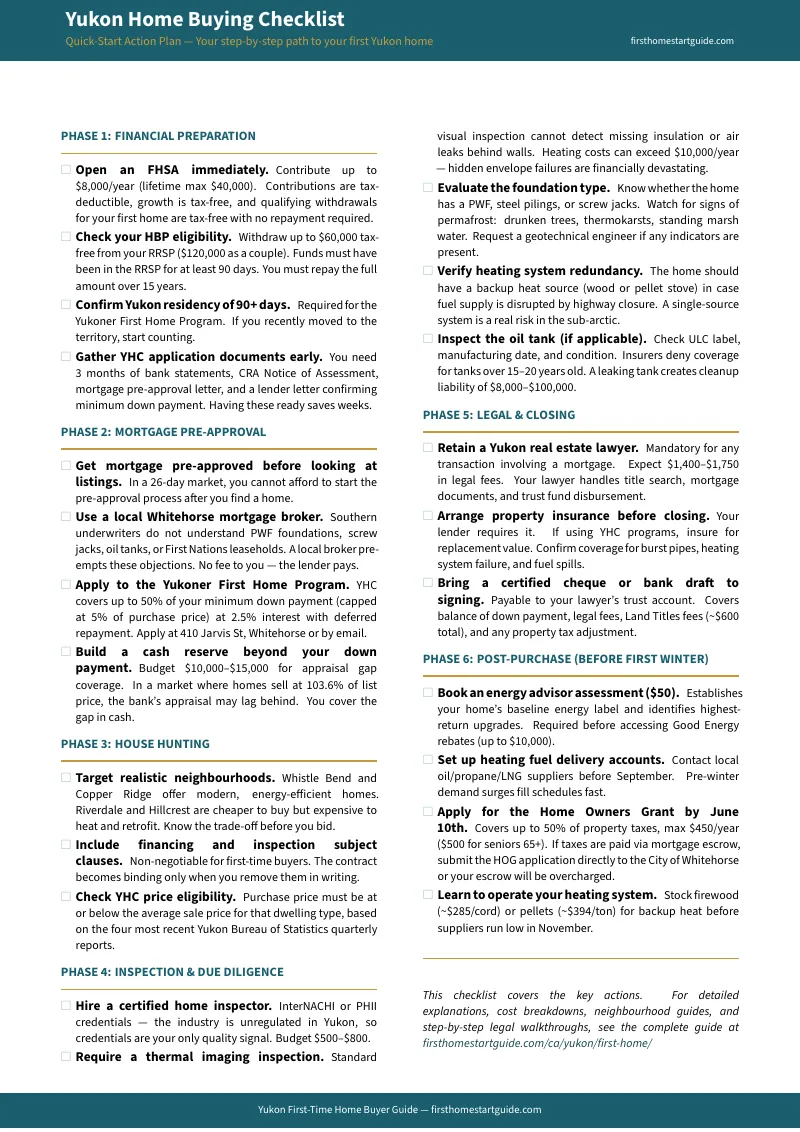
Download the free Yukon Quick-Start Home Buying Checklist to see the step-by-step action plan covering financial preparation, mortgage pre-approval, inspection due diligence, and legal closing. When you're ready for the full Northern Ownership System — the 12-chapter guide with worked examples, cost worksheets, and the complete permafrost inspection protocol — the complete toolkit is here.
The mortgage calculator says you can afford the home. This guide tells you what the home will actually cost to own through a Yukon winter.
Frequently Asked Questions
What if the rules change after I buy?
We update the guide when the rules change. Email us any time, even years later, and we'll send you the current edition free.