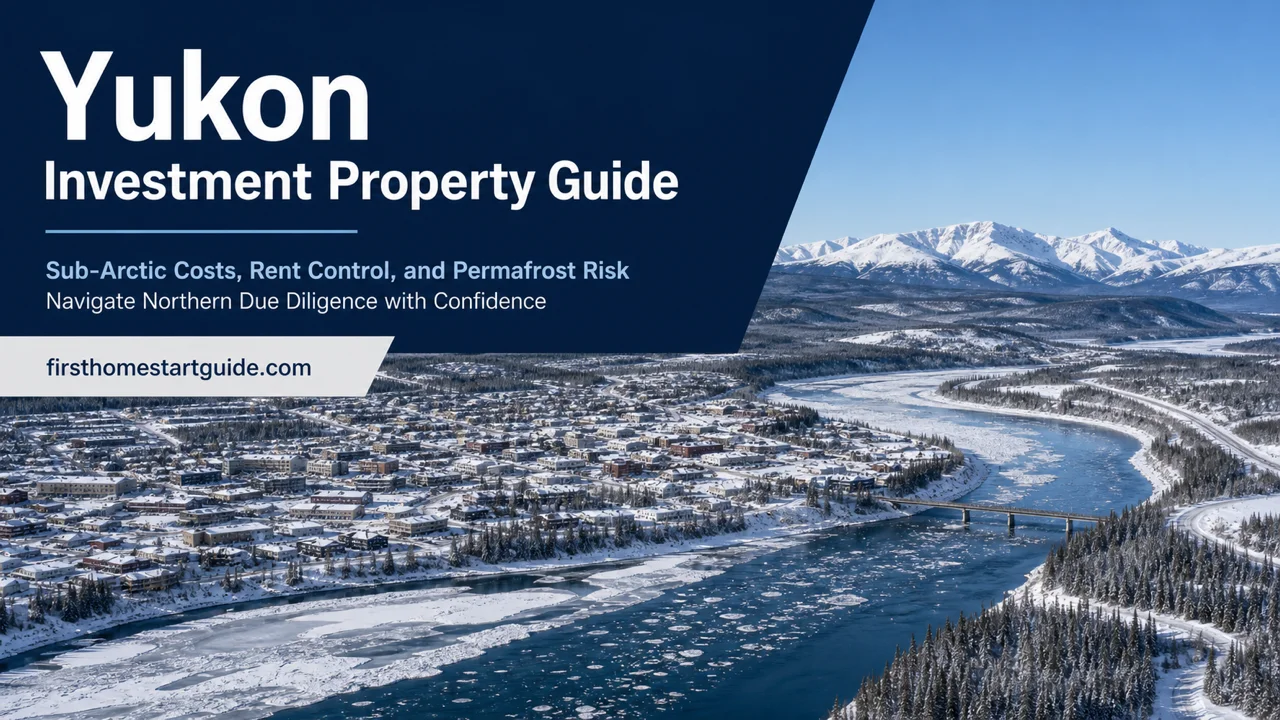
The Northern Affordability Play Falls Apart When You Hit the Heating Bill at Minus Forty, the STR Ban That Killed Your Airbnb Plan, and the Rent Cap That Won't Let You Catch Up
You found a Whitehorse duplex listed at $520,000 — less than a studio condo in Vancouver. Two units renting at $2,200 each in a market with a 1.2% vacancy rate and 0.0% for condos. You ran the numbers against southern Canada and the yield looked exceptional, especially when you factored in zero land transfer tax — Yukon charges a flat Land Titles Office fee of roughly $560 instead of the $8,000-plus you would pay in BC. You planned to hold one unit as a long-term rental anchored by government tenants (48% of Yukon's workforce is public sector) and list the other as a short-term rental targeting summer tourists and winter aurora seekers.
Then Yukon-specific reality arrived. Your short-term rental plan is dead in Whitehorse. The May 2026 STR zoning bylaw requires operators to use their principal residence — you must live there. Operating an investor-owned Airbnb outside the narrow commercial zone loophole is now prohibited. The federal government denies all income tax deductions for non-compliant short-term rentals, meaning you pay tax on gross revenue, not net profit. On $45,000 in rental income with $32,000 in carrying costs, the difference is catastrophic.
Your long-term rental math has a silent ceiling. The Residential Tenancies Act 2025 caps rent increases at 2.6% annually, bans no-cause evictions entirely, and prohibits the use of algorithmic rent-setting tools. You cannot raise rent to market rate between tenants without cause. And that 2.6% cap? The Yukon government has committed to letting it expire in spring 2027 — but "committed" is a political promise attached to an election cycle, not a statutory sunset clause. If you set your initial rent wrong, you may never catch up.
Then winter arrived. Your heating bill for one unit came in at $4,500 for the season — heating oil at $2.02 per litre (up 26% year over year), no natural gas infrastructure anywhere in the territory, and your propane tank's recertification date had quietly expired. The property inspector flagged differential settlement in the foundation — 50 centimetres of sink over 11 years, consistent with permafrost degradation in the Whitehorse Copper subdivision. Your appraiser told you automated valuation models don't work in Yukon's thin market, so you need a bifurcated appraisal process that costs three times what you budgeted.
Here's what no single resource explains: Yukon layers zero land transfer tax (which draws investors in) against sub-arctic operational costs that silently destroy cash flow (heating oil with no natural gas alternative, property taxes that have risen steadily without public debate, permafrost degradation that requires adjustable foundation jacks and annual monitoring), a brand-new Residential Tenancies Act with a 2.6% rent cap and no-cause eviction ban, a Whitehorse STR bylaw that effectively prohibits investor-owned short-term rentals, a 100-day tourism window in Dawson City followed by a nine-month dead zone, and a bifurcated appraisal process because automated valuation models fail in a market with fewer than 400 annual transactions. Each of these has cost real investors tens of thousands because the information was scattered across Yukon Bureau of Statistics reports, RTO bulletins, City of Whitehorse planning documents, and Reddit threads — but nobody had assembled it into a single due diligence system calibrated to Yukon.
The Yukon Investment Property Guide is a Northern Due Diligence System — not a generic Canadian real estate overview, but a structured sub-arctic investment framework that maps every Yukon-specific regulatory mechanism, tax advantage, operational cost, climate risk, and market constraint into a process you work through before you commit capital. It replaces months of cross-referencing YBS vacancy reports, the new RTA, City of Whitehorse zoning bylaws, permafrost mapping data, and forum posts with a single reference that tells you exactly what to verify, exactly where the numbers break, and exactly which strategies work in the territory versus which ones don't.
What's Inside the Northern Due Diligence System
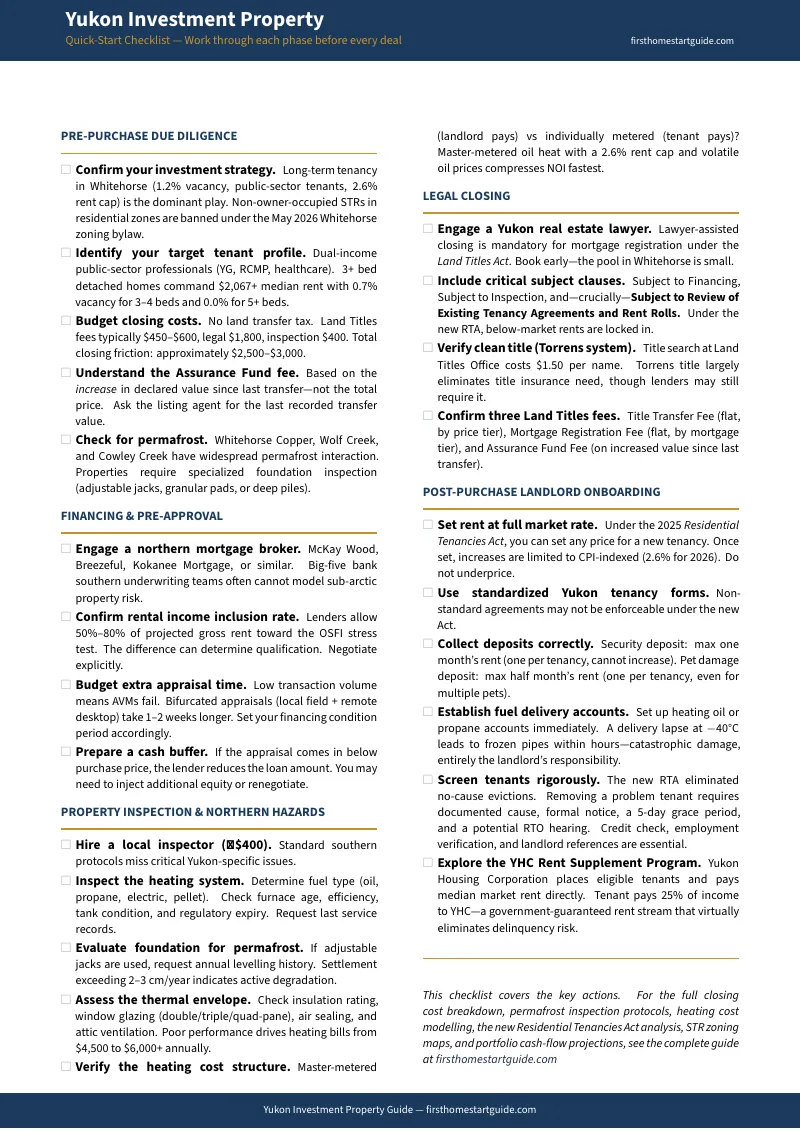
A comprehensive guide, a standalone due diligence checklist, and three printable reference tools — covering every stage from financial modelling through post-purchase operations, built specifically for the regulatory mechanics and environmental risks that make Yukon unlike any other Canadian jurisdiction:
Zero Land Transfer Tax Advantage Analysis
The single most powerful draw for out-of-territory investors — and the number that makes the spreadsheet sing. Yukon charges no percentage-based land transfer tax. The Land Titles Office collects a flat registration fee of approximately $560 regardless of purchase price. On a $520,000 property, you save $8,000 compared to British Columbia and $6,500 compared to Ontario. The guide quantifies the full closing cost advantage with a worked example: $520,000 purchase, $2,760 total closing costs, $14,504 annual operating expenses — and then stress-tests those numbers against the reality of sub-arctic carrying costs that erode the tax savings within the first 18 months if you haven't modelled them correctly.
RTA 2025 Rent Control Navigation
The Residential Tenancies Act 2025 fundamentally changed the landlord-tenant landscape in Yukon. The guide covers the 2.6% annual rent increase cap (tied to CPI), the complete ban on no-cause evictions, the prohibition on AI and algorithmic rent-setting tools, the mandatory 90-day notice period for rent increases using the prescribed form, and the dispute resolution process through the Residential Tenancies Office. It explains why your initial rent-setting is the most consequential financial decision you will make — you cannot reset to market between tenants, and the 2.6% cap compounds to only 13.8% over five years against heating costs rising 26% in a single year. The guide also covers the spring 2027 rent cap expiration commitment: what the government has promised, what the legislative mechanism actually requires, and what happens if a new government decides otherwise.
Whitehorse STR Zoning Framework
The May 2026 Whitehorse zoning bylaw effectively ended the investor-owned short-term rental model in the capital. The guide covers the principal residence requirement (you must live at the property), the commercial zone loophole (properties zoned C1 or C2 may still operate investor-owned STRs — but the inventory is extremely limited), the business licence application process, the insurance requirements, and the federal CRA non-compliance penalty that denies all deductions for non-compliant STRs. It also maps the regulatory landscape outside Whitehorse — where Dawson City's tourism economy creates a genuine but severely time-constrained STR opportunity.
Dawson City Tourism Investment Reality Check
Dawson City's 100-day peak season (June through September) commands premium nightly rates driven by Klondike heritage tourism, the Dempster Highway corridor, and northern lights seekers. The guide stress-tests these numbers against the nine-month dead zone — mortgage payments, insurance, heating costs for a vacant property at -40C, the cost of a local property manager when you are 530 kilometres away in Whitehorse or 2,000 kilometres away in Vancouver, and the seasonal utility shutoff and recommissioning costs. Many Dawson City investment properties operate at a net annual loss. The guide separates the tourism marketing from the financial reality with a 12-month carrying cost model.
Sub-Arctic Operational Cost Modelling
This is the constraint that most fundamentally changes the math for Yukon investment properties. Heating oil at $2.02 per litre with no natural gas infrastructure anywhere in the territory — every property runs on heating oil, propane, electric baseboard, or wood pellets. The guide covers annual heating cost projections at multiple fuel prices and property sizes, propane tank recertification dates (miss one and your insurance may be void), the "silent squeeze" of Whitehorse property taxes that have risen steadily without the political visibility of a formal rate increase, water delivery costs for properties outside municipal service areas, and the full annual OpEx breakdown for a typical Whitehorse rental property. The worked model: $14,504 annual operating expenses on a $520,000 property before mortgage payments.
Permafrost and Foundation Risk Assessment
The invisible structural risk that no listing agent will volunteer. The guide covers the Whitehorse subdivisions with documented permafrost degradation — Whitehorse Copper, Wolf Creek, and Cowley Creek — where differential settlement of 50 centimetres over 11 years has been measured. It explains adjustable steel screw jacks (the standard remediation for permafrost-affected foundations), annual monitoring requirements, the cost of foundation stabilisation when jacks are no longer sufficient, and how to read the Yukon Geological Survey's terrain hazard mapping before you make an offer. Climate change is accelerating permafrost thaw across southern Yukon — this is not a static risk but an escalating one.
Bifurcated Appraisal Process
Automated Valuation Models fail in Yukon. Fewer than 400 residential transactions occur territory-wide in a typical year — there are not enough comparable sales for algorithmic pricing. The guide explains the bifurcated appraisal process used by Yukon lenders (sales comparison where possible, cost approach where comparable data is insufficient), why appraisals take longer and cost more than in southern Canadian markets, how to budget for the appraisal contingency, and why pre-approval from a southern lender does not guarantee they will lend on a Yukon property once the appraiser's report arrives.
YHC Rent Supplement and Government Tenant Strategy
Yukon Housing Corporation's Rent Supplement Program pays a portion of qualifying tenants' rent directly to the landlord — government-guaranteed income in a territory where 48% of the workforce is public sector. The guide covers the program eligibility criteria, the application process for landlords, the rent amount determination methodology, the payment reliability, and how to structure your rental strategy around government-employed and government-subsidized tenants who provide the most stable cash flow in a market with 1.2% vacancy.
Tax Planning and the CCA Trap
Yukon has no territorial sales tax — but the income tax picture requires careful planning. The guide covers T776 rental income reporting, Capital Cost Allowance at Class 1 (4% declining balance for residential buildings), the recapture trap on disposition (a decade of CCA claims creates a significant tax bill in the year of sale), the federal 12-month property flipping rule that treats gains as business income rather than capital gains, and the capital gains inclusion rate increase to 66.67% above $250,000 annually for individuals. It also covers the Yukon-specific deductions that southern investors often miss and the territorial tax credits that partially offset operating costs.
Standalone Printable Tools
Three reference tools you can print independently — fill in during due diligence, bring to your lawyer, or use as an operational reference:
- Closing Cost Worksheet — estimate every dollar you need to close on a Yukon investment property, from the flat Land Titles Office registration fee through legal counsel, title insurance, property inspection, and the appraisal contingency budget for a thin-market bifurcated appraisal
- RTA Rent Control Quick Reference — the 2025 RTA rent increase cap, no-cause eviction ban, prescribed notice forms, dispute resolution process, security deposit rules, and the spring 2027 expiration timeline on a single printable card
- Sub-Arctic OpEx Calculator — annual operating expense estimation covering heating fuel at multiple price points, property tax projections, insurance, water delivery, snow removal, and maintenance reserves calibrated to northern climate wear
Who This Guide Is For
This guide is for real estate investors targeting Yukon who:
- Are long-term Whitehorse residents looking to leverage existing home equity into a rental property and need to understand the new RTA rent control mechanics, the 2.6% cap and its spring 2027 expiration timeline, the Whitehorse STR zoning ban, sub-arctic operational cost modelling, and permafrost risk assessment for specific subdivisions before deploying capital into their own territory's investment market
- Are out-of-territory Canadian investors attracted by zero land transfer tax and need the honest math — the $560 flat fee that saves thousands at closing against the $14,504 annual OpEx, heating oil at $2.02 per litre with no natural gas alternative, the bifurcated appraisal process that southern lenders may not accept, and the thin-market liquidity risk when you want to sell
- Are targeting Whitehorse long-term rentals anchored by government tenants and need to understand the 48% public-sector workforce, the YHC Rent Supplement Program for guaranteed rental income, why your initial rent-setting is irreversible under the new RTA, and how to model cash flow against heating costs that rose 26% in a single year
- Planned a short-term rental strategy in Whitehorse and need to understand why the May 2026 zoning bylaw killed it for investor-owned properties, what the commercial zone loophole actually allows, and where the federal CRA non-compliance penalty turns your gross revenue into a tax liability instead of a tax shelter
- Are evaluating Dawson City tourism properties and need the 12-month carrying cost reality check against the 100-day peak season — covering the nine-month dead zone, remote property management costs, winterisation expenses, and why the Klondike tourism numbers do not translate to annual positive cash flow
- Need the permafrost risk assessment before making an offer — which Whitehorse subdivisions have documented settlement, what adjustable jacks cost, how to read the Yukon Geological Survey terrain hazard mapping, and how climate change is accelerating thaw in southern Yukon
Why Not Free Resources and Forums?
Free information on Yukon real estate investing exists. Here's what it actually delivers:
- Yukon Bureau of Statistics reports provide vacancy rates, average rents, and demographic data. They do not explain the investment implications of a 1.2% vacancy rate when the new RTA caps your rent increases at 2.6%, or how the 0.0% condo vacancy interacts with a market where fewer than 20 condo units turn over annually. You get data without the financial modelling framework to use it.
- Residential Tenancies Office bulletins publish the RTA text and prescribed forms. They do not explain the strategic consequences for investors — why the no-cause eviction ban eliminates your ability to vacate a below-market unit, why the AI rent-setting prohibition affects your pricing methodology, or how the spring 2027 cap expiration changes your hold-period calculation. You get regulatory compliance without investment strategy.
- Real estate agent blogs and market updates celebrate Yukon's affordability, zero land transfer tax, and outdoor lifestyle. They are lead-generation tools. They rarely cover sub-arctic operational costs at current fuel prices, permafrost risk in specific subdivisions, the bifurcated appraisal problem that delays and sometimes kills financing, or the new STR zoning restrictions. They tell you Yukon is an opportunity; they do not tell you where the numbers break.
- Reddit threads (r/PersonalFinanceCanada, r/Yukon) contain valuable firsthand experience from territory residents — including investors navigating heating costs, permafrost issues, and the pre-RTA tenancy rules. But advice mixes pre-2025 RTA guidance with current rules, pre-STR-ban Airbnb strategies, and southern Canadian investment assumptions that do not translate to a market with fewer than 400 annual transactions and no natural gas infrastructure. Sorting current from outdated requires cross-referencing every claim against the latest legislation and municipal bylaws.
This guide fills the Yukon-specific gap — the space between knowing how to analyze a rental property in general and knowing how to underwrite one in a territory where zero land transfer tax draws investors in, sub-arctic operating costs push returns down, a new RTA caps rent growth at 2.6% with no vacancy decontrol, the capital city bans investor-owned short-term rentals, permafrost is degrading under documented subdivisions, and fewer than 400 annual transactions mean your property may take months to sell. It is the analysis that would take a Yukon real estate lawyer, a northern property inspector, a territorial tax specialist, and a CMHC analyst to assemble — structured as a reference you own permanently.
— Less Than One Hour of the Legal Counsel You'll Need Anyway
A Yukon real estate lawyer charges $1,500 or more for closing. A bifurcated appraisal runs $500 to $800 in a thin market. The annual heating bill alone exceeds $4,500 on a standard Whitehorse property. A single year of setting your rent $200 below market under the new RTA's 2.6% cap costs you $2,400 in year one and compounds to over $13,000 in lost revenue over five years — revenue you can never recover because the cap follows the unit.
This guide costs less than one hour of the professional fees you will pay during closing. It covers the regulatory framework, financial traps, climate risks, and operational requirements that determine whether your Yukon investment generates stable returns or becomes an expensive lesson in sub-arctic exceptionalism.
Money-back guarantee, no time limit. If the guide does not cover a Yukon-specific regulatory requirement, tax mechanism, or investment risk that materially affects your acquisition decision, email for a full refund.
Frequently Asked Questions
What if the rules change after I buy?
We update the guide when the rules change. Email us any time, even years later, and we'll send you the current edition free.