
Northern Ireland Delivers 5.1% Gross Yields at Two-Thirds of English Prices. But the Rules That Govern Your Money Are Not English Rules.
You have run the numbers. A three-bedroom terraced house in BT15 costs £120,000 and rents for £650 a month — a 6.5% gross yield on capital that would barely cover a deposit in most English cities. The PropertyPal reports confirm it: Northern Ireland's average house price sits at £196,000, rental demand is running at 73 enquiries per listing, and void periods in Belfast are effectively zero. The investment thesis writes itself.
Then you try to work out what you will actually keep. You discover that domestic rates in Northern Ireland are not council tax — and if the property's capital value is £150,000 or below, the landlord pays them, not the tenant. That compresses your net yield by 50 to 100 basis points before you have collected a single month's rent. You find out that HMO licensing triggers at three occupants forming two households, not the five-person threshold you assumed from English rules. Your solicitor mentions that the property has an unregistered title held in the Registry of Deeds — a names-index system dating to 1708 that adds weeks to conveyancing and has no equivalent anywhere else in the UK. And when you ask about the tenancy framework, nobody can point you to a single resource that explains what actually applies here versus what you assumed from England.
Here is the core problem: Northern Ireland's property market offers structural yield advantages over every other UK region, but the legal framework is fully devolved, the conveyancing system is partially unregistered, and the landlord obligations diverge from England in ways that directly affect your cash flow. Generic UK property courses teach ASTs, Section 21, and council tax liability — none of which exists in Northern Ireland. And the free resources that do cover NI stop at descriptive overviews without the financial modelling or regulatory detail that investment decisions require.
The Northern Ireland Property Investment Guide is an NI Yield Arbitrage System. Not a market overview or a list of steps. It is a jurisdiction-specific decision framework that maps every cost, every regulatory divergence, and every financial calculation from SDLT through tenancy management — so you invest with the actual NI numbers, not the English assumptions that mainland investors bring across the Irish Sea.
What's Inside the NI Yield Arbitrage System
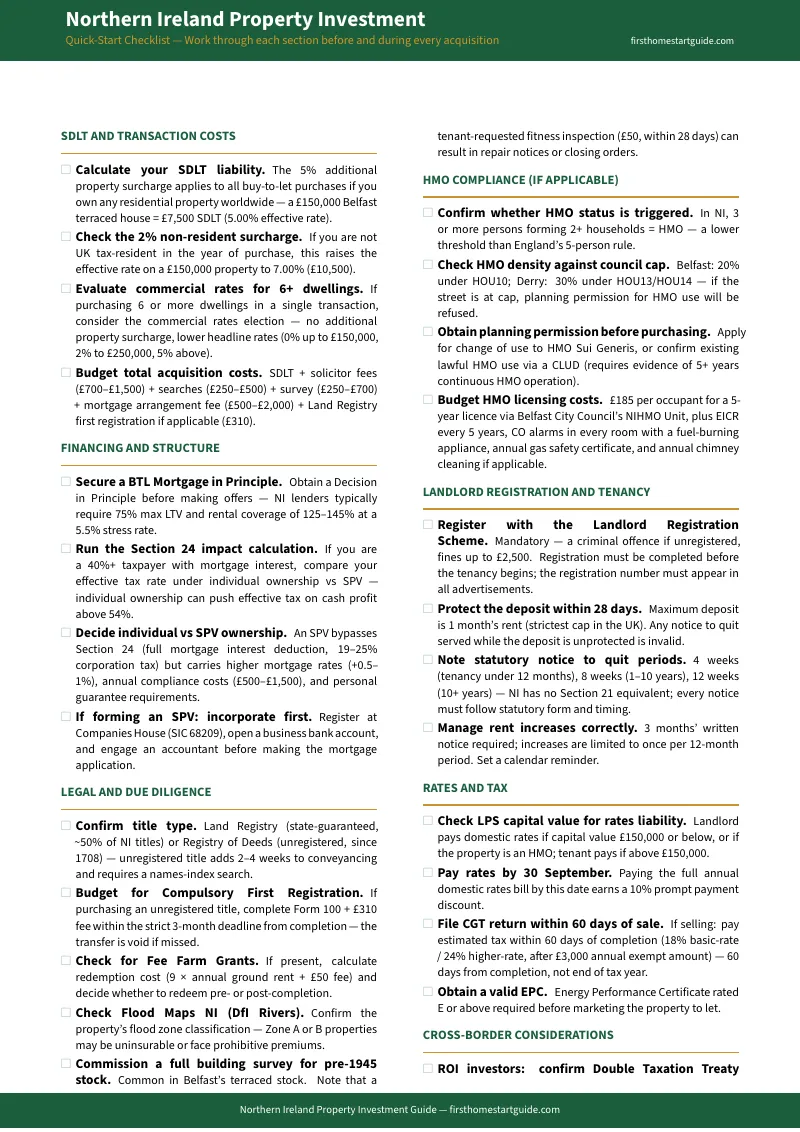
The complete guide, 8 standalone printable worksheets and reference cards, plus a quick-start checklist — covering every stage from yield analysis through landlord registration. Print the worksheet you need and bring it to your solicitor meeting, accountant appointment, or property viewing:
Belfast Postcode-by-Postcode Yield Analysis
BT1 City Centre at 6.2%, BT2 University/Botanic at 6.1%, BT7 Ormeau/Stranmillis at 5.3%, BT9 Malone/Lisburn Road at 4.1%, BT15 North Belfast at 6.5%. Plus commuter belt markets — Lisburn, Antrim, Bangor, Newry, Derry — with entry prices from £120,000 and the price-to-yield equation showing 40% lower capital risk per unit of yield versus England. The guide maps where yields are structural rather than cyclical, so you target postcodes based on fundamentals, not letting agent enthusiasm.
SDLT and Transaction Cost Calculator
The 5% additional property surcharge that applies to every buy-to-let purchase if you own any residential property worldwide. The 2% non-resident surcharge for non-UK-tax-residents. The commercial rates election for 6+ dwelling transactions that removes the surcharge entirely. Worked SDLT calculations at multiple price points — a £150,000 Belfast terraced house costs £7,500 in SDLT at 5.00% effective rate. Total acquisition cost budgeting including solicitor fees, searches, survey, and mortgage arrangement fee, so the upfront capital requirement is a known number, not a surprise at completion.
Domestic Rates — The Cost England Does Not Have
This is the single biggest miscalculation mainland investors make. If the property's capital value is £150,000 or below, the landlord pays domestic rates — not the tenant. If the property is an HMO, the landlord pays regardless of value. The guide covers the Land & Property Services capital value threshold, the 10% prompt payment discount for paying by 30 September, and worked examples showing exactly how rates liability compresses net yields versus English equivalents where council tax sits with the tenant. Without this calculation, your yield spreadsheet is wrong before you start.
Section 24 and SPV Decision Framework
The mortgage interest restriction that caps individual landlords' tax relief at basic rate — pushing effective tax on cash profit above 54% for higher-rate taxpayers. The SPV alternative with full mortgage interest deduction at 19–25% corporation tax. The trade-offs: SPV mortgage rates are typically 0.5–1% higher, annual compliance costs run £500–£1,500, lenders require personal guarantees, and extracting profits triggers additional tax. The guide includes a side-by-side calculation framework at multiple income levels so you can model the break-even point for your specific tax bracket and portfolio size.
Two Title Systems — Land Registry vs Registry of Deeds
Approximately 50% of NI titles are registered with the Land Registry — state-guaranteed, similar to England. The other half are unregistered, held in the Registry of Deeds — a names-index system operating since 1708 where title is traced through chains of deeds. Purchasing an unregistered title adds 2–4 weeks to conveyancing and triggers Compulsory First Registration: Form 100 with a £310 fee within 3 months of completion, or the transfer is void. Plus Fee Farm Grants — perpetual ground rent obligations attached to older titles — and how to calculate the redemption cost at 9× annual ground rent plus £50. The guide covers how to handle both systems and when to negotiate a price reduction for unregistered title complexity.
HMO Licensing and the Overprovision Trap
The 3-occupant trigger threshold — two households, not England's five-person rule. Belfast City Council's 20% overprovision cap under policy HOU10 and Derry's 30% under HOU13/HOU14. Why you must check street-level density and apply for planning permission before purchasing — not after. The Certificate of Lawful Use or Development pathway for pre-existing HMOs. Licensing costs at £62 per occupant per year (£310 per occupant for a 5-year licence), plus the full compliance stack: EICR every 5 years, CO alarms, annual gas safety certificate, chimney cleaning. Managing an unlicensed HMO is a criminal offence carrying fines up to £20,000.
Landlord Registration and Tenancy Law
The mandatory Landlord Registration Scheme — criminal offence if unregistered, fines to £2,500. The Private Tenancies Act (Northern Ireland) 2022 framework that governs all private tenancies. The 1-month maximum deposit cap — the strictest in the UK. The 28-day deposit protection deadline. Notice to quit periods: 4 weeks under 12 months, 8 weeks for 1–10 years, 12 weeks over 10 years. The critical fact that NI has no Section 21 equivalent — every notice must follow statutory form. Rent increase rules: 3 months' written notice, once per 12-month period. If you manage NI tenancies using English assumptions, you will break the law without knowing it.
Cross-Border Investment Strategy
ROI investors and the UK-Ireland Double Taxation Treaty — Article 14(1) means gains on NI property disposal are taxable in Ireland, not double-taxed by HMRC. The Non-Resident Landlords Scheme and the 20% basic-rate withholding your letting agent must deduct if you are not registered. Currency risk modelling for GBP/EUR-denominated income and costs. The GB mainland investor's case for NI yield arbitrage when English portfolios are compressed by Section 24. And why the "consent to let" trap — buying on a residential mortgage with intent to let — is mortgage fraud that catches first-time investors on every property forum.
Financial Modelling Worksheets
Gross-to-net yield conversion with NI-specific cost inputs: domestic rates, agent fees, insurance, maintenance reserves, void allowance, mortgage interest. The yield compression formula showing how domestic rates liability affects returns differently from English council tax. Portfolio scaling scenarios from single BTL to multi-property HMO. Worked ROI calculations at Belfast entry prices versus comparable English markets — so you can see the actual after-cost yield advantage, not just the headline number.
Who This Guide Is For
This guide is for property investors targeting Northern Ireland who:
- Are local NI investors in their 30s to 50s with equity in their primary residence, looking to deploy it into a first buy-to-let in a familiar Belfast postcode — and want the financial modelling to confirm the numbers before committing capital
- Are GB mainland investors attracted by the yield premium who need to understand what changes when you cross the Irish Sea: domestic rates liability, the Registry of Deeds, HMO thresholds, and a tenancy framework that has no ASTs, no Section 21, and no council tax pass-through
- Are Republic of Ireland cross-border investors who see Belfast as a two-hour drive from Dublin with entry prices a fraction of southern markets, and need the UK-Ireland Double Taxation Treaty mechanics, currency risk modelling, and HMRC Non-Resident Landlords Scheme registration process
- Are evaluating HMO opportunities around Queen's University Belfast and the wider student market, and need the 3-occupant trigger rules, Belfast's HOU10 overprovision cap, licensing costs, and the planning permission requirements that mainland HMO investors do not expect
- Are higher-rate taxpayers with English portfolios compressed by Section 24's mortgage interest restriction, considering whether to redeploy capital to NI and whether to hold individually or via an SPV
- Want every NI-specific cost, every regulatory divergence from England, and every financial calculation in one document — so they invest with jurisdiction-specific numbers, not English assumptions
Why Not Free Resources?
Free information on Northern Ireland property investment exists. Here is what each source actually covers:
- PropertyPal Market Reports provide robust quarterly data on average asking prices, rental growth, and transaction volumes across local government districts. Excellent for market context. What they do not cover: legal obligations, tax treatment, domestic rates liability, HMO licensing mechanics, or any financial modelling. They tell you what properties cost. They do not tell you what you will keep after NI-specific costs.
- Northern Ireland Housing Executive (NIHE) offers statutory checklists on landlord registration and housing fitness standards. Useful for compliance basics. Where it stops: no investment analysis, no yield calculation, no SDLT modelling, no SPV decision framework, no cross-border tax treatment. It covers the minimum legal requirements for operating as a landlord, not the financial strategy for optimising returns.
- National Residential Landlords Association (NRLA) covers Northern Irish members with standardised tenancy templates. Its educational content is excellent — for English landlords. The legal framework, deposit caps, notice periods, and eviction procedures described in NRLA guidance overwhelmingly reflect English and Welsh legislation. NI-specific coverage is limited to brief footnotes acknowledging that "different rules apply."
- UK property investment courses (paid, typically £500–£2,000) teach English concepts: ASTs, Section 21 evictions, council tax pass-through to tenants, and five-person HMO thresholds. None of these apply in Northern Ireland. A course that teaches you English landlord law is not just unhelpful for NI — it is actively misleading, because it creates assumptions about your rights and obligations that do not hold across the Irish Sea.
- Reddit (r/northernireland, r/UKPersonalFinance) is where real investors share unfiltered experience — including warnings about domestic rates liability, the "consent to let" trap, and refurbishment costs on older terraced stock. The signal is real. But every thread is a snapshot in time, and the advice ranges from expert landlords with 20-property portfolios to first-time investors who have not yet bought. There is no cross-referencing against current legislation, no financial modelling, and no way to distinguish between NI-specific rules and English assumptions that happen to be wrong.
This guide fills the jurisdiction gap — the space between knowing NI yields look attractive and understanding the NI-specific costs, laws, and calculations that determine what you actually keep. It is the analysis a Northern Irish property solicitor and an NI-specialist accountant would give you across multiple expensive consultations, structured as a permanent reference you own.
— Less Than One Hour of a Solicitor's Time
A Northern Irish property solicitor charges £150 to £250 per hour. A specialist buy-to-let mortgage broker charges an arrangement fee of £500 to £1,000. An HMO licence application costs £310 per occupant for five years. And a single SDLT miscalculation — failing to account for the 5% additional property surcharge — can cost you £7,500 on a £150,000 property.
This guide does not replace your solicitor or your accountant. But it gives you the SDLT calculations, domestic rates modelling, HMO licensing mechanics, SPV decision framework, conveyancing pathway analysis, and cross-border tax treatment that ensure you walk into every professional appointment knowing exactly what to ask — and knowing whether the answer you receive applies to Northern Ireland or to England.
If it catches a single domestic rates miscalculation, prevents one HMO licensing violation, or clarifies whether your tax bracket justifies an SPV structure, it pays for itself before you have made your first offer.
Money-back guarantee, no time limit. If the guide does not make your investment analysis sharper and your NI-specific knowledge stronger, you pay nothing.
Download the free Quick-Start Checklist to see the step-by-step action plan covering SDLT calculations, domestic rates liability, HMO trigger thresholds, conveyancing pathways, and landlord registration requirements. When you are ready for the full decision system — complete with financial modelling, SPV analysis, cross-border tax treatment, and the postcode-level yield data — the complete guide is here.
The yield advantage is real. Now make sure the costs do not take it away.