
The Yield Looks Right. The Devolved Law Says Otherwise.
You found a two-bedroom tenement in Govan delivering 8.5% gross yield backed by 14,000 captive NHS staff at the Queen Elizabeth University Hospital. Or a Dennistoun flat at £130,000 where the rent-to-price ratio clears 7.5% and the gentrification trajectory promises capital growth on top. Or a student HMO in Glasgow's West End where three bedrooms with a shared kitchen push gross returns past 9%. The spreadsheet works. The cap rate is excellent. You're ready to instruct your solicitor to submit a sealed bid.
Then you run the real numbers. The Additional Dwelling Supplement hits at 8% of the full purchase price — not 5% like England's stamp duty surcharge. On that £200,000 Dennistoun flat, you owe £16,000 in ADS alone before standard Land and Buildings Transaction Tax even starts calculating. Your English accountant tells you the Higher Rate income tax kicks in at £50,270 — but you're buying in Scotland, where it starts at £43,663 at 42%, and climbs to 45% at £75,001, and keeps climbing to 48% above £125,140. You planned to issue a Section 21 no-fault eviction notice if you need to sell — but Section 21 does not exist in Scotland. The Private Residential Tenancy is open-ended, with no fixed term, no periodic end date, and no mechanism to remove a tenant without proving one of 18 specific statutory grounds before the First-tier Tribunal. Your English AST template is legally worthless north of the border. Meanwhile, that Edinburgh Airbnb yielding £180 per night now requires both a Short-Term Let licence (criminal offence without one — £2,500 fine) and planning permission for material change of use, which the City of Edinburgh Council is systematically rejecting.
Here's what no single resource explains: Scotland layers an 8% Additional Dwelling Supplement that adds £16,000+ to a £200,000 acquisition with a 36-month refund window that is not retrospective to pre-April 2024 transactions, income tax bands where the Higher Rate (42%) starts £6,600 lower than England and the Top Rate reaches 48%, open-ended tenancies where eviction requires proving specific statutory grounds before a tribunal that takes four months for uncontested cases, an HMO licensing threshold of 3 unrelated persons (not 5 as in England) with triennial fees reaching £2,452 in Glasgow, a short-term let regime that has functionally outlawed secondary Airbnb operations in Edinburgh through planning permission rejections, a mandatory EPC C rating by 2028 with £5,000 non-compliance penalties on Victorian tenement stock that averages £3,200 to upgrade, and a conveyancing system built on sealed bids and binding missives where gazumping is impossible but so is backing out — into an operating environment that rewards investors who understand Scottish devolved law and punishes everyone who assumes English rules apply. Every one of these has cost real investors five to six figures because the information existed — scattered across Revenue Scotland guidance, Shelter Scotland tenancy resources, First-tier Tribunal procedural notes, local authority HMO licensing pages, and LandlordZone forum threads — but nobody had assembled it into a single investment framework.
The Scotland Property Investment Guide is a Devolved Law Investment System — not a motivational overview of UK property investing, but a structured due diligence framework that maps every Scotland-specific transaction tax, tenancy regulation, licensing requirement, and yield opportunity into a process you work through before you submit a sealed bid. It replaces months of cross-referencing Revenue Scotland tax calculators, Shelter Scotland tenancy guides, local authority HMO licensing portals, Edinburgh STL planning applications, and PropertyHub forum debates with a single reference that tells you exactly what the numbers should look like, exactly what the legal requirements are, and exactly where deals go wrong when English assumptions meet Scottish law.
What's Inside the Devolved Law Investment System
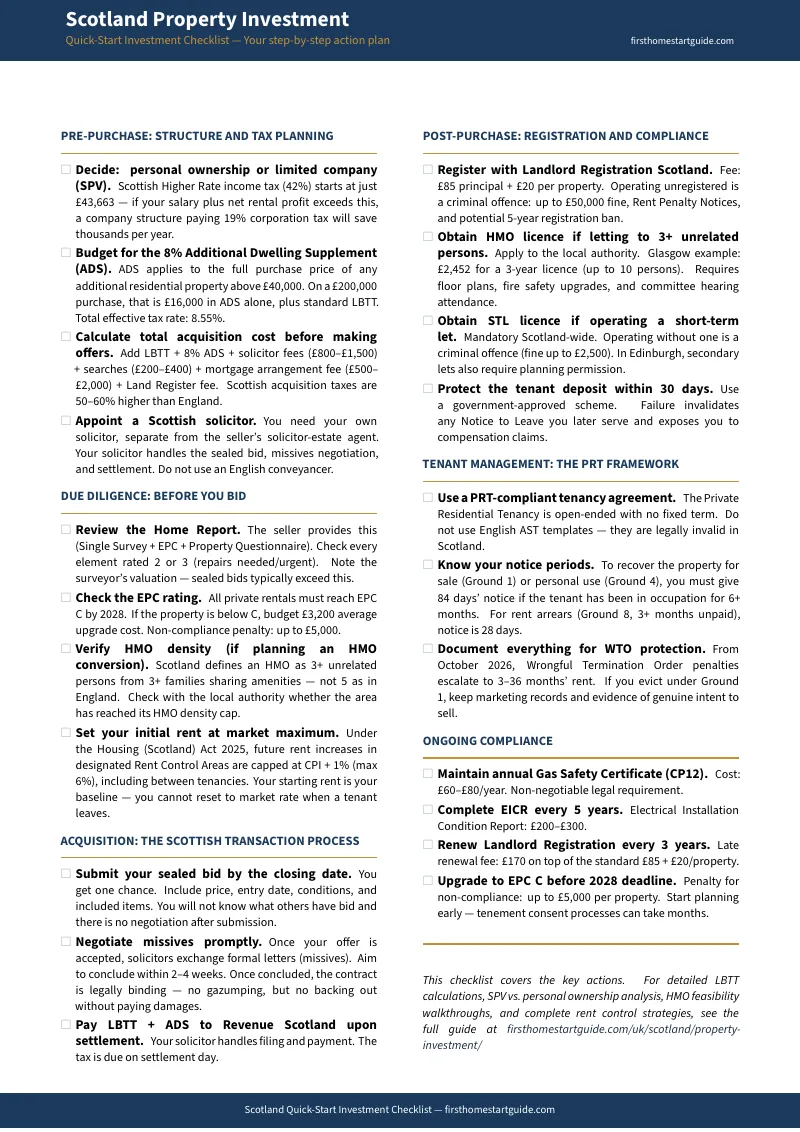
An 11-chapter guide, a quick-start checklist, and 8 standalone printable tools — covering every stage from yield analysis through exit strategies, built specifically for the legislative divergence and regulatory complexity that makes Scotland a fundamentally different investment jurisdiction from the rest of the UK:
Postcode-Level Yield Intelligence
Scotland is not one market — it is five distinct markets with radically different risk-return profiles. Glasgow produces gross yields of 7.2% to 10.3% at entry prices of £90,000–£290,000, driven by structural undersupply: 3,200 annual housing completions against 5,800+ units of demand. Edinburgh delivers 4.0%–5.8% gross yields but with reliable capital appreciation in supply-constrained historic conservation areas. The guide maps every Glasgow postcode from Govan (G51) at 8.3%–9.0% gross yield with 1.8-week void periods, through Dennistoun (G31) at 7.2%–7.8%, Springburn (G21) at 8.7%, to the West End (G11/G12) where standard lets yield 5.8%–6.4% but HMOs reach 8.5%–9.2%. It covers Dundee's undervalued student play (7.0%–8.5% yields at Scotland's lowest entry prices), Aberdeen's oil-correlated volatility (4.3%–8.6% theoretical yields with energy sector risk), and the peripheral markets like Paisley where transport links to Glasgow Central produce 7%–8% yields with airport logistics and NHS staff demand.
The ADS Tax Shock: 8% on Day One
Scotland's Additional Dwelling Supplement charges 8% of the total purchase price on any additional residential property above £40,000. On a £200,000 buy-to-let, that is £16,000 in ADS before standard LBTT even begins — compared to £10,000 under England's 5% surcharge at the same price. The guide provides worked LBTT + ADS calculations at every price point, explains the 36-month refund mechanism for investors who sold a previous main residence (and why this rule is not retrospective to pre-April 2024 purchases), details the "economic unit" trap where a spouse's inherited flat triggers the full 8% on the couple's joint purchase, and walks through the documentation required for successful Revenue Scotland reclaims — utility bills, council tax records, and bank statements proving main residence occupation.
The Private Residential Tenancy: No Section 21, No Fixed Term, No Easy Exit
England's Section 21 no-fault eviction does not exist in Scotland. Every Private Residential Tenancy is open-ended — no fixed term, no periodic end date. To recover a property, a landlord must prove one of 18 specific statutory grounds and serve a Notice to Leave with the correct notice period: 84 days for sale, family occupation, or refurbishment where the tenant has lived there 6+ months; 28 days for rent arrears or antisocial behaviour. If the tenant does not leave voluntarily, the case goes to the First-tier Tribunal, which takes approximately four months for uncontested applications and substantially longer for defended hearings. The guide details each eviction ground with the exact evidence the tribunal requires, explains pre-action requirements for rent arrears (mandatory debt advice referral), and covers the Wrongful Termination Order regime where landlords who evict under false grounds face penalties of 3–36 months' rent from October 2026.
Edinburgh Short-Term Let Survival
The Edinburgh STL regime has transformed short-term letting from a cash cow into a regulatory minefield. Every short-term let in Scotland requires a licence — operating without one is a criminal offence carrying a £2,500 fine. Edinburgh is a designated Short-Term Let Control Area: secondary properties used as STLs after September 2022 require planning permission for material change of use, and the City of Edinburgh Council is systematically rejecting applications. The guide covers the licensing requirements (fire risk assessments, interlinked alarms, EPCs, Legionella controls), the festival exemption system (up to 6 weeks, approximately £120), the incoming 5% visitor levy from July 2026, and the 140/70 rule that transfers properties from Council Tax to Non-Domestic Business Rates. It explains who can still operate legally and who needs an exit strategy.
Scottish Income Tax: The Net Yield Compression Engine
Scottish landlords face structurally higher marginal tax rates than their English counterparts at every income level above £29,527. The Intermediate Rate of 21% starts at £29,527 (versus 20% Basic Rate up to £50,270 in England). The Higher Rate of 42% starts at £43,663 — nearly £7,000 lower than England's 40% threshold. The Advanced Rate of 45% applies from £75,001, and the Top Rate of 48% applies above £125,140. Combined with Section 24 mortgage interest relief restrictions, these rates make personal ownership of leveraged buy-to-let property mathematically unviable above certain income thresholds. The guide provides net yield calculations at each Scottish tax band, models the breakeven point where SPV (limited company) ownership at 19% corporation tax becomes advantageous, and explains the accounting and administrative costs that offset the tax saving.
HMO Licensing: The 3-Person Threshold Trap
Scotland defines a House in Multiple Occupation as 3 or more unrelated persons from 3 or more families sharing amenities. England's threshold is 5. English investors who plan HMO conversions based on English rules discover they need a licence much sooner than expected — and the licensing process involves 1:50 floor plans, fire safety upgrades (interlinked smoke and heat alarms, FD30 fire doors), and committee hearings. Glasgow's 3-year HMO licence costs £2,452 for up to 10 occupants. Edinburgh imposes additional density restrictions. The guide covers the full application process, mandatory safety standards, ongoing compliance (annual gas safety, five-yearly electrical inspections), and the interaction between HMO licensing and PRT eviction grounds that complicates tenant rotation in the academic letting cycle.
The Scottish Conveyancing Process
Scotland's transaction process is fundamentally different from England's. The seller's solicitor-estate agent markets the property and sets a closing date. Buyers submit sealed bids through their own solicitor — one chance, no negotiation. Once an offer is accepted, solicitors exchange missives. When missives are concluded, the contract is legally binding. There is no gazumping and no chain — but there is no backing out either, without paying damages. The guide covers the Home Report system (Single Survey + EPC + Property Questionnaire), sealed bid strategy, missive negotiation tactics, settlement mechanics, and why using an English conveyancer for a Scottish transaction is a procedural disaster.
EPC 2028, Rent Control, and the Compliance Calendar
All Scottish private rentals must reach EPC C by 2028. Non-compliance penalty: up to £5,000 per property. Upgrading a traditional Victorian tenement flat with solid stone walls and single-glazed sash windows averages £3,200. The Housing (Scotland) Act 2025 introduces rent control in designated areas: future rent increases capped at CPI + 1% (maximum 6%), applied between tenancies — meaning your starting rent is your permanent baseline. Landlord registration costs £85 plus £20 per property; operating unregistered is a criminal offence with fines up to £50,000. The guide consolidates every compliance deadline, mandatory certification (gas safety, electrical installation, fire detection), and registration requirement into a single calendar so nothing is missed.
8 Standalone Printable Tools
Every tool is a self-contained PDF you can print, fill in, and use independently:
- LBTT and ADS Calculator — worked examples at four price points, LBTT vs SDLT comparison, and blank rows to calculate your own acquisition tax bill
- Eviction Grounds Reference — all 18 PRT grounds with notice periods, evidence requirements, and Wrongful Termination Order penalties on a single reference card
- Tax Comparison Worksheet — Scottish income tax bands, Section 24 penalty comparison, SPV breakeven analysis, and blank rows for your own marginal rate calculation
- Compliance Calendar — every mandatory certification, registration renewal, and deadline with costs, penalties, and a fillable portfolio tracker
- Deal Analysis Worksheet — blank template covering acquisition costs, operating income, personal and SPV tax calculations, and net return metrics
- Yield Comparison Card — regional yields and Glasgow postcode data on a dense reference card to take to property viewings
- Edinburgh STL Decision Guide — licensing rules, planning permission requirements, and a city-by-city decision flowchart for short-term let operators
- Conveyancing Checklist — step-by-step Scottish transaction process from pre-offer through post-settlement with timeline and cost tables
Who This Guide Is For
This guide is for property investors targeting the Scottish market who:
- Are an English or Welsh investor attracted to Glasgow's 7%+ gross yields and need to understand the complete regulatory framework before committing capital — the 8% ADS, the PRT eviction mechanics, the HMO licensing threshold of 3 (not 5), the Scottish income tax bands, and the conveyancing process that has no equivalent south of the border
- Are a Scottish homeowner buying your first investment property and need to model the true acquisition cost — LBTT plus 8% ADS means a £200,000 purchase costs £16,000+ in transaction taxes alone, and the 42% Higher Rate starts at £43,663, not £50,270
- Are an Edinburgh short-term let operator who needs to understand whether you can still legally operate, need planning permission, can access festival exemptions, must pivot to long-term letting, or should exit the market entirely
- Are targeting student HMOs in Glasgow, Edinburgh, or Dundee and need the licensing costs, density restrictions, fire safety requirements, and PRT-specific challenges around academic year tenant rotation
- Are deciding between personal ownership and SPV (limited company) structure and need the net yield comparison at each Scottish income tax band — including the breakeven point where 19% corporation tax beats 42%–48% personal rates
- Are comparing Scottish yields to English yields and need the tax-adjusted analysis — because Scotland's 2–3 percentage point gross yield advantage over England can be entirely consumed by higher ADS, higher income tax, and higher compliance costs if you don't model them accurately
Why Not Free Tools and Forums?
Free information on Scottish property investment exists across dozens of sources. Here's what it actually delivers:
- Scottish Government and Shelter Scotland provide legally accurate tenancy guidance — but in dense bureaucratic language with zero commercial context. They tell you what the 18 PRT eviction grounds are, not how to structure your investment to avoid needing them. They explain the ADS exists, not how to calculate whether a deal still works after paying it. An investor must already know exactly what they're looking for to find the right page, and a cross-border novice will miss the critical interplay between HMO licensing, PRT eviction mechanics, and Edinburgh STL restrictions entirely.
- PropertyHub and LandlordZone forums are where English investors debate whether Glasgow yields justify the regulatory burden, Scottish landlords troubleshoot specific First-tier Tribunal procedures, and everyone argues about whether the PRT has destroyed the market. Experience reports from seasoned operators sit alongside panicked questions from landlords who just discovered they can't use a Section 21 notice. Tax threads reference "the surcharge" without distinguishing between England's 5% SDLT surcharge and Scotland's 8% ADS. Someone in a 2023 thread says Edinburgh Airbnb is still viable; someone in 2025 reports a planning permission rejection. Sorting current from obsolete takes longer than reading a guide that has already done it.
- The Scottish Association of Landlords provides excellent compliance support, template documents, and a helpline — behind a £115/year membership paywall. Their content focuses on day-to-day operational compliance rather than strategic investment analysis, yield mapping, or cross-border tax comparison. You get the compliance framework without the investment framework.
- National UK property investing courses teach cap rate analysis, portfolio scaling, and financing mechanics that assume English law. They don't cover LBTT (Scotland uses a different tax), the ADS at 8% (not 5%), the PRT (not the AST), the First-tier Tribunal (not the county court), the 3-person HMO threshold (not 5), or the Scottish income tax bands that start compressing net yields £7,000 sooner than England. Applying English frameworks to Scottish property is how investors lose five figures on their first deal.
This guide fills the Scotland-specific gap — the space between knowing how to analyse a rental property in general and knowing how to underwrite one in a jurisdiction where 8% ADS, open-ended tenancies, 42%–48% income tax rates, HMO licensing at 3 occupants, mandatory EPC C by 2028, criminalised STL operation, binding missives with no escape, and rent control between tenancies can each independently determine whether a deal creates wealth or destroys it. It's the analysis that would take a Scottish property solicitor, a chartered accountant with Scottish tax expertise, a letting agent with PRT tribunal experience, and an HMO licensing consultant to assemble — structured as a reference you own permanently.
— Less Than One Tax Miscalculation
A single buy-to-let acquisition modelled with England's 5% stamp duty surcharge instead of Scotland's 8% ADS understates your transaction costs by thousands of pounds on day one. An English AST template used for a Scottish letting is legally invalid and will not survive a tribunal challenge. A Section 21 notice served on a Scottish tenant is void — and the time you wasted issuing it has given the tenant additional weeks of occupancy while you scramble to learn the actual PRT eviction grounds. A student HMO operated without a licence because you assumed the threshold was 5 occupants (it's 3 in Scotland) is a criminal offence. An Edinburgh Airbnb operated without a licence and planning permission carries a £2,500 fine per offence.
This guide doesn't replace your Scottish solicitor, your chartered accountant, or your letting agent. But it gives you the transaction tax calculations, yield analysis by postcode, tenancy law framework, HMO licensing requirements, STL compliance roadmap, income tax band comparison, and EPC upgrade cost modelling that ensure you identify every Scotland-specific risk and opportunity before you're contractually bound by concluded missives — instead of discovering them on your first ADS bill, your first tribunal hearing, or your first licensing enforcement action.
If it catches a single ADS miscalculation, prevents a single invalid eviction notice, or saves you from operating an unlicensed HMO, it pays for itself before you've finished reading it.
Money-back guarantee, no time limit. If the guide doesn't sharpen your underwriting and protect your capital in Scotland's regulatory environment, you pay nothing.
Download the free Scotland Quick-Start Home Buying Checklist to see the due diligence framework covering ADS calculations, PRT compliance, HMO licensing, EPC requirements, and conveyancing mechanics. When you're ready for the full postcode-level yield analysis, tax band modelling, eviction ground navigator, and 11-chapter investment guide, the complete guide is here.
The yield looks right on the spreadsheet. This guide tells you whether Scottish law agrees.