
Every Stamp Duty Calculator You've Used Is Wrong for Wales. This Guide Has the Right Numbers — and the Devolved Rules That Could Cost or Save You Thousands.
You've found a semi-detached in Cardiff for £295,000. You plug the price into a stamp duty calculator on MoneySavingExpert. It tells you that first-time buyers pay nothing on properties under £300,000. You budget accordingly — deposit, solicitor fees, moving costs — and the numbers work.
Then your conveyancer sends over a completion statement. There's a line item for Land Transaction Tax: £4,200. Not stamp duty. Not zero. Four thousand two hundred pounds that every English calculator told you didn't exist. Because in Wales, there is no first-time buyer tax relief. The Welsh Revenue Authority charges 6% on everything above £225,000 — and no one warned you until the money was due in 30 days.
This is not an edge case. It is the single most common financial shock for first-time buyers in Wales. And the tax is only the beginning. Help to Buy Wales is still running (the English version closed in 2023) but with strict conditions — a £300,000 price cap, new-builds only, interest that starts at 1.75% in Year 6 and escalates by CPI + 2% annually. The Renting Homes (Wales) Act 2016 means that if you ever plan to rent your starter home out, you face six-month notice periods, mandatory written contracts within 14 days, and financial penalties for paperwork errors that don't exist in England. Council tax premiums of up to 300% on second homes are reshaping rural markets in ways that no generic UK guide covers.
Here's the core problem: Wales has its own tax, its own equity loan schemes, its own tenancy law, and its own council tax powers — but almost every property guide, calculator, and forum thread you find defaults to English rules without telling you. You're budgeting with the wrong numbers, planning with the wrong assumptions, and discovering the Welsh-specific costs at exactly the moment you can't adjust.
The Wales First-Time Buyer Guide is a Wales Devolved Rules Toolkit. Not a rehash of generic UK advice with "Wales" in the title. It's a structured system that maps every tax band, every government scheme, every legal divergence, and every transaction cost to Welsh rules specifically — so you know your real figures before you make an offer, not when your solicitor sends the bill.
What's Inside the Wales Devolved Rules Toolkit
The complete 17-chapter guide, a standalone printable checklist, and 8 printable tools — covering every stage from financial planning through to collecting your keys, with every figure specific to Wales and current as of 2026:
Land Transaction Tax — The £4,200 Surprise Nobody Mentions
In England, first-time buyers pay zero stamp duty up to £300,000. In Wales, there is no first-time buyer relief at all. The Land Transaction Tax charges 0% on the first £225,000, then 6% on the portion from £225,001 to £400,000, then 7.5% above that. A £250,000 purchase costs £1,500 in LTT. A £295,000 purchase costs £4,200. A £350,000 purchase costs £7,500. The guide includes worked calculations at every common Welsh price point, explains the Welsh Revenue Authority filing process (30 days, not England's 14), covers the higher rates surcharge for additional properties, and shows you how to integrate LTT into your total budget so the number on your solicitor's completion statement matches the number in your head.
Help to Buy Wales Phase 4 — The Scheme England Lost, Wales Extended
England's Help to Buy closed permanently in 2023. Wales extended theirs to September 2026, with legal completions permitted until June 2027. The scheme provides a 20% shared equity loan from the Welsh Government — you put in 5%, a mortgage covers 75%, the government covers 20%. No interest for five years. But the conditions are strict: new-builds only, £300,000 price cap, EPC rating of B or higher, broadband-ready, no part-exchange, no buy-to-let. And from Year 6, interest kicks in at 1.75% and escalates annually by CPI + 2%. The guide covers the full eligibility criteria, the realistic cost curve over 10 and 15 years, the repayment options, and how to plan your exit before the escalating interest overtakes the savings.
The Renting Homes (Wales) Act — Your Starter-Home-to-Rental Plan Just Got Complicated
Many first-time buyers plan to keep their starter home as a rental when they eventually move up. In England, you have relative flexibility. In Wales, the Renting Homes Act 2016 — fully implemented in December 2022 — abolished Assured Shorthold Tenancies entirely. Tenants are now "contract-holders" under Standard Occupation Contracts. As a landlord, you must give six months' notice to regain possession, cannot serve notice during the first six months (guaranteeing 12 months' occupancy from day one), must provide a comprehensive written statement within 14 days, and face compensation of up to two months' rent for every day that statement is late. Miss the 14-day deadline, and a court will refuse your possession order entirely. The guide maps every obligation, every penalty, and the true cost of converting your first home into a Welsh rental — before you buy with assumptions based on English law.
The Bristol-to-Newport Commuter Calculation
The average first-time buyer price in Bristol is £309,000. In Newport, it's £200,000. That £109,000 gap is why thousands of Bristol workers now live in South East Wales. But the financial saving doesn't tell the full story. The M4 corridor is notoriously congested. Train services between Newport and Bristol Temple Meads are subject to regular delays. Community forums describe the rush-hour commute as "depression-inducing." The guide covers the real-world commute data, the rental comparison (£1,885/month in Bristol vs £953 in Newport), the LTT implications of buying in Wales while earning in England, and the honest trade-offs — because saving £100,000 on your purchase price means nothing if the commute costs you your quality of life.
Second Home Premiums and Rural Market Strategy
In rural Wales, the property market is defined by the second homes crisis. In Abersoch, over 46% of housing stock is second homes. In Aberdyfi, over 43%. Welsh councils now charge council tax premiums of up to 300% on second homes — Pembrokeshire at 150%, Gwynedd at 150%, Wrexham at 200-250%. The guide covers how these premiums are reshaping prices for local first-time buyers, the Class 1-7 statutory exemptions, the tightened holiday-let loophole (252 days available, 182 actually let), Self-Build Wales (£210 million scheme covering 75% of land and 100% of build costs with a two-year payment holiday), Homebuy Wales (30-50% equity loan for existing properties), and Shared Ownership Wales (buy 25-75% of a property if your household income is under £60,000).
Welsh-Specific Property Searches
The South Wales Valleys, parts of Pembrokeshire, and north-eastern Wales sit above historical mining infrastructure dating back to the 1700s. The Coal Mining Search (CON29M) investigates mine shafts, subsidence history, and hazardous gas risk — and your mortgage lender will almost certainly require one. The Drainage and Water Search (CON29DW) goes through Dwr Cymru (Welsh Water), not English utilities. Local authority search turnaround varies from 5 to 40 working days depending on the council. The guide covers every search, every cost, and every red flag specific to Welsh geography and infrastructure.
Complete Cost Worksheet
Every cost beyond the deposit tallied in one place — Land Transaction Tax at Welsh rates (not Stamp Duty), solicitor fees (£800-£1,500), local authority searches (£100-£250), coal mining search (£35-£60), drainage search via Dwr Cymru (£49-£59), environmental search (£35-£60), RICS survey (£500-£900+), Land Registry fees, CHAPS transfer fee (£42), mortgage arrangement fee, and a £1,000-£2,000 contingency reserve. Worked examples at £188,000 (Welsh average), £233,000 (Cardiff average), and £295,000 (the LTT threshold pain point) so you know your true all-in figure before you start viewing properties.
Standalone Printable Tools (Included)
In addition to the 17-chapter guide, you get 8 standalone printable tools — each works independently, so you can print exactly what you need for each stage of the process:
- LTT Calculator — Every rate band, a fillable calculation worksheet, pre-calculated examples at common Welsh price points, and the joint-purchase trap warning for buyers with parents on the mortgage
- Total Cost Worksheet — Fillable cost breakdown at Welsh rates: deposit, LTT, solicitor fees, coal mining search, drainage search via Dwr Cymru, survey, Land Registry, CHAPS fee, and contingency reserve
- Government Schemes Comparison — Help to Buy Wales, Shared Ownership, Homebuy, Self-Build, and the Lifetime ISA compared side by side with a "Which Scheme Fits You?" decision checklist
- Renting Homes Act Reference Card — Every landlord obligation, deadline, and penalty under the 2016 Act, plus Rent Smart Wales registration fees and Fitness for Human Habitation requirements
- Property Viewing Scorecard — Print-and-bring viewing checklist with Wales-specific items: coal mining area check, EPC rating, broadband speed, drainage, and questions to ask the estate agent
- Conveyancing Timeline — Step-by-step visual timeline from accepted offer to keys, with search costs, bottleneck warnings, and the 30-day LTT filing deadline
- Council Tax Premiums Reference — Second home and empty property premium rates by Welsh authority, Class 1–7 statutory exemptions, and the holiday-let reclassification thresholds
- Post-Purchase Essentials — Day One, First Week, and First Month action checklist: meter readings, council tax reclassification, Dwr Cymru setup, lock changes, and maintenance fund
Who This Guide Is For
This guide is for first-time buyers in Wales who:
- Have been saving toward a house purchase using English stamp duty calculators and generic UK property advice — and need every figure recalculated for Land Transaction Tax, Welsh Government schemes, and Welsh tenancy law before they make an offer based on the wrong numbers
- Are buying in Cardiff or Swansea at £225,000 to £350,000 and need to know whether Help to Buy Wales, Shared Ownership, or saving for a larger deposit gives them the best financial outcome — with the LTT bill factored in, not ignored
- Are working in Bristol and considering Newport or South East Wales for the £100,000+ price saving, and need an honest assessment of the commute reality, the LTT costs, and the cultural adjustment — not just the headline property price
- Plan to keep their starter home as a rental and have no idea that the Renting Homes (Wales) Act 2016 imposes six-month notice periods, 14-day written contract deadlines, and financial penalties for administrative errors that do not exist in England
- Are buying in rural Wales — Gwynedd, Pembrokeshire, Carmarthenshire, Anglesey — and need to understand how Self-Build Wales, Homebuy Wales, and the council tax premiums can help them stay in their communities
- Want the entire Welsh system — tax, schemes, tenancy law, searches, conveyancing, and costs — mapped in one document so they walk into every appointment knowing the Welsh rules, not the English ones
Why Not Free Resources?
Free information on buying your first home in Wales is scattered across a dozen sources, each covering one piece of the picture:
- MoneySavingExpert covers mortgages, deposits, and stamp duty with characteristic thoroughness — for England. Wales gets a sidebar mention noting that LTT replaces Stamp Duty. It doesn't model the LTT bands at Welsh price points, doesn't explain why there's no first-time buyer relief, doesn't cover Help to Buy Wales or the Renting Homes Act, and doesn't mention coal mining searches. If you're buying in Wales, it covers about a third of what you need to know.
- The Welsh Revenue Authority publishes LTT rates and an online calculator. It does not tell you how to integrate LTT into your total budget, how the 30-day filing deadline works in practice, or what happens when your solicitor files late. It's a tax authority, not a buying guide.
- Help to Buy Wales portal explains the scheme eligibility. It does not model the escalating interest curve from Year 6 onwards, compare the total cost against saving for a larger deposit, or explain the EPC B requirement that eliminates most older properties.
- Reddit (r/HousingUK, r/Wales) has genuine experiences from Welsh buyers — commute stories, solicitor recommendations, LTT shock posts. Half the responses come from English buyers describing a different tax system, and the advice from six months ago may not reflect current Help to Buy Wales deadlines or council tax premium rates.
- Individual council websites publish their council tax premium rates. No single source compiles the rates across all Welsh authorities, lists the Class 1-7 exemptions, or explains how the tightened holiday-let loophole affects the market.
This guide consolidates the entire Welsh system into one document — the space between knowing that Wales charges a different tax and understanding exactly how much you owe, which schemes you qualify for, what the tenancy law means for your long-term plan, and what every cost adds up to when you use Welsh figures instead of English ones. It's the analysis an independent advisor with no listing commission and no agenda would give you, structured as a permanent reference you own.
— Less Than a Single Property Search Fee
Solicitor fees for a Welsh property purchase run £800 to £1,500. A RICS Level 2 survey costs £500 to £900. The LTT on a £295,000 property is £4,200 — money that a first-time buyer in England would not pay. A single coal mining search costs £35 to £60.
This guide doesn't replace your solicitor or mortgage broker. But it gives you the LTT calculations, the scheme comparisons, the tenancy law breakdown, the Welsh-specific search guidance, and the complete cost worksheets that ensure you budget with Welsh figures from day one — instead of discovering the gap between English assumptions and Welsh reality when the completion statement arrives.
If it prevents a single budget miscalculation where you're £4,200 short on completion day, catches a Help to Buy Wales deadline before the scheme closes, or stops you converting your starter home into a rental without understanding the six-month notice periods and 14-day contract requirements, it pays for itself before you've finished reading it.
Money-back guarantee, no time limit. If the guide doesn't make your Welsh home buying process clearer and your financial position stronger, you pay nothing.
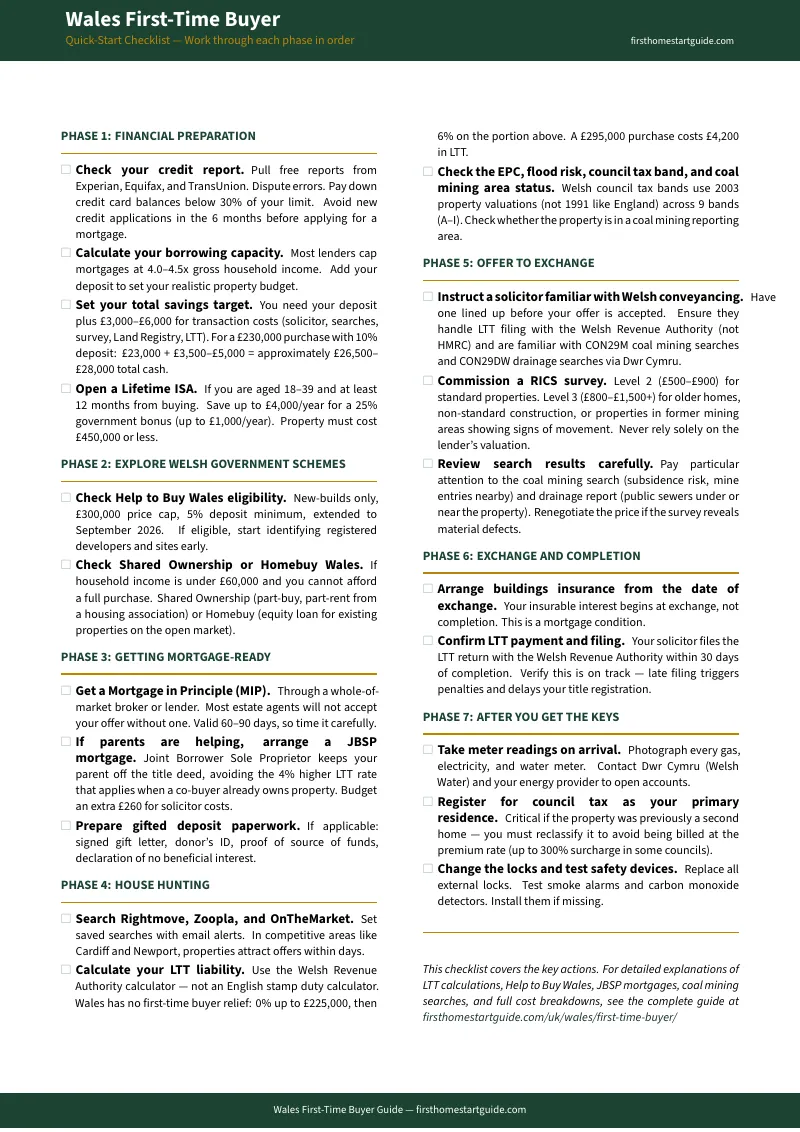
Download the free Wales Quick-Start Home Buying Checklist to see the step-by-step action plan covering LTT calculations, Help to Buy Wales eligibility, the Renting Homes Act, Shared Ownership, and the conveyancing timeline. When you're ready for the full system — the 17-chapter guide plus 8 standalone printable tools including the LTT Calculator, Total Cost Worksheet, Government Schemes Comparison, and Property Viewing Scorecard — the complete toolkit is here.
You've saved the deposit. Now stop English assumptions from costing you thousands in a Welsh market.
Frequently Asked Questions
What if the rules change after I buy?
We update the guide when the rules change. Email us any time, even years later, and we'll send you the current edition free.