
The Yield Looks Right. Welsh Law Says Otherwise.
You found a two-bedroom terrace in Newport at £170,000 delivering 6.4% gross yield, underpinned by cross-border commuter demand from Bristol since the Severn Bridge tolls disappeared. Or a four-bed Victorian conversion in Cardiff's CF24 — the UK's number one buy-to-let postcode for 2026 — where HMO yields clear 9% and average void periods run eight days. Or a holiday cottage on the Pembrokeshire coast pulling £1,200 per week in July and August. The spreadsheet works. The deposit is ready. Your solicitor says they handle "UK property" all the time.
Then Welsh law arrives. You serve a Section 21 no-fault eviction notice on your tenant — but Section 21 does not exist in Wales. It was abolished and replaced by Section 173, which requires six months' notice and cannot be served during the first six months of the tenancy. Your English AST template is legally void — Wales replaced Assured Shorthold Tenancies with Standard Occupation Contracts, your tenant is now a "contract-holder," and you must deliver a written statement within 14 days of occupation or face penalties of one day's rent for every day late, up to two months' rent. You budgeted Stamp Duty at England's rates — but Wales charges Land Transaction Tax at different rates, with a 5% surcharge on additional properties at the lowest band alone, rising to 17% above £1.5 million. Your holiday let accountant told you to claim mortgage interest against rental income — but the Furnished Holiday Lettings regime was abolished in April 2025, and Section 24 now restricts you to a 20% tax credit. Meanwhile, your Pembrokeshire cottage failed to hit 182 actual letting days, so the Valuation Office reclassified it from business rates to domestic council tax — plus a 150% second home premium. Your £1,200-per-week summer goldmine just became a £4,800-per-year council tax liability on top of the standard band.
Here's what no single resource explains: Wales layers a Land Transaction Tax system where a £260,000 buy-to-let costs £15,950 in acquisition tax (higher than an equivalent purchase in England), tenancy law where Section 21 is dead and Section 173 requires six months' notice plus compliance with five separate prerequisites before it can be served, a Rent Smart Wales licensing regime where operating without registration is a criminal offence with unlimited fines, HMO density caps that freeze new licence applications in Cardiff's highest-yielding postcodes, a 182-day threshold that strips holiday lets of business rate status and triggers council tax premiums up to 300%, Article 4 Directions that require planning permission for holiday let conversions in national parks, an impending statutory licensing scheme for all visitor accommodation by Autumn 2026, and a visitor levy from April 2027 — into an operating environment that rewards investors who understand Welsh devolved law and destroys the returns of everyone who assumes English rules apply. Every one of these has cost real investors four to five figures because the information existed — scattered across Welsh Revenue Authority guidance, Rent Smart Wales portals, Renting Homes (Wales) Act summaries, local authority council tax premium schedules, and planning authority Article 4 notices — but nobody had assembled it into a single investment framework.
The Wales Property Investment Guide is a Devolved Law Investment System — not a motivational overview of UK property investing, but a structured due diligence framework that maps every Wales-specific transaction tax, tenancy regulation, licensing requirement, and yield opportunity into a process you work through before you exchange contracts. It replaces months of cross-referencing the Welsh Revenue Authority's LTT calculator, Rent Smart Wales registration portals, local authority council tax premium schedules, Valuation Office 182-day guidance, and LandlordZone Wales threads with a single reference that tells you exactly what the numbers should look like, exactly what the legal requirements are, and exactly where deals go wrong when English assumptions meet Welsh law.
What's Inside the Devolved Law Investment System
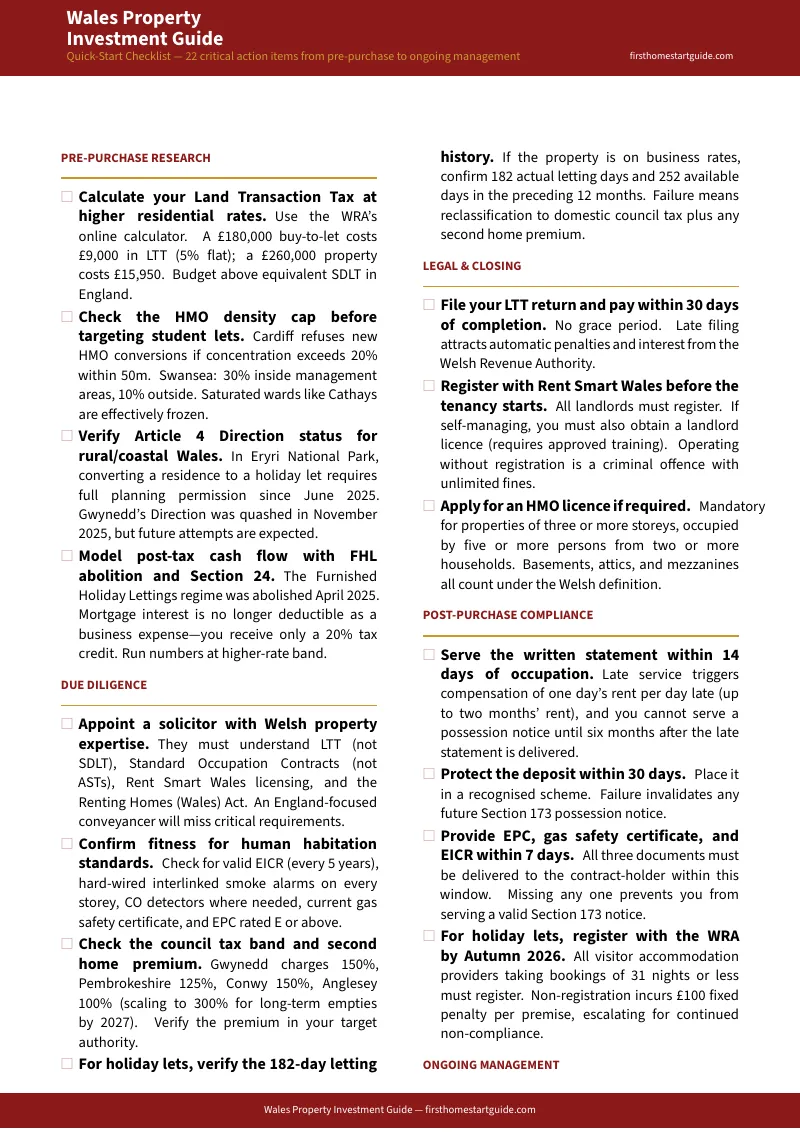
A 12-chapter guide and a quick-start checklist — covering every stage from yield analysis through ongoing compliance, built specifically for the legislative divergence and regulatory complexity that makes Wales a fundamentally different investment jurisdiction from England:
Postcode-Level Yield Intelligence
Wales is not one market — it is four distinct markets with radically different risk-return profiles. Cardiff produces gross yields of up to 7.3% at standard lets and 8.9%+ at HMOs in CF24, the UK's number one buy-to-let postcode. Newport delivers 5.1%–6.4% yields at a 22.4% discount to the English average property price, driven by post-toll cross-border commuter demand from Bristol. Swansea ranks as the UK's number one city for student accommodation investment, with average yields of 9.56%. The Valleys offer entry points from £105,000 with gross yields of 7%–9% — but with elevated void risk and maintenance costs that most yield calculators ignore. The guide maps every major postcode with price-per-square-foot data, rental yields, demand drivers, void period estimates, and notes on where HMO density caps have frozen new licensing.
The LTT Tax Shock: 5% From the First Pound
Wales charges Land Transaction Tax on additional residential properties at higher rates than England's stamp duty surcharge — and the rates increased again on 11 December 2024. A £180,000 buy-to-let costs £9,000 in LTT (5% flat). A £260,000 buy-to-let costs £15,950. A £400,000 property costs £29,950. The guide provides worked LTT calculations at every price bracket, compares them side-by-side with English SDLT, explains the Multiple Dwellings Relief rules, and covers the Leasing Scheme Wales mechanism that can recover the entire higher-rate LTT element on properties under £400,000 if you lease to a local authority within 18 months of purchase — including the trade-offs of LHA-capped rent, 5-to-20-year lease terms, and a 5-year clawback.
The Renting Homes (Wales) Act: No Section 21, 14-Day Written Statement, Six-Month Notice
England's Section 21 no-fault eviction does not exist in Wales. It has been replaced by Section 173, which requires six months' notice and cannot be served during the first six months of the tenancy — effectively guaranteeing every contract-holder 12 months of secure tenure. Before you can serve a Section 173 notice, you must satisfy five separate prerequisites: Rent Smart Wales registration and licensing, written statement delivered within 14 days, deposit protected within 30 days, and EPC, gas safety certificate, and EICR delivered within 7 days of occupation. Miss any single prerequisite and the notice is void. The guide details every compliance step with deadlines, penalties (including the one-day-per-day-late compensation for missing the 14-day written statement window), and the retaliatory eviction protections that prevent landlords from evicting tenants who report property condition issues.
The Holiday Let Squeeze: 182 Days, 300% Premiums, and Article 4
Three regulatory weapons are converging on Welsh holiday let investors simultaneously. The 182-day rule requires actual commercial letting for 182 days per year to retain business rate classification — failure means reclassification to domestic council tax plus second home premiums of 75% to 300% depending on the local authority. Article 4 Directions in Eryri (Snowdonia) National Park require planning permission for any holiday let conversion, while Gwynedd's Article 4 attempt was quashed by the High Court but future attempts are expected. The Pembrokeshire Coast National Park Authority has imposed Article 4 restrictions on 28-day camping and caravan sites from January 2026. The guide covers every council's premium rate, the VOA's occupancy evidence requirements, strategies for meeting the 182-day threshold, and when it makes financial sense to pivot a failing holiday let to a Standard Occupation Contract for long-term letting.
Rent Smart Wales: Criminal Offence Territory
Every landlord operating a rental property in Wales must register with Rent Smart Wales. If you self-manage, you must also hold a landlord licence, which requires completing approved training. Operating without registration is a criminal offence carrying unlimited fines — and an unregistered landlord cannot serve any possession notice, meaning your tenant can remain indefinitely while you scramble to complete the registration process. The guide covers the registration and licensing process, training requirements, the distinction between registered-and-licensed and registered-using-an-agent, and how RSW compliance interacts with Section 173 eviction prerequisites.
HMO Licensing and Density Caps
Mandatory HMO licensing applies to properties of three or more storeys occupied by five or more persons from two or more households. Cardiff and Swansea impose additional HMO density controls — in Cardiff, planning permission for new HMO conversions is refused if existing concentration exceeds 20% within a 50-metre radius. Saturated wards like Cathays are effectively frozen: no new licences are being issued, making existing licensed HMO stock a scarce and appreciating asset class. The guide covers HMO definitions (including the Welsh storey definition where basements and attics count), density thresholds by authority, licensing costs and timelines, fire safety requirements, and the regulatory moat that density caps create for existing licensed operators.
Impending Legislation: Statutory Licensing and the Visitor Levy
By Autumn 2026, all visitor accommodation providers taking bookings of 31 nights or less must register with the Welsh Revenue Authority — non-registration incurs a £100 fixed penalty per premise, escalating for continued non-compliance. From April 2027, local councils can introduce an overnight visitor levy (tourist tax) that accommodation providers must collect and remit. The guide covers the registration requirements, timeline, and how to prepare your operations before both deadlines arrive.
7 Standalone Printable Worksheets and Reference Cards
In addition to the 12-chapter guide and the quick-start checklist, your download includes 7 standalone PDFs designed to be printed separately and used at your desk, in solicitor meetings, or during property viewings:
- LTT Calculator Reference Card — Higher residential rate table, two worked examples (£180K and £260K), blank calculation worksheet for your own property, Leasing Scheme Wales summary, and MDR reform overview
- Section 173 Prerequisites Reference — All 8 prerequisites for a valid possession notice on one page, the 14-day written statement penalty, terminology changes from English to Welsh law, and retaliatory eviction protections
- Council Tax Premiums Reference — Every charging authority's second home premium rate, long-term empty property escalation schedules, and the exemptions that can save you from the premium
- Market Comparison Card — Postcode-level yields, average prices, investment strategy, and risk level for Cardiff, Swansea, Newport, and the Valleys — plus 5/10/30-year capital appreciation track records
- Pre-Purchase Due Diligence Checklist — 15-item checklist with separate sections for all properties, HMOs, and holiday lets, plus a deal decision worksheet
- Holiday Let Compliance Checklist — 182-day threshold rules, Article 4 Direction status by area, FHL abolition impact, visitor registration and levy deadlines, and a pre-purchase decision checklist
- HMO Density Reference Card — Cardiff's 20% cap, Swansea's dual 30%/10% threshold, the Welsh storey definition trap, and frozen ward analysis
Who This Guide Is For
This guide is for property investors targeting the Welsh market who:
- Are an English investor attracted to Wales's yield advantage and need to understand the complete regulatory framework before committing capital — the higher LTT rates, the Section 173 eviction mechanics, the Rent Smart Wales licensing requirement, the HMO density caps, and the conveyancing process where your English AST template is legally worthless
- Are a Bristol or South West England investor eyeing Newport's M4 corridor yields at a 22.4% discount to English average prices and need to model the true acquisition cost — including LTT at higher residential rates that are steeper than English SDLT
- Are a Welsh landlord expanding your portfolio in Cardiff, Swansea, or the Valleys and need a systematised compliance framework for Standard Occupation Contracts, the 14-day written statement requirement, and Section 173 notice prerequisites
- Are a holiday let investor in Pembrokeshire, the Gower, Gwynedd, or Eryri who needs survival strategies for the 182-day threshold, council tax premiums, Article 4 restrictions, and the impending visitor accommodation licensing scheme
- Are deciding whether to hold a Welsh property personally or through a limited company and need the net yield comparison at each UK income tax band — accounting for Section 24 mortgage interest restrictions and LTT differences
- Are a first-time investor attracted to Wales's low entry prices and need foundational education on the complete Welsh compliance stack before your enthusiasm outpaces your regulatory literacy
Why Not Free Tools and Forums?
Free information on Welsh property investment exists across dozens of sources. Here's what it actually delivers:
- Welsh Government and Rent Smart Wales provide legally accurate tenancy guidance — but in dense bureaucratic language with zero commercial context. They tell you what the Renting Homes (Wales) Act requires, not how to structure your investment to comply efficiently. They explain the 14-day written statement rule exists, not what happens operationally when you miss it during a multi-property acquisition sprint. An investor must already know exactly what they're looking for to find the right page, and a cross-border novice will miss the critical interplay between RSW licensing, Section 173 prerequisites, and LTT surcharges entirely.
- PropertyHub and LandlordZone forums are where English investors debate whether Cardiff yields justify the compliance burden, Welsh landlords troubleshoot specific Renting Homes Act procedures, and everyone argues about whether the 182-day rule has killed the holiday let market. Experience reports from seasoned operators sit alongside panicked questions from landlords who just discovered Section 21 doesn't exist in Wales. Tax threads reference "stamp duty surcharge" without distinguishing between England's SDLT and Wales's LTT. Someone in a 2023 thread says Pembrokeshire holiday lets are still viable; someone in 2025 reports their property failed the 182-day threshold and now faces a 150% council tax premium. Sorting current from obsolete takes longer than reading a guide that has already done it.
- The NRLA Wales section provides excellent compliance content and a helpline — but focuses on legal adherence rather than strategic investment analysis, yield mapping, or cross-border tax comparison. You get the compliance framework without the investment framework.
- National UK property investing courses teach cap rate analysis, portfolio scaling, and financing mechanics that assume English law. They don't cover LTT (Wales uses a different tax), the Renting Homes (Wales) Act (not the Housing Act 1988), Section 173 (not Section 21), Standard Occupation Contracts (not ASTs), Rent Smart Wales (not a Selective Licensing scheme), or the holiday let regulatory framework that has no English equivalent. Applying English frameworks to Welsh property is how investors lose five figures on their first deal.
This guide fills the Wales-specific gap — the space between knowing how to analyse a rental property in general and knowing how to underwrite one in a jurisdiction where higher LTT rates, abolished Section 21, 14-day written statement penalties, Rent Smart Wales criminal offences, HMO density freezes, 182-day holiday let thresholds, council tax premiums up to 300%, Article 4 planning restrictions, and impending visitor levies can each independently determine whether a deal creates wealth or destroys it. It's the analysis that would take a Welsh property solicitor, a chartered accountant with LTT expertise, a letting agent with Renting Homes Act experience, and an HMO licensing consultant to assemble — structured as a reference you own permanently.
— Less Than One Compliance Mistake
A single buy-to-let acquisition modelled with England's stamp duty rates instead of Welsh LTT understates your transaction costs by thousands of pounds on day one. An English AST template used for a Welsh letting is legally invalid — you need a Standard Occupation Contract, and the written statement must be delivered within 14 days or you owe your tenant one day's rent for every day late. A Section 21 notice served on a Welsh tenant is void — and the six months you wasted before discovering you needed a Section 173 notice has given your tenant additional occupancy while you scramble to meet the five prerequisites. A holiday let operated without hitting 182 actual letting days loses its business rate classification and faces council tax premiums that can exceed the annual rental income. Operating without Rent Smart Wales registration is a criminal offence.
This guide doesn't replace your Welsh solicitor, your chartered accountant, or your letting agent. But it gives you the LTT calculations, yield analysis by postcode, tenancy law framework, RSW licensing requirements, HMO density analysis, holiday let compliance roadmap, and council tax premium schedules that ensure you identify every Wales-specific risk and opportunity before you exchange contracts — instead of discovering them on your first LTT bill, your first invalid eviction notice, or your first council tax premium assessment.
If it catches a single LTT miscalculation, prevents a single invalid Section 173 notice, or saves you from a 300% council tax premium on a holiday let that missed the 182-day threshold, it pays for itself before you've finished reading it.
Money-back guarantee, no time limit. If the guide doesn't sharpen your underwriting and protect your capital in Wales's regulatory environment, you pay nothing.
Download the free Wales Quick-Start Home Buying Checklist to see the due diligence framework covering LTT calculations, Renting Homes Act compliance, Rent Smart Wales licensing, HMO density analysis, and holiday let regulatory requirements. When you're ready for the full postcode-level yield analysis, Section 173 navigator, council tax premium schedules, and 12-chapter investment guide, the complete guide is here.
The yield looks right on the spreadsheet. This guide tells you whether Welsh law agrees.
Frequently Asked Questions
What if the rules change after I buy?
We update the guide when the rules change. Email us any time, even years later, and we'll send you the current edition free.