
You Signed a Kaufanbot Thinking It Was an Opening Offer. In Austria, It Was the Final Contract.
You've relocated to Vienna. Or transferred to Salzburg. Or your contract puts you in Graz for the foreseeable future. The rent keeps climbing thanks to inflation-indexed contracts, you've run the numbers, and buying makes sense. So you browse willhaben.at, find an apartment you like, and your real estate agent asks you to submit a Kaufanbot. You sign it, thinking it's a preliminary offer subject to financing, inspection, and negotiation. Within hours, the seller countersigns. You have now entered a legally binding purchase contract under Austrian law. Not a conditional expression of interest. Not an offer pending due diligence. A binding obligation to complete the transaction at the agreed price. If you haven't inserted an explicit exit clause making the offer contingent on mortgage approval and Grundverkehrsbehoerde permit approval, you're liable for the agent's full commission plus a penalty that can reach 10-20% of the purchase price. On a EUR 400,000 apartment, that exposure starts at EUR 40,000 -- for signing a document you assumed was the beginning of a conversation.
You search for help. Engel and Voelkers publishes a polished overview that skips the Grundverkehrsbehoerde approval process entirely -- because explaining that non-EU buyers wait three to nine months in legal limbo while their deposit sits in notary escrow would discourage transactions, which is bad for brokerage business. The oesterreich.gv.at portal provides dense German legalese that doesn't explain how to actually assemble the dossier that proves your "social need" to Magistrate 35. Reddit threads on r/Austria contradict each other about whether US citizens can buy property at all. And the property lawyers who understand the nine-province system charge EUR 300-500 per hour -- to explain rules you need to know before your first viewing, not after you've already signed a Kaufanbot you can't escape.
Here's the structural problem no free resource solves: Austria is not one property market. It's nine. Each of the nine federal provinces enforces its own Grundverkehrsgesetz -- its own foreign property acquisition law with different approval requirements, different timelines, and different definitions of who qualifies. Vienna requires non-EU buyers to prove social need and financial connection through Magistrate 35, a process that takes three to nine months. Tyrol and Vorarlberg have effectively banned foreign purchases of holiday homes through draconian Freizeitwohnsitz restrictions that include fines, forced compliance, and court-ordered property auctions. Salzburg runs a points-based housing subsidy system that most expats don't know exists. And every province layers its rules on top of a base transaction cost of 10-12% of the purchase price -- a surcharge that includes 3.5% transfer tax, 1.1% land registry fee, 1.5-3% notary fees, and 3.6% agent commission that no EU Bestellerprinzip law has eliminated for property sales.
The Buying Property in Austria -- Expat Guide is The Nine-Province Navigator. Not a relocation blog article about charming Viennese apartments. It's a structured decision framework that maps every stage of the Austrian property transaction -- from the Kaufanbot through the Grundverkehrsbehoerde approval, the Kaufvertrag, the notarial authentication, and the Grundbuch registration -- so you make each decision understanding which province's rules apply, what the financial exposure is, and how to protect yourself before you sign anything.
What's Inside The Nine-Province Navigator
A 9-PDF toolkit: comprehensive 72-page guide, printable quick-start checklist, plus 7 standalone reference tools -- covering every stage from property search through Grundbuch entry:
The Province-by-Province Legal Map
Each of Austria's nine provinces enforces its own Grundverkehrsgesetz governing who can buy, what they can buy, and what permits they need. EU/EEA citizens and Swiss nationals have full parity with Austrian buyers in all nine provinces. Third-country nationals -- Americans, British post-Brexit arrivals, Indians, anyone outside the EU/EEA -- face a completely different system. In Vienna, Magistrate 35 requires proof of social need through long-term residency registration, children enrolled in local schools, or demonstrated German proficiency, plus financial connection through Austrian employment or business ownership. The review takes three to nine months while your 10% deposit sits frozen in notary escrow. In Tyrol, foreign purchases of leisure residences face near-total prohibition. In Salzburg, approval requirements vary by municipality. The guide maps every province's rules with the specific permit requirements, typical timelines, and documentation checklists -- so you know before you start searching whether your target province will approve you, how long it will take, and what evidence to prepare.
The Kaufanbot Defence Protocol
In the UK and US, initial property offers are non-binding -- you can withdraw after inspection, after survey, after your solicitor reviews the contract. In Austria, the Kaufanbot is the contract. The moment the seller accepts your signed offer, even one submitted informally through an agent, you are legally obligated to complete the purchase. There is no statutory cooling-off period. If your mortgage is declined and the Kaufanbot doesn't contain a financing contingency clause, you owe the penalty. If the Grundverkehrsbehoerde rejects your permit application and the Kaufanbot doesn't contain a permit contingency clause, you owe the penalty. The guide covers the exact protective clauses your Kaufanbot must contain: the Ruecktrittsrecht for financing contingency, the permit approval contingency, the timeline requirements, and the specific language to insist on before you sign. Because the difference between a protected Kaufanbot and a naked one is the difference between a structured transaction and a EUR 40,000 lesson in Austrian contract law.
The Closing Cost Calculator
Transaction costs in Austria absorb 10-12% of the purchase price in non-recoverable taxes and fees -- among the highest in Western Europe. The guide breaks down every component: Grunderwerbsteuer at 3.5% of the purchase price, Grundbucheintragungsgebuehr at 1.1%, Pfandrechtseintragung at 1.2% of the loan amount, notary and legal fees at 1.5-3% plus 20% VAT, and Maklerprovision at 3% plus 20% VAT. It also covers the critical distinction that trips up informed buyers: the Bestellerprinzip introduced in July 2023 eliminated agent fees for renters only. For property purchases, the buyer still pays the full 3.6% commission. And it maps the temporary federal exemption that waives the 1.1% land registry fee and 1.2% mortgage registration fee for primary residences up to EUR 500,000 -- but only for applications submitted by June 30, 2026. On a EUR 400,000 property, that exemption saves up to EUR 11,500. Miss the deadline and those savings disappear.
The Wohnbaufoerderung Subsidy Decoder
Austria offers some of the most generous housing subsidies in Europe -- low-interest provincial loans, non-repayable grants, and subsidised construction financing. But because housing is a provincial matter, the eligibility rules are different in every province and published exclusively in German bureaucratic language. Vienna offers substitute equity loans for buyers who meet residency and income requirements. Tyrol provides structured low-interest loans starting at 0.2% fixed for the first five years, but imposes strict income caps of EUR 3,800 net per month for single applicants. Salzburg runs a points-based system offering capital grants of EUR 8,000 to EUR 14,000 depending on household size. The guide translates every provincial subsidy programme into plain English with the eligibility criteria, income limits, residency requirements, and application procedures -- so you know which subsidies you qualify for before you finalise your budget, not after you've already committed to a price you could have reduced by EUR 10,000 or more.
The Expat Mortgage Navigator
Since the KIM-V lending regulations expired on July 1, 2025, Austrian banks have regained flexibility in assessing creditworthiness -- but the banking sector remains fundamentally conservative. Non-residents and expats face steeper requirements: foreign-sourced income gets discounted during risk assessment, freelance and variable income triggers deep scepticism, and an indefinite employment contract is the gold standard for approval. US citizens face the most severe friction because of FATCA compliance -- Austrian banks view American applicants as high-risk regulatory burdens requiring two to three years of translated tax returns, audited financials, and substantially higher equity deposits. The guide covers which Austrian banks actively lend to expats, the documentation requirements for different income types, the post-KIM-V lending parameters, the FATCA compliance obligations for US citizens who own Austrian property, and how to structure your mortgage application timeline so approval arrives before your Kaufanbot contingency deadline expires.
The Freizeitwohnsitz Reality Check
The dream of buying a ski chalet in Tyrol or a lake house in Salzburg runs directly into Austria's most aggressively enforced zoning laws. The western provinces have enacted strict Freizeitwohnsitz restrictions designed to prevent foreign capital from creating seasonal ghost towns. Properties must be explicitly zoned for leisure use -- such zoning is exceedingly rare and practically never granted for new construction. Purchasing a standard residential property and using it for occasional holidays without registering permanent residency triggers fines, forced compliance measures, and in extreme cases, court-ordered property auctions. For non-EU buyers, Freizeitwohnsitz approvals are effectively zero. The guide maps the restriction regime across all nine provinces, explains what is and isn't legally possible for each buyer category, and identifies the alternatives that actually work -- so you don't invest months and tens of thousands of euros pursuing a purchase that the provincial authorities will never approve.
Who This Guide Is For
This guide is for foreign buyers and expats purchasing property in Austria who:
- Work for an international organisation, UN agency, or multinational in Vienna and are weighing whether to stop paying inflation-indexed rent and buy a primary residence -- but need to understand the Magistrate 35 approval process, the timeline, and what documentation proves "social need" before committing to a Kaufanbot they cannot exit
- Are EU/EEA citizens who enjoy full legal parity with Austrian buyers but still need to navigate 10-12% closing costs, provincial subsidy programmes they've never heard of, a Kaufanbot system that works nothing like the offer process in their home country, and an agent commission structure that the Bestellerprinzip did not change for property purchases
- Are American, British post-Brexit, or other third-country nationals who need the province-by-province permit requirements mapped out before they start viewing properties -- because a purchase that takes six weeks in Vienna's free market takes six to nine months through Magistrate 35, and they need to know which exit clauses protect their deposit during that wait
- Are considering a holiday home in the Austrian Alps and need to understand why the Freizeitwohnsitz regime in Tyrol, Salzburg, and Vorarlberg makes this functionally impossible for most foreign buyers -- before they engage agents, commission surveys, and draft offers for properties the provincial authorities will block
- Want every provincial permit requirement, every closing cost component, every subsidy eligibility rule, and every Kaufanbot protection clause in one document -- so they negotiate, sign, and close with the same structural understanding as a local Austrian buyer, not the surface-level confidence of someone who read a brokerage overview that skipped the parts that would have discouraged the transaction
Why Not Free Resources?
Free information on buying property in Austria as a foreigner exists. Here's what each source actually delivers:
- International brokerage guides (Engel and Voelkers, RE/MAX Austria, Savills) publish polished overviews that correctly list the standard closing costs and describe the general transaction flow. What they skip: the Grundverkehrsbehoerde approval process that adds three to nine months to non-EU purchases, the Kaufanbot's legally binding nature and the exit clauses you need before signing, the Freizeitwohnsitz enforcement that makes Alpine holiday purchases functionally impossible, and the provincial subsidy programmes that could reduce your costs by thousands. They orient you toward a transaction. They don't tell you what could go wrong with yours.
- Reddit (r/Austria, r/FinanzenAT, r/expats) contains real questions from real buyers -- alongside contradictory answers about whether US citizens can buy at all, whether the Bestellerprinzip eliminated agent fees for purchases (it didn't), and whether buying property creates a path to residency (it doesn't). You'll find someone whose Magistrate 35 approval took eight weeks and someone whose took seven months. Both stories are true. Neither tells you how to prepare a dossier that lands on the shorter end.
- Government portals (oesterreich.gv.at) contain accurate legal information -- in dense German, using Austrian legal terminology, structured for Austrian residents who grew up inside the system. The portal states that third-country nationals need a permit. It doesn't explain how to compile the evidence package that satisfies Magistrate 35's subjective "social need" assessment. The law is there. The practical translation is not.
- Law firms and notaries produce technically accurate articles on specific topics -- Tyrolean Freizeitwohnsitz restrictions on one site, Vienna's MA 35 process on another, FATCA implications on a third. Each article is correct within its scope. No single source unifies all nine provinces' rules, all closing cost components, and all subsidy programmes into a chronological buying framework. Assembling this picture yourself requires reading twenty sources in two languages and hoping none of them are outdated.
- Relocation agencies handle corporate relocations professionally -- for their corporate clients. If your employer isn't paying for a relocation package, you need the same quality of information, structured as a permanent reference, without the EUR 3,000-5,000 service fee.
This guide fills the structural gap -- the space between knowing that Austria has nine provinces with different foreign buyer rules and understanding exactly how those rules interact with your citizenship, your purchase target, your financing, and your subsidy eligibility. It's the analysis a bilingual Austrian property lawyer would give you over a three-hour consultation, structured as a permanent reference you own.
-- Less Than One Hour of a Property Lawyer's Time
A legal consultation runs EUR 300-500 per hour. A relocation agency charges thousands. The land registry fee exemption saves up to EUR 11,500 on a EUR 400,000 primary residence -- but only if you submit before June 30, 2026. The penalty for a Kaufanbot without exit clauses can reach EUR 40,000 or more. The provincial housing subsidies you don't know about could reduce your costs by EUR 8,000-14,000. And the Freizeitwohnsitz enforcement in Tyrol can result in forced sale of a property you just purchased.
This guide doesn't replace your notary or your Rechtsanwalt. But it gives you the province-by-province permit map, the Kaufanbot defence protocol, the closing cost calculator, the subsidy decoder, and the mortgage navigation that ensure you walk into every viewing, every Kaufanbot signing, and every notary appointment understanding which province's rules apply and what they cost -- instead of discovering how Austrian property law works by paying for the lesson.
If it prevents a single unprotected Kaufanbot, catches a single Freizeitwohnsitz prohibition before you engage agents, or identifies a single provincial subsidy you would have missed, it pays for itself before you've finished reading it.
Money-back guarantee, no time limit. If the guide doesn't make the Austrian property transaction clearer and your financial position stronger, you pay nothing.
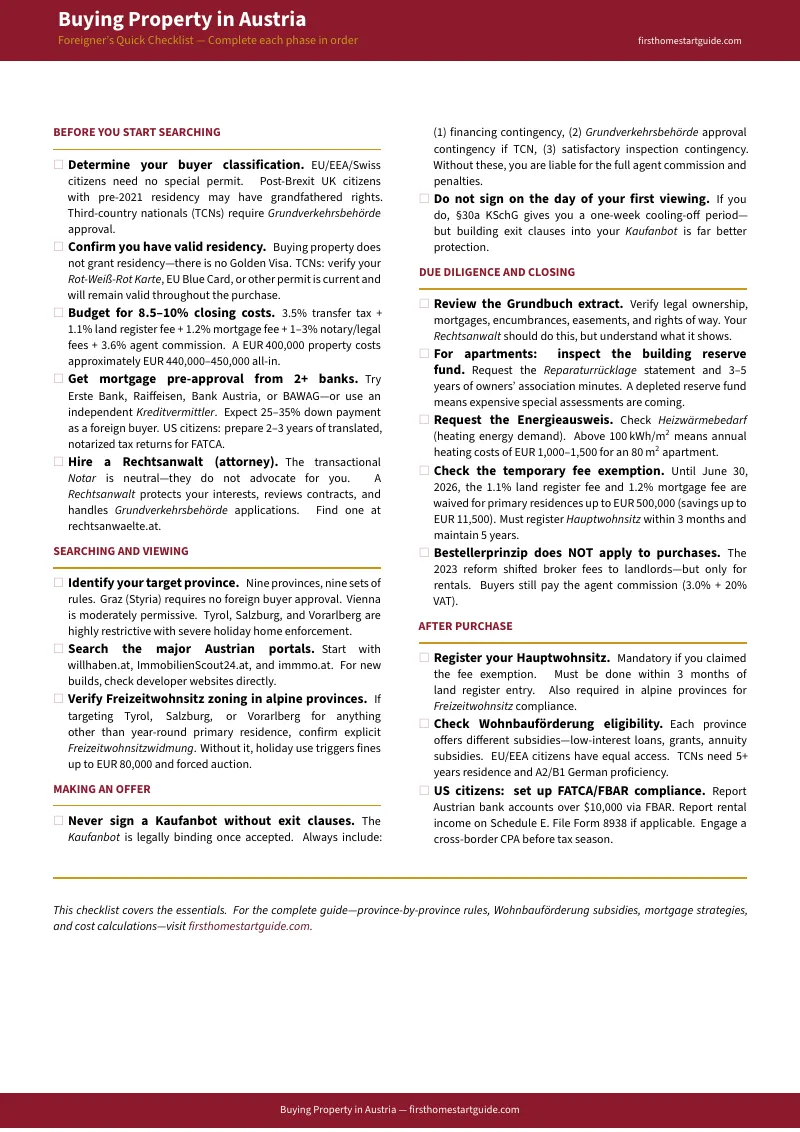
Download the free Quick Checklist to see the step-by-step action plan covering provincial permit requirements, Kaufanbot protection essentials, closing cost breakdown, and the subsidy eligibility check. When you're ready for the full Nine-Province Navigator -- the 72-page guide plus 7 standalone printable tools including the province legal map, Kaufanbot defence sheet, closing cost calculator, subsidy decoder, mortgage navigator, Freizeitwohnsitz map, and Grundverkehr dossier checklist -- the complete 9-PDF toolkit is here.
You've found the property. Now find out which province's rules apply to it -- and what they'll cost you if you don't.