
You Found Your Investment in Bahrain. The Regulatory System Between You and the Title Deed Assumes You Already Know How It Works.
You've checked the numbers. Gross rental yields of 7.5% to 9.5% in Juffair. No income tax, no capital gains tax, no inheritance tax. A property registration fee less than half of Dubai's. A currency pegged to the US dollar. A Golden Residency visa that lets you self-sponsor your entire family without an employer. You've found a two-bedroom apartment in Amwaj Islands or a waterfront unit on Reef Island, and you're ready to move forward. Within a week you've learned that foreigners can only buy freehold in government-designated investment zones — and the listing agent hasn't confirmed whether the property is in one. The building has "district cooling" — a centralized chilled-water system that charges a fixed capacity fee every month whether you run the air conditioning or not. And the ten-year Golden Residency that sold you on the purchase requires BHD 130,000 of property to be completely mortgage-free — which nobody mentioned when you were discussing bank financing at 70% LTV.
You search for guidance. Developer marketing portals publish "how to buy" pages that walk you through the transaction steps in polished English — written and maintained by platforms that earn listing fees from agents who want you to buy. RERA and SLRB government websites provide procedural outlines and fee tables, but fragment the information across two separate regulatory bodies with different jurisdictions and offer zero practical buyer-side context. Reddit threads in r/Bahrain contain real experiences from real buyers — alongside advice that confuses freehold with leasehold rights, recommends skipping the independent lawyer because "the notary handles everything," and confidently states that any building in Juffair will attract US Navy tenants at premium rents without mentioning the 25% military occupancy cap that the Naval Housing Service Center enforces building by building.
Here's the problem no free resource solves: Bahrain's property transaction runs on a dual regulatory system where the SLRB handles title registration and the RERA regulates developers and escrow accounts — and most expatriates can't tell you which body does what until they've already made a mistake. The 60-day registration window that saves you 15% on transfer fees has a hard deadline that starts the moment your SPA is notarized. The 10% municipal tax on assessed rental value applies even when the property is vacant. Off-plan purchases that looked safe until you read about Marina West — where 400 investors from 28 nationalities lost access to $750 million in capital for 15 years — are now protected by RERA-mandated escrow accounts and Swiss Re-backed insurance bonds, but only if you know how to verify them before you sign. The system has structural protections for buyers. But only if you know they exist, understand which regulatory body administers them, and activate them before you transfer funds.
The Buying Property in Bahrain — Expat Guide is the Dual Regulatory Decoder. Not a developer marketing page about luxury waterfront living. It's a structured decision system that decodes every stage of the Bahraini property purchase — from verifying freehold zone designation through the SPA, the Ministry of Interior clearance, the SLRB registration, the municipal tax obligations, and the residency application — so you make each decision understanding the regulatory mechanism behind it, the government body that administers it, and the financial consequence of getting it wrong.
What's Inside the Dual Regulatory Decoder
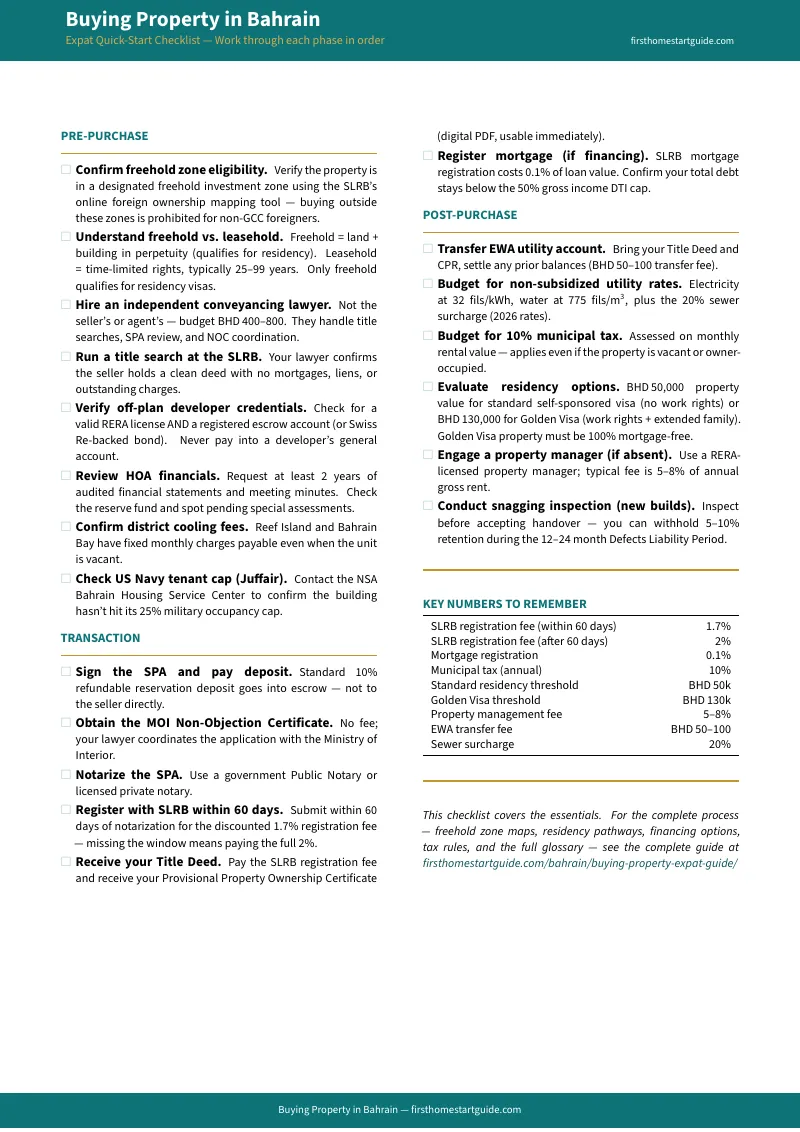
A 14-chapter guide, a standalone printable checklist, and 5 ready-to-print tools — covering every stage from freehold zone verification through post-purchase setup, with the regulatory bodies, fee structures, deadlines, and operational pitfalls that determine whether your transaction succeeds or bleeds money. Your download includes 7 PDFs: the full guide, a 20-item quick-start checklist, a freehold zone reference card, a due diligence verification checklist, a transaction cost worksheet, a residency pathway comparison card, and an off-plan verification checklist.
Freehold Zone Navigator
The single most important decision in Bahraini property buying — and the one that free resources handle with a vague list of area names. Non-GCC foreigners can own 100% freehold only within government-designated investment zones. Outside those zones, you're limited to leasehold arrangements of 25 to 99 years, and leasehold properties don't qualify for residency visas. The guide profiles every major freehold zone — Juffair, Seef, Amwaj Islands, Reef Island, Bahrain Bay, Marassi Al Bahrain, Diyar Al Muharraq, Dilmunia, Durrat Al Bahrain, and Riffa Views — with price ranges, yield profiles, tenant demographics, and the operational realities that determine whether a specific zone matches your investment strategy. Including the Saar trap: a neighbourhood that looks like a freehold area on broker maps but isn't one.
The 60-Day Registration Optimizer
When you buy property in Bahrain, the standard SLRB registration fee is 2% of the purchase value. But if your lawyer submits the registration application within 60 days of the SPA notarization, the fee drops to 1.7% — a 15% discount that saves BHD 300 on a BHD 100,000 property. Miss the window by a single day and the full 2% applies automatically. No exceptions, no appeals. The guide maps the exact sequence — SPA signing, Ministry of Interior clearance, notarization, SLRB submission — so you hit the 60-day deadline with margin to spare, and includes the timeline for receiving your Provisional Property Ownership Certificate.
RERA vs. SLRB Decoder
Bahrain's real estate sector is governed by two separate regulatory bodies, and most expatriates have no idea which one does what. The SLRB (Survey and Land Registration Bureau) maintains the Land Register and issues title deeds — no property transfer is legally recognized until SLRB registers it. RERA (Real Estate Regulatory Authority) licenses brokers, approves off-plan projects, and regulates escrow accounts. When your agent says "it's registered," you need to know: registered where? An agent's RERA license doesn't mean the property's title is clean at the SLRB. An SLRB title search doesn't tell you whether the off-plan developer's escrow account is properly administered. The guide explains the sequential operational process — which checks happen at which body, in which order — so you never confuse regulatory compliance with title security.
Off-Plan Protection System
The Marina West disaster is the reason modern protections exist — and the proof that you need to verify them. Between 2006 and 2010, over 400 investors from 28 nationalities paid up to 80% of their purchase prices for luxury apartments in a $750 million beachfront development. The developer halted construction. Investors' capital was frozen for 15 years. The project was finally auctioned in November 2025 for BHD 19.8 million — a fraction of the original investment. Today, RERA mandates three protective instruments for off-plan buyers: escrow accounts administered by CBB-licensed banks, bank guarantees, and Swiss Re-backed insurance bonds provided by six licensed Bahraini insurers. The guide tells you exactly what to demand from a developer before you sign: the RERA project license number, the escrow account bank name and account number, and written confirmation of the insurance bond. If a developer cannot produce all three, you walk away.
Municipal Tax and Hidden Cost Calculator
Bahrain is marketed as tax-free. It is not. There is no income tax, no capital gains tax, and no inheritance tax — but the government imposes a 10% municipal tax on the assessed monthly rental value of any property leased to or occupied by expatriates. The tax applies even if the property is vacant, calculated against a deemed rental value assessed by the municipality. Add annual service charges of 1% to 2% of the property value (BHD 500 to BHD 3,000 for a typical two-bedroom apartment), district cooling capacity fees in Reef Island and Bahrain Bay that you pay whether the AC is running or not, and non-subsidized EWA utility rates at 32 fils per kWh for electricity and 775 fils per cubic meter for water plus a 20% sewer surcharge — and your actual net yield can be 2 to 3 percentage points below the gross figure that every marketing brochure advertises. The guide provides a complete cost model so you calculate net yield before you buy, not after.
Residency Pathway Blueprint
Bahrain offers two property-linked residency tracks, and the differences between them are substantial enough to determine your entire investment strategy. The standard self-sponsored visa (BHD 50,000 minimum property value) grants 2, 5, or 10-year renewable residency but prohibits local employment — you need a separate employer-sponsored work permit. The Golden Residency Visa (BHD 130,000 minimum, reduced from BHD 200,000 in late 2025) grants a 10-year visa with full local work rights and sponsors your spouse, children up to 25, and parents. But the Golden Visa qualifying property must be 100% mortgage-free — if you financed the purchase, only your paid-down equity counts. You can combine multiple properties across different freehold zones to reach the threshold, but every property must be registered in your name. No physical stay requirement — you can manage the property entirely from abroad. The guide maps both pathways step by step, including the NPRA application process, documentation requirements, and the consequence of selling your qualifying property without an immediate replacement.
Bahrain vs. Dubai Comparison
The comparison every Gulf property buyer makes — and the one that free resources answer with marketing slogans instead of numbers. The guide provides a side-by-side analysis of registration fees (Bahrain's 1.7% vs. Dubai's 4%), typical yields, residency thresholds, tax structures, and the practical differences in market liquidity, exit timelines, and tenant pools. Not to argue that one market is better than the other, but to give you the structural data to match the right market to your specific investment strategy.
Who This Guide Is For
This guide is for foreign buyers and expats purchasing property in Bahrain who:
- Are buying their first Bahraini property and need the entire transaction mapped — from freehold zone verification through the SPA, Ministry of Interior clearance, notarization, SLRB registration, and post-purchase setup — so they understand what happens at each stage, which regulatory body handles it, and what can go wrong
- Have found a property and need to confirm, before transferring any funds, that the plot is in a designated freehold zone, that the title is clean at the SLRB, and that the agent holds a valid RERA license
- Are buying off-plan and need to verify the developer's RERA project license, escrow account, and insurance bond — because Marina West proved what happens when buyers skip this step
- Want residency through property investment and need to understand the precise difference between the BHD 50,000 standard visa (no work rights) and the BHD 130,000 Golden Visa (full work rights) — including the mortgage-free requirement that can disqualify an otherwise sufficient investment
- Are investing in Juffair to rent to US Navy personnel and need to verify the building's military occupancy status before committing to a purchase whose entire financial model depends on OHA-funded tenants
- Need to calculate actual net yield after the 10% municipal tax, service charges, district cooling fees, and non-subsidized utility rates — because the 7.5% to 9.5% gross yield in every marketing brochure is not the number that hits your bank account
- Want every transaction cost, every regulatory deadline, every government portal, and every operational requirement in one document — so they walk into lawyer meetings, SLRB offices, and contract signings with the same structural understanding as a locally experienced buyer
Why Not Free Resources?
Free information on buying property in Bahrain as a foreigner exists. Here's what each source actually delivers:
- Developer marketing portals (Property Finder Bahrain, OKA Real Estate, individual developer websites) publish "how to buy" guides that walk you through the transaction in clean English — maintained by platforms that earn listing fees and commissions from sellers. The guides cover the high-level process and mention freehold zones by name. What they don't cover: the 10% municipal tax that applies even on vacant properties, the district cooling trap in premium zones, the 60-day registration window that saves 15% on transfer fees, or the building-level Navy occupancy cap that can make or break a Juffair investment. The information is real. The costs and restrictions that affect your net return are systematically absent.
- Government portals (SLRB, RERA) provide procedural outlines, fee schedules, and licensing directories. The information is authoritative and accurate. It's also spread across two separate websites with different mandates, written for regulatory compliance rather than buyer guidance, and offers no integration between the title registration process (SLRB) and the developer/escrow oversight process (RERA). You get the official rules. You don't get the practical sequence for executing them as a foreign buyer.
- Reddit and expat forums (r/Bahrain, Bahrain Expats Facebook, InterNations Bahrain) contain genuine experiences from real buyers — alongside advice that confuses freehold with leasehold rights, recommends buildings in Juffair without mentioning the Navy occupancy cap, and states that "there's no property tax" without disclosing the 10% municipal tax. You'll find someone who closed smoothly and someone who's been paying district cooling fees on an empty apartment for two years. Both stories are true. Neither tells you which outcome applies to your property.
- Market research reports (JLL, Savills, Knight Frank, CBRE) publish quarterly reviews with supply pipelines, vacancy rates, and yield summaries — written for institutional developers and corporate tenants. A BHD 3,000 consulting engagement distilled into a PDF that tells you the market is "moderately optimistic." It does not tell you how to verify a title at the SLRB, hit the 60-day registration deadline, or structure a purchase that qualifies for the Golden Visa.
This guide fills the structural gap — the space between knowing that Bahrain allows foreigners to buy property and understanding exactly how the dual regulatory system works at each stage, which body administers which process, what the hidden costs actually are, and how the residency pathways function in practice. It's the analysis an independent advisor with no commission to earn would give you, structured as a permanent reference you own.
— Less Than One Hour of a Bahraini Lawyer's Time
A conveyancing lawyer in Bahrain charges BHD 400 to BHD 800 for a single transaction. The 10% reservation deposit you're protecting in the SPA is BHD 5,000 to BHD 15,000 on a typical apartment. Missing the 60-day SLRB registration window costs an extra BHD 300 on a BHD 100,000 property. Buying in a zone that isn't designated freehold means you've purchased a leasehold that doesn't qualify for residency and can't be inherited by your heirs.
This guide doesn't replace your lawyer or your agent. But it gives you the freehold zone navigator, the RERA-vs-SLRB decoder, the off-plan protection checklist, the municipal tax calculator, and the residency pathway blueprint that ensure you walk into every viewing, every contract signing, and every SLRB appointment understanding the regulatory mechanism behind each step — instead of discovering how Bahrain's property system works by losing money to it.
If it catches a single non-freehold listing before you sign, identifies the 60-day registration deadline before you miss it, or reveals the municipal tax and district cooling costs before you calculate your yield without them, it pays for itself before you've finished reading it.
Money-back guarantee, no time limit. If the guide doesn't make the Bahraini property transaction clearer and your financial position stronger, you pay nothing.
Download the free Quick Checklist to see the step-by-step action plan covering freehold zone verification, title searches, off-plan escrow checks, the 60-day registration window, and residency requirements. When you're ready for the full Dual Regulatory Decoder — complete with the zone-by-zone profiles, municipal tax calculator, off-plan protection system, residency pathway blueprint, and Bahrain-vs-Dubai comparison — the complete guide is here.
You've found the investment. Now decode the regulatory system that stands between you and the title deed.