
Belgium Has No Restrictions on Foreign Buyers. It Has Something Worse: Three Separate Legal Systems That Tax the Same House Three Different Ways.
You've been posted to Brussels. Or transferred to Antwerp. Or your NATO assignment puts you near Mons for the next four years. The rental market is expensive and competitive, you've run the numbers, and buying makes sense. So you start searching on Immoweb, find a place you like, and make an offer by email. Within 48 hours you've made a legally binding commitment to purchase the property. Not a preliminary expression of interest. Not a conditional offer subject to financing. A binding sale. In Belgium, the moment the seller accepts your written offer — by email, SMS, or handshake followed by a signed document — the sale is legally concluded. The notarial deed signed three to four months later simply registers a transaction that has already occurred. If you haven't secured mortgage approval, and your offer doesn't contain a suspensive condition for financing, you owe a 10% penalty on the purchase price. On a EUR 400,000 property, that's EUR 40,000 — for signing a document you thought was the starting point of negotiations.
You search for help. Expatica gives you a cheerful overview that doesn't mention the 2025 registration duty reforms. Reddit threads on r/BEFire contradict each other about whether a cooling-off period exists (it doesn't, for standard purchases). The official notaire.be calculator is in French or Dutch only. And the tax consultancies that actually understand the three-region system charge EUR 300-500 per hour — to explain information you need before your first viewing, not after you've already signed a compromis.
Here's the structural problem no free resource solves: Belgium is not one property market. It's three. Flanders charges 2% registration duty on a primary residence. Wallonia charges 3%. Brussels charges 12.5%. Buying a EUR 450,000 family home in the Flemish periphery costs EUR 9,000 in registration duties. Buy the same house a few streets inside the Brussels border and your tax bill jumps to EUR 56,250 — or EUR 31,250 if you qualify for the abattement, which you don't if you own property anywhere else in the world. The compromis de vente is legally binding on signature with no statutory cooling-off period. An F-rated property in Flanders triggers a mandatory renovation to D-label within five years of purchase. And the syndic managing your apartment building may have voted on a EUR 50,000 facade repair three months before you signed — a liability that transfers to you on completion.
The Buying Property in Belgium — Expat Guide is The Three-Region Defence System. Not a relocation blog article about charming Belgian townhouses. It's a structured decision framework that maps every stage of the Belgian property transaction — from the written offer through the compromis de vente, the notarial deed, the regional registration duty calculation, the EPC renovation obligations, and the syndic disclosure requirements — so you make each decision understanding which region's rules apply, what the financial exposure is, and how to protect yourself before you sign anything.
What's Inside The Three-Region Defence System
The complete guide plus standalone printable worksheets — covering every stage from property search through notarial deed, plus fillable tools you print and use when reviewing contracts, calculating costs, and inspecting properties:
The Registration Duty Calculator
Registration duties alone can swing your transaction costs by tens of thousands of euros depending on which side of a regional border you buy. The guide maps all three regimes with exact 2025/2026 rates. Flanders: 2% for a sole primary residence (down from 6% pre-2025), with a 1% surcharge applied if you fail to register within the compliance window. Wallonia: 3% for a primary residence (down from 12.5% pre-2025), dramatically reducing the barrier for NATO personnel and corporate transferees near Mons and Liege. Brussels: 12.5% standard, with an abattement exempting the first EUR 200,000 of the purchase price — but only if the property costs EUR 600,000 or less, the buyer occupies it as their primary residence, and the buyer owns no other property anywhere in the world. The guide provides side-by-side calculations at common price points so you see the exact euro difference before choosing a municipality.
The Compromis Defence Protocol
In the UK, you can withdraw from a property purchase right up to exchange of contracts. In the US, inspection contingencies and attorney review periods provide structured exit points. In Belgium, none of this exists for standard resale purchases. The compromis de vente is the sale — legally binding the moment both parties sign. There is no statutory cooling-off period. The Breyne Law's 7-day reflection period applies only to off-plan purchases from developers. The guide covers exactly what the compromis must contain to protect you: the suspensive condition for mortgage financing (condition suspensive / opschortende voorwaarde), the timeline for securing formal bank approval, the consequences of proceeding without one, and the specific contractual language to request from your notary before signing. Because the 10% penalty for failing to complete is not theoretical — it's the standard contractual consequence that Belgian courts routinely enforce.
The EPC Renovation Liability Map
Energy performance ratings in Belgium aren't cosmetic labels you can ignore. In Flanders, buying a residential property with an EPC label of E or F triggers a legal obligation to renovate to at least D-label within five years of the notarial deed — tightening to C-label from 2028. The Flemish government is discontinuing its popular renovation grants for middle and high-income applicants from January 2026, meaning expats bear the full, unsubsidised cost. Wallonia mandates D-label within five years for properties purchased from 2028 onwards, with oil and coal boilers phased out from 2026. Brussels requires every building to have an EPB certificate by 2033 and hit C-label by 2046, with gas boiler phase-outs adding further capital costs. The guide maps every regional obligation with current deadlines, explains how to read the EPC/PEB/EPB certificate at a property viewing, and provides the budget framework for calculating renovation costs before you sign the compromis — so you don't inherit a EUR 30,000-50,000 mandatory renovation that the seller priced into their discount but you didn't budget for.
The Syndic Interrogation Checklist
Buying an apartment in Belgium means entering a co-ownership structure managed by the syndic. Monthly common charges of EUR 50-150 appear manageable. The danger is the extraordinary charges — a roof replacement, facade remediation, or elevator modernisation voted on by the general assembly months before your purchase. The seller's obligation to disclose this information exists, and the syndic must legally provide financial data within 15 days of request. But foreign buyers routinely fail to request it, or don't know what to look for in the acte de base and assembly minutes. The guide provides the exact list of documents to demand before making an offer, the financial red flags in the working capital and reserve fund that signal a building heading toward a special assessment, and the critical rule that the seller's reserve fund contribution stays with the co-ownership — it is not refunded to you or credited against your purchase price.
The Expat Mortgage Navigator
Non-residents and recent arrivals face stricter lending criteria than Belgian nationals. While the National Bank permits banks to lend up to 90% loan-to-value, non-residents without Belgian credit histories are typically required to put 20-30% down in cash. Interest rates run 3.0-4.5%, and the debt-to-income ratio is assessed against your global obligations. The guide covers which Belgian banks actively lend to expats, the documentation requirements (including the 30% ruling tax status and its implications for income verification), the difference between a fixed and variable rate hypotheek/hypotheque, the woonbonus and cheque habitat deductibility rules by region, and how to structure your mortgage timeline so formal approval arrives before the compromis completion deadline — because without a properly drafted suspensive condition, a delayed mortgage approval costs you 10% of the property price.
The Cadastral Income Trap
If you hold property in another country while tax-resident in Belgium, the Belgian tax authorities will assign a notional Cadastral Income to your foreign property and use it to push you into a higher marginal tax bracket for your Belgian salary — even if a double taxation treaty prevents Belgium from directly taxing the foreign property. The guide explains the Cadastral Income system, how the 2021 foreign property rules work, the annual precompte immobilier / onroerende voorheffing property tax and how it varies by region and municipality, and the declaration requirements that many expats only discover when they receive a correction notice from the SPF Finances.
The Notary Selection Guide
In Belgium, the notary (notaire/notaris) is a state-appointed official who authenticates the transaction and ensures legal compliance — not an advocate for your interests. You have the right to appoint your own notary alongside the seller's, and the regulated fee is split between the two offices at no additional cost to you. The guide explains when you need your own English-speaking notary, how to find one through the Chambers of Notaries, what the dual-notary structure looks like in practice, and the typical notary fees (1-2% of purchase price) so you know exactly what you're paying for.
Who This Guide Is For
This guide is for foreign buyers and expats purchasing property in Belgium who:
- Work for an EU institution, NGO, or lobbying firm in Brussels and are weighing whether to buy a primary residence in the capital or invest in a property in the Flemish periphery where registration duties are a fraction of the Brussels rate — and need the exact calculations to make that geographic decision with confidence
- Are posted to NATO/SHAPE near Mons on a three-to-five-year assignment and need to know whether buying makes financial sense given the break-even timeline, and how the new Wallonia 3% registration duty changes the rent-versus-buy calculation that previous expats relied on
- Have been transferred by a multinational to Antwerp, Ghent, or the Brussels pharmaceutical corridor and are navigating the Belgian mortgage system for the first time — including the 30% ruling implications for income verification and the suspensive condition that protects their deposit
- Are British nationals who assume the Belgian property transaction works like the English system — with a non-binding offer, a survey, a mortgage in principle, and an exchange of contracts — and need to understand that in Belgium, the first document they sign is the last chance they had to walk away
- Are purchasing an apartment and need to interrogate the syndic's financial records, understand the co-ownership structure, and verify that no extraordinary charges have been voted on before they commit to buying someone else's building maintenance liability
- Want every regional tax rate, every legal deadline, every EPC renovation obligation, and every notary fee in one document — so they negotiate, sign, and complete with the same structural understanding as a Belgian buyer, not the surface-level confidence of someone who read an Expatica overview written before the 2025 reforms
Why Not Free Resources?
Free information on buying property in Belgium as a foreigner exists. Here's what each source actually delivers:
- Expatica publishes a general overview of Belgian property buying that correctly identifies the lack of foreign ownership restrictions, outlines basic transaction costs, and explains superficial mortgage mechanics. What it doesn't cover: the 2025 registration duty reforms that slashed Flanders from 6% to 2% and Wallonia from 12.5% to 3%, the Brussels abattement disqualification for buyers who own property anywhere else in the world, or the EPC renovation mandates that make an F-rated house in Flanders a five-year renovation deadline disguised as a discount. It orients you. It doesn't protect you.
- Reddit (r/BEFire, r/belgium) contains real questions from real buyers — alongside contradictory answers about cooling-off periods, with some posters incorrectly claiming a 14-day withdrawal right that does not exist for standard property purchases. You'll find someone who signed a compromis without a suspensive condition and completed successfully, and someone who lost EUR 40,000 because their mortgage was declined. Both stories are true. Neither tells you which outcome applies to your situation.
- Notaire.be and official government portals contain accurate legal information — in French and Dutch, using Belgian legal terminology, structured for Belgian residents who grew up inside the system. The registration duty calculator doesn't explain the abattement eligibility criteria in plain English. The EPC pages don't connect the renovation obligation to the purchase timeline. The information is there. The translation — cultural, not just linguistic — is not.
- Tax consultancies (BDO, Grant Thornton, Taxpatria) possess deep technical expertise on cross-border taxation, Cadastral Income implications, and corporate structuring. Their published articles function as lead generation for retained advisory services at EUR 300-500 per hour. A mid-market expat buying a EUR 400,000 family home in Ghent cannot financially justify a multi-hour consultation to understand registration duties — but they desperately need the knowledge those consultants possess.
- Relocation agencies (ABRA members) handle corporate relocations professionally and efficiently — for their corporate clients. Independent expats making their own purchase decisions don't have a EUR 5,000 relocation budget allocated by their employer. They need the same information, structured as a permanent reference, at a fraction of the cost.
This guide fills the structural gap — the space between knowing that Belgium has three regions with different tax systems and understanding exactly how those systems interact with your purchase, your mortgage, your renovation liability, and your annual tax obligations. It's the analysis a bilingual Belgian property lawyer would give you over a two-hour consultation, structured as a permanent reference you own.
— Less Than One Hour of a Tax Consultant's Time
A tax consultation runs EUR 300-500 per hour. A relocation agency charges thousands. The registration duty difference between buying in Flanders versus Brussels on a EUR 450,000 property is EUR 47,250. The penalty for signing a compromis without a suspensive condition and failing to complete is 10% of the purchase price. The mandatory EPC renovation on an F-rated Flemish house costs EUR 30,000-50,000 that the listing price doesn't mention.
This guide doesn't replace your notary or your mortgage broker. But it gives you the three-region registration duty calculations, the compromis defence strategy, the EPC renovation liability assessment, the syndic interrogation checklist, and the mortgage timeline that ensure you walk into every viewing, every notary appointment, and every contract signing understanding which region's rules apply and what they cost — instead of discovering how Belgian property law works by paying for the lesson.
If it prevents a single compromis penalty, catches a single EPC renovation liability before you sign, or identifies the region where registration duty saves you EUR 20,000 or more, it pays for itself before you've finished reading it.
Money-back guarantee, no time limit. If the guide doesn't make the Belgian property transaction clearer and your financial position stronger, you pay nothing.
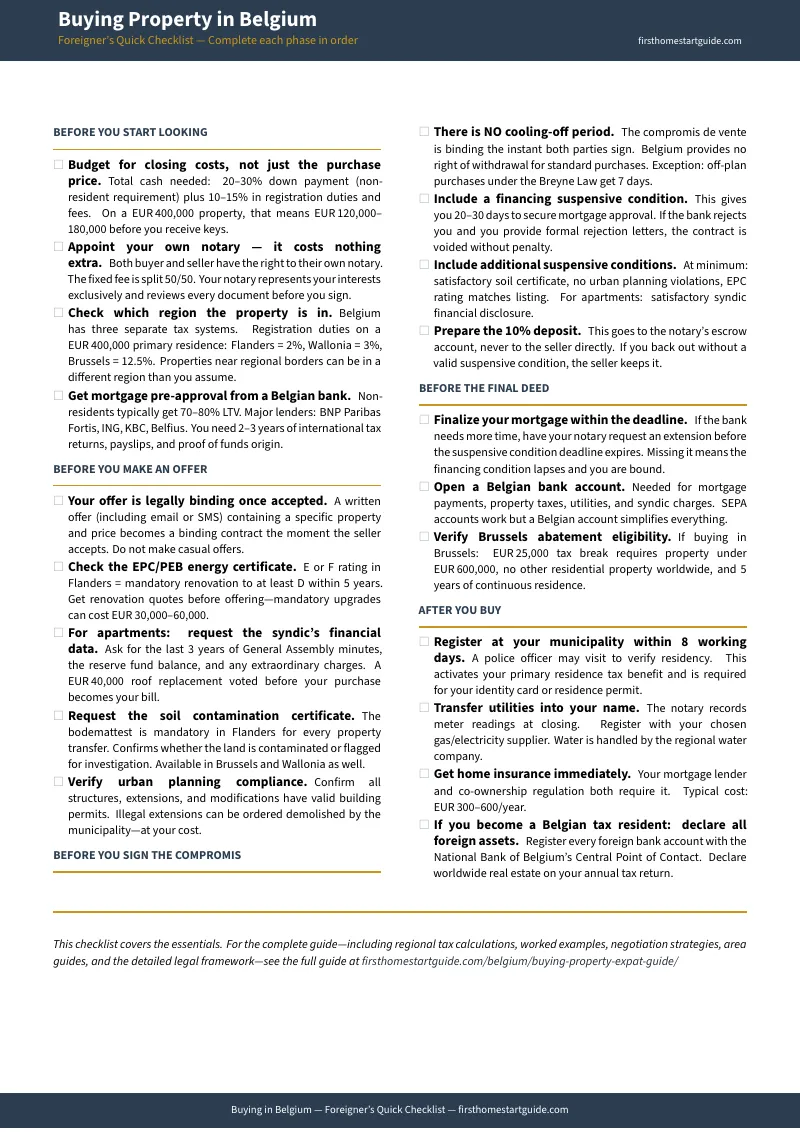
Download the free Quick Checklist to see the step-by-step action plan covering regional registration duty comparison, compromis de vente essentials, EPC verification, and the notary selection process. When you're ready for the full Three-Region Defence System — complete with registration duty calculations, compromis defence protocol, EPC renovation liability map, syndic interrogation checklist, and expat mortgage navigator — the complete guide is here.
You've found the property. Now find out which region's rules apply to it — and what they'll cost you if you don't.