
You Found the Florianópolis Beachfront Apartment. You Ran the Exchange Rate Math. Now You Need to Navigate a Dual-Notary System Where Signing the Deed Doesn't Make You the Owner — and Nobody Will Tell You That Until It's Too Late.
You've done the currency arithmetic. Your dollars, pounds, or euros buy five times what they did against the real a decade ago. Beachfront apartments in Leblon and Ipanema trade at a fraction of comparable waterfront in Miami or Lisbon. Compact units near São Paulo's Faria Lima corridor yield 6-7% gross. Brasília's government-tenant market delivers steady returns that would be exceptional anywhere in Europe. The macroeconomic thesis is obvious. You're ready to buy.
Then you discover the operational reality. Brazilian real estate runs on a civil law system with no title insurance, no centralized escrow, and no safety net for the uninformed buyer. The entire burden of due diligence falls on you. You sign what you think is the final deed at a Notary Office — the Escritura Pública at the Tabelionato de Notas — and assume you own the property. You don't. Under Brazilian law, ownership transfers only when that deed is registered at a completely separate government office — the Cartório de Registro de Imóveis — on the property's Matrícula. Skip this step, and the seller remains the legal owner. The property stays exposed to the seller's creditors, pending lawsuits, tax liens, or a second sale to a different buyer. Brazilian lawyers have an axiom for this: "Quem não registra, não é dono" — he who does not register is not the owner.
You search for help. Free expat blogs give you the basics: foreigners can buy urban property freely, you need a CPF, the process involves a contract and a deed. Accurate and completely insufficient. None of them explain that certain debts — unpaid condominium fees, IPTU tax arrears — attach to the physical property itself and transfer to you automatically at closing. None of them explain that the beachfront condo you're eyeing in Florianópolis may sit on Terrenos de Marinha — federal coastal land where you'll never hold true freehold, you'll owe an annual lease fee to the government, and every future sale triggers a 5% Laudêmio transfer tax paid to the federal Union. None of them mention that as of January 2025, every foreign CPF holder living outside Brazil must complete an annual biometric facial recognition check on a mobile app or have their taxpayer number suspended — freezing bank accounts and halting all property transactions.
Here's the gap every free resource leaves open: Brazil's property market runs on a dual-notary bureaucracy where the document that feels like closing isn't closing, the debts you didn't incur become legally yours, and the beachfront property you thought was freehold may be permanently leased from the federal government. The STJ — Brazil's highest court for civil matters — ruled that condominium associations can ban Airbnb by two-thirds vote, destroying yield projections that investors built their entire purchase around. The ITBI transfer tax rate varies across 5,500+ municipalities with no centralized reference. The capital repatriation process requires a specific foreign exchange contract executed at the time of purchase — skip it, and your money is trapped in Brazil permanently. And the CPF biometric mandate that took effect January 2025 transforms a one-time tax ID into an annual compliance obligation that can paralyze your entire asset portfolio with a single missed deadline. Free guides mention none of this. Law firm blogs outline the risks but withhold the solutions, because their business model is to convert you into a R$15,000 retainer client.
The Buying Property in Brazil — Expat Guide is The Cartório Decoder. Not a lifestyle tour or a neighborhood ranking. It's an 18-chapter operational manual that maps every friction point between "I want to buy in Brazil" and "the Matrícula is registered in my name" — with the dual-notary mechanics, tax breakdowns, due diligence protocols, capital repatriation framework, and restricted-zone warnings that determine whether your transaction closes cleanly or collapses at the Registry Office.
What's Inside The Cartório Decoder
A comprehensive guide covering 18 chapters and a complete glossary — plus a 20-item Quick Start Checklist and standalone printable tools (worksheets, reference cards, and checklists you can bring to bank meetings, Cartório appointments, and property viewings). Every chapter ties directly to a decision point where foreign buyers lose money, lose time, or lose their entire transaction:
The Dual Cartório System Decoded — Why Signing the Deed Doesn't Make You the Owner
The single most dangerous assumption foreign buyers bring from common-law countries. In the US, UK, or Australia, a title company handles everything. In Brazil, the process is legally split between two completely separate offices: the Tabelionato de Notas (where you sign the deed) and the Cartório de Registro de Imóveis (where ownership actually transfers). The guide walks through both institutions — what each one does, what each one does NOT do, and the exact sequence of steps from preliminary contract through registered title. It explains why the Notary serves the state, not you, and why the property's Matrícula — not your signed deed — is the only document that proves you own anything.
The CPF Biometric Mandate — The 2025 Rule That Turns a Tax ID Into an Annual Compliance Trap
Every English-language guide written before 2025 treats the CPF as a one-time registration. It's not anymore. Since January 13, 2025, the Receita Federal requires every non-resident CPF holder aged 16+ to complete an annual biometric facial recognition check via their mobile app by December 31 each year. Miss the deadline, and your CPF status flips to "Suspended" — freezing every bank account, halting pending transactions, and blocking your ability to manage Brazilian assets. The guide covers the full process: e-Consular application from abroad, in-person registration inside Brazil, the annual recadastramento mechanics, and what to do if your CPF gets suspended.
The Terrenos de Marinha Trap — When Your "Freehold" Property Is Actually Federal Land
The trap that hits lifestyle buyers hardest. Terrenos de Marinha is a 33-meter strip of land measured from the 1831 high-tide line — and it covers prime beachfront in Copacabana, Florianópolis, and across the Northeast coast. Properties on this land are never truly freehold: the federal government retains ultimate ownership through the SPU, the buyer holds only "useful domain," and every sale triggers a 5% Laudêmio transfer tax on top of everything else. On a R$2 million beachfront property, that's R$100,000 in hidden cost. The guide explains how to check for Terrenos de Marinha classification, the annual Foro fee (0.6%), and the remição de foro process under Law 14,011/2020 that can consolidate full freehold ownership.
Due Diligence Protocol — Propter Rem Obligations and the Debts That Follow the Property
Brazil has no title insurance. The buyer assumes total legal liability for pre-existing encumbrances. The guide covers the complete due diligence sequence: pulling the updated Matrícula and Certidão de Ônus Reais from the Registry, collecting over a dozen Certidões Negativas on the seller (federal, state, municipal, labor, civil, protested debts), verifying IPTU payment history, obtaining the Declaração de Quitação Condominial from the Síndico, and checking for rural land classification that triggers Lei 5.709 restrictions. It explains propter rem obligations — the debts that attach to the physical property and transfer to you at closing regardless of who incurred them — and exactly which clearance documents protect you.
Capital Controls and Repatriation — How to Get Your Money In Legally and Back Out Later
The fear that keeps sophisticated investors awake. Brazil's Central Bank maintains strict foreign exchange controls, and the inbound wire must be executed through an authorized bank that generates a Contrato de Câmbio explicitly stating the purpose is real estate acquisition. Skip this step — use an unregulated remittance service or peer-to-peer transfer — and you will be unable to justify the origin of funds upon resale. The guide covers the modernized framework under Law 14,286/2021, when RDE-IED registration is required (corporate buyers above USD 100,000) vs. when it's not (individual buyers), and the mechanics of repatriating principal and capital gains when you eventually sell. The 15% non-resident capital gains tax is calculated against your Contrato de Câmbio — lose that document, and proving your cost basis becomes nearly impossible.
The ITBI Tax Map — Municipal Rates Across Every Major Expat Market
The largest transactional cost — and the one with no single national rate. Because ITBI is municipal legislation, rates vary across 5,500+ municipalities. Foreign buyers searching for "Brazil property transfer tax" find contradictory answers because every city is different. The guide provides exact current rates for every major expat target market: São Paulo (3%), Rio de Janeiro (3%), Florianópolis (2%), Brasília (2% resale / 1% new builds), Balneário Camboriú (2%), Recife (3%), and more. It also covers the STJ Tema 1113 ruling that struck down inflated municipal reference values, Cartório notary and registry fee structures, and a full closing cost breakdown showing the 5-8.5% total above the purchase price.
The STJ Airbnb Ruling — Why Your Rental Yield Projections May Be Worthless
The Superior Court of Justice ruled that condominium associations can legally ban short-term rentals if they determine high turnover compromises security or peaceful coexistence. Under Article 1,351 of the Civil Code, amending the building's bylaws requires a two-thirds supermajority of all unit owners. Foreign investors can no longer assume an inherent right to Airbnb a unit in Leblon or Copacabana. The guide includes the due diligence checklist for auditing condominium bylaws: which clauses to look for in the Convenção de Condomínio, what the Regimento Interno must say, and how to read recent assembly minutes to determine whether short-term stays are explicitly authorized, explicitly prohibited, or in a grey zone that could flip against you.
City-by-City Investor Guide — São Paulo, Rio, Florianópolis, Brasília, and the Northeast
Not a lifestyle ranking — a pricing and yield analysis across every major foreign buyer market. São Paulo's Itaim Bibi at R$15,000-R$20,000/m² for corporate housing demand. Rio's Leblon at R$22,000-R$25,000/m² after a 40% surge in foreign buyer activity. Florianópolis's Jurerê Internacional at R$2.5-R$15 million for master-planned luxury. Brasília's Asa Sul and Asa Norte delivering 6.35-7%+ gross yields from government tenants. Northeast entry points from R$400,000 with the RN 36 investor visa threshold at R$700,000 instead of R$1,000,000. Each city gets ITBI rates, target neighborhoods, price-per-square-meter data, and an honest assessment of liquidity risk and rental enforcement reliability.
Standalone Printable Tools — Included
Every purchase comes with standalone reference PDFs designed to be printed and used in the field — at the bank, the Cartório, or during property viewings:
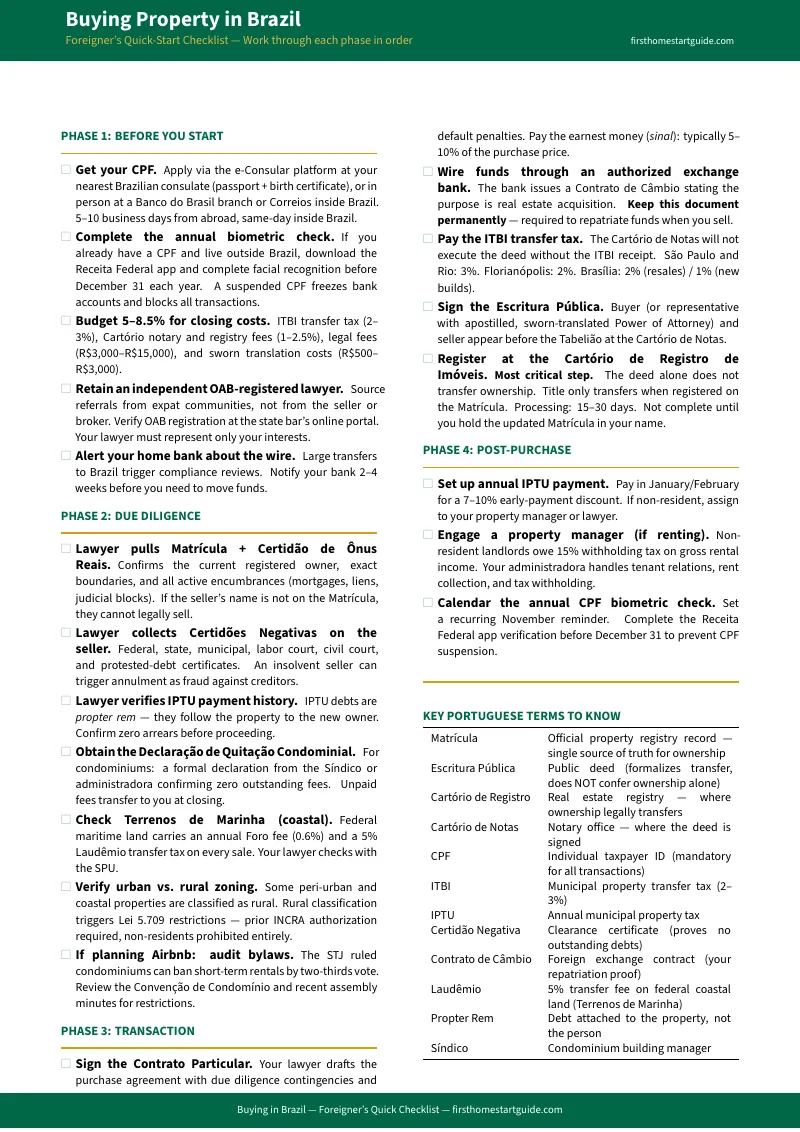
- 20-Item Quick Start Checklist — Every critical step from CPF application through registered title, in order
- Transaction Cost Worksheet — Fill in your target property price and municipality to calculate ITBI, Cartório fees, legal fees, and total closing costs
- Due Diligence Checklist — Every verification item to confirm before signing the Escritura, plus propter rem red flags
- ITBI Rate Reference Card — Municipal transfer tax rates across all major expat target cities
- Cartório Process Timeline — Contrato Particular → Escritura Pública → Matrícula Registration with deposits, deadlines, and penalties
- Airbnb Bylaw Audit Checklist — What to verify in the Convenção de Condomínio before underwriting short-term rental income
- Capital Repatriation Flowchart — Contrato de Câmbio → Central Bank compliance → exit mechanics
- Portuguese Legal Terms Glossary — 35+ essential terms with plain-English translations for every document you'll encounter
Who This Guide Is For
This guide is for foreign nationals buying property in Brazil who:
- Are buying their first Brazilian property and need the entire transaction mapped — from CPF application through dual-Cartório navigation, ITBI payment, Escritura signing, and Matrícula registration — so they understand what happens at each stage, what it costs, and what the penalty is for getting it wrong
- Are eyeing beachfront property in Florianópolis, Rio, or the Northeast and need to understand whether the land is classified as Terrenos de Marinha — where they'll never hold true freehold, they'll owe an annual Foro fee, and every resale triggers the 5% Laudêmio transfer tax that no listing agent will mention voluntarily
- Plan to generate rental income and need to understand the 15% non-resident withholding tax on gross income, the STJ ruling that lets condominiums ban Airbnb by two-thirds vote, and the practical logistics of managing a property from another continent through a local administradora de imóveis
- Need to move capital into Brazil through an authorized exchange bank and establish the Contrato de Câmbio documentation that guarantees legal repatriation when they eventually sell — not discover five years from now that their wire transfer left no compliant paper trail
- Are pursuing the RN 36 investor visa and need to understand how the R$1,000,000 threshold (South/Southeast) or R$700,000 threshold (North/Northeast) interfaces with Federal Police documentation, the pathway to permanent residency, and the risk of selling the property before securing immigration status
- Already hold a CPF and need to understand the January 2025 biometric recadastramento mandate — the annual mobile app facial recognition check that, if missed, suspends their CPF and freezes every bank account and property transaction in Brazil
Why Not Free Resources?
Free information on buying Brazilian property is everywhere. Here's what each source actually delivers:
- Expat blogs and property aggregators (ExpatFocus, Global Property Guide, International Living) publish accurate overviews: foreigners can buy urban property freely, you need a CPF, closing costs run 5-8%. What they skip: the dual-Cartório mechanics that determine whether you actually own the property, the Terrenos de Marinha classification that strips your freehold rights on beachfront, the 2025 CPF biometric mandate, and the propter rem debts that transfer to you at closing. You get a surface-level summary designed to make Brazil seem accessible, not to prepare you for the Matrícula registration.
- Law firm blogs (Oliveira Lawyers, Pinheiro Neto, ZS Advogados) produce high-quality, legally accurate articles explaining exactly how dangerous the system is. That's their business model — outline the risks in vivid detail, then funnel you into a R$15,000 retainer. They excel at telling you what can go wrong. They intentionally withhold the step-by-step operational mechanics that would let you verify their work and negotiate from a position of knowledge.
- YouTube channels and lifestyle influencers produce compelling content about cost of living, beach culture, and neighborhood tours. The best ones are genuinely informative about lifestyle. What they don't provide: the due diligence checklist you hand to your lawyer, the ITBI rate table for your target municipality, the Cartório fee breakdown, or the capital repatriation framework. You get aspiration optimized for watch time, not a reference document for a six-figure closing.
- Reddit and expat forums (r/Brazil, r/expats, Internations) contain real stories from real buyers — alongside advice that predates the 2025 CPF biometric mandate, recommends skipping the independent lawyer to save R$10,000, and confidently states that "the Cartório handles everything" without distinguishing between which Cartório does what. Some of these buyers closed smoothly. Some discovered propter rem debts months after closing. Both outcomes are documented. Neither tells you which applies to your situation.
This guide fills the operational gap — the space between knowing that foreigners can buy property in Brazil and understanding exactly how to navigate the dual-Cartório system, verify the Matrícula, clear propter rem debts, structure compliant capital transfers, audit condominium bylaws for the STJ Airbnb ruling, and register your title without losing your deposit, your CPF status, or your ability to repatriate capital later. It's the analysis an independent advisor with no retainer to earn and no property to sell would give you, structured as a permanent reference you own.
— Less Than One Hour of a Brazilian Property Lawyer's Time
An OAB-registered real estate lawyer charges R$3,000-R$15,000 for a standard transaction. The ITBI transfer tax alone runs 2-3% of the purchase price. The Laudêmio on a beachfront property you didn't know was Terrenos de Marinha adds 5%. The condominium fee arrears that attach to the property through propter rem obligations can run into tens of thousands of reais. A suspended CPF from a missed biometric check freezes every bank account you hold in Brazil.
This guide doesn't replace your OAB-registered lawyer or your despachante. But it gives you the dual-Cartório roadmap, the due diligence protocol, the ITBI rate tables, the capital repatriation framework, the Airbnb bylaw audit checklist, and the CPF compliance calendar — as standalone printable tools you can bring to every meeting — so you walk in understanding the system instead of discovering how Brazilian real estate works by paying for mistakes at each stage.
If it prevents a single unregistered deed by explaining the Matrícula step, catches a single Terrenos de Marinha classification before you sign, or identifies a single propter rem debt your lawyer should clear before closing, it pays for itself before you've finished the first chapter.
Money-back guarantee, no time limit. If the guide doesn't make the Brazilian property transaction clearer and your capital safer, you pay nothing.
Download the free Foreigner's Quick Checklist to see the step-by-step action plan covering CPF application, due diligence, ITBI payment, Escritura signing, and Matrícula registration. When you're ready for the full Cartório Decoder — the 18-chapter guide plus standalone printable tools including the transaction cost worksheet, due diligence checklist, ITBI rate reference, and capital repatriation flowchart — the complete kit is here.
The apartment exists. The exchange rate is right. The only question is whether you can navigate the Cartório system without the system swallowing your capital first.
Frequently Asked Questions
What if the rules change after I buy?
We update the guide when the rules change. Email us any time, even years later, and we'll send you the current edition free.