Your Agent Said "We'll Put It in a Nominee's Name — Everyone Does It." He Didn't Mention It's Unconstitutional. Your Developer Said "Soft Title Is Fine." He Didn't Explain What Happens When Someone Else Shows Up With a Hard Title.
You have found a two-bedroom villa in Siem Reap. $85,000. The agent is friendly, the neighborhood is quiet, and the price is half of what a comparable place costs in Bangkok. You are ready to wire the deposit.
Then three things happen. The agent structures the purchase through a Cambodian nominee — a local citizen who will hold the title in their name "on your behalf." He assures you that 90% of foreign buyers do it this way and that a mortgage lien on the title will keep you safe. He does not mention that if the nominee dies, the property passes to their Cambodian heirs under local probate law, and your security agreements become evidence in a lawsuit you may not win. The villa carries a soft title — recognized by the local commune chief but invisible to the national cadastral system. If anyone produces a hard title covering the same parcel, your claim vanishes entirely. And the $120,000 condo your colleague bought off-plan in Sihanoukville two years ago? The developer went silent after the casino ban. The building is one of 362 abandoned shells dotting the coastline.
Each of these traps is documented in Cambodian law, CBRE market reports, and NBFSA regulatory filings. None of them are assembled in one English-language resource designed for a foreign buyer navigating Cambodia for the first time.
Here is what no free resource puts together: Cambodia operates under a constitutional prohibition on foreign land ownership (Article 44), but offers five distinct legal pathways to control property — a strata title system for condos that gives you direct freehold above ground floor, a 2019 Trust Law that lets licensed trustees hold hard title while you remain the legal beneficiary (already managing $1.68 billion in assets), a nominee structure that 90% of agents still recommend despite being a circumvention of the constitution, a Land Holding Company that gives corporate control at a cost most individual buyers cannot justify, and a perpetual lease system (15-50 years, renewable) that is legally powerful when registered at the national Cadastral Office but completely worthless if you only have a Sangkat chief's stamp. Each of these has cost foreign buyers their entire investment because the information existed in Civil Code articles, NBFSA Prakas regulations, and law firm bulletins — but nobody had assembled it into one system designed for a foreigner deciding which path actually fits their situation.
The Buying Property in Cambodia — Foreigner's Guide is a Cambodia Ownership Matrix — not a market overview or a real estate listing FAQ, but a structured reference that maps every ownership pathway, every title risk, every cost, and every regulatory trap into a decision framework you work through before you commit capital. It replaces months of cross-referencing Realestate.com.kh articles, agent assurances, Reddit warnings, and Google-translated Prakas documents with one resource that tells you exactly what each ownership structure costs, exactly where the legal risk sits, and exactly how to verify that your title is real before you wire a single dollar.
What's Inside the Cambodia Ownership Matrix
A comprehensive guide and a verification checklist — covering every stage from understanding your legal options to completing your purchase, built specifically for foreign buyers navigating Cambodia's constitutional restrictions:
The Five Ownership Structures — What You Can Actually Buy and How Each One Works
Foreigners cannot own land in Cambodia. That is the starting point, not the ending point. The guide maps all five legal pathways side by side: strata title condominiums (direct ownership, post-2010 buildings only, above ground floor, 70% foreign quota), the 2019 Trust Law (licensed trustee holds hard title, you are the registered beneficiary, assets ring-fenced from trustee bankruptcy), the nominee structure (a Cambodian citizen holds title with mortgage liens and security agreements layered on top — still the most common approach, still constitutionally precarious), the Land Holding Company (51% Cambodian ownership with dual-class share structures for foreign control), and the perpetual lease (15-50 years plus one renewal, powerful when properly registered). Each pathway includes setup costs, ongoing compliance requirements, and the specific scenario where it makes sense or falls apart.
Hard Title vs. Soft Title — The Single Most Important Distinction in Cambodian Real Estate
Approximately 70% of urban properties and 80% of rural properties in Cambodia are held under soft titles — local commune-level recognition that carries no weight at the national level. If a dispute arises between a soft title holder and a hard title holder over the same parcel, the hard title wins permanently and the soft title holder loses everything. The guide explains how hard titles work (Ministry of Land Management registration, QR-code verification, precise boundary coordinates), why the 4% transfer tax on hard titles is actually a feature rather than a cost to avoid, and the exact steps to verify title authenticity through the national cadastral system before you commit funds.
The 2019 Trust Law — Why This Changes Everything for Foreign Landed Property Buyers
Before 2019, foreign buyers who wanted a villa, a shophouse, or commercial land had exactly two options: the risky nominee arrangement or the expensive Land Holding Company. The Trust Law created a third pathway that is regulated, asset-protected, and already managing $1.68 billion across over 1,000 trust accounts. The guide covers how NBFSA-licensed trustees (such as Stronghold Trustee and Phillip Trustee) operate, the capitalization requirements that ensure trustee solvency ($1 million minimum for commercial trust licenses), the fee structures you should expect, and the critical tax advantage — reselling beneficial rights to another foreign buyer bypasses the 4% hard title transfer tax entirely because the registered owner (the trustee) does not change.
The Nominee Risk — What Your Agent Will Not Tell You
Up to 90% of foreign buyers seeking landed property still use nominee arrangements. The guide does not pretend this pathway does not exist. It breaks down the four layers of legal protection that specialized lawyers construct — mortgage liens, perpetual lease-backs, loan agreements, and undated transfer documents — and then explains exactly why each layer can fail. The constitutional risk: a government crackdown on nominee structures would invalidate the foundation of your ownership. The probate risk: if your nominee dies, the property passes to their heirs under Cambodian succession law, forcing you into litigation to enforce your security agreements. The practical risk: nominees can mortgage the property without your knowledge if the security agreements are not perfectly drafted and registered. The guide quantifies these risks and presents the Trust Law as the modern, regulated alternative.
The Phnom Penh Condominium Market — High Yields, Severe Oversupply, and Where to Deploy Capital
Phnom Penh holds 76,000-80,000 condominium units across 150+ projects, with mid-range developments accounting for over 50% of total stock. New off-plan projects are selling at historic lows of 3-4%. Yet rental yields remain among the highest in Southeast Asia — 5.2% to 7.4% gross, averaging 6.5% — because the dollarized economy eliminates currency risk for foreign landlords. The guide explains this paradox, shows you how to calculate net yield after vacancy, management fees, and maintenance, and identifies the only buying strategy that makes sense in the current market: completed, prime-location, high-end units with proven tenant demand. If an agent is pitching you an off-plan mid-range condo, the guide explains exactly why you should walk away.
Sihanoukville — Distressed Assets, Government Incentives, and the Recovery Timeline
The coastal city is scarred with 362+ abandoned buildings from the casino boom collapse. The government's response — the Special Programme to Promote Investment in Sihanoukville — has approved $7.97 billion in investment incentives covering 412 projects, including total exemptions from income tax, VAT, and property tax on unfinished buildings through 2028. The $2 billion Phnom Penh-Sihanoukville Expressway is complete, and the $243 million deep-water port expansion finishes in late 2026. The guide provides the data framework for evaluating distressed coastal assets: which incentives apply to foreign buyers, what the infrastructure timeline means for property values, and how to distinguish between a genuine recovery play and a second round of developer risk.
The Perpetual Lease Trap — Why a Sangkat Stamp Is Not Enough
The Cambodian Civil Code allows foreigners to lease land for 15-50 years with one 50-year renewal. A properly registered perpetual lease is a powerful proprietary right — you can develop the land, sublease it, and use the lease certificate as mortgage collateral. But here is where foreign buyers lose everything: an unregistered lease is valid only between the two signing parties. If the landowner sells the land or defaults on debts, your lease is unenforceable against the new owner or the creditors. Registration must happen at the national Cadastral Office, takes 6-12 months, and results in a Long-Term Lease Certificate. Many foreign buyers believe a Sangkat chief's stamp provides this protection. It does not. The guide provides the exact registration process, the documents required, and the timeline to expect.
Costs, Taxes, and the Dollarized Advantage
Cambodia's economy runs on USD — rental income, purchase prices, and most business transactions are denominated in dollars, eliminating the currency risk that erodes returns in Thailand, Vietnam, or Indonesia. The guide covers every acquisition cost (4% transfer tax on hard title transfers, 0.1% stamp duty, legal fees, due diligence costs), ongoing costs (property tax at 0.1% of assessed value above $25,000, condominium management fees, trust management fees), and the specific cost structures for each ownership pathway so you can compare the true total cost of a strata title purchase against a trust structure against a nominee arrangement.
Who This Guide Is For
- Expats living in Cambodia considering their first property purchase — whether you have been renting in Phnom Penh for three years and want to stop paying $1,200 a month for an apartment you will never own, or you are arriving on a new contract and want to understand your legal options before your first agent meeting
- Regional investors comparing Southeast Asian yields — who have seen Cambodia's 6-7% gross rental yields and dollarized economy but need to understand the ownership structures, the title system, and the real net returns before deploying capital from Singapore, Australia, Hong Kong, or anywhere else
- Coastal lifestyle buyers looking at Sihanoukville, Kampot, or the islands — who are attracted by low coastal property prices and retirement-friendly costs of living but need an honest assessment of the post-casino-boom landscape, the specific government incentives that are reshaping the market, and the legal structures available for foreign buyers seeking landed property on the coast
Why Free Resources Leave You Exposed
Realestate.com.kh and Harbor Property publish solid primers on hard titles versus soft titles and basic overviews of the 2010 Strata Title law. These are lead-generation platforms funded by developer advertising and agency listing fees. They will explain the foreign ownership restriction in broad strokes but will not walk you through the specific cost comparison between a trust structure and a nominee arrangement, because their business model depends on connecting you with the agents who profit from the cheaper, riskier option.
IPS Cambodia and other agencies are notably transparent — they will tell you openly that 90% of their foreign clients use nominee structures. But their advice is fragmented across dozens of short blog posts. You get the nominee explanation in one article, the trust overview in another, and the market data in a third. Nobody assembles the complete decision framework in one place because their job is to sell you a specific property, not to help you evaluate the legal vehicle first.
Law firms like VDB Loi, DFDL, and BNG Legal publish excellent legal analyses of the Trust Law, the Civil Code lease provisions, and corporate structuring. These are written in dense legalese with Prakas regulation numbers and capitalization requirement tables — designed for corporate compliance officers, not for a foreign buyer trying to decide between a $95,000 condo in BKK1 and a $120,000 villa held through a trust.
Reddit and expat Facebook groups provide the raw, unfiltered reality — veteran expats comparing condos to "feeding $100 bills into a shredder" and warning newcomers away from soft titles. The sentiment is authentic, but the legal advice is frequently outdated, anecdotal, and almost entirely unaware of the Trust Law's maturation since 2019.
The guide sits in the gap between all four: institutional market data, law-firm-grade legal precision, agency-level practical advice, and expat-community honesty — in one structured resource at a fraction of the cost of a single hour with a Phnom Penh property lawyer.
What You Get
The complete guide, quick-start checklist, and standalone printable tools you bring to every meeting:
- The full Guide — the five ownership structures compared side by side, hard title vs. soft title verification, the 2019 Trust Law explained in plain English, nominee risk assessment, the Phnom Penh condo market (yields, oversupply, where to buy), Sihanoukville recovery analysis, perpetual lease registration, costs and taxes across every ownership pathway, and common mistakes that cost foreign buyers their entire investment
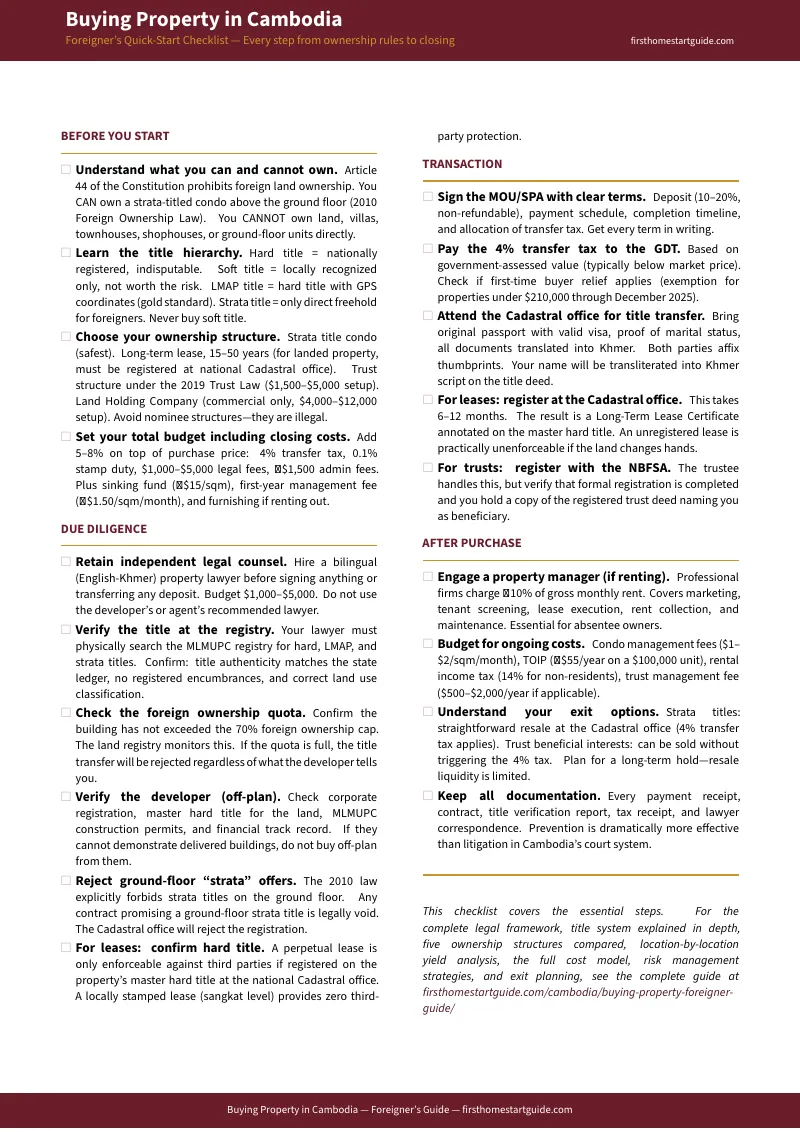
- The Quick Checklist — verification items grouped by purchase phase (Legal Structure Decision, Property Selection, Due Diligence, Transaction Execution, Post-Purchase) with the specific checks, thresholds, and decision points for each step
- Ownership Structure Comparison Worksheet — fillable side-by-side comparison of strata title, trust, nominee, LHC, and perpetual lease — setup costs, ongoing fees, legal security rating, and which structure fits your situation
- Title Verification Card — step-by-step process to verify hard title authenticity, check for encumbrances, and confirm cadastral registration before you commit funds
- Net Yield Calculator — gross-to-net yield worksheet covering management fees, vacancy, maintenance, and trust/compliance costs so you know your actual return before you buy
The free checklist covers what to verify at each stage. The full guide covers how — with the legal context, cost calculations, worked examples, and the specific verification procedures that turn each checklist item into an informed decision.
Satisfaction Guarantee
If the guide does not give you a clearer understanding of the Cambodian property system than everything you have read online combined, email [email protected] and we will make it right.
A single mistake in Cambodia — trusting a soft title, skipping Cadastral registration on a lease, relying on a nominee without understanding the probate risk, or buying off-plan from a developer without verifying their completion track record — can cost you your entire investment. The guide costs less than an hour with a Phnom Penh property lawyer and covers the complete scope of what you need to know before you hire one.
Frequently Asked Questions
What if the rules change after I buy?
We update the guide when the rules change. Email us any time, even years later, and we'll send you the current edition free.