
You Found a Lakefront Property in Southern Chile Listed at 5,000 UF and You Have No Idea What That Means in Dollars
You searched Portal Inmobiliario --- the only property portal that matters in Chile --- and found a two-bedroom apartment in Las Condes for UF 4,200. You asked your agent what UF means. They said it's like a peso but adjusted for inflation. You asked what 4,200 UF is in dollars. They said "about $185,000." You asked again two weeks later. They said "about $189,000." The price didn't change. The UF value did --- it changes every single day, recalculated by the Central Bank based on the previous month's Consumer Price Index. And the Chilean Peso moved against the dollar in the same period. You are now exposed to two simultaneous currency movements on a purchase denominated in a unit of account that does not physically exist.
Then you learned you cannot sign a deed, register ownership, open a bank account, or even set up an electricity contract without a Chilean tax identification number --- the RUT. Not your passport. Not your home country's tax ID. A Chilean-issued RUT de Inversionista Extranjero, which requires you to appoint a legal representative who is a resident of Chile, file Form 4415 with the Servicio de Impuestos Internos, and wait five to ten business days. If you drafted a Power of Attorney abroad, it must be apostilled and then protocolized at a Chilean notary before it takes effect. Without this number, you cannot do anything.
You asked about escrow. Your agent looked confused. Chile has no independent bank-backed escrow service. Instead, you issue a physical bank draft --- a Vale Vista --- to a notary, who holds it under handwritten escrow instructions called Instrucciones Notariales. Those instructions dictate exactly when the notary can release the money to the seller. If the instructions are drafted wrong --- if they fail to condition release on confirmed CBR inscription --- your deposit can be released before you legally own the property. And the notary, unlike a settlement agent back home, is a public officer whose duty is to the Chilean state, not to you.
And nobody mentioned this: real estate agents in Chile are completely unregulated. No license. No exam. No professional body. No mandatory educational standards. Anyone can practice, and double-commission billing --- charging both buyer and seller 2% to 4% plus 19% VAT --- is standard. The agent who showed you the property also represents the seller. The attorney the agent recommends works with the seller's brokerage. And if you are looking at rural land in the Lake District, the parcela de agrado you fell in love with may be sold as "derechos" --- undivided rights to a larger parcel --- rather than individual title with its own tax roll number. Buying derechos means you do not legally own a specific piece of land. You cannot sell it, develop it, or register it independently.
Chile is one of the most open real estate markets in the world. No restrictions on foreign ownership. No transfer tax on resales. Absolute freehold title in your own name. No bank trust, no local partner, no corporate shell required. But the transaction runs through a notary-based civil law system where prices are denominated in an inflation-indexed phantom currency, there is no escrow, agents are unregulated, title verification requires a 10-to-30-year chain study through an analog land registry, seismic building codes determine whether your investment is safe or a liability, and three categories of geographic restriction can void your purchase entirely --- and every free resource available in English covers the first paragraph of "foreigners can buy" while skipping the twelve chapters of "here's how it actually works."
The Buying Property in Chile --- Expat Guide is The Notaria Navigation System --- a structured walkthrough of every stage of the Chilean property transaction, from the RUT application through the UF pricing mechanics, the Promesa de Compraventa deposit structure, the Estudio de Titulos, the Escritura Publica signing, the CBR inscription that actually transfers ownership, and the tax regime that determines whether you keep 65% or 100% of your capital gains depending on your residency status. It replaces months of cross-referencing Spanish-language portals, scattered law firm blog posts, and Reddit threads with a single English-language reference that tells you exactly what each document means, exactly what each step costs, and exactly where foreign buyers lose money they never recover.
What's Inside the Notaria Navigation System
A comprehensive 13-chapter guide, 5 standalone printable references, and a quick-start checklist --- covering every stage from your constitutional ownership rights through property management and ongoing tax obligations, built specifically for the regulatory structures and market dynamics that make buying property in Chile as a foreigner fundamentally different from buying in your home country:
The UF Decoder
The Unidad de Fomento is not a currency. It is a non-circulating, inflation-indexed unit of account created in 1967, recalculated daily by the Central Bank of Chile based on the previous month's CPI variation. Every property listing, every mortgage, every construction contract, every rental agreement in Chile is denominated in UF. The guide explains the daily conversion mechanics, the geometric adjustment formula, how a UF 5,000 listing translates to a daily-shifting peso equivalent, and the double-sided currency risk you face as a foreign buyer --- where domestic inflation drives the UF up in CLP terms while the CLP/USD exchange rate fluctuates independently. It covers the 3% to 5% currency buffer you should budget, the timing strategy for locking your exchange rate at closing, and why pre-construction UF installments over a 24-to-36-month build period can magnify your currency exposure dramatically.
RUT Application Walkthrough
Without a RUT de Inversionista Extranjero, you cannot sign a binding contract, register ownership, pay property taxes, or open a utility account. The guide walks you through the complete process: appointing a resident representative, preparing Form 4415 for the SII, drafting the Power of Attorney if you are applying remotely, the apostille and protocolization requirements for documents drafted abroad, and the five-to-ten-day processing timeline. It explains the distinction between the RUN (for residents) and the RUT (for non-resident investors) and why starting this process before you view properties eliminates the single biggest source of deadline pressure in Chilean real estate.
The Promesa-to-CBR Closing Sequence
Chile has no independent bank-backed escrow. Your 10% deposit is secured through Instrucciones Notariales --- physical escrow instructions drafted at the notary that govern when a Vale Vista bank draft can be released to the seller. If these instructions are not correctly conditioned on confirmed CBR inscription, you are exposed. The guide maps the complete 30-to-90-day transaction: the Oferta de Compra, the Promesa de Compraventa with reciprocal penalty clauses, the 15-to-30-day Estudio de Titulos, the Escritura Publica de Compraventa signing, the CBR inscription that creates the legal moment of ownership transfer, and the escrow release triggered by the new Certificado de Dominio Vigente. It explains why the Escritura Publica signing does not transfer ownership --- only CBR inscription does --- and why submitting the deed to the CBR on the same day you sign is non-negotiable.
Estudio de Titulos --- The Title Study
Chilean real estate has no title insurance. Your only protection is an independent attorney tracing the chain of title back 10 to 30 years through the Conservador de Bienes Raices. The guide covers every certificate your attorney must pull: the Certificado de Dominio Vigente (current ownership confirmation), the Certificado de Hipotecas, Gravamenes y Prohibiciones (the GP certificate listing all mortgages, liens, judicial disputes, and prohibitions on sale), the Certificado de Informaciones Previas (municipal zoning and expropriation plans), and the Certificado de Recepcion Definitiva (building permit compliance). It covers tax clearance from the TGR to confirm no outstanding contribuciones will transfer with the property. For rural land, it adds the SAG certification, individual tax roll verification, and why hiring a licensed topografo to verify physical boundaries is essential when fences and access roads do not match legal descriptions.
Geographic Restriction Map
Three categories of restriction can void your purchase. Border zones under Decreto Ley 1.939 prohibit nationals of Argentina, Bolivia, and Peru from buying within 10 kilometers of Chile's international borders --- and non-bordering nationals need presidential authorization for fiscal land in those zones. Coastal fiscal land within 5 kilometers of the coastline cannot be acquired by foreigners when it is state-owned. Indigenous land classified as tierras indigenas under Ley 19.253 cannot be transferred to non-indigenous buyers --- a restriction that overlaps with popular lifestyle property markets in the Araucania region and parts of the Lake District. The guide maps which restrictions apply to which buyer nationalities and which property types, so you verify eligibility before you commit capital.
Earthquake Safety Decoder
Chile sits on the Nazca-South American plate boundary. The 2010 Mw 8.8 El Maule earthquake was the sixth-largest in recorded history. The guide explains the NCh 433 seismic design code, the post-2010 DS 61 amendments that significantly upgraded soil classification and structural requirements, and what the three building vintage categories mean for your purchase: post-2011 buildings built to DS 61 standards are among the safest in the world; 1985-to-2011 buildings performed well but lack the post-2010 improvements; pre-1985 buildings require structural evaluation and carry higher insurance premiums. It covers the mandatory 3/5/10-year structural warranty periods for new construction and the Ad Corpus "as is" clause that eliminates seller liability on second-hand properties.
Geographic Deep-Dive
Santiago premium communes: Vitacura at 105 to 130 UF per square meter, Las Condes at 100 to 120 UF, Providencia at 90 to 110 UF --- with price ranges, rental yields, and the specific buyer profiles each serves. Coastal Valparaiso Region: Vina del Mar's resort market, Concon's premium oceanfront sector, and the Navy coastal permit requirements. Southern Chile: Puerto Varas lakefront estates, Pucon seasonal tourism demand, Chiloe's remote character and infrastructure limitations. Plus the critical parcela de agrado section: DL 3.516 subdivision rules, the minimum 0.5-hectare lot requirement, construction restrictions, illegal urban loteo risks, and the derechos versus dominio real trap that is the single biggest danger in rural Chilean land purchases.
Tax Architecture
The difference between resident and non-resident tax treatment in Chile is massive. Residents get a lifetime 8,000 UF capital gains exemption --- approximately USD 320,000 --- while non-residents pay a flat 35% Additional Tax on the entire gain with no exemption. Non-resident landlords face a flat 35% withholding on gross rental income with no expense deductions. The furnished rental VAT trap reclassifies your lease as a commercial service, triggering 19% VAT on monthly rent. Annual contribuciones run 1.0% to 1.4% of fiscal valuation. New-build VAT at 19% applies to the construction component. And the 0.8% stamp tax on mortgage documents means financed purchases carry higher transaction costs than cash purchases. The guide gives you the complete tax architecture so you can model your actual after-tax returns before you commit.
Closing Costs Breakdown
Total buyer closing costs on a cash purchase in Chile run approximately 1.3% to 2.5% of the property value --- among the lowest in the world. The guide breaks down every component: notary fees at 0.1% to 0.3%, CBR inscription fees at 0.2% (capped at CLP 264,200), legal fees at 1.0% to 2.0%, and the zero transfer tax that makes Chile so competitive. It includes a worked example showing total closing costs on a UF 5,000 Santiago apartment, plus the additional costs for financed purchases: bank appraisal, stamp tax, and mortgage inscription fees.
Standalone Printable References
Five ready-to-print PDFs you can bring to meetings, hand to your attorney, or pin above your desk:
- RUT Application Walkthrough --- Step-by-step numbered process from appointing a resident representative through receiving your Foreign Investor RUT, with a document checklist and key SII contacts
- Title Study Checklist --- Every CBR and municipal certificate your attorney must pull, plus the additional rural land checks for parcela de agrado purchases, with checkbox markers for tracking completion
- Geographic Restrictions Reference Card --- DIFROL border zones, coastal Navy jurisdiction, and indigenous land restrictions mapped by buyer nationality and property type
- Closing Costs Worksheet --- Fill in your property value in UF and calculate exact notary, CBR inscription, legal, and broker fees for both cash and financed purchases
- Tax Reference Card --- Side-by-side resident versus non-resident comparison for capital gains, rental income, contribuciones, and the furnished rental VAT trap
Who This Guide Is For
- Retirees relocating to Chile who are drawn to the Lake District or Patagonia and need to understand the parcela de agrado rules, indigenous land restrictions, border zone prohibitions, and the full cost of rural ownership before signing anything
- Remote workers and digital nomads buying an apartment in Santiago's Sector Oriente --- Vitacura, Las Condes, or Providencia --- who need the RUT application process, the UF pricing system, and the HOA short-term rental restrictions explained before they commit to a building that may prohibit Airbnb
- International investors targeting rental yields in Santiago or seasonal tourism properties in Pucon and the coast, who need to model the actual tax burden --- the 35% non-resident rate on rental income and capital gains, the furnished rental VAT trap, and the corporate structure option that reduces the capital gains rate from 35% to 27%
- Corporate relocatees transferring to Santiago with employer support who need the practical closing timeline, the mortgage access tiers, and the UF-denominated loan mechanics explained clearly before they start viewing properties
- Anyone buying property in Chile from abroad who cannot afford to learn about Instrucciones Notariales, the CBR inscription requirement, and the derechos versus dominio real distinction after they have already wired money and signed a Promesa de Compraventa
Why Not Free Guides and YouTube Channels?
- Portal Inmobiliario and Yapo.cl are the primary property listing sites in Chile. They are entirely in Spanish, with no English translation, no transactional guidance, and no explanation of the UF pricing system, the RUT requirement, or the closing process. You get listings. You get nothing that tells you how to safely convert those listings into ownership.
- Immigration law firm blogs (Expat.cl, Becker Abogados, NSS Abogados) publish helpful English-language articles on the RUT process and ownership rights at a high level. These are SEO pages designed to generate billable consultations at $200 to $400 per hour. They do not walk you through the Instrucciones Notariales structure, the GP certificate reading process, the three geographic restriction categories, or the 35% versus 10% capital gains differential based on residency status. You get just enough to know you need help, and then you pay by the hour to get it.
- TheLatinvestor and international real estate blogs offer city-by-city overviews and lifestyle-focused content on Santiago's premium communes. They highlight the "no restrictions, no transfer tax" headline but do not cover the escrow gap, the unregulated agent problem, the parcela de agrado trap, or the seismic building code implications that determine whether your apartment is safe or a structural liability. You get the marketing pitch for Chile as a destination. You do not get the operational manual for buying there.
- Reddit threads (r/chile, r/expats) contain genuine warnings about RUT scam services, the derechos trap, and furnished rental VAT --- mixed with outdated information, advice from people who bought under different regulations, and contradictory recommendations about neighborhoods and attorneys. Sorting current from outdated takes longer than reading a guide that verified everything against the 2026 regulatory environment.
This guide fills the Chile-specific gap --- the space between knowing that foreigners can buy property freely and knowing how to actually navigate the notary-based civil law system, the phantom-currency pricing, the escrow-free deposit structure, and the tax regime that treats residents and non-residents radically differently. It is the analysis that would take a bilingual real estate attorney, a tax advisor, a surveyor, and a property manager to assemble --- structured as a reference you own permanently and can bring to every meeting.
--- Less Than One Hour of a Chilean Attorney's Time
A bilingual real estate attorney in Santiago charges $200 to $400 per hour. A comprehensive Estudio de Titulos runs 1.0% to 2.0% of the property value --- on a UF 5,000 apartment, that is roughly $2,200 to $4,400. The 10% deposit you are protecting through Instrucciones Notariales is approximately $22,000. A single mistake in the escrow instructions, a derechos purchase instead of dominio real, or a failure to verify geographic restrictions can cost you the entire investment.
This guide does not replace your real estate attorney, your notary, or your tax advisor. But it gives you the UF conversion framework, the RUT application walkthrough, the Instrucciones Notariales explanation, the title study certificate checklist, the geographic restriction map, the seismic safety decoder, the closing costs breakdown, and the complete tax architecture --- so you understand exactly what each document means, exactly what each step costs, and exactly where foreign buyers lose money they never recover, before you sign anything or wire a single peso.
If it prevents a single deposit loss from poorly drafted escrow instructions, catches a single derechos sale before you commit, or identifies the residency-based tax planning that saves you 25 percentage points on capital gains, it pays for itself before you finish reading the first chapter.
Money-back guarantee, no time limit. If the guide does not sharpen your Chile property buying analysis and protect your capital, you pay nothing.
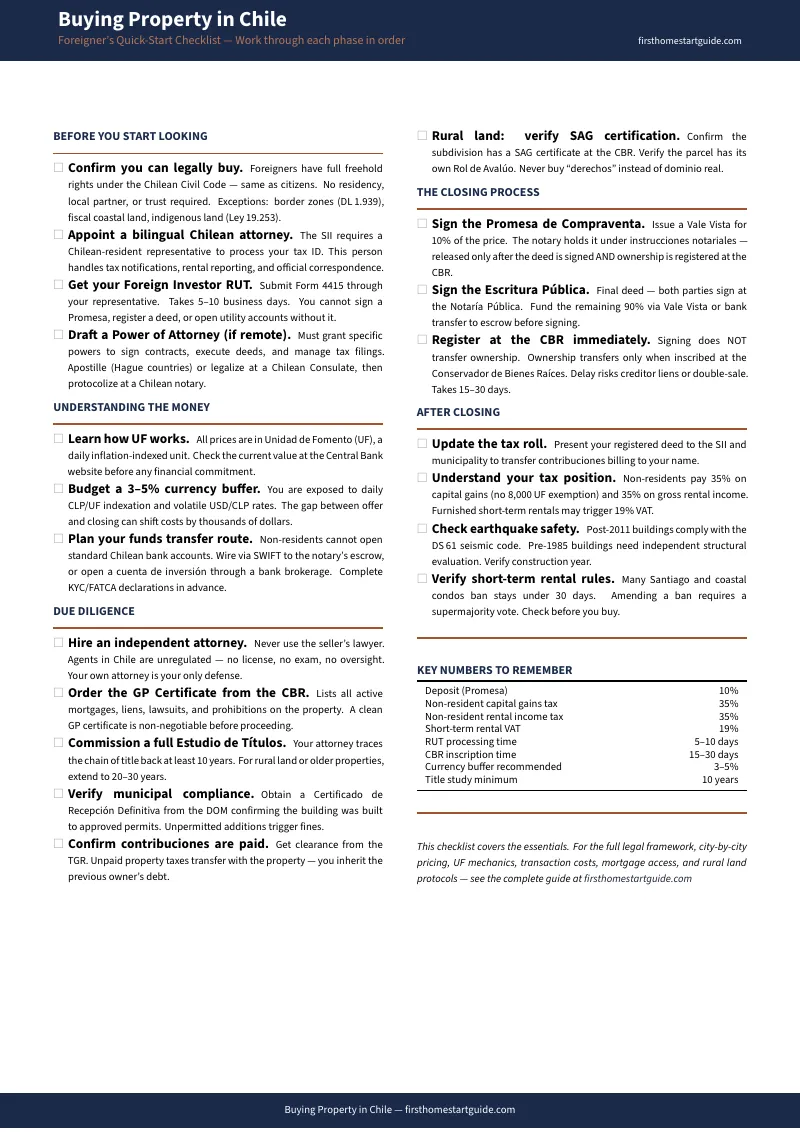
Download the free Buying in Chile Quick Checklist to see the step-by-step action plan covering the RUT process, UF pricing, Instrucciones Notariales, the title study, geographic restrictions, and the closing sequence. When you are ready for the full Notaria Navigation System --- the complete 13-chapter guide with the UF decoder, the earthquake safety analysis, the tax architecture, and the geographic deep-dives --- the full toolkit is here.
Chile's open property market only works if you know how to navigate the notary system that controls it. This guide makes sure you do.