You Found a Beautiful Apartment in El Poblado for $180,000 and Assumed the Purchase Would Work Like Buying Property Back Home
You searched FincaRaíz, found a two-bedroom in Laureles for COP 650 million. Your agent said foreigners have the same rights as Colombian citizens --- no restrictions, no local partner needed, just sign the deed. You asked about wiring the money. They said to send it directly to the seller's Colombian bank account. Simple.
Except that wire transfer just permanently destroyed your ability to get your money back out of Colombia. Under Colombian exchange law, a direct bank-to-bank transfer is automatically classified as a personal remittance --- filed under Formulario 5 instead of Formulario 4. That classification strips your legal right to repatriate your capital and profits when you eventually sell. It disqualifies you for the investor visa. And the mistake is irreversible. No appeal, no retroactive fix, no attorney who can undo it after the fact.
Then your agent mentioned the Certificado de Libertad y Tradición. You assumed it was like a title search back home --- routine paperwork. But Colombia has no title insurance. That certificate, valid for only 30 days, is your only defense against active mortgages, judicial attachments, family housing protections, and asset forfeiture claims. Your agent did not explain how to read it. Your attorney pulled one, but you signed the Promesa de Compraventa without understanding what the annotations meant.
And nobody told you about the building's Reglamento de Propiedad Horizontal. You planned to Airbnb the apartment when you were not living in it. But under Law 2068 of 2020, short-term rentals require a Registro Nacional de Turismo, which requires the building's RPH to explicitly authorize tourist stays. Amending the RPH requires a 70% co-owner vote. Your building has not held that vote. Operating without an RNT exposes you to fines up to 2,000 times the monthly minimum wage. The Airbnb income you budgeted? It is illegal in your building.
The problem is not that Colombia restricts foreign buyers. The problem is that Colombia layers a foreign exchange compliance loop that can permanently trap your capital, a title verification system with no insurance backstop, building-level rental restrictions that override your ownership rights, a socioeconomic estrato system that controls your utility costs, an unpredictable valorización infrastructure tax, and an under-declaration trap that inflates your future capital gains bill --- and the free guides, YouTube walkthroughs, and real estate agency blogs that foreigners rely on routinely skip or oversimplify every one of these.
The Buying Property in Colombia --- Expat Guide is a Capital Protection System for Foreign Buyers --- a structured walkthrough of every Colombian regulatory trap, exchange compliance requirement, title verification step, and hidden cost that determines whether your property purchase protects your investment or silently locks you out of your own money. It replaces months of cross-referencing Reddit threads, YouTube channels, agency marketing pages, and scattered legal blog posts with a single reference that tells you exactly what to file, exactly what each document means, and exactly where foreign buyers lose money they never get back.
What's Inside the Capital Protection System
A comprehensive 17-chapter guide, a quick-start checklist, and 6 standalone printable tools --- 8 PDFs covering every stage from constitutional rights through property management, built specifically for the regulatory structures and market dynamics that make buying property in Colombia as a foreigner fundamentally different from buying in your home country:
The Foreign Exchange Compliance Loop
This is the single most critical chapter in the guide --- and the one that no free resource explains properly. Colombian exchange law requires all inbound capital for property purchases to route through an authorized brokerage intermediary (such as Alianza Valores or Acciones & Valores). You must file Formulario 4 (Declaración de Cambio por Inversiones Internacionales) with the Banco de la República when converting your foreign currency to Colombian pesos. A separate Formulario 11 must be filed within 60 days of deed registration. Skip this loop --- wire money directly to a personal account --- and the central bank classifies your funds as a personal remittance, permanently stripping your repatriation rights, disqualifying your investor visa application, and exposing you to DIAN exchange control fines. The guide walks you through the brokerage account setup ($150 to $350 USD), the FX commission structure (~1%), the 4×1000 financial transaction tax, and the exact sequence of filings that protects your capital.
Reading the Certificado de Libertad y Tradición
Colombia has no title insurance. The CLT --- a document that costs COP 21,900 and expires in 30 days --- is the property's complete legal ledger and your only line of defense. The guide provides a line-by-line reading framework: how to identify active hipotecas (mortgages), embargos (judicial attachments), afectación a vivienda familiar (family housing protections), and extinción de dominio (asset forfeiture proceedings). It covers the mandatory 20-year chain-of-title review, how to spot a closed folio, what regional matrícula codes mean, and why you must pull a fresh CLT immediately before signing both the Promesa de Compraventa and the Escritura Pública. No other English-language resource walks you through reading this document annotation by annotation.
City and Neighborhood Deep-Dives
What a two-bedroom apartment costs varies dramatically by city and barrio --- and so do the hidden costs that follow the purchase. The guide covers El Poblado (COP 800M to COP 2.2B, Estrato 6, premium utility surcharges, gringo pricing endemic), Laureles (COP 450M to COP 700M, Estrato 4-5, flat walkable layout, significantly lower carrying costs), Envigado (COP 600M to COP 1.2B, independent municipality with El Poblado amenities at lower prices), Sabaneta (COP 350M to COP 550M, rapidly growing suburb), Bogotá's business corridors (Usaquén, Chapinero, La Cabrera), Cartagena's tourist zones (Bocagrande, Getsemaní), and the Coffee Region for retirees. Each entry includes price per square meter, estrato classification, the buyer profile it serves, and the specific risks that neighborhood presents.
Short-Term Rental Compliance
Buying an apartment in Colombia does not mean you can rent it on Airbnb. Under Law 2068 of 2020, rentals under 30 days require a Registro Nacional de Turismo (RNT). The RNT cannot be issued unless the building's RPH explicitly authorizes tourist lodging. Amending the RPH requires a 70% co-owner vote at a general assembly --- a process that takes 12 to 18 months and may never succeed. The guide covers the exact verification steps to confirm STR authorization before buying, the fine structure for non-compliance (up to 2,000 times the minimum wage from municipalities, up to 100 times from building administrations), the current enforcement crackdown in El Poblado, and how to evaluate a building's Manual de Convivencia for restrictive clauses that can devalue a tourist-facing investment.
The Estrato System and True Cost of Ownership
Under Ley 142 de 1994, Colombian properties are classified on a 1-to-6 scale. Estratos 5 and 6 pay utility surcharges of 20% to 50%+ on electricity, gas, and water to subsidize lower estratos. Estrato 4 pays baseline rates with no surcharge and no subsidy. For a buyer choosing between El Poblado (Estrato 6) and Laureles (Estrato 4-5), the difference in monthly carrying costs --- HOA fees, utilities, property tax --- can reach COP 400,000 to COP 600,000 per month. The guide gives you the exact surcharge percentages, the monthly cost comparisons, and the analysis framework for evaluating whether premium infrastructure and amenities justify premium ongoing costs at your income level.
Transaction Cost Breakdown and Timeline
Total transaction costs run 3% to 5% of the purchase price. The guide breaks down every component: notaría fees (0.54% to 0.70%, split 50/50 between buyer and seller), registration tax at the ORIP (1.0%, paid by buyer), brokerage account setup, FX commission, the 4×1000 tax, and attorney fees for the title study (~1%). It maps the full 30-to-45-day closing timeline from Promesa de Compraventa through deed registration, including deposit norms (10% to 30%), penalty clauses to negotiate, and the fiducia trust option for off-plan pre-venta deals.
Tax Traps and Ongoing Obligations
The annual impuesto predial (property tax) runs 0.3% to 1.6% of cadastral value. The valorización tax --- a non-recurring municipal charge for infrastructure works --- can appear without warning and must be settled before the property can be sold. Capital gains on sale are taxed at a flat 15%. And the under-declaration trap: if you register the sale at the lower cadastral value instead of the actual commercial price (a common practice that sellers will pressure you to accept), you create an artificially inflated profit margin that hits you with a massive capital gains bill when you eventually sell at the real market price. Article 90 of the Colombian Tax Statute requires registration of the actual commercial value.
The Investor Visa Pathway
The M-type Investor Visa requires a minimum property investment of 350 SMMLV --- roughly COP 613 million (approximately USD 150,000) in 2026. The property must be registered in your name, funds must be of verifiable origin and registered as Foreign Direct Investment through the brokerage compliance loop, and both Formulario 4 and Formulario 11 must be correctly filed. The visa is valid for up to three years, is renewable, and counts toward the five-year residency requirement for permanent R-type status. The guide covers the exact documentation package, common application mistakes, and how the property purchase threshold interacts with the FDI registration requirements.
Finding Property Without Getting Overcharged
Colombia has no agent licensing requirements and no centralized MLS. Anyone can set up a Facebook page and practice as an agent, and agencies only show their proprietary listings. The guide covers the in-person Se Vende strategy (walking neighborhoods and contacting porteros for unlisted inventory), effective use of FincaRaíz and Metrocuadrado, how to identify and avoid gringo pricing markup, and why experienced buyers bypass agencies entirely for lower local-market pricing.
Who This Guide Is For
- Retirees relocating to Colombia who need to understand the full cost of ownership beyond the purchase price --- estrato utility surcharges, valorización risk, annual property tax, and carrying costs that vary dramatically by neighborhood and city
- Remote workers and digital nomads who have been renting in Medellín or Bogotá and are ready to buy, but need to set up the brokerage account and complete the exchange compliance loop correctly before wiring a single dollar
- Short-term rental investors targeting Airbnb yields in Cartagena or El Poblado who must verify RPH authorization and RNT compliance before committing capital to a building that may prohibit tourist stays
- Investor visa applicants who need to meet the 350 SMMLV threshold and ensure their property purchase is correctly registered as Foreign Direct Investment to qualify for the M-type visa
- Anyone wiring money into Colombia for a property purchase who cannot afford to make the Formulario 4 mistake --- the single error that permanently strips your right to repatriate capital when you sell
Why Not Free Guides and YouTube Channels?
- Real estate agency blogs and marketing sites tell you that foreigners have equal rights to buy property and highlight the lifestyle appeal of Medellín. They do not explain the foreign exchange compliance loop, the difference between Formulario 4 and Formulario 5, the brokerage account requirement, or the fact that a single wire transfer routed to the wrong account permanently destroys your repatriation rights. You get a sales pitch, not a compliance guide.
- YouTube channels (Medellín Living, The Wandering Investor, Harry In Colombia) offer valuable neighbourhood tours and lifestyle content, but they are not structured references you can hand to your attorney. They do not walk you through reading a CLT annotation by annotation, they do not cover the Formulario 11 filing deadline, and they do not model the true cost difference between Estrato 4 and Estrato 6 carrying costs over five years.
- Reddit threads (r/medellin, r/Colombia) contain genuine warnings about gringo pricing, direct-wire traps, and building restrictions, but they are mixed with outdated information, anecdotal advice from people who bought under different regulations, and contradictory recommendations about neighborhoods and agents. Sorting current from outdated takes longer than reading a guide that already verified everything against the 2026 regulatory environment.
- International Living and generic expat relocation sites provide overview articles that touch on the process at a high level. They do not explain how to read the CLT, the 70% RPH vote requirement for Airbnb authorization, the valorización tax trap, or the under-declaration scheme that sellers will pressure you to accept. You get a teaser, not the analysis that protects your money.
This guide fills the Colombia-specific gap --- the space between knowing that foreigners can buy property and knowing how to actually protect your capital when you do. It is the analysis that would take a bilingual real estate attorney, a brokerage compliance specialist, a tax advisor, and a local property manager to assemble --- structured as a reference you own permanently and can bring to every meeting.
--- Less Than Your Brokerage Account Setup Fee
Setting up a brokerage account with Alianza Valores or Acciones & Valores costs $150 to $350 USD. A single attorney consultation in Medellín runs $100 to $300. Losing your capital repatriation rights by wiring funds to the wrong account? That costs you the entire value of your property investment --- permanently, with no recourse.
This guide does not replace your real estate attorney, your brokerage firm, or your tax advisor. But it gives you the exchange compliance walkthrough, the CLT reading guide, the STR verification checklist, the transaction costs worksheet, the closing timeline, and the ongoing costs reference --- 6 standalone printable tools plus the complete 17-chapter guide --- so you understand exactly what every document means, exactly what every filing does, and exactly where foreign buyers lose money they never recover, before you sign anything or wire a single peso.
If it prevents the Formulario 4 mistake alone, it pays for itself before you finish reading the first chapter.
Money-back guarantee, no time limit. If the guide does not sharpen your Colombia property buying analysis and protect your capital, you pay nothing.
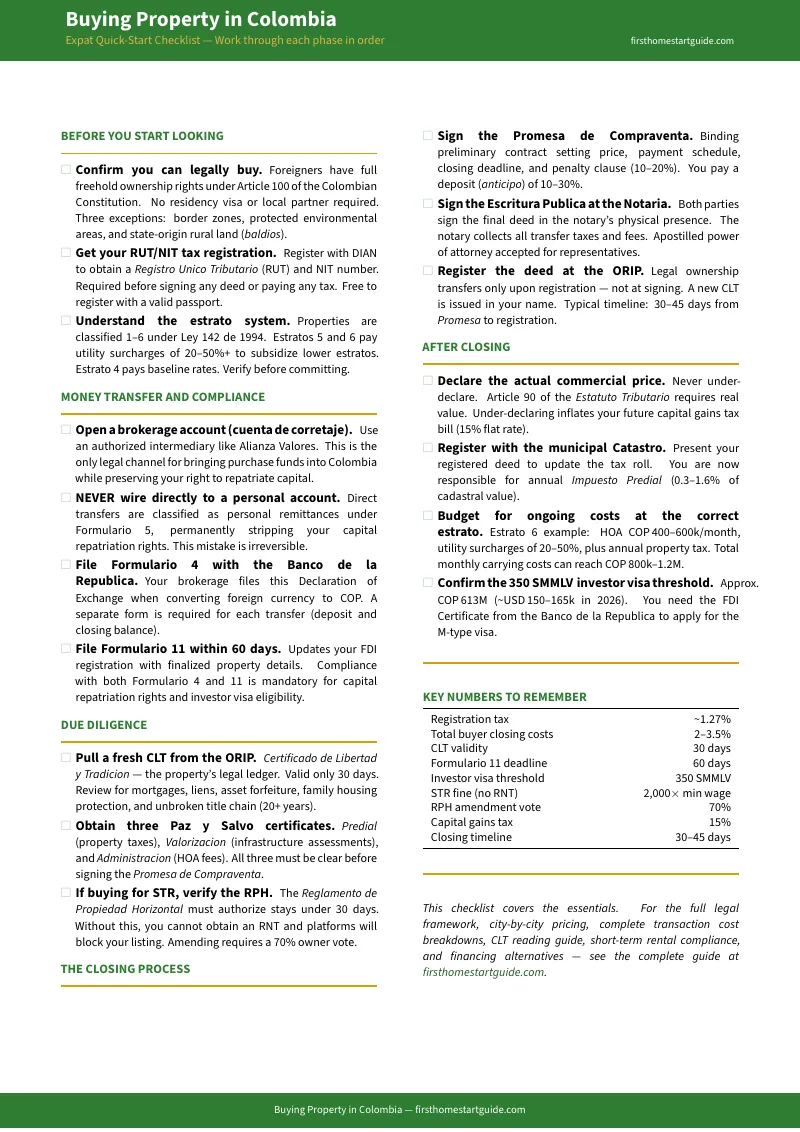
Download the free Buying in Colombia Quick Checklist to see the 17-item compliance framework covering legal verification, money transfer steps, due diligence, the closing sequence, and post-purchase obligations. When you are ready for the full CLT reading guide, exchange compliance walkthrough, city-by-city analysis, and the complete 17-chapter guide, the full toolkit is here.
Colombia's open property market only works if you know how to protect your capital inside it. This guide makes sure you do.