You Found a Beachfront House in Tamarindo. The Maritime Zone Law, Concession Bait-and-Switch, and Corporate Compliance Trap Between You and the Title Assume You Already Know How They Work.
You've found a three-bedroom villa steps from the sand in Guanacaste, an eco-lodge lot in Nosara overlooking the Pacific, or a Central Valley home near Escazu with mountain views and private healthcare ten minutes away. You've confirmed your budget covers the asking price, checked that Costa Rica grants foreigners the exact same property rights as citizens, and started imagining your morning coffee on the terrace. Within a week you've discovered that the first 200 meters from every high-tide line in the country is governed by Law 6043 — the Maritime Terrestrial Zone — and that stunning beachfront listing isn't titled land at all. It's a municipal concession that no foreigner can hold without five years of continuous legal residency, or a Costa Rican corporation where a local partner must own 51% of the shares, which means the majority owner of your $350,000 property is someone you met three weeks ago. The lot two blocks inland that the agent swears is "totally fee simple" has no Carta de Agua — the water availability letter that Costa Rican law requires before any municipality will issue a building permit — and without it the land is functionally undevelopable. And the holding corporation the previous owner set up to avoid capital gains tax hasn't filed Form 272, hasn't submitted the RTBF beneficial ownership declaration, and faces a $2,700 minimum fine and automatic dissolution within three years.
You search online for help. Costa Rican law firm blogs publish technically precise articles on capital gains under Law 9635 or RTBF filing mechanics — dense, academic, and spread across dozens of separate websites, each covering one topic in isolation at consultation-grade prices. Re/Max and Coldwell Banker Costa Rica publish polished buying guides that make the process sound like a tropical formality while systematically minimizing concession risk, glossing over the corporate compliance calendar, and never mentioning that the notario handling your closing historically represented the seller's interests first. Reddit's r/costarica and r/expats contain real stories from buyers who navigated the Registro Nacional and fought water letter denials — alongside advice that confuses fee-simple title with concession rights, recommends corporate structures without explaining the annual filing burden, and confidently claims the Inversionista visa works with corporate-held property. Since 2025, it does not.
Here's the problem no free resource solves: Costa Rica's property system runs on a coastal zoning framework, corporate compliance regime, and tax structure that directly contradict the assumptions North American and European buyers bring to the table. The first 50 meters from every beach is permanently inalienable public land. The next 150 meters can only be held through municipal concessions that foreigners cannot hold personally without five years of residency — and that require 51% Costa Rican citizen ownership if held through a corporation. Inland property is straightforward fee-simple title, but 95% of the listings that excite foreign buyers are in the coastal zone. Capital gains tax didn't exist before July 2019 — now it's 15% on profits, with a 2.25% gross alternative for pre-2019 acquisitions that requires careful mathematical comparison. Non-resident sellers face a mandatory 2.5% buyer-side withholding at closing. Starting in 2026, Airbnb and VRBO must report all host income directly to the Costa Rican Tax Administration — retroactive to 2025 — and owners who never registered for a RUT, never collected 13% VAT, and never issued version 4.4 electronic invoices face severe retroactive audits. The Carta de Agua expires within 6-12 months with no automatic renewal, meaning the lot you bought for retirement construction five years from now may be permanently undevelopable. The system has real protections — the Registro Nacional's public folio real, the Inversionista residency at $150,000, the primary residence capital gains exemption, the CCSS healthcare integration — but only if you know they exist, understand the legal mechanism behind each one, and verify them before you sign.
The Buying Property in Costa Rica — Expat Guide is The ZMT-Proof Buying Framework. Not a lifestyle article about Pura Vida and cheap beachfront living. It's a structured decision system that decodes every stage of the Costa Rican property purchase — from Maritime Zone classification and concession mechanics through Carta de Agua verification, corporate compliance, Registro Nacional due diligence, and cross-border tax planning — so you make each decision understanding the legal framework behind it, the specific law that governs it, and the financial consequence of getting it wrong.
What's Inside The ZMT-Proof Buying Framework
The complete 10-chapter guide, a printable quick-start checklist, and 8 standalone reference sheets — covering every stage from Maritime Zone assessment through post-purchase corporate and tax compliance, with the Costa Rican legal terms, law references, tax rates, and regional variations that determine whether your purchase builds equity or traps capital:
Maritime Zone Decoder — How Law 6043 Actually Works
The single biggest source of financial catastrophe for foreign buyers in Costa Rica isn't overpaying — it's buying the wrong type of property. Law 6043 divides the first 200 meters from the ordinary high-tide line into two zones. The first 50 meters is permanently inalienable public domain — no ownership, no lease, no development, no exceptions. The next 150 meters is the Restricted Zone, where land can only be held through municipal concessions approved by the Costa Rican Tourism Board (ICT), typically for 20-year renewable terms. A foreigner cannot hold a concession personally without five continuous years of legal residency. The corporate workaround requires a Costa Rican S.A. or S.R.L. where at least 51% of shares are held by a Costa Rican citizen — and certain municipalities like Parrita require citizenship by birth or naturalization, closing even the most common legal loopholes. The guide explains the complete ZMT framework, how to verify whether a specific property is fee-simple or concession before contacting the agent, how concession transfers actually work at the municipal level, and why the price discount on beachfront listings is the single most reliable indicator that the property isn't what the listing claims.
Concession vs. Fee-Simple Classifier — The Verification That Saves Everything
The most common and devastating real estate scam in Costa Rica is the concession bait-and-switch. A foreigner browsing listings from the US or Canada sees a stunning beachfront property priced well below inland comparables and assumes they're getting a deal on titled land. The listing doesn't mention that it's a concession — or worse, an expired, non-transferable, or illegally constructed one. Buyers who close without verifying the property's legal classification through the Registro Nacional's folio real system are left holding an asset they cannot register, cannot insure, cannot finance, and that faces potential municipal demolition orders. The guide provides the step-by-step folio real lookup procedure, explains the difference between fee-simple title and concession notation in the registry, lists the red flags that distinguish legitimate concession transfers from fraudulent ones, and includes a standalone printable classifier card you use before scheduling your first property visit.
Carta de Agua Due Diligence — The Prerequisite Nobody Mentions
Since September 2014, Costa Rican municipalities cannot issue any building permit without a valid Carta de Disponibilidad de Agua — a water availability letter issued by AyA (the national water institute) or the local ASADA (community water board). This applies to every piece of raw land in the country. The trap: a property may have a physical water pipe, a functioning well, or a neighbor offering to share access — none of which constitute the legal certification required for a building permit. Water letters expire within 6 to 12 months with no automatic renewal. In rapidly developing Guanacaste, where aquifer depletion has accelerated since 2020, buyers who purchase land intending to build years later routinely discover that water rights have been revoked and the lot is permanently undevelopable. Institutional lenders will not finance properties without this certification. The guide covers the complete Carta de Agua verification process, how to request one from AyA vs. local ASADAs, expiration and renewal mechanics, and the Guanacaste-specific water scarcity risks that every buyer in the country's most popular market needs to understand before releasing any deposit.
Corporate Compliance Navigator — The Invisible Cost of Ownership
Foreign buyers historically used Costa Rican holding corporations (S.A. or S.R.L.) to own property, assuming an "inactive" company holding a single house or lot was exempt from government oversight. The modern regulatory reality is punitive. Every corporation — active or inactive — must pay the annual Impuesto a las Personas Juridicas (approximately 69,330 colones) by January 31st; file Form 272 (formerly D-195) disclosing all assets and fund sources by April 30th; and submit the RTBF beneficial ownership declaration, also due April 30th. Missing the corporate tax for three consecutive years triggers automatic dissolution of the company — meaning the legal entity that holds your property ceases to exist. Missing the RTBF filing carries a minimum fine of approximately $2,700. The National Registry recently stopped accepting standard Powers of Attorney for RTBF filings, creating a logistical nightmare for absentee owners who can't travel to Costa Rica to sign in person. The guide maps the complete annual compliance calendar, explains each filing step-by-step, covers the Power of Attorney workaround for remote filing, and includes a standalone printable compliance tracker so you never miss a deadline that triggers fines or dissolution.
Capital Gains and Non-Resident Tax Framework — The Rules That Changed in 2019
Before July 1, 2019, Costa Rica had no capital gains tax on real estate for non-habitual sellers. That era is over. Law 9635 introduced a flat 15% tax on net capital gains (sale price minus purchase price) for all investment properties, vacation rentals, and commercial real estate. Properties acquired before July 2019 qualify for a grandfathered alternative: 2.25% of the gross sale price instead of 15% of profit — a calculation that favors sellers whose properties have appreciated substantially, but punishes those with modest gains. Non-resident sellers face an additional layer: Resolution MH-DGT-RES-0039-2025 requires the buyer's notario to withhold 2.5% of the total gross transaction value at closing as a definitive tax guarantee. The primary residence exemption exists but requires strict criteria to establish. The guide walks through both tax calculation methods with worked examples, explains how to determine which option saves more on your specific property, covers the 2.5% non-resident withholding mechanics, and maps the rental income taxation framework — 15% on rental revenue with a 15% automatic expense deduction (effective 12.75%), the tax-free threshold of 3.8 million colones (approximately $7,600), and the 2026 mandatory platform reporting that retroactively exposes 2025 transactions.
Inversionista Residency Roadmap — The $150,000 Ownership Trap
The Inversionista (Investor) residency program under Law 9996 reduced the minimum real estate investment from $200,000 to $150,000 — making property purchase and legal residency a single transaction for many buyers. But the 2025 regulatory tightening created a structural conflict that catches buyers mid-transaction. To qualify for Inversionista residency, the property must be held in the individual applicant's personal name — not through a corporate entity. This directly contradicts the decades-long practice of using Costa Rican holding corporations for liability protection and estate planning. Buyers who purchase through an S.A. expecting to also secure residency discover at the immigration office that their corporate-held property doesn't qualify. The guide explains the personal-vs-corporate ownership trade-off, when each structure makes financial and legal sense, how to structure the purchase for residency qualification without sacrificing essential protections, and the Pensionado and Rentista alternatives for buyers whose investment doesn't reach the $150,000 threshold.
Closing Cost Breakdown — What You'll Actually Pay
Total buyer-side closing costs in Costa Rica run 4.5-6.5% of the purchase price — borne entirely by the buyer. The largest component is the Property Transfer Tax (Impuesto de Traspaso) at 1.5% of the higher of the declared price or registered fiscal value. Documentary and registry stamps aggregate 0.5-0.85%. Notary Public conveyancing fees run 1.0-2.0%, plus a mandatory 13% VAT on professional services. Ancillary costs include escrow administration, due diligence checks, and mandatory interpreter services ($80-$200 per hour during closing). The guide includes a complete line-item breakdown with a fillable worksheet for a $300,000 purchase, so you budget the actual number instead of discovering it at the notario's office.
Regional Market Intelligence
Costa Rica is not one market. The guide covers the regulatory environment, cost structure, and practical risks for the specific regions where foreigners buy. Guanacaste and the Nicoya Peninsula (Tamarindo, Nosara, Samara): the epicenter of ZMT concession risk, water scarcity, and luxury market pricing with median listings approaching $1.32 million. The Central Valley (Escazu, Santa Ana, Atenas, San Ramon): advanced infrastructure, international healthcare, titled property, median prices around $610,000, and the retiree enclave of choice. The Southern Pacific (Uvita, Dominical, Ojochal): rapidly appreciating eco-development market with critical Carta de Agua considerations. Caribbean Coast (Puerto Viejo, Cahuita): lower price points with distinctive land title irregularities from historical occupancy claims.
Who This Guide Is For
This guide is for foreign buyers and expats purchasing property in Costa Rica who:
- Are US or Canadian retirees evaluating Costa Rica for retirement or seasonal living and need the Maritime Zone rules, fee-simple vs. concession classification, and Pensionado residency pathway explained clearly before committing capital — not by a broker earning a commission on the sale, but by an independent reference they can verify against their own attorney
- Are digital nomads or remote workers living in Costa Rica on tourist visa border runs who want to transition from renting to ownership and need to understand whether the Inversionista $150,000 threshold applies to their target property, why it must be held personally and not through a corporation, and how the 2026 digital nomad tax reforms affect their ongoing ownership costs
- Are short-term rental investors evaluating yield properties in Guanacaste or the Southern Pacific and need the ZMT concession assessment, the 2026 Airbnb/VRBO mandatory reporting retroactive to 2025, the 12.75% effective rental tax rate, and a realistic cap rate model before committing to a deposit
- Are Canadian or European expats already living in Costa Rica on a Rentista or Pensionado visa who have been renting long-term in Tamarindo or Nosara, watching rent inflation erode their equity, and need the Carta de Agua verification, corporate vs. personal ownership trade-off, and full closing cost breakdown to convert from renter to owner
- Want every Maritime Zone classification, every concession verification step, every corporate compliance deadline, every closing cost line item, every tax calculation, and every residency pathway in one document — so they walk into agent meetings, notario appointments, and contract signings with the same structural understanding as a Costa Rican buyer working with domestic counsel
Why Not Free Resources?
Free information on buying property in Costa Rica as a foreigner is abundant. Here's what each source actually delivers:
- Costa Rican law firm blogs publish technically precise articles on the RTBF registry, capital gains under Law 9635, or corporate compliance Form 272 — dense, academic, and designed to demonstrate the complexity that justifies retainer-based consultations. Each article covers one topic in isolation. What they don't provide: a single integrated roadmap that connects Maritime Zone classification, concession mechanics, Carta de Agua verification, corporate compliance, closing costs, and the capital gains framework into one coherent decision sequence. You get fragments of expertise designed to demonstrate competence, not to replace it.
- Real estate brokerages (Re/Max, Coldwell Banker, Century 21 Costa Rica) publish polished English-language buying guides that make the process sound straightforward. What they systematically soften: the catastrophic risk of concession bait-and-switch in the Maritime Zone, the annual corporate compliance burden that can dissolve your holding company, the Carta de Agua requirement that renders undevelopable lots indistinguishable from buildable ones in listings, and the 2026 retroactive rental reporting mandate. The information is real. The structural risks that cost foreign buyers real money are consistently understated by the parties earning commissions on the transaction.
- Reddit and expat forums (r/costarica, r/expats, Facebook groups) contain genuine ground-level experiences from buyers who navigated the Registro Nacional, fought ASADA water denials, and managed corporate compliance remotely — alongside confidently stated advice that confuses concession rights with fee-simple title, recommends corporate structures without explaining the three annual filings, claims that any property qualifies for Inversionista residency regardless of holding structure, and dismisses the Carta de Agua as "just a formality." Both the successes and the disasters are real. Neither tells you which outcome applies to your specific property, zone, and ownership structure.
- Legacy books and YouTube channels on relocating to Costa Rica provide foundational lifestyle context — climate, healthcare, community, cost of living — that was accurate when published. What they structurally cannot cover: the 2019 capital gains law, the 2025 Inversionista personal-ownership requirement, the 2026 retroactive rental platform reporting, the recent RTBF Power of Attorney restriction, and the corporate dissolution timeline that activates after three years of non-payment. The regulatory environment changes faster than any print edition or video series can track.
This guide fills the structural gap — the space between knowing that foreigners can buy property in Costa Rica and understanding exactly how Law 6043, the ZMT, concession mechanics, Carta de Agua verification, corporate compliance, the Registro Nacional, capital gains taxation, and the Inversionista residency framework actually work at each stage of the purchase. It's the analysis an independent advisor with no commission to earn would give you, structured as a permanent reference you own.
— Less Than One Hour With a Bilingual Real Estate Attorney
An independent bilingual attorney charges $1,500-$4,000 for contract review and due diligence on a single Costa Rican transaction. The corporate setup for a holding S.A. runs $1,200-$2,000, plus the annual compliance burden. The deposit you're protecting in the sales agreement is $25,000-$75,000 on a standard purchase. A single concession property that you didn't verify through the Registro Nacional can cost you everything you invested.
This guide doesn't replace your attorney or your notario. But it gives you the Maritime Zone decoder, the concession-vs-fee-simple classifier, the Carta de Agua verification system, the corporate compliance navigator, the closing cost breakdown, the capital gains calculator, the Inversionista residency roadmap, and 8 standalone printable reference sheets (ZMT reference card, due diligence checklist, closing cost worksheet, corporate compliance tracker, regional market comparison, tax comparison, transaction timeline, and Spanish legal glossary) that ensure you walk into every agent meeting, every notario appointment, and every contract signing understanding the mechanism behind each step — instead of discovering how Costa Rican property law works by losing capital to it.
If it prevents a single concession deposit on land you can never legally title, catches a single missing Carta de Agua before you close, or identifies the corporate filing deadline that prevents your holding company from dissolving, it pays for itself before you've finished reading it.
Money-back guarantee, no time limit. If the guide doesn't make the Costa Rican property transaction clearer and your financial position stronger, you pay nothing.
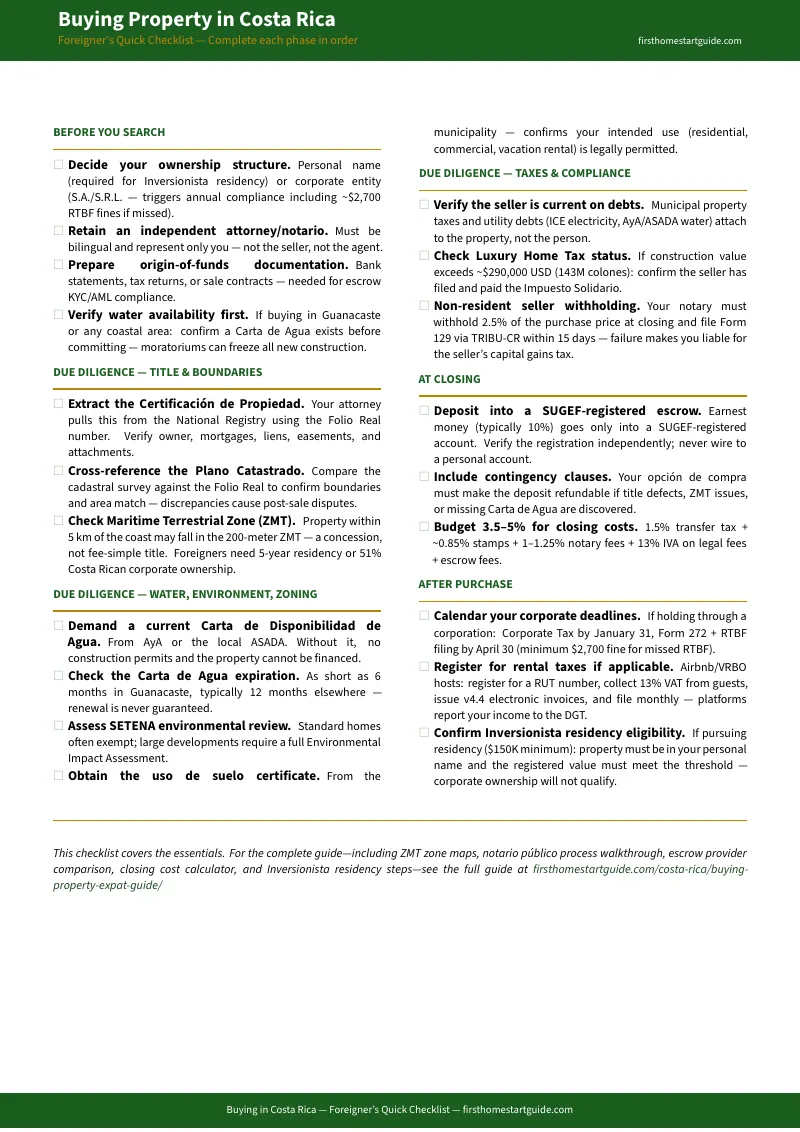
Download the free Quick Checklist to see the action plan covering Maritime Zone classification, concession verification, Carta de Agua screening, corporate structure assessment, and the sales-agreement-to-inscription timeline. When you're ready for the full ZMT-Proof Buying Framework — complete with the Maritime Zone decoder, concession classifier, Carta de Agua verification, corporate compliance navigator, and capital gains calculator — the complete guide is here.
You've found the property. Now decode the system that stands between you and the title.
Frequently Asked Questions
What if the rules change after I buy?
We update the guide when the rules change. Email us any time, even years later, and we'll send you the current edition free.