You Found Your Dream Property on the Adriatic Coast. The Legal System Between You and the Title Was Designed for People Who Grew Up Inside It.
You've found a stone house in Istria, a sea-view apartment in Split, or a villa on Hvar. You've run the numbers, checked the exchange rate, and confirmed you can afford the asking price. So you start the process. Within a week you've learned that Croatia operates two entirely separate property databases — the Katastar (which records who physically possesses the land) and the Zemljišna knjiga (which records who legally owns it) — and roughly 15% of properties have mismatches between them. The notary doesn't protect you. They authenticate your signature. That's it. And if you're buying a charming cottage that was built or modified without permits after June 21, 2011, it cannot be legalized under any current or pending law, regardless of what the seller tells you.
You search online for help. Croatia Gems publishes regional guides written by estate agents who earn 2–3% commission from both you and the seller. Total Croatia News posts outdated FAQ articles that don't reflect the 2025 square-metre property tax or the 2027 mandatory rental registration number. Reddit and the Expat Forum are full of conflicting anecdotes from British retirees who bought before Brexit and Americans who don't realise that their reciprocity status depends on which US state they're from. Every agency website makes the process look frictionless because friction doesn't generate commissions.
Here's the problem no free resource solves: Croatia layers a dual property registry inherited from the Austro-Hungarian Empire, an inflexible building legalization framework tied to a single aerial photograph from 2011, a constitutionally mandated six-metre public coastal strip that makes private beaches legally impossible, and a nationality-based ownership restriction system that changes country by country — and for Americans, state by state. Every one of these systems has specific deadlines, specific documents, and specific consequences for getting them wrong. Miss one and you lose your 10% deposit, your title transfer, or your ability to ever resell the property.
The Buying Property in Croatia — Expat Guide is the Adriatic Transaction Decoder. Not a lifestyle article about finding your dream villa on the Dalmatian coast. It's a structured legal and financial reference that decodes every stage of the Croatian property purchase — from verifying your reciprocity status through to registering your name in the Zemljišna knjiga — so you make each decision understanding the legal mechanism behind it, the timeline attached to it, and the financial consequence of getting it wrong.
What's Inside the Adriatic Transaction Decoder
The complete guide plus standalone printable worksheets — covering every stage from reciprocity verification through key handover, plus fillable tools you print, bring to lawyer meetings, and use when reviewing contracts:
The Reciprocity Navigator
EU/EEA citizens buy freely with the same rights as Croatian citizens. Non-EU citizens can only buy if their country has a bilateral reciprocity agreement — and even then, they need individual Ministry of Justice approval that takes 2 to 6 months with their 10% deposit locked the entire time. But the details are where buyers get hurt: American reciprocity is evaluated state by state (New York and California are straightforward; Arkansas and Hawaii require proof of permanent residency). British citizens have full reciprocity but face the Ministry approval process that didn't exist before Brexit. Canadians are stuck in "verification underway" limbo. Australians face a blanket ban on existing residential property until March 2027. And citizens of China, India, and Singapore cannot buy as individuals at all. The guide maps every nationality, every restriction, and the d.o.o. corporate workaround that lets restricted buyers purchase through a Croatian LLC — including the €2,500 minimum capital, the 2–4 week setup, and the ongoing corporate tax and accounting obligations that come with it.
The Dual Registry Decoder — Zemljišna Knjiga vs Katastar
The single most dangerous pitfall for foreign buyers: assuming that one database proves ownership. It doesn't. The Katastar records physical boundaries and possession. The Zemljišna knjiga records legal ownership, mortgages, liens, and disputes. When they don't match — and they don't match for roughly 15% of Croatian properties — the transaction cannot safely proceed. The seller might be listed as possessor in the Katastar while a deceased great-grandfather's estate, never formally probated, still appears as owner in the Zemljišna knjiga. The Katastar might show 850 m² while the Zemljišna knjiga says 620 m². The guide explains how to read a Zemljišna knjiga extract (List A posjedovnica, List B vlastovnica, List C teretovnica), what each section proves, how to cross-reference against the Katastar, and the mandatory geodetic harmonization process when the two systems disagree — including the licensed surveyor requirement, realistic timelines, and costs.
The Ozakonjenje Trap — Building Legalization and the 2011 Cut-Off
Every foreign buyer dreaming of restoring an old stone cottage needs to understand one absolute rule: only structures captured on the State Geodetic Administration's aerial orthophoto by June 21, 2011 are eligible for legalization. Anything built or modified without permits after that date — a storey, an enclosed terrace, a swimming pool — cannot be legalized under current law, regardless of ownership, and faces perpetual demolition orders. A 2026 legislative update permanently reopened the application window but strictly retained the 2011 cut-off. The guide explains how to verify legalization status (Uporabna dozvola vs Rješenje o izvedenom stanju), the mandatory ISPU electronic filing system, and why buying an unlegalized property blocks utility connections, bank financing, insurance, and future resale. Including the specific documents to request before you sign anything.
Coastal Reality Check — Pomorsko Dobro and ZOP Restrictions
The concept of a legally recognised private beach does not exist in Croatia. The Pomorsko dobro (Maritime Domain) law designates a minimum six-metre strip from the line of average higher high waters as constitutionally state-owned public property — it cannot be privately owned, sold, or fenced off. Many expats purchase expensive frontline properties assuming their land extends to the sea, only to discover a public walkway runs across what they thought was their garden. Beyond the six-metre strip, the ZOP (Protected Coastal Area) imposes building restrictions within 1,000 metres of the shoreline. The guide covers both frameworks, agricultural land restrictions for non-EU buyers, military and border zone prohibitions, and how to verify a property's exact zoning classification before committing capital.
The Nine-Step Transaction Process
From initial search to key handover: (1) verifying reciprocity and assembling your team, (2) obtaining an OIB tax number, (3) opening a Croatian bank account with source-of-funds documentation, (4) conducting due diligence across both registries, (5) signing the Predugovor and paying the 10% kapara deposit, (6) Ministry of Justice application for non-EU buyers, (7) signing the Kupoprodajni ugovor before a notary, (8) obtaining the Tabularna izjava from the seller, and (9) filing the electronic registration proposal at the municipal land registry court. Every step with the exact documents required, the timeline, and what goes wrong when one is missed or delayed. Including the critical detail that the notary authenticates signatures only — they do not verify title, check for liens, or confirm legalization status.
Transaction Cost Calculator
Budget 5–8% above the purchase price. The 3% RETT (Real Estate Transfer Tax) isn't calculated on your contract price — the Tax Administration independently assesses market value and charges the 3% on their valuation, which can be higher than what you agreed to pay. New builds from VAT-registered developers carry 25% VAT instead (mutually exclusive with RETT). Agency commission: 2–3% plus VAT from both buyer and seller (dual agency is standard and legal in Croatia). Plus lawyer fees (1–2%), notary fees, court interpreter costs, land registry filing, and the geodetic survey if harmonization is needed. The guide provides a fillable worksheet so you calculate total acquisition cost before you sign the Predugovor — not after.
Rental Compliance Decoder — Airbnb Rules for Foreign Landlords
EU citizens can operate short-term rentals as individuals under a flat-rate per-bed tax below €60,000 annual income — no VAT registration required. Non-EU citizens face a completely different reality: mandatory d.o.o. or sole proprietorship formation, immediate VAT registration via Form P-PDV (bypassing the €60,000 threshold), 13% VAT on accommodation, 25% on auxiliary services, and monthly ePorezna returns. Since 2025, rentals in multi-unit buildings require 80% co-owner consent plus unanimous approval from adjacent units. And from 2027, every rental unit must carry an official digital registration number or be purged from Airbnb and Booking.com. The guide maps the complete regulatory path for both EU and non-EU landlords so you know the compliance burden before you model the yield.
Who This Guide Is For
This guide is for foreign buyers and expats purchasing property in Croatia who:
- Are buying their first Croatian property and need the entire transaction mapped — from reciprocity verification through Zemljišna knjiga registration — so they understand what happens at each stage, what documents are required, and what can go wrong
- Have found a property they want to make an offer on and need to know, before they sign anything, whether the Zemljišna knjiga and Katastar match, whether the building is legalized, and whether any pre-emption rights or coastal restrictions apply
- Are American and need to understand that their reciprocity status depends on their home state — or British and need to understand that Brexit added 2–6 months of Ministry approval to a process that used to be frictionless
- Are buying for rental income and need to understand the Categorization Decision, the co-owner consent rules, the non-EU company formation requirement, and the 2027 registration mandate before committing capital to a property they may not be able to legally rent
- Are considering an old stone house and need to verify Ozakonjenje status before falling in love with a property that cannot be legalized, insured, financed, or resold
- Want every transaction cost, every legal deadline, and every procedural requirement in one document — so they walk into lawyer meetings, notary appointments, and property viewings with the same structural understanding as a Croatian buyer, not the surface-level confidence of someone who read an agency blog
Why Not Free Resources?
Free information on buying property in Croatia as a foreigner is abundant. Here's what each source actually delivers:
- Croatia Gems and Total Croatia News publish regional guides with genuine local knowledge — written and sponsored by estate agents who collect commission from both buyer and seller. Their advice to "hire a good lawyer" is technically sound, but they never explain that the agency's recommended lawyer is a conflict of interest, that the notary doesn't protect you, or that 15% of properties have registry mismatches that no agency listing mentions. The information is real. The financial incentive behind every recommendation is too.
- Expat Forum Croatia and Reddit contain authentic stories from buyers who've been through the process — alongside advice that pre-dates the 2025 property tax, the 2025 co-owner consent supermajority rule, and the 2027 rental registration mandate. You'll find someone who bought in Split with no issues and someone who lost their deposit on a property with a Zemljišna knjiga mismatch. Both stories are true. Neither tells you which outcome applies to your situation.
- Rightmove Overseas and Kyero aggregate listings from local agencies and present the process as straightforward — because their revenue model depends on connecting buyers with agents, not on warning buyers about dual registries, unlicensed construction, or the non-existence of private beaches.
- Local lawyers offer essential professional representation — for fees of €150–250 per hour. The good ones are necessary. But their initial consultation covers your specific property, not the structural knowledge that tells you which properties to avoid entirely. Understanding the system before you engage professionals is how you avoid paying for orientation you should already have.
This guide fills the structural gap — the space between knowing that Croatia has a land registry and understanding exactly how the dual registry system works, what legalization status means, where the coastal public domain starts, and what the nine-step transaction process requires at each stage. It's the analysis an independent advisor with no commissions to earn would give you, structured as a permanent reference you own.
— Less Than One Hour of a Croatian Lawyer's Time
A local lawyer charges €150–250 per hour. The agency commission you're paying on top of the seller's commission is 2–3% plus VAT. The 10% kapara deposit you're protecting on a €300,000 property is €30,000. A single Zemljišna knjiga mismatch you didn't catch can stall your purchase for months. An unlegalized structure you didn't verify can make your property unsellable.
This guide doesn't replace your lawyer or your geodetic surveyor. But it gives you the reciprocity analysis, the dual registry decoder, the legalization verification process, the transaction cost calculator, and the nine-step procedure that ensure you walk into every appointment, every viewing, and every contract signing understanding the mechanism behind each step — instead of discovering how Croatian property law works by losing money to it.
If it prevents a single deposit loss on a registry mismatch, catches a single Ozakonjenje problem before you sign the Predugovor, or identifies the rental compliance burden before you model the yield, it pays for itself before you've finished reading it.
Money-back guarantee, no time limit. If the guide doesn't make the Croatian property transaction clearer and your financial position stronger, you pay nothing.
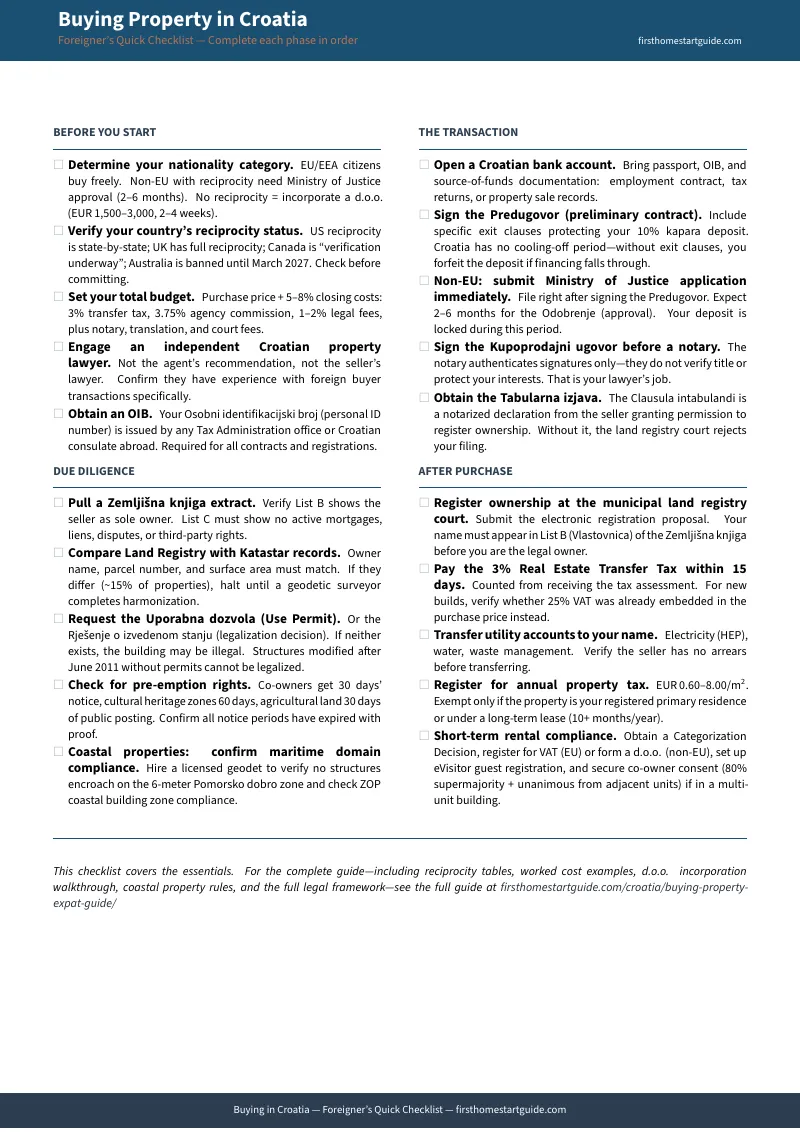
Download the free Quick Checklist to see the step-by-step action plan covering nationality verification, Zemljišna knjiga cross-check, Ozakonjenje document request, and the complete nine-step transaction timeline. When you're ready for the full Adriatic Transaction Decoder — complete with reciprocity navigator, dual registry decoder, rental compliance guide, and transaction cost calculator — the complete guide is here.
You've found the property. Now decode the system that stands between you and the title.
Frequently Asked Questions
What if the rules change after I buy?
We update the guide when the rules change. Email us any time, even years later, and we'll send you the current edition free.