
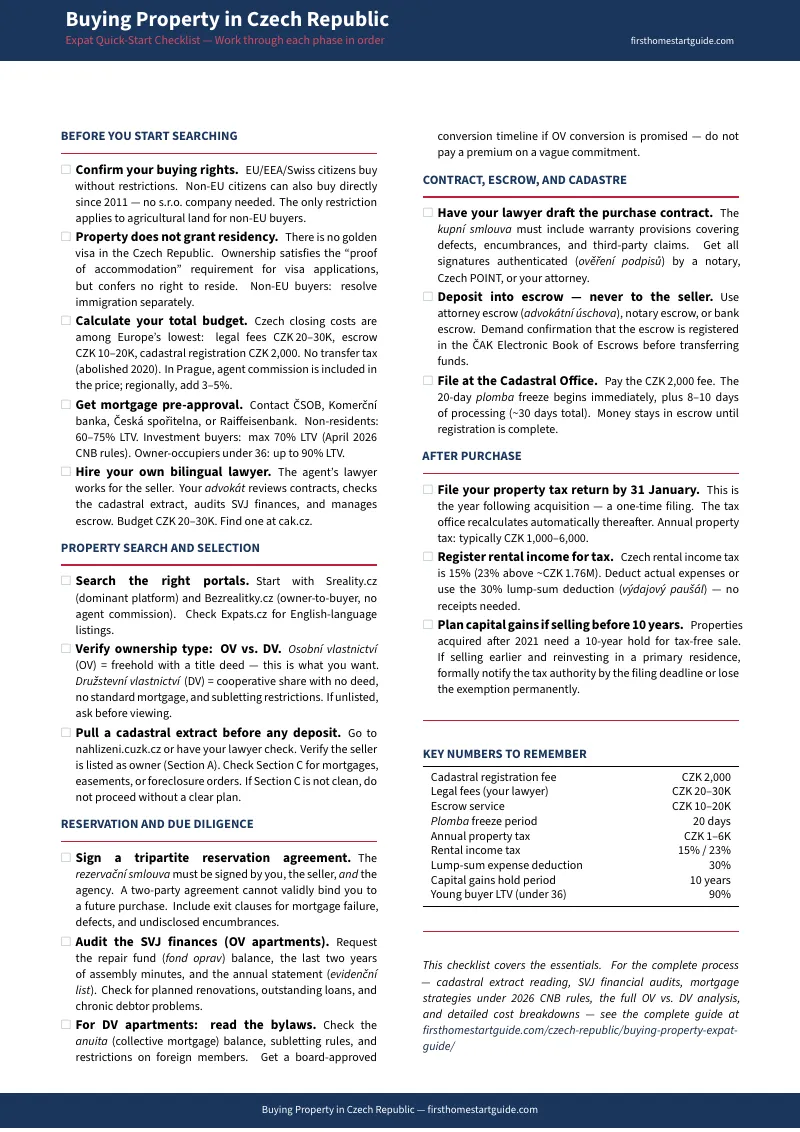
You Found the Prague Apartment. The System Between You and the Title Deed Was Built Entirely in Czech.
You've found a two-bedroom in Vinohrady, a renovated flat in Brno, or an investment unit near the new Metro D line. You've checked the price, compared it to London or Munich, and confirmed you can afford it. So you start the process. Within a week you've learned that the listing says "DV" — which means you wouldn't actually own real estate at all, just a cooperative membership share that no bank will accept as mortgage collateral. The next apartment says "OV" and the price is right, so you pay a reservation deposit. Then your lawyer tells you the cadastral extract shows a plomba — a 20-day freeze — and the entire Section C is in Czech with no English translation available from the state. The SVJ maintenance fund shows monthly contributions of CZK 4,200, but nobody can tell you whether that's normal or whether it means the building is servicing a CZK 8 million renovation loan that you'll inherit the moment you sign.
You search online for help. Expats.cz publishes general relocation guides written by agents who earn commission when you buy. Reddit threads from 2022 still reference the 4% property acquisition tax that was abolished in 2020. Law firm blogs explain what an advokátni uschova is in three paragraphs but don't mention that since 2026, the Czech Bar Association requires every escrow to be registered in the Electronic Escrow Register before you wire a single koruna — and that if you skip this verification step, you have no centralized fraud protection. Every English-language resource covers one piece of the puzzle. None of them sequence the pieces into a transaction you can actually execute.
Here's the problem no free resource solves: Czech property law runs on two parallel ownership systems (one gives you a title deed, one doesn't), a cadastral register that operates entirely in Czech with a 20-day mandatory freeze on every transfer, an escrow system that changed its fraud-protection rules in 2026, and a capital gains tax regime that doubled its holding period from 5 to 10 years — with a reinvestment exemption that evaporates permanently if you miss a single administrative notification deadline. The system has real buyer protections built in. But they only work if you know they exist, understand their Czech-language procedures, and activate them in the correct sequence.
The Buying Property in Czech Republic — Expat Guide is The Cadastral Navigator. Not a lifestyle article about expat life in Prague. It's a structured decision system that decodes every stage of the Czech property purchase — from verifying OV versus DV ownership through the reservation agreement, the ČAK escrow verification, the kupní smlouva, the cadastral plomba, and the SVJ financial audit — so you make each decision understanding the legal mechanism behind it, the Czech-language term attached to it, and the financial consequence of getting it wrong.
What's Inside The Cadastral Navigator
The complete 15-chapter guide plus 9 standalone printable worksheets — covering every stage from property search through title registration, plus fillable tools you print, bring to lawyer appointments, bank meetings, and property viewings:
The OV vs. DV Decision Framework
The single most consequential distinction in Czech real estate. An OV apartment gives you a title deed registered in the Cadastre, mortgage eligibility, and unrestricted selling and rental rights. A DV apartment gives you a cooperative membership share — no title deed, no standard mortgage, collective debt exposure through the anuita, and subletting restrictions written into bylaws you haven't read. The guide covers how to verify ownership type on Sreality and Bezrealitky, what the cooperative debt structure means for your financial exposure, when DV-to-OV conversion is realistic versus a sales pitch, and why the CZK 500,000 price gap between DV and OV for the same unit exists for a reason.
The ČAK Electronic Escrow Verification Protocol
Czech property transactions require the entire purchase price to be deposited in escrow before title transfers. Since 2026, the Czech Bar Association mandates that all attorney escrows are registered in a centralized Electronic Escrow Register — and that both buyer and seller receive direct electronic confirmation from ČAK before any funds leave the buyer's bank account. This is your primary fraud protection mechanism. The guide explains the exact verification sequence: what the ČAK confirmation looks like, when to demand it, what to do if your attorney hasn't provided it, and how this system replaced the older regime where isolated cases of attorney misappropriation cost buyers their entire purchase price.
Cadastral Extract Decoder (Section A, B, C)
The Katastr nemovitosti is the definitive public register of property ownership in the Czech Republic — and every word of it is in Czech. Section A identifies the owner. Section B describes the property. Section C lists encumbrances: mortgages, easements, foreclosure orders, preemption rights, and judicial liens. The guide teaches you how to pull a free extract from nahlizeni.cuzk.cz, what each Czech-language field means, how to identify the red flags in Section C that indicate the property is legally encumbered, and what the 20-day plomba freeze means for your transaction timeline. Including what happens if the Cadastral Office rejects your filing for an administrative error — and how to avoid the 30-to-50-day restart that costs you the CZK 2,000 fee and weeks of delay.
SVJ Financial Audit Worksheet
Buying an OV apartment makes you a mandatory member of the building's owners' association (Společenstvi vlastniku jednotek — SVJ). The SVJ controls the repair fund (fond oprav), votes on renovations, and can levy special assessments that land as surprise five-figure bills months after purchase. The guide covers how to request and interpret the evidenční list (annual SVJ statement), which costs are yours as owner versus a tenant's responsibility, what a healthy repair fund contribution looks like per square meter (approximately CZK 25-30/m²), and the financial red flags that indicate the building is carrying a commercial loan whose elevated monthly payments will become your obligation the moment title transfers.
Non-Resident Mortgage Strategy
Czech National Bank macroprudential rules cap standard mortgages at 80% LTV, but internal bank risk policies compress non-resident foreign buyers to 60-75% LTV — meaning you need 25-40% of the purchase price in liquid equity just to qualify. The DTI cap limits total loans to 8.5 times annual net income. The DSTI cap limits monthly payments to 45% of net monthly income. With mortgage rates at 4.5-4.9% in 2026, the guide covers which banks actively lend to non-residents (ČSOB, Komercni banka, Ceska spořitelna, Raiffeisenbank), the income documentation required for foreign-source earnings, fixed versus variable rate strategy at current CNB policy rates, and how owner-occupiers under 36 can access the elevated 90% LTV tier.
Capital Gains Tax Planning
Properties acquired after January 2021 require a 10-year holding period for automatic CGT exemption — doubled from the previous 5-year rule. If you sell before 10 years, profits are taxed at 15% (or 23% above the threshold). But two exemptions exist that most expat guides mention without explaining the procedure: the 2-year primary residence exemption and the housing reinvestment exemption. The reinvestment exemption requires a formal written notification to the Czech Tax Authority by the tax filing deadline for the year of sale. Miss that administrative step — one piece of paper, one deadline — and the exemption is permanently forfeited. The guide maps both exemptions in detail, including the exact notification requirement that free resources consistently omit.
Reservation Agreement Red Flags
The rezervačni smlouva is the first document you'll sign and the first place you can lose money. Czech courts have ruled (Supreme Court 33 Cdo 3448/2012) that a two-party agreement between buyer and agent — without the seller's signature — cannot validly bind you to a future purchase. Yet agents routinely present two-party agreements with non-refundable deposits of CZK 100,000-300,000. The guide covers what makes a reservation agreement legally enforceable, why it must be tripartite (buyer + seller + agent), which exit clauses to insist on for mortgage failure and undisclosed defects, and the timeline pressure tactics agents use to prevent you from having the agreement reviewed by your own lawyer.
Who This Guide Is For
This guide is for foreign buyers and expats purchasing property in the Czech Republic who:
- Are buying their first Czech property and need the entire transaction mapped — from ownership verification through the reservation agreement, escrow deposit, cadastral filing, the 20-day plomba, and title registration — so they understand what happens at each stage, what it costs, and what can go wrong
- Have found a property on Sreality or Bezrealitky and need to know, before they sign anything, whether it's OV or DV, what the cadastral extract reveals about encumbrances, and whether the SVJ finances indicate hidden costs that the asking price doesn't reflect
- Are considering a mortgage and need to understand the non-resident LTV compression (60-75%), the DTI and DSTI caps, and how to structure their application so their foreign-source income satisfies Czech bank verification requirements
- Plan to sell within 10 years and need to understand the capital gains tax regime — including the reinvestment exemption notification that, if missed, permanently eliminates a potentially six-figure tax benefit
- Are comparing DV apartments (cheaper upfront) against OV apartments and need to understand cooperative debt, subletting restrictions, conversion timelines, and the reason the price gap exists before committing their deposit
- Want every Czech legal term, every procedural deadline, and every financial trap in one document — so they walk into lawyer meetings, bank appointments, and cadastral offices with the same structural understanding as a local buyer, not the surface-level confidence of someone who read a forum post from 2022
Why Not Free Resources?
Free information on buying property in the Czech Republic as a foreigner is available. Here's what each source actually delivers:
- Expats.cz maintains a directory of real estate agents and general "buying in Prague" guides. The information is broadly accurate but high-level — it tells you that OV and DV exist without explaining the cooperative debt structure, doesn't cover the 2026 ČAK escrow verification requirement, and links to agents who earn commission when you buy. It gets you oriented. It doesn't get you through the transaction.
- Czech law firm blogs (ARROWS, Dostupny Advokat, Philip & Frank) publish legally precise articles on individual topics — how escrow works, what a plomba is, what the CGT rate is. Each article is accurate in isolation. But they're written as lead generation for legal services, they don't connect into a sequenced transaction strategy, and they rarely cover the procedural traps (the ČAK electronic confirmation step, the CGT reinvestment notification deadline, the SVJ statement interpretation) that cause the actual financial damage.
- Reddit (r/Prague, r/Czech) and Facebook expat groups contain real experiences from real buyers — alongside advice from 2022 that references the abolished 4% acquisition tax, pre-dates the ČAK Electronic Escrow Register, and doesn't reflect the 10-year CGT rule. You'll find someone who bought a DV apartment and was fine, and someone who lost their reservation deposit because they signed a two-party agreement. Both stories are true. Neither tells you which outcome applies to your situation.
- English-speaking real estate agents in Prague offer transaction support as part of their commission. But their commission comes from the seller — their legal duty is to close the deal, not to advise you against a building with a CZK 8 million collective SVJ loan or a cooperative apartment with conversion bylaws that haven't been updated since 2003.
This guide fills the structural gap — the space between knowing that Czech property can be bought by foreigners and understanding exactly how the cadastral system, the escrow verification, the SVJ finances, and the tax regime work at each stage. It's the analysis an independent advisor with no commission to earn would give you, structured as a permanent reference you own.
— Less Than One Hour of a Prague Property Lawyer's Time
A bilingual property lawyer in Prague charges CZK 20,000-30,000 for transaction support. A reservation deposit you're protecting is CZK 100,000-300,000. The capital gains tax exemption you could permanently forfeit by missing one notification deadline is potentially CZK 500,000 or more on a Prague apartment. A cooperative apartment's collective debt can reduce your share's resale value to zero.
This guide doesn't replace your lawyer or your mortgage broker. But it gives you the OV/DV analysis, the cadastral extract decoder, the ČAK escrow verification protocol, the SVJ financial audit worksheet, and the CGT planning framework that ensure you walk into every appointment, every viewing, and every contract signing understanding the mechanism behind each Czech-language term — instead of discovering how Czech property law works by losing money to it.
If it prevents a single lost reservation deposit on a two-party agreement, catches a single undisclosed cooperative debt before you sign, or preserves a single capital gains tax exemption through the correct notification procedure, it pays for itself before you've finished reading it.
Money-back guarantee, no time limit. If the guide doesn't make the Czech property transaction clearer and your financial position stronger, you pay nothing.
Download the free Quick Checklist to see the step-by-step action plan covering OV/DV verification, cadastral extract checks, escrow protocol, and the reservation-to-title timeline. When you're ready for the full Cadastral Navigator — complete with SVJ financial audit, mortgage strategy, CGT planning, and the escrow verification sequence — the complete guide is here.
You've found the property. Now decode the system that stands between you and the title deed.
Frequently Asked Questions
What if the rules change after I buy?
We update the guide when the rules change. Email us any time, even years later, and we'll send you the current edition free.