You Found Your Dream Condo in Punta Cana. The Torrens Title System, the Deslinde Requirement, and the CONFOTUR Trap Between You and the Keys Assume You Already Know How They Work.
You've found a pre-construction condo in Bávaro or a beachfront villa in Las Terrenas. You've checked the exchange rate, confirmed you can afford the asking price, and started picturing yourself on the rooftop terrace watching the Caribbean sunset. Within a week you've learned that your developer's "included CONFOTUR benefits" might mean nothing — because "pending" and "approved" are two completely different legal statuses, and if the application is denied after you close, you owe the full 3% transfer tax plus every year of IPI back-taxes you thought were exempt. The agent selling you the property doesn't hold a license — because the Dominican Republic doesn't require one. And the escrow account protecting your $50,000 deposit? It doesn't exist, because escrow is not standard practice in Dominican real estate transactions. Your deposit was wired directly to the developer's operating account.
You search online for help. Guzman Ariza publishes technically precise blog posts on individual topics — the Torrens system, CONFOTUR, the Pensionado visa — but each article covers one concept in isolation and functions as an SEO lead-generation page for billable legal consultations. Developer websites showcase gross rental yields of 10-12% without deducting the 20-55% property management fees, the 18% ITBIS on Airbnb revenue, the 1% annual IPI, seasonal vacancy, or the impending 18% digital platform tax. Reddit threads on r/DominicanRepublic and r/DRRealEstate contain real stories from real buyers — alongside advice that confuses a Constancia Anotada with a Certificado de Título, doesn't mention the Deslinde requirement at all, and confidently states you can "just wire the deposit to the developer." The DR1 Forum archives go back decades but mix current law with outdated procedures from before Law 108-05.
Here's the problem no free resource solves: The Dominican Republic runs on a Torrens title system where ownership only exists when the state registers it — not when you sign a deed. The mandatory Deslinde process that gives your title legal boundaries didn't exist before 2007. The CONFOTUR tax exemption that saves you $15,000 at closing can be revoked if your developer misrepresented its status. Escrow accounts that protect your six-figure deposit are not standard practice. Real estate agents who earn 5-10% commission are not required to hold licenses or carry fiduciary duty. And the title transfer at the Registro de Títulos that makes you the legal owner takes 45-90 days after closing — during which the property technically remains in the seller's name. The system has structural protections for buyers — the Certificado de Título, the Deslinde, the escrow mechanism — but only if you know they exist, understand the law that governs each one, and activate them before you sign anything.
The Buying Property in Dominican Republic — Expat Guide is The Title Verification System. Not a lifestyle article about Caribbean living. It's a structured decision system that decodes every stage of the Dominican property purchase — from getting your RNC tax number through the Promesa de Venta, the CONFOTUR verification, and the Escritura de Venta — so you make each decision understanding the legal mechanism behind it, the law number that governs it, and the financial consequence of getting it wrong.
What's Inside The Title Verification System
The complete guide, a standalone printable checklist, and 9 printable reference tools — covering every stage from obtaining your tax ID through title registration, with the Dominican legal terms, law numbers, tax rates, and deadlines that determine whether your transaction succeeds or collapses:
Deslinde Decoder — Cadastral Surveys Under Law 108-05
The single most dangerous trap in Dominican property buying, and the one that pre-construction marketing never explains. Since April 4, 2007, Law 108-05 prohibits the sale, purchase, or mortgaging of any property that hasn't completed the Deslinde — a GPS-referenced topographic survey executed by a licensed surveyor authorized by the Regional Directorate of Cadastral Surveys. The process has three mandatory phases: the survey with formal neighbor notification, judicial review at the First Instance Land Court, and registration that produces an individualized Certificado de Título. Before 2007, properties were sold on Constancias Anotadas — fractional, undivided ownership rights to a specified area somewhere within a larger shared parcel, with no defined physical boundaries. A Constancia Anotada cannot be resold, mortgaged, or defended against boundary disputes. The guide covers how to verify Deslinde status, the six red flags that indicate un-deslinded property, and why "the developer said it's fine" is not a legal verification. Cost of the independent title search: $500-$1,500. Cost of buying property with undefined boundaries: the entire purchase price.
CONFOTUR Verification Playbook — The Pending vs. Approved Trap
CONFOTUR (Law 158-01) grants three massive tax exemptions: complete waiver of the 3% transfer tax at closing, 100% exemption from the 1% annual IPI wealth tax for 10-15 years, and income tax exemption on rental yields for up to 10 years. On a $500,000 property, that's $15,000 at closing plus approximately $48,300 over 15 years. Here's what catches foreigners: developers routinely advertise CONFOTUR benefits to drive pre-construction sales when the project is merely in the "application" phase. Approval is not guaranteed — the Ministry of Tourism and Ministry of Environment maintain strict compliance standards. If you close on a property whose CONFOTUR is denied, you owe the full 3% transfer tax and all subsequent annual IPI. The guide includes a five-step CONFOTUR verification checklist: demand the exact Resolución de CONFOTUR with your specific unit number, verify directly with the Ministry of Tourism, confirm the remaining exemption years, verify that the exemption transfers on resale, and get written confirmation from your independent attorney — not the developer's lawyer.
Escrow Shield — Because Direct Deposits Destroy Your Leverage
In domestic Dominican transactions, the use of third-party escrow is exceedingly rare. Buyers traditionally wire deposits — often 10% of the purchase price, meaning $25,000-$50,000 on a typical expat purchase — directly to the seller or developer with no security or recorded interest against the property title. This is an unacceptable risk. If the developer's bank forecloses on the master plot, your deposit vanishes. If the developer goes bankrupt, your money is in their operating account. The Novasco/Remax One scheme extracted $18 million from 122 foreign investors through exactly this mechanism. The guide explains how to structure escrow through an independent law firm, how to tie payment milestones to verifiable construction deliverables, and how to draft default penalties into the Promesa de Venta that protect your capital during the 2-to-4-week due diligence window.
Costs and Taxes Calculator
Closing costs run 5.5-8% of the purchase price for standard transactions, or 2-3% for CONFOTUR. The 3% transfer tax (Law 288-04) is calculated on the higher of the sale price or the DGII government-assessed value — which the DGII routinely reappraises upward during the transfer process. Legal fees run 1-1.5%, notary and registry 0.25-1%. The 1% annual IPI applies only to cumulative assessed value above RD$10,695,494 (approximately $178,000-$182,000 USD). Capital gains tax is 27% on net profit — but the DGII allows the original purchase price to be adjusted for inflation, which significantly reduces the taxable base on long-held assets. The guide includes worked examples for a $250,000 standard condo ($13,300 closing) and a $400,000 CONFOTUR villa ($9,200 closing), plus annual holding cost projections.
Rental Yield Reality Check
Developer brochures show 10-12% gross yields. Here's what those numbers look like after real costs. Property management: 20-55% of gross revenue. HOA fees: often exceeding what the property tax would have been. Insurance: 0.2-0.6% of insured value. Seasonal vacancy: varies by region. The 18% ITBIS on short-term rental gross revenue. Income tax: 15-27% on net profit after deductions. The new 18% digital platform tax targeting Airbnb and VRBO. Net result: 4-6% in high-traffic zones, often lower elsewhere. The guide includes a complete P&L model, a yield-by-region comparison table, and a condominium bylaw check — because many buildings now ban short-term rentals entirely, and discovering this restriction post-purchase destroys the asset's business model.
Regional Market Intelligence
Five distinct markets analyzed with price ranges, buyer profiles, yield expectations, and specific risks. Punta Cana/Bávaro/Cap Cana: the yield-driven corridor (entry $110K-$170K, gross yields 8-9.4%, net 5-5.8%, heavily CONFOTUR-dependent). Las Terrenas/Samaná: eco-luxury lifestyle market ($250K-$1.5M+, net yields 5.6-7.7%, strict height limits preserving supply constraints). North Coast — Cabarete/Sosúa/Puerto Plata: the value corridor ($150K-$350K+, 42 new direct flights in 2025-2026, 7% buyer leverage on asking prices). Santo Domingo: urban appreciation play (7.5-8.5% gross, 6.0-6.4% net, insulated from seasonal tourism volatility). Pedernales/Cabo Rojo: the $2.245B government frontier project (speculative, new airport under construction). Each section includes who this region is best for, what the typical buyer spends, and the specific risks that apply.
Residency Pathways Through Property
Three immigration routes mapped with eligibility, tax benefits, and processing. Investor Permanent Residency ($200,000 minimum property investment, CEI-RD investment certificate, skips provisional residency, fast-track citizenship after 6 months of holding status). Pensionado Visa ($1,500/month pension plus $250/dependent, full 3% transfer tax waiver on first purchase, permanent 50% IPI reduction). Rentista Visa ($2,000/month passive income or $200,000 capital investment). Side-by-side comparison table showing which pathway applies to which buyer profile.
Standalone Printable Tools Included
In addition to the complete guide and checklist, your purchase includes 9 standalone reference tools designed to be printed and used in the field:
- Budget Worksheet — Fillable acquisition cost and annual holding cost calculator. Print one for each property you evaluate.
- CONFOTUR Verification Checklist — The 5-step verification process with the three exemptions summary. Take this to every developer meeting.
- Due Diligence Reference Card — The 7-item checklist your independent attorney must complete before you sign anything.
- Closing Costs Reference — Cost breakdown tables and worked examples for standard (5.5-8%) and CONFOTUR (2-3%) transactions.
- Pre-Construction Red Flags — 8 warning signs that distinguish legitimate developers from the scams that have cost foreign investors millions.
- Residency Pathways Comparison — Investor, Pensionado, and Rentista visas compared side by side with eligibility, tax benefits, and citizenship timeline.
- Rental Yield Worksheet — Fillable P&L model to calculate your actual net rental yield after management fees, taxes, and vacancy.
- Key Contacts & Resources — Government agencies and key laws reference card.
- Transaction Timeline — Week-by-week roadmap from accepted offer to title in your name.
Who This Guide Is For
This guide is for foreign buyers and expats purchasing property in the Dominican Republic who:
- Are buying their first Dominican property and need the entire transaction mapped — from the RNC tax number through the Promesa de Venta, the CONFOTUR verification, the Escritura de Venta, and the Registro de Títulos filing — so they understand what happens at each stage, what it costs, and what can go wrong
- Have found a property they want to make an offer on and need to know, before they sign anything, whether the Deslinde is complete, the CONFOTUR status is genuine, and the title is clean
- Are evaluating a pre-construction project and need to assess the eight red flags that distinguish legitimate developers from the scams that have cost foreign investors millions — Novasco ($18M, 122 victims), InDisArq (targeting New York diaspora), Grupo Paceo (forged land documents)
- Are planning to generate rental income via Airbnb and need realistic net yield calculations after management fees, seasonal vacancy, the 18% digital platform tax, the ITBIS, and income tax — not the developer brochure gross figures that ignore 40-60% of operating costs
- Are retirees or passive income earners who want to understand the Pensionado and Rentista visa pathways and the Law 171-07 tax incentives before committing to a jurisdiction
- Want to know how the Torrens title system differs from the deed-based systems they're accustomed to, why a Constancia Anotada is not a real title, and what the Certificado de Título actually guarantees
- Want every transaction cost, every law number, every tax rate, every timeline, and every procedural requirement in one document — so they walk into attorney meetings, closing tables, and developer presentations understanding the legal mechanism behind each step
Why Not Free Resources?
Free information on buying property in the Dominican Republic as a foreigner is abundant. Here's what each source actually delivers:
- Law firm websites (Guzman Ariza, Arthur & Castillo) publish technically precise articles on individual topics — the Torrens system, CONFOTUR, the 3% transfer tax — but each covers one concept in isolation and functions as a lead-generation page for retainer consultations at $200-400 per hour. What they don't provide: a single integrated roadmap connecting the legal, tax, title verification, and residency tracks into one sequence.
- Developer websites and resort marketing showcase yields, lifestyle photography, and CONFOTUR benefits — produced by entities earning 5-10% commission on your purchase. They systematically overstate rental yields by 40-60%, omit the distinction between "pending" and "approved" CONFOTUR status, and never mention that escrow is not standard practice. The information architecture is designed to get you to wire a deposit, not to protect your capital.
- Reddit and expat forums (r/DominicanRepublic, r/DRRealEstate, DR1 Forum) contain genuine buyer experiences — alongside advice that doesn't distinguish between a Constancia Anotada and a Certificado de Título, pre-dates Law 108-05, and confidently recommends using the developer's attorney. You'll find someone who closed smoothly and someone who lost their deposit in a pre-construction scam. Both stories are true. Neither tells you which outcome applies to your property.
- Buyer's agents offer professional representation — for fees starting at 2-5% of the purchase price. The good ones navigate the system expertly. But their pitch begins with "the process is too complicated to do alone" — which is true only if you don't understand the process. Understanding the process is what this guide provides.
This guide fills the structural gap — the space between knowing that the DR has a Torrens title system and understanding exactly how that system works at each stage, what the law says, what your attorney should verify, what your escrow must protect, and what happens to your capital when you miss a step. It's the analysis an independent advisor with no commission to earn would give you, structured as a permanent reference you own.
— Less Than One Hour of a Dominican Attorney's Time
An independent Dominican real estate attorney charges 1-1.5% of the purchase price for due diligence and closing — $2,500-$3,750 on a $250,000 property. The Novasco scheme extracted $18 million from 122 investors. A failed CONFOTUR verification on a $500,000 property means $15,000 in transfer tax you thought was waived. The 10% deposit you're protecting in the Promesa de Venta is $25,000-$50,000.
This guide doesn't replace your independent attorney. But it gives you the Deslinde decoder, the CONFOTUR verification playbook, the escrow structuring requirements, the true cost calculator, and the transaction timeline that ensure you walk into every attorney meeting, every developer presentation, and every closing table understanding the mechanism behind each step — instead of discovering how Dominican property law works by losing money to it.
If it prevents a single deposit loss from missing escrow, catches a single invalid CONFOTUR claim before you close, or identifies the Law 171-07 qualification that waives your 3% transfer tax, it pays for itself before you've finished reading it.
Money-back guarantee, no time limit. If the guide doesn't make the Dominican property transaction clearer and your financial position stronger, you pay nothing.
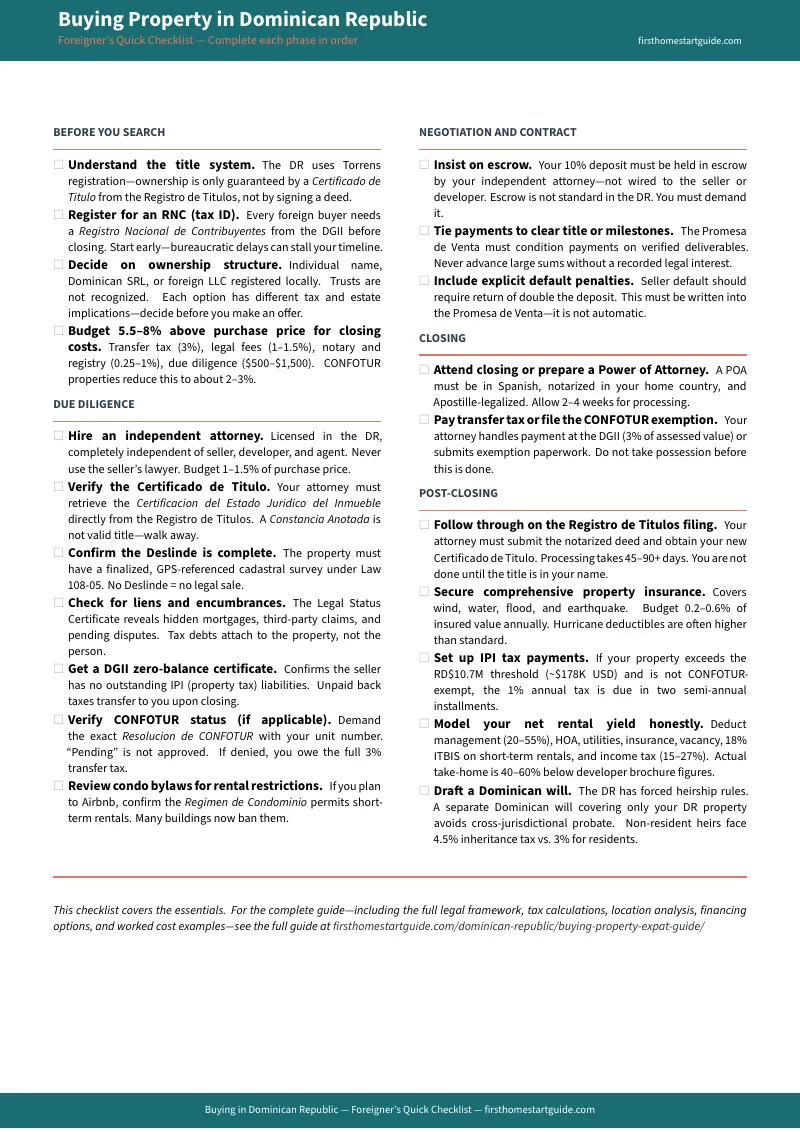
Download the free Quick Checklist to see the 20-step action plan covering independent attorney selection, Deslinde verification, CONFOTUR status checks, escrow requirements, and the closing-to-registry timeline. When you're ready for the full Title Verification System — complete with the Deslinde decoder, CONFOTUR playbook, escrow shield, cost calculator, rental yield model, and regional market intelligence — the complete guide is here.
You've found the property. Now decode the title system that stands between you and the keys.