You Found a Beautiful Condo in Cuenca for $120,000 and Assumed Buying Property in Ecuador Would Be Straightforward
You searched Plusvalia.com, found a two-bedroom in El Centro Historico with mountain views. Your agent said foreigners have the same property rights as Ecuadorian citizens --- no restrictions, no local partner, no trust required. Just sign the deed and the place is yours. Simple.
Except the deed you signed at the notary --- the Escritura Publica --- did not actually transfer ownership. In Ecuador, ownership only transfers when the deed is inscribed at the Registro de la Propiedad. That inscription takes 10 to 15 business days. If your attorney did not follow up, you flew home thinking you owned a condo while the seller still held legal title. And during that gap, the seller could have sold the same property to someone else, taken out a lien against it, or simply disappeared. There is no title insurance in Ecuador to protect you.
Then there was the tax document. The Certificado de Avaluo listed the property at $32,000 --- a fraction of the $120,000 you paid. Your agent brushed it off: "That's just the cadastral value, the government's assessment for tax purposes." But nobody explained that the Alcabala transfer tax is calculated on the higher of the cadastral or contract value, that the seller wanted to record a lower sale price to reduce their Utilidad (capital gains) liability, and that agreeing to under-declare the price on the deed means your own future capital gains bill explodes when you sell at the real market value. You saved the seller money and created a tax trap for yourself.
And the investor visa. You heard the minimum threshold is $48,200 in 2026 --- three times the Basic Unified Salary of $482. But the value that counts is the amount recorded on the deed, not what you actually paid. If the cadastral value on your deed says $32,000, your property does not qualify for the visa. Your agent did not mention this. Your attorney assumed you knew.
The problem is not that Ecuador restricts foreign buyers. The problem is that Ecuador layers a civil law property system with no title insurance, a registry inscription requirement that creates an ownership gap after signing, a cadastral valuation system that disconnects deed values from purchase prices, a notary who does not represent either party, an under-declaration culture that creates future tax traps, a 50-kilometer border zone that makes entire regions off-limits, and a post-purchase reality where tenant eviction requires a minimum two-year lease term and remote property management means trusting people you cannot supervise --- and the free expat blogs, YouTube walkthroughs, and agency marketing sites that foreigners rely on routinely skip or oversimplify every one of these.
The Buying Property in Ecuador --- Expat Guide is a Title Protection System for Foreign Buyers --- a structured walkthrough of every Ecuadorian legal requirement, due diligence check, tax obligation, and ownership trap that determines whether your property purchase secures your investment or leaves you holding a deed that does not mean what you think it means. It replaces months of cross-referencing Reddit threads, expat forum posts, agency marketing pages, and scattered blog advice with a single reference that tells you exactly what each document does, exactly what each Spanish legal term means, and exactly where foreign buyers lose money they never get back.
What's Inside the Title Protection System
A comprehensive 12-chapter guide, a quick-start checklist, and 9 standalone printable tools --- covering every stage from constitutional rights through property management, built specifically for the regulatory structures and market dynamics that make buying property in Ecuador as a foreigner fundamentally different from buying in your home country:
The Registry Inscription Gap
This is the single most critical concept in Ecuadorian real estate --- and the one that no free resource explains properly. Signing the Escritura Publica at the notary's office does not transfer ownership. Title only transfers when the deed is inscribed at the Registro de la Propiedad, a process that takes 10 to 15 business days. During this gap, the property remains in the seller's name. The guide walks you through the full six-step legal process --- from retaining an independent attorney through registry inscription --- with the exact sequence, the exact documents, and the exact timeline so you never leave Ecuador thinking you own property when you do not.
The 5 Non-Negotiable Due Diligence Checks
Ecuador has no title insurance. Your only protection is a set of five specific certificates that your attorney must obtain and verify before you sign anything. The Certificado de Gravamenes y Prohibiciones (valid 90 days) confirms the property is free of mortgages, liens, embargoes, and sale prohibitions. The Certificado de Historial de Dominio traces the ownership chain back 15 years --- Ecuador's adverse possession statute of limitations. The Certificado de Avaluo y Registro Catastral verifies the municipal boundaries match the physical property. The Certificado de No Adeudar al Municipio confirms zero outstanding property taxes, special assessments, and utility debts. And the zoning check confirms you can legally use and modify the property as intended. The guide explains what each certificate contains, how to read it, what red flags look like, and why skipping any one of them can cost you the entire investment.
Cadastral Value vs. Market Value --- and the Under-Declaration Trap
The cadastral value is the municipality's official assessment for tax purposes. It is almost always dramatically lower than the actual purchase price. When your Certificado de Avaluo lists a $120,000 condo at $32,000, that is normal. What is not normal is agreeing to record the lower number on your deed. Sellers pressure buyers to under-declare because it reduces the seller's Utilidad (capital gains) tax. But the recorded value becomes the baseline for your own future capital gains calculation, your annual Impuesto Predial, and --- critically --- your investor visa qualification. The guide covers exactly how the cadastral system works, exactly how the Alcabala transfer tax is calculated, and exactly why under-declaration creates a compounding tax trap that costs you far more than it saves the seller.
Location Deep-Dives: Cuenca, Quito, Coast, and Rural Valleys
Foreign buyer preferences cluster in four distinct zones, each with different price ranges, lifestyle profiles, and hidden risks. Cuenca ($80,000 to $200,000, UNESCO historic center, largest English-speaking expat community, strict heritage renovation restrictions). Quito and Cumbaya ($100,000 to $300,000, metropolitan amenities, higher capital appreciation, altitude adjustment period). Coastal areas --- Salinas, Manta, Olon ($60,000 to $150,000, beachfront lifestyle, potential coastal zoning restrictions on raw land within 8 km of the shoreline). And the rural valleys --- Vilcabamba, Cotacachi, Yunguilla (highly variable pricing, larger acreage, limited infrastructure, cadastral boundary discrepancies common). The guide covers price per square meter, the specific buyer profile each area serves, the lifestyle trade-offs, and the location-specific risks that affect each zone.
The Investor Visa Pathway
The 2026 Ecuador Investor Visa requires a minimum real estate investment of $48,200 --- three times the Basic Unified Salary of $482. The visa grants temporary residency that transitions to permanent residency after 21 months. But the qualifying value is the amount recorded on the deed, not the amount you paid. If the cadastral value on your deed falls below $48,200, the property does not qualify. The guide covers the exact threshold calculation, the documentation package, the health insurance timing requirement, the visa lien that prevents you from selling the property while your visa is active, and the path from temporary to permanent residency.
Transaction Costs and the Full Tax Picture
Total closing costs run 2% to 3% of the purchase price. The Alcabala transfer tax is 1% calculated on the higher of the cadastral or contract value. Notary fees range from 0.1% to 0.5%. Registry inscription costs approximately 0.1% to 0.2%. Attorney fees for a bilingual real estate lawyer run $800 to $2,000. Beyond closing costs, the guide covers annual Impuesto Predial (0.025% to 0.5% of cadastral value, typically under $200/year), the January payment discount (10% for early payment), Contribucion Especial de Mejoras (special assessments for municipal infrastructure), capital gains tax on sale (Utilidad), and the cross-border tax obligations for Americans (FBAR, FATCA, Form 1116), Canadians (Canada-Ecuador DTA), and UK citizens (UK-Ecuador DTA effective January 2025).
Common Scams and How to Spot Them
The expat community in Ecuador is small and interconnected. Horror stories spread fast and they are specific. The guide covers the bait-and-switch broker scheme (showing you a desirable property, claiming it is unavailable, steering you to a less desirable one, then listing the original the next day), the under-declared deed scam (where the broker and seller collude to record a fraction of the actual sale price), the cadastral boundary fraud (where a parcel marketed as 14 hectares turns out to be 8 hectares because no official geographic survey was conducted), fake rental listings on unmoderated platforms (stolen photos, aggressive underpricing, high-pressure deposit demands before physical viewings), and the predatory lease agreement with waived consumer rights, arbitrary penalty fees, and vague condition clauses designed to confiscate your security deposit.
Post-Purchase: Managing Your Property from 3,000 Miles Away
Most free guides end at the closing table. But for the foreign buyer who lives in the US, Canada, or Europe, the real complexity starts after the purchase. Ecuadorian tenant law mandates a minimum two-year lease term and heavily favors the tenant in eviction disputes. Finding a trustworthy local property manager without an in-person network is a genuine operational challenge. The guide covers the legal framework for landlord obligations, HOA (alicuota) structures and disputes, utility payment setups, maintenance contractor vetting, the short-term rental landscape, and the specific steps for setting up remote oversight systems when you cannot physically supervise your property.
Who This Guide Is For
- Retirees relocating to Ecuador who need to understand the full cost of ownership beyond the purchase price --- Alcabala, notary fees, annual Impuesto Predial, Contribucion Especial de Mejoras, and carrying costs that vary by location and building type
- Investor visa applicants who need to meet the $48,200 threshold and ensure their property purchase is correctly recorded on the deed at a value that qualifies --- not at the under-declared cadastral figure that the seller prefers
- Digital nomads and remote workers who have been renting in Cuenca or on the coast and are ready to buy, but need to understand the registry inscription process, the due diligence checks, and the post-purchase realities before committing capital
- Short-term rental investors targeting beach properties in Salinas or Manta who must verify coastal zoning restrictions, municipal rental regulations, and the practical economics of managing rental income remotely
- Anyone buying property in Ecuador for the first time who cannot afford to sign a deed that does not actually transfer ownership, agree to an under-declared purchase price that creates a future tax trap, or skip the five due diligence checks that are the only thing standing between you and a property with hidden liens, boundary discrepancies, or outstanding municipal debts
Why Not Free Guides and Expat Blogs?
- Real estate agency marketing sites (EcuaAssist, Live the Life in Ecuador, local Cuenca brokerages) tell you that foreigners have equal rights, that Ecuador uses the US dollar, and that Cuenca has eternal spring weather. They do not explain the registry inscription gap, the difference between signing the deed and actually owning the property, the five specific due diligence certificates your attorney must obtain, or how the cadastral value under-declaration trap works. You get a destination pitch, not a legal compliance guide.
- Expat blogs and YouTube channels (YapaTree, Amy Prisco, International Living) offer valuable neighbourhood tours and lifestyle content. But they are not structured references you can hand to your attorney. They do not walk you through reading a Certificado de Gravamenes annotation by annotation, they do not model the true cost difference between Cuenca's historic center and the coast over five years, and they do not cover the visa lien that prevents you from selling your property while your investor visa is active.
- Reddit threads and Facebook groups (r/Ecuador, r/ExpatFIRE, Cuenca Expats, Expats in Ecuador) contain genuine warnings about bait-and-switch brokers, cadastral boundary fraud, and predatory lease agreements. But they are mixed with outdated information, anecdotal advice from people who bought under different regulations, and contradictory recommendations about attorneys and agents. Sorting current from outdated takes longer than reading a guide that already verified everything against the 2026 regulatory environment.
- Law firm websites (Grace & Nelson, Expat Law Group) provide excellent technical overviews of the legal requirements. But they cover the process at a high level and naturally steer toward their own services. They do not give you the full transaction cost breakdown, the location-by-location analysis, the scam identification framework, or the post-purchase property management playbook. You get legal marketing, not the complete buyer's reference.
This guide fills the Ecuador-specific gap --- the space between knowing that foreigners can buy property and knowing how to actually protect your investment when you do. It is the analysis that would take a bilingual real estate attorney, a notary, a tax advisor, and a local property manager to assemble --- structured as a reference you own permanently and can bring to every meeting.
--- Less Than a Single Attorney Consultation
A bilingual real estate attorney in Cuenca charges $800 to $2,000 for the full transaction. A single consultation runs $100 to $300. Discovering after you sign the deed that the registry inscription was never completed, that the cadastral boundaries do not match the physical property, or that you agreed to under-declare the purchase price and disqualified your investor visa? That costs you the entire investment --- and there is no title insurance to fall back on.
This guide does not replace your real estate attorney or your tax advisor. But it gives you the registry inscription walkthrough, the due diligence certificate reference card, the cadastral value analysis framework, the transaction cost worksheet, the scam identification reference, the investor visa checklist, the Spanish legal terms glossary, the annual obligations worksheet, and the transaction timeline planner --- 11 PDFs total, so you understand exactly what each document means, exactly what each filing does, and exactly where foreign buyers lose money they never get back, before you sign anything or wire a single dollar.
If it prevents the registry inscription gap alone --- if it stops you from leaving Ecuador thinking you own a property when the deed was never inscribed --- it pays for itself before you finish reading the first chapter.
Money-back guarantee, no time limit. If the guide does not sharpen your Ecuador property buying analysis and protect your investment, you pay nothing.
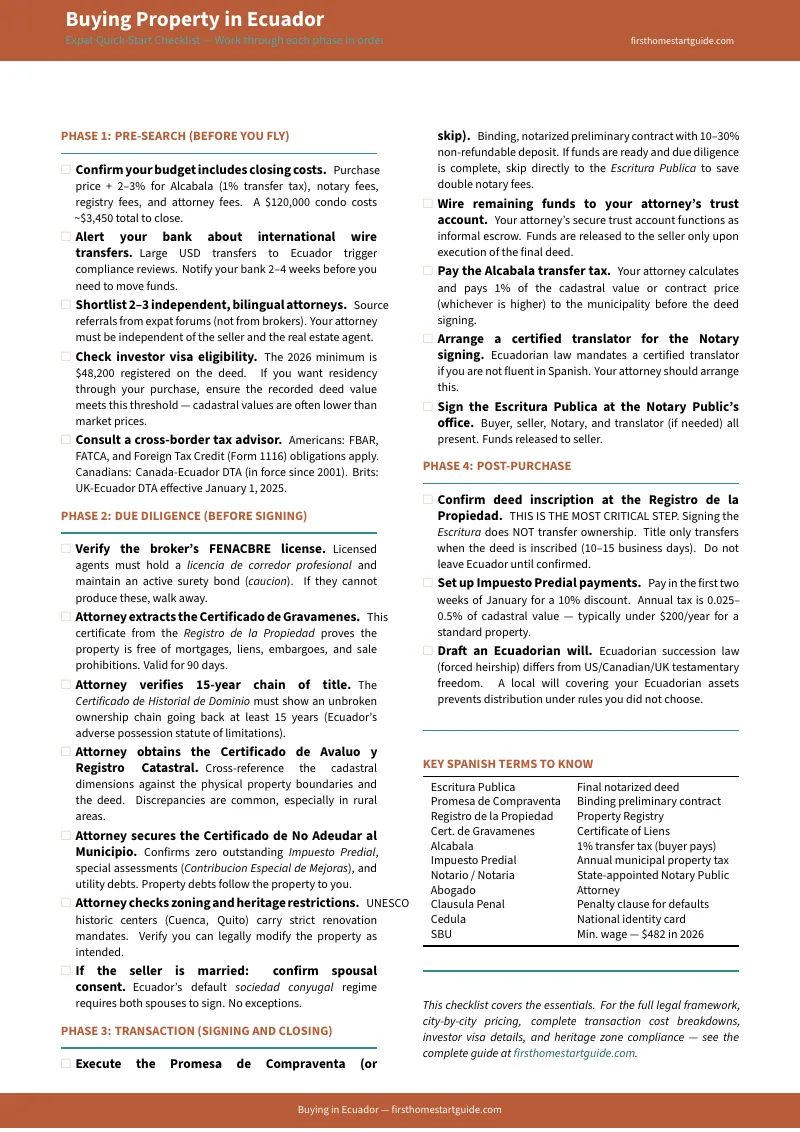
Download the free Buying in Ecuador Quick Checklist to see the 20-item compliance framework covering due diligence certificates, the legal buying process, transaction steps, and post-purchase obligations. When you are ready for the complete 12-chapter guide plus all 9 standalone printable tools --- the due diligence reference card, cost worksheets, scam identification card, investor visa checklist, Spanish legal terms glossary, location comparison, and transaction timeline --- the full toolkit is here.
Ecuador's open property market only works if you know how to protect your title inside it. This guide makes sure you do.