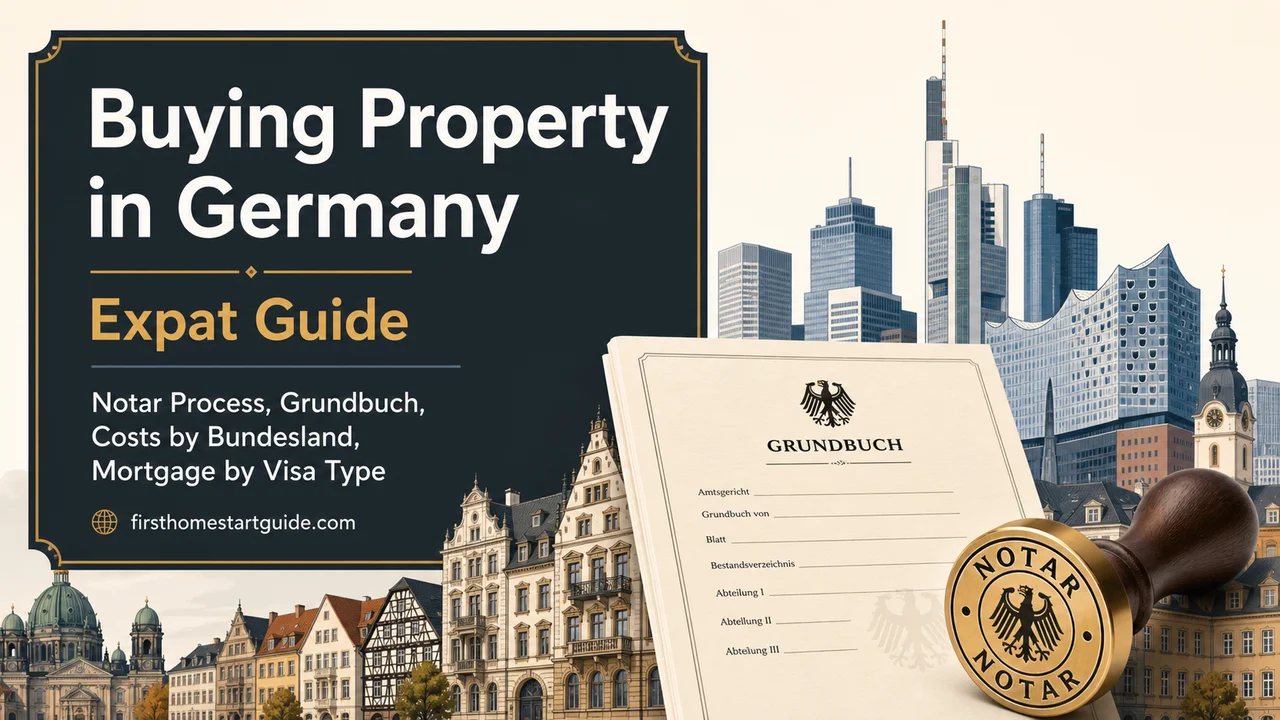
You Found an Apartment in Berlin, a House in Bavaria, or a Flat in Frankfurt. Between You and the Keys: a Notary Who Won't Protect You, a Land Registry That Takes Six Months, and Closing Costs That Nobody Explained Add Up to 15% of the Purchase Price.
You've browsed ImmobilienScout24 and Immowelt. You've read the Hypofriend "Buying Property as a Foreigner" guide and scrolled through r/germany threads where expats share conflicting advice about mortgages, SCHUFA scores, and cooling-off periods. You've seen mortgage brokers advertise "up to 100% financing" — without mentioning that this only applies if you hold a Niederlassungserlaubnis. If you're on an EU Blue Card or a temporary work visa, your maximum loan-to-value ratio drops to 80% or less. If you're a non-resident buying from abroad, most banks will cap you at 60% LTV — meaning you need 40% of the purchase price in cash, plus another 10-15% for transfer tax, notary fees, registration charges, and agent commission. That's more than half the purchase price in liquid capital before the bank lends you a single euro.
You search online for help. Hypofriend publishes detailed mortgage comparisons — because they earn commission from the banks they recommend. Expatrio offers a general relocation overview that covers property in two paragraphs. English-language Reddit threads cite cooling-off periods that don't exist in German real estate, SCHUFA advice from 2019, and Grunderwerbsteuer rates from before the last legislative change. Every English-speaking mortgage broker in Berlin offers a free consultation — because the real product is the bank referral fee, not the consultation. And the one professional who could explain the WEG meeting minutes, the Sonderumlage risk, and the Teilungserklärung before you sign — a bilingual real estate lawyer — charges €300-€1,000 per hour to tell you what you could have known walking in.
Here's the problem no free resource solves: Germany's property transaction runs through a notary who is neutral by law and will not protect your interests, a land registry (Grundbuch) that takes 2-6 months to update, a property transfer tax (Grunderwerbsteuer) that changes rate the moment you cross a state border, a homeowners' association system (WEG) where a single vote can land you with a €25,000 special assessment for a roof you didn't know was failing, and a capital gains regime that taxes your profit at your full income tax rate if you sell within 10 years. The legal protections exist. But they only work if you trigger them in the right order, at the right time, before you sign.
The Buying Property in Germany — Expat Guide is the German Property Transaction Blueprint. Not a mortgage broker's lead magnet designed to funnel you toward a lending product. It's a structured decision system that decodes every stage of the German property purchase — from understanding your mortgage eligibility based on your exact visa type, through Grundbuch verification, WEG due diligence, tax planning, and post-purchase compliance — so you make each decision understanding the legal mechanism behind it, the financial consequence of getting it wrong, and the German bureaucratic office responsible for it.
What's Inside the German Property Transaction Blueprint
The complete guide plus 8 standalone printable tools — covering every stage from property search through Grundbuch registration, with the financial and legal detail that mortgage broker blogs leave out:
The Complete Buying Process — Six Sequential Stages
German property transfers follow the Trennungsprinzip (separation principle) — the contract and the ownership transfer are legally separate events, each with its own requirements and timeline. The guide walks through every stage in sequence: property search and offer (legally non-binding — verbal agreements have zero force), mortgage approval and Kaufvertrag drafting, the notary appointment and signing, Auflassungsvormerkung filing (the priority notice that prevents double-selling), purchase price transfer, and final Grundbuch registration. Each stage includes the timeline, the documents required, the parties involved, and the specific points where foreign buyers commonly make irreversible mistakes.
Costs Breakdown — Every Fee, Every State, Every Line Item
Grunderwerbsteuer (property transfer tax) rates for all 16 federal states: 3.5% in Bavaria, 5% in Baden-Württemberg, 5.5% in Hamburg, 6% in Berlin and Hesse, 6.5% in Brandenburg and NRW. Notary fees at 1.5-2%. Grundbuch registration at 0.5%. Makler commission and the 2020 reform mandating a 50/50 buyer-seller split — typically 3.57% each including VAT. Sworn interpreter costs at €300-€1,000 if you're not fluent in German. Two complete worked examples: a €350,000 apartment in Berlin and a €500,000 house in Bavaria, showing the exact euro amount for every cost component. Because "budget 10-15% for closing costs" is advice. The guide gives you the spreadsheet.
Financing by Visa Type — What Your Residency Status Actually Means for Your Mortgage
German banks don't assess expat mortgage applications on income alone — they assess them on residency status. Permanent residents (Niederlassungserlaubnis): treated identically to German citizens, eligible for up to 100% LTV. EU Blue Card holders: highly favoured, with the critical threshold at 21 months — waiting until this point dramatically reduces the required down payment. Non-residents and tax foreigners: maximum 60% LTV, requiring 40% cash down plus closing costs. The valuation gap problem: banks currently appraise properties up to 10% below asking price, and you must cover that shortfall entirely in cash. SCHUFA credit scoring for expats with no German credit history. KfW subsidised loans: KfW 124 for owner-occupiers, KfW 300 for families buying energy-efficient new builds, KfW 261 for green renovations — with interest rates as low as 0.6% and principal reduction subsidies up to €37,500. Plus the Section 489 BGB right to refinance penalty-free after 10 years, regardless of what your mortgage contract says.
Due Diligence — Hausgeld, WEG, Sonderumlage, and the Documents Nobody Tells You to Read
Hausgeld vs Nebenkosten: the total monthly fee an apartment owner pays to the WEG includes management fees and reserve contributions that cannot legally be passed to a tenant — a distinction that can turn a positive rental yield into a loss. The Teilungserklärung (Declaration of Division): what constitutes your private property vs communal property, how voting works, and which alterations you can make without WEG approval. WEG meeting minutes: how to spot underfunded maintenance reserves, upcoming Sonderumlage votes, and management disputes that signal future problems. The Sonderumlage itself: how a single vote at a WEG meeting can generate a €20,000-€30,000 lump-sum bill for a roof replacement or mandatory heat pump installation — and why auditing three years of minutes before you buy is the single most important due diligence step for apartment buyers. Plus the Energieausweis (energy certificate), GEG retrofit obligations triggered by ownership change, and when to hire a Baugutachter (building surveyor) at €500-€1,500.
Tax Traps — Spekulationssteuer, Rental Income, and the 10-Year Rule
The Spekulationssteuer (speculation tax): sell a non-owner-occupied investment property within 10 years and your profit is taxed at your personal income tax rate — which can exceed 42% for high earners. The owner-occupied exemption: live in the property during the year of sale and the two preceding calendar years, and you sell completely tax-free — minimum effective hold of 2 years and 1 day. Rental income taxation for residents (progressive brackets) and non-residents (minimum 15.825% effective rate). Depreciation (AfA): 2% per year for pre-1925 buildings, 2.5% for newer stock. The 2025 Grundsteuer reform and how municipal multipliers affect your annual bill. Double tax treaty mechanics and how to avoid being taxed in both Germany and your home country.
The Tenanted Apartment Trap — Eigenbedarf, Sperrfrist, and Mietpreisbremse
Buying a tenanted apartment and planning to move in yourself? In Berlin, Munich, and Hamburg, a Sperrfrist (blocking period) of up to 10 years prevents new owners from claiming Eigenbedarf (personal need) to evict existing tenants in converted buildings. That means a decade during which the property is legally useless for personal occupation. The guide covers when the Sperrfrist applies, how Eigenbedarf claims actually work (you must prove genuine need — not just preference), what the Mietpreisbremse (rent cap) means for your rental returns, and why buying a tenanted apartment in a strained housing market is a fundamentally different investment than buying a vacant one.
The Erbbaurecht Trap — When "Buying" Means Leasing
Suspiciously cheap listings on ImmobilienScout24 almost always have one thing in common: Erbbaurecht. You buy the building but only lease the land — typically from a municipality or church — for up to 99 years. The ground rent (Erbbauzins) adjusts upward over time. Resale value collapses as the remaining lease shortens. Banks offer significantly worse LTV ratios. The guide explains exactly how ground leases work in Germany, how to spot them in listings, and why they're almost never a good deal for expat buyers.
The 2026 Cash Ban and AML Enforcement
Since 2023, Germany has enforced a total ban on cash, gold, platinum, and cryptocurrency for any real estate transaction. Every euro must be traceable through the banking system. If you're buying through a company, trust, or foundation, the Ultimate Beneficial Owner must be registered in the Transparency Register (Transparenzregister) at least one month before signing. The notary will halt the transaction if funds cannot be verified. The guide explains the source-of-funds documentation, what the notary checks, and how to structure international fund transfers to avoid delays.
Legal Protections You Don't Know About — and the One That Doesn't Exist
The 14-day "cooling-off period" is the most dangerous myth in German real estate. The law requires that a consumer buyer receives the draft Kaufvertrag at least 14 days before the notary appointment — this is a review period, not a cancellation right. Once the contract is signed and the notary applies their seal, you are irrevocably committed. There is no way out. The guide explains why the Notar is neutral and will not protect your commercial interests, why hiring your own bilingual Rechtsanwalt is essential, how the 14-day draft review actually works, and how to use a Power of Attorney (Vollmacht) if you can't attend the signing in person.
City-by-City Market Guide — The Big 7 and Beyond
Munich: highest prices, lowest transfer tax (3.5%), strong rental yields, automotive and engineering job market. Berlin: tech hub, 6% transfer tax, stabilising post-rent-cap market. Frankfurt: banking sector, strong expat infrastructure, 6% transfer tax. Hamburg: 5.5% transfer tax, harbour premium, media industry. Cologne and Düsseldorf: NRW at 6.5%, lower entry points. Stuttgart: automotive hub, 5% in Baden-Württemberg. Plus emerging secondary cities — Leipzig, Dresden, Nuremberg — where prices are 40-60% lower than the Big 7 with increasingly strong rental demand. Average prices per square metre, realistic rental yields, and which market fits which buyer profile.
Standalone Printable Tools
Every purchase comes with 7 standalone worksheets, checklists, and reference cards you can print individually and bring to meetings with your Makler, bank, notary, or Steuerberater: a Closing Cost Worksheet with Grunderwerbsteuer rates for all 16 Bundesländer and two worked examples, a Financing Reference Card mapping mortgage eligibility to your exact visa type, a Due Diligence Checklist covering every item to verify before instructing the notary, a Notary Preparation Checklist combining documents for the notary appointment and mortgage application, a WEG Audit Worksheet for analysing Hausgeld breakdowns and maintenance reserves, a City Comparison Card comparing the Big 7 markets at a glance, and a German Real Estate Glossary with all key terms and their English translations.
Who This Guide Is For
This guide is for foreign buyers and expats purchasing property in Germany who:
- Are buying their first German property and need the entire transaction mapped — from understanding their mortgage eligibility based on visa type, through property search, due diligence, notary process, and Grundbuch registration — so they understand what happens at each stage, what it costs, and what can go wrong
- Hold an EU Blue Card or temporary work visa and need to know exactly how their residency status affects borrowing power, LTV ratios, and required cash deposits — and whether waiting for a Niederlassungserlaubnis could save them tens of thousands in required equity
- Are American, British, Canadian, or Australian non-residents facing the strictest financing terms — 60% LTV cap, 40% down payment plus 10-15% closing costs — and need to understand the full capital requirement before committing
- Are buying an apartment and need to understand WEG obligations, Hausgeld pass-through rules, the Sonderumlage risk, and how to audit the Teilungserklärung and meeting minutes — because an underfunded maintenance reserve can generate a five-figure bill in your first year of ownership
- Are considering a tenanted investment property and need to understand Eigenbedarf restrictions, Sperrfrist blocking periods of up to 10 years, Spekulationssteuer timing, and Mietpreisbremse rent caps — so they model realistic returns, not fantasy yields
- Want every legal requirement, every tax rate, every timeline, and every cost in one document — so they walk into Makler meetings, notary appointments, and bank consultations with structural understanding, not the surface-level confidence of someone who read a mortgage broker's blog
Why Not Free Resources?
Free information on buying property in Germany as a foreigner is abundant. Here's what each source actually delivers:
- Hypofriend publishes detailed English-language mortgage guides and calculators — because they're a digital mortgage broker who earns commission from the banks they recommend. Their financing content is genuinely useful. What they don't cover in depth: WEG due diligence, Sonderumlage risk assessment, Teilungserklärung review, Eigenbedarf rules for tenanted properties, or the Erbbaurecht trap. Their coverage stops precisely where their monetisation stops.
- Expatrio and Settle in Berlin offer general expat relocation guides that cover property in a few paragraphs. They'll tell you notary fees exist without explaining why the Notar is neutral and won't protect you. They'll mention Grunderwerbsteuer without listing the rates for all 16 states. You get a summary. You don't get the operational detail.
- Reddit (r/germany, r/berlin, r/finanzen) contains real stories from real buyers — alongside SCHUFA advice from before the scoring model changed, "cooling-off period" claims that confuse the 14-day draft review with a post-signing cancellation right, and Grunderwerbsteuer rates that haven't been updated since the last state legislative session. You'll find someone who got 100% financing and someone who was rejected at 70% LTV. Both experiences are real. Neither tells you which outcome applies to your visa type.
- Bilingual real estate lawyers offer professional representation — for initial consultations at €300-€1,000 per hour and contract reviews that can cost thousands. They are essential for the actual signing. But their knowledge is what you're paying for. Understanding the system before you walk in — knowing which questions to ask, which documents to request, which clauses to flag — is what this guide provides.
— Less Than One Hour of a Bilingual Lawyer's Time
A bilingual real estate lawyer in Berlin or Munich charges €300-€1,000 per hour. A Sonderumlage from an underfunded WEG reserve can cost €20,000-€30,000 in your first year. Grunderwerbsteuer miscalculation from not checking which Bundesland your commuter-belt property actually sits in costs an extra €2,500 on a €500,000 purchase. The valuation gap — buying without knowing banks appraise 10% below asking — means scrambling for five-figure cash at the worst possible moment.
The guide costs less than one hour of a lawyer's time. It covers what lawyers charge thousands to explain — and what mortgage brokers never mention because it falls outside their commission structure.
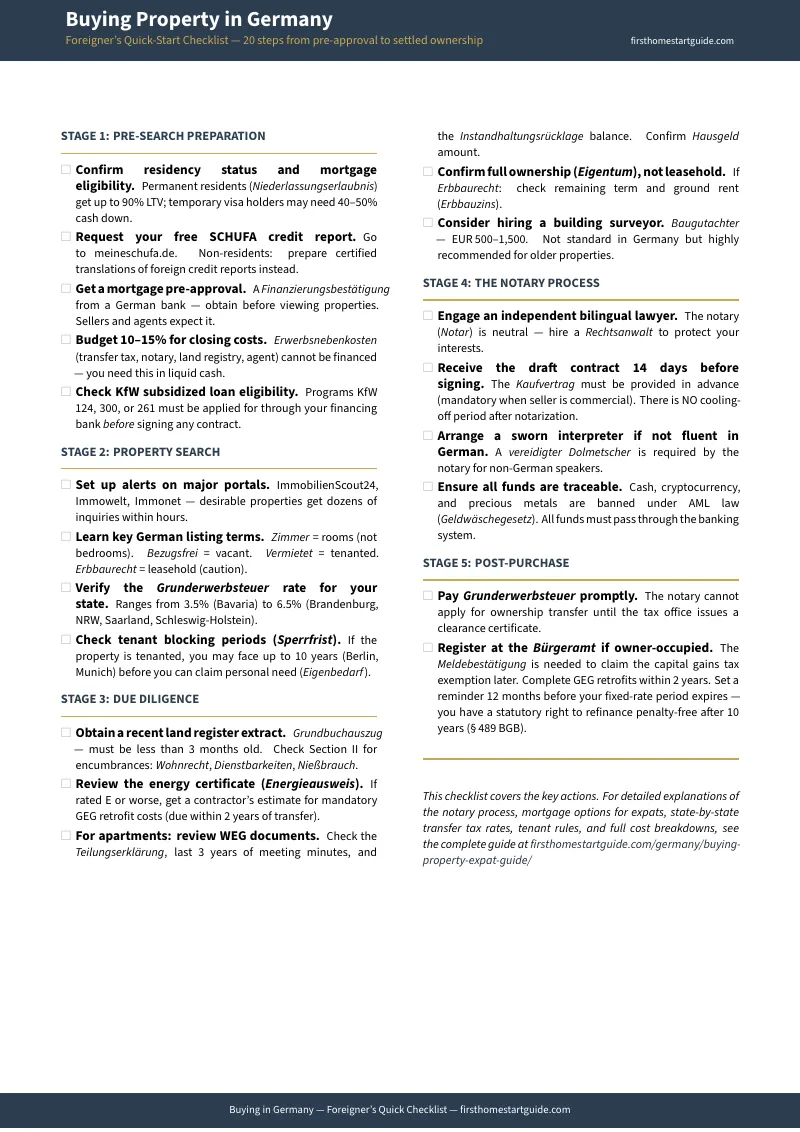
Not sure yet? Download the free checklist — 20 action items covering every stage of the purchase process, with Grunderwerbsteuer rates, mortgage eligibility by visa type, and the due diligence steps that protect you from the most expensive surprises.