You Found Your Dream Property in Greece. The System Between You and the Keys Involves an AFM, a Ktimatologio Transition, a Border Permit You May Not Know Exists, and a Golden Visa Framework That Changed Three Times in Two Years.
You've found a whitewashed house on a Cycladic hillside, a stone villa overlooking the Cretan coastline, or a renovated apartment in a leafy Athens neighbourhood. You've checked the asking price, compared it to Spain and Portugal, and confirmed that Greece is still one of the most affordable property markets in southern Europe. So you start the process. Within a week you've learned that total transaction costs aren't the 1-2% you expected — they're 8-10% of the purchase price once you add the 3.09% transfer tax, notary fees, lawyer fees, and land registry charges. The Greek notary who drafts the deed isn't your advocate — they're a neutral state official. And the property you're looking at on Rhodes, Samos, or Lesvos sits in a designated border area where non-EU buyers need Ministry of Defence clearance that takes 6-12 months to process.
You search online for help. Elxis publishes polished guides written by their in-house agents who earn commission when you buy through them. Astons offers a general overview that mentions border restrictions in passing but doesn't list which islands and regions are affected or what documents you need. Get Golden Visa explains the new thresholds but doesn't mention the €150,000 fine for failing to complete a heritage restoration within five years, or the €50,000 penalty and permit revocation for listing a Golden Visa property on Airbnb. Reddit threads from 2023 still cite €250,000 as the Golden Visa minimum everywhere — two years and three legislative changes out of date. And every English-language buyer's agent in Athens charges thousands in consulting fees before they've verified a single cadastral record.
Here's the problem no free resource solves: Greece's property transaction runs on a layered system where you need a tax number (AFM) before you can sign anything, a 20-year title search through a national cadastre that is mid-transition from paper to digital, a civil engineer's certificate confirming the property has no unauthorized construction, and — if you're non-EU and buying on certain islands — a military clearance permit that can delay your purchase by a year. Each requirement has its own application process, its own government office, its own timeline, and its own penalty for getting it wrong. The protections exist. But they only work if you know they exist, understand the sequence, and trigger them in the right order.
The Buying Property in Greece — Expat Guide is the Greek Property Compliance Navigator. Not an agency blog designed to funnel you toward a listing. It's a structured decision system that decodes every stage of the Greek property purchase — from obtaining your AFM remotely, through Ktimatologio verification, civil engineer inspections, border area permits, Golden Visa compliance, and the notarial deed — so you make each decision understanding the legal mechanism behind it, the government office responsible for it, and the financial consequence of skipping it.
What's Inside the Greek Property Compliance Navigator
The complete guide plus 8 standalone printable tools — covering every stage from property search through deed registration, with the administrative detail that agency blogs leave out:
AFM Remote Application — Getting Your Greek Tax Number Without Travelling to Greece
Every property transaction in Greece requires an AFM (Arithmos Forologikou Mitrou) — and you need it before you can sign a reservation agreement, open a Greek bank account, or pay transfer tax. Non-residents apply through the specialized Tax Office for Foreign Residents (DOY Katoikon Exoterikou), and the most efficient route is granting a Power of Attorney to a Greek lawyer who handles the entire registration remotely. The guide walks through the application requirements — passport, justification letter, tax representative (antiklitos) appointment — the processing timeline, and the specific PoA language that satisfies AADE without requiring you to fly to Athens for a stamp.
Ktimatologio Verification — Navigating Greece's Mid-Transition Land Registry
Greece is replacing its legacy person-based land registries (Ypothikofylakeia) with a unified digital property cadastre (Ktimatologio). This is a modernization that will eventually make Greek titles far more secure — but during the transition, it creates specific risks. Legacy titles rely on historical descriptions instead of GPS coordinates, producing boundary discrepancies when properties are digitized. Properties whose owners missed declaration deadlines are flagged as "owner unknown" and require complex legal procedures before they can be sold. The guide explains how to check a property's cadastral status online, what boundary discrepancies mean for your transaction, how to verify whether the seller's declared boundaries match the digital record, and why your lawyer must conduct a 20-year title search tracing ownership history back through the statute of limitations for adverse possession and inheritance claims.
Border Area Permits — The Restriction That Covers More of Greece Than You Think
Non-EU and non-EFTA nationals buying property in designated border regions need Ministry of Defence clearance. These zones include the East Aegean islands (Samos, Lesvos, Chios), the Dodecanese (Rhodes, Kos, Astypalaia), parts of the northern mainland (Evros, Kastoria, Florina), and pockets like Preveza. This isn't a niche restriction — it covers some of the most popular islands foreign buyers search for. The application requires apostilled criminal records, a CV translated into Greek, detailed property plans, and submission to the local Decentralized Administration. Processing takes 6-12 months. The guide maps every affected zone, lists every required document, explains the application path through the Decentralized Administrations, and shows how to structure your purchase timeline so the permit process doesn't kill the deal. Because agency blogs mention border permits in one sentence; the guide gives you the document checklist and the realistic calendar.
Golden Visa 2026 — Three Tiers, Two Exceptions, and the Penalties Nobody Mentions
The Greek Golden Visa has transitioned from a straightforward €250,000 program to a three-tier framework with strict zone-based thresholds. The €800,000 tier covers Attica (all of Athens and Piraeus), Thessaloniki, Mykonos, Santorini, and every island with a population over 3,100 — that's 32 major islands including Crete, Rhodes, Corfu, Paros, and Naxos, with a mandatory 120 square metre minimum. The €400,000 tier covers all other mainland areas and smaller islands. The €250,000 exceptions still exist — but only for commercial-to-residential conversions and heritage building restorations, each with its own compliance requirements. The guide details each tier's geographic boundaries, the 120 sqm minimum floor area rule, the commercial conversion requirements, and the penalties that the promotional guides leave out: a €50,000 fine and permit revocation for listing a Golden Visa property on Airbnb, and a €150,000 fine plus revocation for failing to complete a heritage restoration within the five-year permit cycle.
Civil Engineer Certificate and Unauthorized Construction (Afthaireta)
A significant structural risk in Greek real estate is the historical prevalence of unauthorized construction — enclosed balconies, unpermitted guest houses, extensions built without approval. Under Greek law, liability for all illegal construction transfers entirely to the buyer upon signing the deed. The seller must obtain a Civil Engineer's Certificate (Vevaiosi Michanikou) issued within two months of closing, where an engineer physically inspects the property and cross-references it against the official blueprints filed at the municipal Urban Planning Office (Poleodomia). Any discrepancies must undergo formal legalization (taktopoiiisi) before the transaction can close. The guide explains what the engineer checks, what regularization costs, how long legalization takes, and the red flags that indicate a property carries structural liabilities the asking price doesn't reflect.
Transaction Cost Breakdown — Where 8-10% of Your Purchase Price Actually Goes
The Property Transfer Tax (FMA) is 3% of the declared price or the official objective value, whichever is higher, plus a 3% municipal surcharge on the tax — bringing the effective FMA rate to 3.09%. Add notary fees (typically 1-1.5% on a sliding scale), lawyer fees (around 1%), land registry fees (0.5%), and civil engineer certification costs, and total transaction costs reach 8-10% of the purchase price. For new-build properties permitted after January 2006, a 24% VAT normally applies instead of FMA — but the government has suspended this VAT through the end of 2026, allowing buyers to use the lower 3.09% rate. The guide itemizes every fee, explains the objective value system (antikeimeniki axia) that can inflate your tax base above the actual purchase price, and shows how to calculate your total all-in cost before you make an offer.
ENFIA Tax and Post-Purchase Obligations
Non-resident property owners pay the annual Unified Real Estate Property Tax (ENFIA), composed of a Primary Tax calculated on zone values, building age, floor level, and facade coefficients (€2 to €16.20 per square metre base rate), plus a Supplementary Tax that kicks in when your total Greek property holdings exceed €500,000 in objective value (starting at 0.10%, scaling to over 1.05%). Corporate-held properties face a flat 0.55% supplementary rate — rising to a punitive 15% special tax for undocumented offshore structures. The guide breaks down both ENFIA components with worked examples, explains the myAADE digital portal where you pay in 10-12 monthly installments, and covers the ongoing compliance obligations that follow you for as long as you own Greek property.
Rental Income Tax and the 2026 Reform
If you plan to rent your property, Greek rental income is taxed on a progressive scale that changed in 2026. The reform introduced a new 25% bracket for rental income between €12,001 and €24,000, smoothing the previous jump from 15% straight to 35%. The guide covers the full updated bracket structure, how non-resident rental income is declared, the interaction with your home country's tax treaty, and what the Golden Visa Airbnb ban means for your rental strategy — including how to pivot to compliant mid-term and long-term rental models if you're a Golden Visa holder.
Tax Incentive Programs — Non-Dom and the 7% Pension Regime
Greece offers two powerful fiscal incentive programs for foreign residents. The Non-Dom flat-tax regime lets qualifying high-net-worth individuals pay a flat €100,000 annual tax on all worldwide income, regardless of how much they earn abroad. The retiree program offers a flat 7% tax rate on all foreign pension income for individuals who transfer their tax residency to Greece. Both programs have residency requirements, application windows, and eligibility criteria that determine whether you qualify — and whether they make financial sense compared to your current tax structure. The guide explains each program's mechanics, the minimum days in Greece, and how property ownership interacts with tax residency.
Power of Attorney and Remote Closing
If you can't be in Greece for every step, a Power of Attorney (PoA) allows your Greek lawyer to execute the AFM registration, sign the preliminary agreement, pay the transfer tax, and attend the notarial deed on your behalf. The guide explains how to draft a PoA at your local Greek consulate or through an apostille process, what specific authorities the PoA must grant to cover the full transaction, and how the remote closing timeline differs from an in-person purchase.
Regional Market Guide — Athens vs Islands vs Mainland
The Greek market is not one market. Athens Southern Suburbs (Glyfada, Voula) and the Riviera command prices above €4,000 per square metre and attract high-net-worth lifestyle buyers. Crete (especially Chania) offers year-round expat infrastructure, stable rental demand, and prices starting around €1,500 per square metre for older stock. Thessaloniki provides urban yields at roughly half the price of Athens. The Cyclades (Mykonos, Santorini, Paros) command luxury premiums but fall under the €800,000 Golden Visa tier. The guide compares regional price trends, rental yield expectations, infrastructure quality, and Golden Visa tier classification so you match your budget and objective to the right location — not the one an agent is trying to sell you.
Due Diligence Red Flags — What to Check Before You Sign Anything
A practical checklist of the transaction red flags that indicate structural, legal, or financial risk: properties in mid-transition cadastral zones with unresolved boundary disputes, buildings with visible extensions that don't appear in the Poleodomia blueprints, sellers who resist a 20-year title search, objective values that diverge significantly from the asking price (inflating your tax base), border area properties marketed to non-EU buyers without mentioning the permit requirement, and Golden Visa listings that advertise Airbnb income potential in violation of the short-term rental ban. The guide explains what each red flag means and what to do about it before you commit.
Plus 7 Standalone Printable Tools
Every paid download includes standalone PDFs you can print and bring to meetings, viewings, and lawyer appointments: the Due Diligence Checklist (every item your lawyer and engineer must verify before the deed), the Transaction Cost Worksheet (fillable calculator with worked examples at two price points), the Border Area Reference Card (every restricted zone and required document mapped), the Golden Visa 2026 Reference Card (three tiers, penalties, and application steps on one page), the Regional Market Comparison (five markets compared on price, Golden Visa tier, and buyer profile), the Greek Real Estate Glossary (every Greek legal term you'll encounter, from AFM to Symvolaio), and the AFM Application Checklist (the document requirements and process steps for getting your tax number).
Who This Guide Is For
This guide is for foreign buyers and expats purchasing property in Greece who:
- Are buying their first Greek property and need the entire transaction mapped — from obtaining an AFM and appointing a tax representative, through title search, civil engineer inspection, transfer tax payment, and notarial deed — so they understand what happens at each stage, what it costs, and what can delay or derail the purchase
- Are American, British, Canadian, or Australian and don't know whether their target property sits in a border area that requires Ministry of Defence clearance — adding 6-12 months to the purchase timeline if they're non-EU
- Are considering Greece for a Golden Visa and need the actual 2026 tier structure, zone boundaries, the 120 square metre minimum, the Airbnb ban, the commercial conversion exception, and the penalties for non-compliance — not the outdated €250,000 figure still circulating on forums
- Have found a property on one of the islands and need to verify the Ktimatologio status, check for unauthorized construction, confirm the objective value, and calculate total transaction costs before making an offer — so they negotiate from real numbers, not listing-price assumptions
- Are retirees evaluating the 7% pension tax regime, investors assessing the rental income reform, or high-net-worth individuals considering the Non-Dom flat tax — and need to understand how each program interacts with property ownership and residency requirements
- Want every administrative requirement, every government office, every document, and every cost in one document — so they walk into lawyer meetings, notary appointments, and property viewings with the same structural understanding as a Greek buyer, not the surface-level confidence of someone who read an agency blog
Why Not Free Resources?
Free information on buying property in Greece as a foreigner is abundant. Here's what each source actually delivers:
- Elxis publishes comprehensive buying guides with genuine regional expertise — written by their in-house legal team and sales agents who earn commission when you buy through them. Their content is professionally produced and covers the fundamentals. What it doesn't cover in detail: the full border area document checklist, the regularization cost structure for unauthorized construction, or the specific penalties attached to Golden Visa non-compliance. The information is real. The incentive to keep you moving toward a transaction is too.
- Astons and Global Citizen Solutions offer general foreigner's guides that mention AFM, notary, and Golden Visa in broad strokes. They'll tell you border restrictions exist — without listing which islands are affected or what documents the Decentralized Administration requires. They'll reference the Ktimatologio transition without explaining what "owner unknown" status means for your purchase timeline. You get a map of the country. You don't get the address.
- Get Golden Visa provides thorough Golden Visa coverage — because that's their consulting funnel. Their threshold information is current. What they don't cover: the full property transaction process for buyers who aren't pursuing a visa, the civil engineer certification, the 20-year title search, or the ENFIA tax calculation. If your purchase is motivated by lifestyle, retirement, or rental yield rather than residency, their guide covers one chapter of a fifteen-chapter story.
- Reddit (r/AskGreece, r/expats, r/AmerExit) contains real stories from real buyers — alongside Golden Visa threshold advice that predates the 2024 and 2025 legislative changes, border permit information that confuses military interest permits (2-3 weeks, everyone) with border region permits (6-12 months, non-EU only), and tax guidance that doesn't reflect the 2026 rental income reform. You'll find someone who closed in six weeks and someone whose border permit took fourteen months. Both stories are true. Neither tells you which outcome applies to your situation.
- English-speaking buyer's agents and legal consultancies offer professional representation — for fees ranging from €2,000 to €5,000 in initial consulting costs before the transaction even begins. The good ones are essential. But their pitch starts with "the process is too complex to navigate alone" — which is true only if you don't understand the process. Understanding the process is what this guide provides.
This guide fills the structural gap — the space between knowing that Greece has an AFM requirement and understanding exactly how to get one remotely, between knowing that border permits exist and having the document checklist and timeline to plan around them, between knowing that the Ktimatologio is transitioning and understanding what that means for the specific property you're about to buy. It's the analysis an independent advisor with no properties to sell or commissions to earn would give you, structured as a permanent reference you own.
— Less Than One Hour of a Buyer's Agent Consultation
A buyer's agent consultation costs €2,000-5,000. Transaction costs on a €300,000 property run €24,000-30,000. The border area permit you didn't know about can delay your purchase by a year. A civil engineer certificate that reveals unauthorized construction can save you from inheriting a structural liability. A Golden Visa Airbnb violation costs €50,000 and your residency permit.
This guide doesn't replace your Greek lawyer or notary. But it gives you the AFM application strategy, the Ktimatologio verification process, the border area document checklist, the Golden Visa compliance framework, the transaction cost breakdown, and the due diligence red flags that ensure you walk into every appointment, every viewing, and every contract signing understanding the mechanism behind each step — instead of discovering how Greek property law works by losing money to it.
If it catches a single border area restriction before you commit to a timeline, identifies unauthorized construction before you sign the deed, prevents a single Golden Visa compliance violation, or reveals a cadastral issue before you pay the transfer tax, it pays for itself before you've finished reading it.
Money-back guarantee, no time limit. If the guide doesn't make the Greek property transaction clearer and your financial position stronger, you pay nothing.
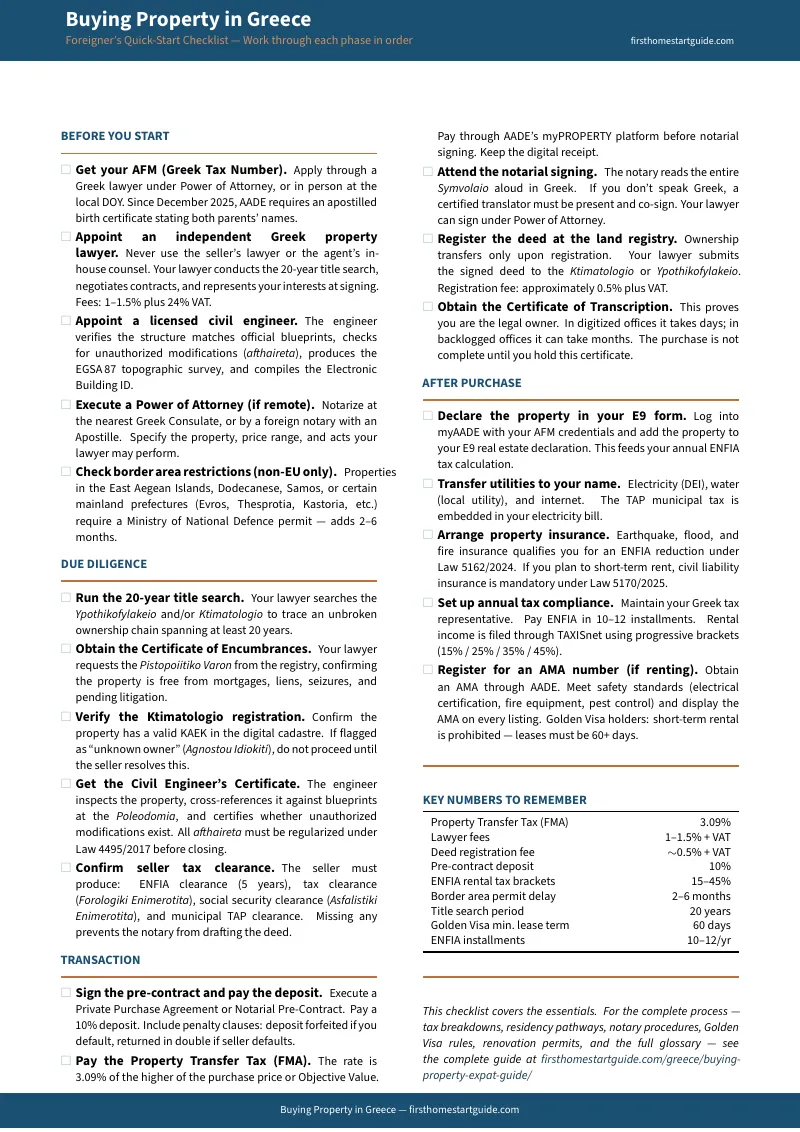
Download the free Quick Checklist to see the 20-item action plan covering AFM registration, border area verification, Ktimatologio checks, and the transaction timeline. When you're ready for the full Compliance Navigator — complete with Golden Visa tier analysis, civil engineer guidance, ENFIA tax calculations, rental income reform, and regional market intelligence — the complete guide is here.
You've found the property. Now navigate the system that stands between you and the keys.