
You Have Been Searching "Buying Property in Israel as a Foreigner" and Every Result Assumes You Already Understand the System That Will Take Your Money
You have saved enough for a down payment, found an apartment listing in Jerusalem or a coastal unit in Netanya, and started the research. Within a day you have learned three things that nobody warned you about. First, the purchase tax is not 1-2% like back home — it is 8% from the very first shekel, because the Israeli Tax Authority treats every non-resident as a multi-property investor. On a ₪5 million apartment, that is ₪400,000 in cash, payable within 60 days, and it cannot be rolled into your mortgage. Second, the mortgage will cover only 50% of the property value — not 75% or 80% like you expected — because the Bank of Israel caps non-residents at half. And third, 93% of the land in Israel is not actually for sale: it is state-owned and leased to you, and you need to verify whether your lease is the safe kind (capitalized, automatically renewed) or the dangerous kind (ongoing ground rent, manual renewal fees, and a ticking clock).
You search for help. Nefesh B'Nefesh publishes excellent Aliyah guides — written for people who are immigrating, not for foreign investors who want to keep living abroad. Boutique law firm blogs in Jerusalem explain Mas Rechisha in isolation without mentioning the retroactive Aliyah loophole that could save you hundreds of thousands of shekels. An Anglo-Israeli Facebook group tells you the process is "straightforward with a good lawyer" — but nobody explains that your CPI-linked mortgage principal can grow faster than you pay it down, that the beautiful Talbiya apartment at a 30% discount sits on Greek Orthodox Church land with a lease expiring in 2051, or that the "20/80" off-plan payment deal indexes your unpaid balance to construction material costs so the final price is not known when you sign the contract.
Here is the problem no free resource solves: Israel layers a bifurcated land registry (Tabu vs Minhal), a purchase tax system that penalizes every foreigner from the first shekel, a mortgage architecture built from multiple indexed tracks instead of a single loan, AML regulations that routinely block international wire transfers for weeks, and a construction pricing index that can inflate off-plan apartments by hundreds of thousands of shekels — and no single English-language source explains how these systems interact or how a foreign buyer navigates them as one connected process.
The Buying Property in Israel — Expat Guide is The Foreign Buyer's Operating Manual. Not a Nefesh B'Nefesh integration guide, not a law firm's promotional blog post, not a real estate agency's lead-capture landing page. It is a structured system that decodes every mechanism in the Israeli property transaction — from verifying your land rights at the Tabu through the Mas Rechisha calculation, the He'arat Azhara fraud protection, and the mortgage track architecture — so you make each decision understanding the legal structure behind it, the cash requirement attached to it, and the financial consequence of getting it wrong.
What's Inside The Foreign Buyer's Operating Manual
The complete guide, 10 standalone printable tools, and a quick-start checklist — 12 PDFs total — covering every stage from buyer classification through post-purchase tax setup. The standalone worksheets, reference cards, and checklists are designed to print and bring to attorney meetings, bank appointments, and property viewings:
The Land Ownership Decoder — Tabu vs Minhal vs Church Land
Only 7% of Israeli land is privately owned and registered in the Tabu (Land Registry Bureau) — the gold standard of freehold ownership. The remaining 93% is state-owned, administered by the Israel Land Authority (Minhal), and leased for 49 or 99 years. The guide explains the critical difference between capitalized (Mehuvan) leases — which renew automatically at no cost, making them functionally identical to freehold — and uncapitalized leases that carry ongoing ground rent and substantial renewal fees you may not discover until years after purchase. It covers the Chevra Meshakenet interim registry for new builds. And it maps the Greek Orthodox Church land crisis in Jerusalem: 99-year leases signed in the 1950s expiring between 2051 and 2052 in Rehavia, Talbiya, Nayot, Baka, and Abu Tor — apartments trading at 30-35% below comparable Tabu properties because banks refuse to mortgage them and the renewal terms remain legally unresolved. That "bargain" listing in Talbiya is a rapidly depreciating leasehold with a toxic expiration date.
The Mas Rechisha Calculator — Foreign vs Resident vs Oleh Rates
Foreign non-residents pay 8% on values up to approximately ₪6.05 million and 10% above that threshold — from the first shekel, with no tax-free bracket. An Israeli resident buying their sole home pays 0% on the first ₪1.97 million. New immigrants (Olim Chadashim) pay 0-0.5%. The guide models exact tax liabilities at ₪3M, ₪5M, and ₪8M purchase prices across all three buyer profiles, showing the cash delta. Then it explains the retroactive Aliyah loophole: buy now at the 8% foreign rate, make Aliyah within two years of the purchase date, and petition to reclaim the difference. On a ₪5M apartment, the refund exceeds ₪375,000. This chapter turns the most devastating cost into a strategic planning tool for diaspora Jews considering future immigration.
The 7-Step Purchase Process — From Title Search to Tabu Registration
The complete chronological workflow: starting with the Pinkas check for liens, illegal building additions, and permit compliance. Then trust account setup and AML source-of-funds clearance (which takes 30-60 days and must begin weeks before you sign). Why you must refuse the Zichron Devarim — the informal binding memorandum that agents push as a "standard" preliminary agreement but that creates enforceable obligations without the protections of a formal contract. Contract execution (Choze Mecher) and immediate registration of the He'arat Azhara (Warning Note) in the Tabu — your primary state-backed fraud protection in a country where title insurance does not exist. The 60-day Mas Rechisha payment deadline and the penalties for missing it. Each step explained with the exact Hebrew legal terms you will encounter so you recognize them when they appear in contracts and correspondence.
Non-Resident Mortgage Architecture
The Bank of Israel caps foreign borrowers at 50% LTV — calculated on the lower of the purchase price or the bank's independent appraisal. If you contract a property at ₪3M but the appraiser values it at ₪2.8M, the bank lends 50% of ₪2.8M, and you cover the entire gap. The total capital requirement worked out: a ₪4M property requires ₪2,320,000 in liquid capital for a foreign buyer (50% equity + 8% Mas Rechisha + closing costs) compared to ₪1,110,000 for a local resident. The guide then breaks down the mortgage track system: CPI-linked (Madad) tracks where your principal grows with inflation even as you make payments, Prime-linked variable tracks that spike when the central bank raises rates, unlinked fixed tracks with severe early repayment penalties, and foreign currency tracks with exchange rate risk. Stress-testing scenarios at +1.5% rate increase and +2% higher inflation show the exact monthly payment impact.
The Off-Plan Trap — 20/80 Deals and the Construction Input Index
Developers market "20/80" payment plans as ideal for cash-flow management — pay 20% now, 80% at delivery three to four years later. The hidden mechanism is the Construction Input Index (Madad Tesumot Habniya), which links your unpaid balance to the cost of steel, cement, energy, and construction labor. During post-COVID supply chain disruptions, this index rose over 5% annually, inflating final balances by hundreds of thousands of shekels. The 2022 Sales Law amendment introduced a 40% statutory linkage cap — but contract specifics vary widely and older templates may not comply. The guide explains how to audit developer contracts for index compliance, calculate your maximum exposure under different inflation scenarios, and evaluate whether the deferred payment advantage is worth the price uncertainty.
Cross-Border Capital Mechanics — AML, Wire Transfers, and FX Brokers
Israeli banks operate under extreme regulatory scrutiny: when you wire hundreds of thousands of dollars to close a property, the receiving bank will frequently block, delay, or reject the transfer while demanding exhaustive source-of-funds documentation — 12 months of bank statements, translated tax returns, apostilled inheritance records. Standard bank-to-bank transfers take up to five business days, and a single irregularity bounces the funds back to your home country. Meanwhile your 60-day Mas Rechisha deadline is ticking. The guide explains how to set up a dedicated FX broker account (like IsraTransfer) 4-6 weeks before contract signing to pre-clear compliance, execute currency conversions at institutional wholesale rates instead of punishing retail bank spreads, and land the converted shekels in the lawyer's trust account within 48 hours — bypassing the retail bank bottleneck entirely.
Transaction Costs, Ongoing Taxes, and Carrying Costs
The 3-7% in ancillary costs beyond the purchase price: legal representation (0.5-1.5% + VAT), brokerage commissions (1.5-2% + VAT), mortgage arrangement fees, FX conversion costs, Tabu registration fees, and VAT at 18% on professional services and new construction. Arnona (municipal property tax) calculated per square metre and owed whether the property is occupied or vacant — a constant drain for pied-à-terre owners. The 70-90% Arnona discount for Olim Chadashim and the strict activation window. Three rental income tax tracks (exemption under ₪5,654/month, 10% flat rate, or marginal with deductions). Capital gains tax (Mas Shevach) at 25% on inflation-adjusted gains. The full carrying cost picture so you budget for ownership, not just acquisition.
Who This Guide Is For
This guide is for foreign buyers and expats purchasing property in Israel who:
- Are buying their first Israeli property and need the entire transaction mapped — from land registry verification through contract execution, He'arat Azhara registration, Mas Rechisha payment, mortgage structuring, and Tabu transfer — so they understand what happens at each stage, what it costs in cash, and what can go wrong
- Are American, British, Canadian, Australian, or South African and assume fee-simple ownership, fixed-rate mortgages, and title insurance exist in Israel — and need to learn that none of them do before they discover the 50% LTV cap, the CPI-linked mortgage that inflates their debt, and the 8% purchase tax from the first shekel
- Are diaspora Jews planning Aliyah in the next 2-3 years who want to buy now at market prices and retroactively claim the Oleh Chadash tax rate after immigration — a strategy that can recover over ₪375,000 on a ₪5M property but requires precise timing and documentation
- Have been shown a new-build "20/80" payment plan and want to understand the Construction Input Index exposure, the statutory linkage cap, and how to audit the developer contract before signing
- Are executing the transaction remotely via Power of Attorney and need to understand AML compliance timelines, FX broker setup, trust account mechanics, and the He'arat Azhara that protects them from fraud while they are thousands of kilometres away
- Want every tax bracket, every closing cost, every legal mechanism, and every Hebrew legal term in one document — so they walk into attorney meetings, bank appointments, and property viewings with the same structural understanding as a local buyer, not the surface-level confidence of someone who read a Nefesh B'Nefesh forum thread
Why Not Free Resources?
Free information on buying property in Israel as a foreigner exists. Here is what each source actually delivers:
- Nefesh B'Nefesh maintains the most comprehensive English-language resource on Israeli property — for people who are making Aliyah. Their guides focus on the Oleh Chadash experience: subsidized benefits, tax exemptions, integration support. If you are buying as a foreign investor who plans to remain abroad, their framework does not apply to your tax situation, your LTV cap, or your AML compliance requirements. Excellent for immigrants. Not designed for the foreign buyer persona.
- Israeli law firm blogs (Barnea Jaffa Lande, S. Horowitz, Goldfarb Gross Seligman) publish legally precise articles — each covering a single slice of the process. One explains Mas Rechisha without the retroactive Aliyah loophole. Another describes the Tabu without warning about Church land. None connect the tax calculation to the mortgage requirement to the AML timeline to the total cash demand. They are accurate pieces of a puzzle without the picture on the box.
- Anglo-Israeli Facebook groups and forums contain real stories from real buyers — alongside advice from 2023 that predates the 2024 TAMA 38 termination and the latest Mas Rechisha bracket indexation. Someone tells you the process was "smooth" with their lawyer. Someone else lost three weeks to a blocked wire transfer. Both experiences are real. Neither explains the mechanism that determines which outcome you will get.
- Real estate agency websites (Anglo-Saxon, RE/MAX Israel, Home in Israel) offer English-language landing pages designed to capture leads and generate viewings, not to explain CPI-linked mortgage mechanics, the Construction Input Index, or the Church land expiration crisis. Their incentive is to get you into the funnel, not to help you evaluate whether a specific property is a sound purchase.
This guide fills the structural gap — the space between knowing that Israel has a purchase tax and understanding exactly how that tax interacts with your mortgage cap, your AML timeline, your closing costs, and your total cash requirement. It is the analysis an independent advisor with no commissions to earn, no listings to promote, and no Aliyah agenda would give you — structured as a permanent reference you own.
— Less Than One Hour of an Israeli Real Estate Attorney's Time
An Israeli real estate attorney charges ₪10,000-25,000 per transaction. The Mas Rechisha on a ₪5M property is ₪400,000. The FX spread on a $1 million wire through a retail bank costs $15,000-30,000 more than an institutional broker rate. A single purchase on Church land with an unresolved 2051 lease expiration can erase 30-35% of the property's market value overnight.
This guide does not replace your attorney or your mortgage advisor. But it gives you the land registry verification framework, the tax calculation across all buyer profiles, the mortgage track comparison, the AML compliance timeline, and the off-plan contract audit that ensure you walk into every meeting, every viewing, and every contract signing understanding the mechanism behind each step — instead of discovering how Israeli property law works by losing money to it.
If it catches a single Church land risk before you sign, identifies the retroactive Aliyah loophole that saves you ₪375,000, or prevents a blocked wire transfer from blowing your Mas Rechisha deadline, it pays for itself before you have finished reading it.
Money-back guarantee, no time limit. If the guide does not make the Israeli property transaction clearer and your financial position stronger, you pay nothing.
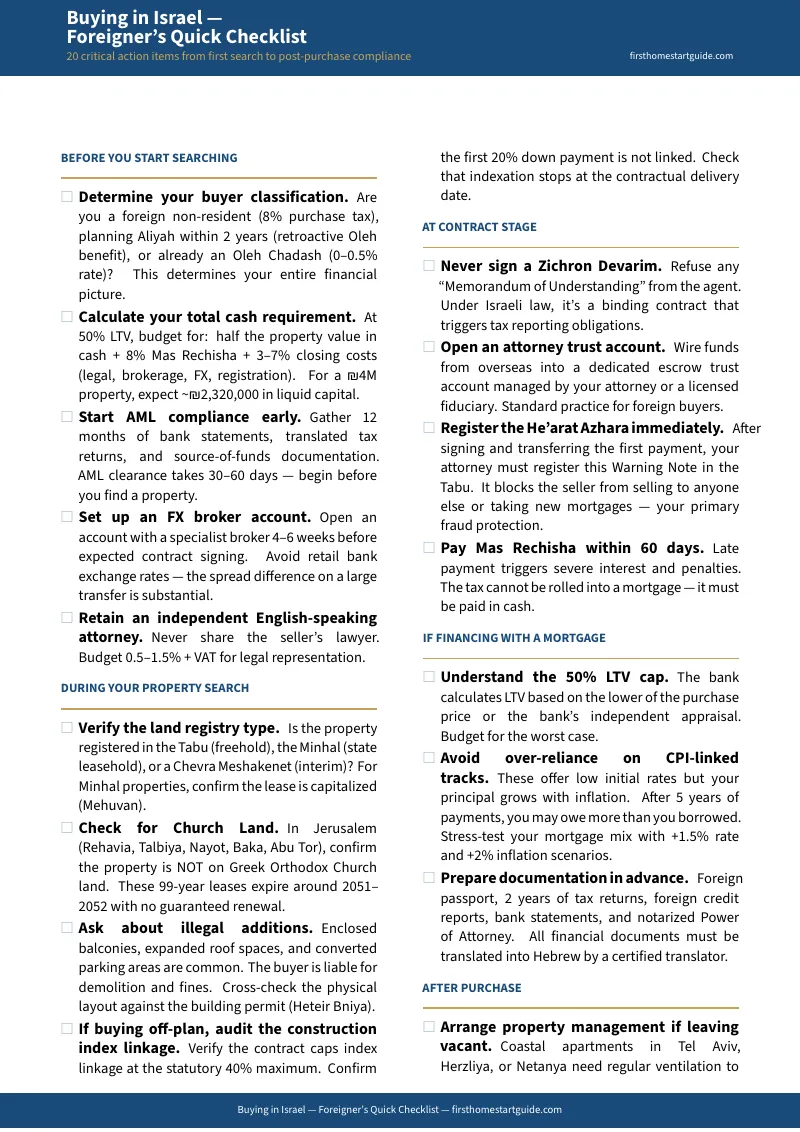
Download the free Quick Checklist to see the 20-item step-by-step action plan covering buyer classification, cash requirement calculation, AML compliance, land registry verification, and the He'arat Azhara registration timeline. When you are ready for the full Foreign Buyer's Operating Manual — the complete guide plus 10 standalone printable tools including the Mas Rechisha reference card, capital requirement worksheet, mortgage track comparison, purchase process tracker, AML document checklist, transaction cost estimator, property due diligence checklist, off-plan contract audit, Aliyah tax timeline, and location profiles reference — the complete toolkit is here.
You have found the property. Now decode the system that stands between you and the keys.
Frequently Asked Questions
What if the rules change after I buy?
We update the guide when the rules change. Email us any time, even years later, and we'll send you the current edition free.