
You Found Your Dream Property in Italy. The Civil Law System Between You and the Keys Assumes You Already Know How It Works.
You've found a stone farmhouse in Puglia, a sun-lit apartment overlooking Lake Como, or a terraced house in a Sicilian hilltop village. You've checked the exchange rate, confirmed you can afford the asking price, and started picturing yourself on the terrace with an Aperol Spritz. Within a week you've learned that the notaio handling the transaction isn't your lawyer — they're a state-appointed public official whose legal duty is to the Italian Republic, not to you. The closing costs on a second home aren't 3-4% — they're 12% or more once you add the 9% registration tax, the agent's 3% commission plus 22% VAT, the notaio fee, and the independent lawyer you didn't know you needed. And the property you want to buy — the one that's perfectly registered in the Catasto — has an enclosed balcony that was never authorized by the municipality, which means the entire deed would be legally null and void the moment the notaio discovers it.
You search online for help. Gate-away.com publishes a "purchase process" page that walks you through the steps in polished English — written and maintained by a portal that earns listing fees from agents who want you to buy. Italian law firm websites publish technically precise articles on individual topics like the compromesso or the prima casa tax relief, but each article covers one concept in isolation, functions as an SEO lead-generation page for billable consultations, and never integrates the legal, financial, and immigration tracks into a single actionable sequence. Reddit and expat forums contain real stories from real buyers — alongside advice that pre-dates the 2026 short-term rental reforms, confuses the two types of deposit, and confidently states that buying property grants you a residence visa. It does not.
Here's the problem no free resource solves: Italy's property transaction runs on a civil law framework where the notaio is neutral, the dual compliance system can void your deed over an unauthorized internal wall, the type of deposit you pay determines whether you can force the sale or merely lose your money, the reciprocity rule can block your purchase entirely based on which US state you live in, and buying a EUR 2 million villa on the Amalfi Coast does not give you a visa or residence permit. The system has structural protections for buyers — transcription of the preliminary contract, the prezzo-valore tax mechanism, suspensive conditions — but only if you know they exist, understand their legal basis, and activate them before you sign. Miss one, and you're exposed.
The Buying Property in Italy — Expat Guide is The Civil Law Decoder. Not a lifestyle article about finding your dream trullo in Puglia. It's a structured decision system that decodes every stage of the Italian property purchase — from the Codice Fiscale through the proposta d'acquisto, the compromesso, the conformita urbanistica survey, and the rogito notarile — so you make each decision understanding the legal mechanism behind it, the Civil Code article that governs it, and the financial consequence of getting it wrong.
What's Inside The Civil Law Decoder
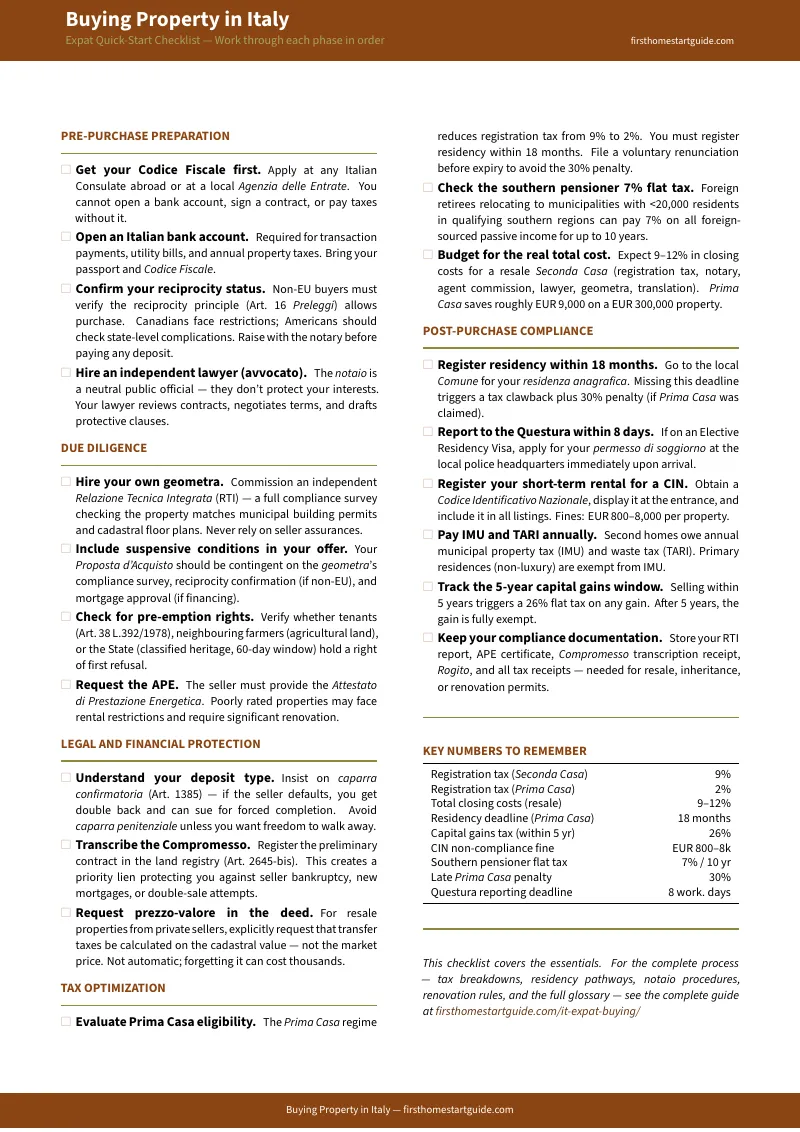
The complete guide plus 8 standalone printable tools — reference cards, worksheets, and a quick-start checklist covering every stage from obtaining your tax code through key collection, with the Italian legal terms, article numbers, tax rates, and deadlines that determine whether your transaction succeeds or collapses:
Conformita Urbanistica Decoder
The single most dangerous trap in Italian property buying, and the one that no portal or lifestyle guide explains properly. Italian law requires that a property's physical state matches two independent sets of records: the municipal building permits (conformita urbanistica) and the Catasto floor plans (conformita catastale). Here's what catches foreigners: the Catasto is a fiscal database, not a legal registry. A property can be perfectly registered there while containing severe, un-regularized building violations — enclosed balconies, moved internal walls, converted attics — that make the deed null and void. Since 2010, the notaio must cite building permits in the deed or the contract is invalid. The guide covers the full dual compliance system, the 2024 Decreto Salva Casa tolerance thresholds (2-6% depending on property size), the simplified regularization process under Article 36-bis, and how to hire an independent geometra to produce a Relazione Tecnica Integrata (RTI) before you sign anything binding. Cost of the survey: EUR 1,000-2,000. Cost of skipping it: the entire purchase price.
Deposit Shield — Caparra Confirmatoria vs. Penitenziale
When you sign the compromesso (preliminary contract), you pay a 10-20% deposit. The type of deposit you pay determines your entire legal position if the deal goes wrong — and most foreigners don't know there are two types. Under caparra confirmatoria (Art. 1385 of the Civil Code), if the seller defaults, you get double your deposit back and retain the right to sue for specific performance under Art. 2932, forcing the transfer of ownership through court. Under caparra penitenziale (Art. 1386), either party can walk away — you lose the deposit, or the seller returns double — and that's the end of it. No further claims, no forced sale. The guide explains which structure protects you, how to transcribe the compromesso in the land registry under Art. 2645-bis to create a priority lien against seller bankruptcy or double-sale, and how to clear the three categories of pre-emption rights (prelazione) that can unwind your purchase after closing — tenant, agricultural, and cultural heritage.
Prima Casa Tax Calculator
The difference between prima casa and seconda casa on a EUR 300,000 property is roughly EUR 9,000 in registration tax alone — 2% versus 9%, calculated on the cadastral value, not the market price. But qualifying requires strict compliance: you must register residency in the municipality within 18 months of the deed date, you cannot own another residential property in the same municipality, and if you already hold a prima casa property in Italy, you have 24 months to sell it. Miss the 18-month residency deadline and the Agenzia delle Entrate audits you for the full tax difference plus a 30% administrative penalty plus accrued interest. The guide includes a worked example using the prezzo-valore mechanism — where taxes are calculated on the cadastral value (rendita catastale x 1.05 x multiplier) rather than the market price — and a side-by-side comparison of private-seller versus developer purchases, including the 4%/10%/22% VAT tiers that apply to new builds.
The Notaio Playbook
The notaio is a self-employed professional who simultaneously serves as a public official appointed by the Ministry of Justice. Their involvement is legally mandatory under Article 1350 of the Civil Code. They verify ownership, check for liens and mortgages, confirm reciprocity for non-EU buyers, collect all transfer taxes, and register the deed in the public registries. What they do not do: negotiate terms, draft protective clauses for you, inspect the property, or advocate for your interests if a dispute arises. The guide explains why you need an independent avvocato (lawyer) in addition to the notaio, what the avvocato should review in the proposta d'acquisto and compromesso, how the Procura Speciale (Power of Attorney) works if you can't attend the rogito in person, and the typical fee structures — notaio fees on a sliding tariff scale (EUR 2,500-4,500 for a EUR 100,000-300,000 property, plus 22% VAT), plus 1-1.5% for legal counsel.
Reciprocity Navigator
Under Article 16 of the Preleggi (Preliminary Provisions to the Civil Code), a non-EU citizen can only buy property in Italy if Italian citizens enjoy equivalent rights in the buyer's home country. The notaio must verify this before executing the final deed — and if a transaction completes without confirmed reciprocity, the purchase is radically null and void. For most nationalities, reciprocity is established. But the United States presents a uniquely fragmented problem: because real estate law is regulated at the state level, states that restrict Italian citizens from buying agricultural or strategic land can trigger reciprocal blocks on American buyers in Italy. British buyers currently have reciprocity but face ongoing post-Brexit uncertainty. Canadians face significant residential restrictions in major municipal zones following Canada's 2023 non-resident purchase ban. Australian buyers are protected by the 1967 Bilateral Investment Treaty. The guide maps the reciprocity status for every major buyer nationality and explains how to clear this check during due diligence — not at the rogito, where a failure means forfeiting your deposit.
2026 Rental Compliance Guide
If you're planning to offset ownership costs through vacation rentals, the 2026 Budget Law (Legge di Bilancio) has fundamentally restructured the rules. The cedolare secca flat tax applies at 21% on your first property and 26% on a second. But the 2026 reform lowered the commercial activity threshold from five properties to three — meaning anyone renting out three or more short-term lets must register for a VAT number (Partita IVA), enroll in the INPS social security system, and maintain double-entry business accounting. Every property now requires a National Identification Code (CIN) displayed at the entrance and on all listings, with fines of EUR 800-8,000 for non-compliance. And effective May 20, 2026, EU Regulation 2024/1028 (DAC7) mandates that Airbnb, Booking.com, and Vrbo transmit booking and payment data directly to the Agenzia delle Entrate. The guide covers all three regulatory layers so you know the true tax burden before you buy.
Regional Buying Intelligence
Italy is not one market. The guide covers the regulatory quirks, price levels, and practical considerations for the regions where foreigners actually buy. Tuscany's cultural heritage protections and the State's 60-day pre-emption right on classified properties. Puglia's agricultural pre-emption rights that give neighboring farmers first refusal on rural land, and the preservation orders on trulli that dictate traditional dry-stone construction methods. Sicily's 7% flat-tax incentive for foreign pensioners relocating to municipalities under 20,000 residents. Lake Como's landscape protection orders and condominium complexities in historic villa conversions. Plus the Amalfi Coast's UNESCO restrictions and what they mean for renovation timelines.
EUR 1 House Reality Check
The symbolic price is real. Everything else is expensive. The guide breaks down the mandatory commitments behind the headline: surety bonds of EUR 3,000-10,000 held by the municipality, detailed restoration plans due within 12 months, renovations that must be completed within 2-3 years under penalty of bond forfeiture and property reclamation, and the logistics of transporting building materials through narrow streets in remote mountain villages. A realistic financial model shows a minimum total outlay of EUR 80,000-130,000 — and compares this to a move-in-ready resale apartment in a nearby provincial town at EUR 100,000-135,000 that's habitable within days. The EUR 1 house can make sense as a long-term project in a specific community. It rarely makes sense as a financial investment.
Who This Guide Is For
This guide is for foreign buyers and expats purchasing property in Italy who:
- Are buying their first Italian property and need the entire transaction mapped — from the Codice Fiscale through the proposta d'acquisto, the compromesso, the conformita urbanistica survey, and the rogito notarile — so they understand what happens at each stage, what it costs, and what can go wrong
- Have found a property they want to make an offer on and need to know, before they sign anything, whether they pass the reciprocity check, how much closing costs will actually be, and which type of deposit protects their legal position
- Are American and need to verify that their home state doesn't restrict Italian citizens from buying land — because if it does, the notaio is legally barred from executing their deed in Italy
- Are British and need to understand how post-Brexit reclassification as non-EU nationals affects their purchase timeline and the ongoing reciprocity landscape
- Are Canadian and need to navigate the residential purchase restrictions triggered by Canada's 2023 non-resident buying ban, including the small-municipality exception and dual-citizenship exemptions
- Are buying for rental income and need to understand the 2026 cedolare secca tiers, the three-property commercial threshold, mandatory CIN registration, and DAC7 platform reporting before they commit to an investment property
- Want to know whether they can actually live in Italy after buying — and need the Elective Residency Visa requirements (EUR 31,000-32,000 passive income, registered deed, 8-day Questura reporting) explained alongside the transaction timeline
- Are considering a EUR 1 house and want the real financial model before committing to a surety bond, a 3-year renovation deadline, and a remote village with limited services
- Want every transaction cost, every legal deadline, every Civil Code article reference, and every procedural requirement in one document — so they walk into notaio appointments, geometra surveys, and contract signings with the same structural understanding as an Italian buyer
Why Not Free Resources?
Free information on buying property in Italy as a foreigner is abundant. Here's what each source actually delivers:
- Gate-away.com publishes a detailed "Purchase Process" page and a series of buying guides written in clear English — maintained by a property portal that earns listing fees from agents who pay to reach international buyers. The guides cover the transaction steps at a high level and explain transfer taxes. What they don't cover: the difference between conformita urbanistica and conformita catastale, the dual compliance system that can void your deed, the reciprocity complications for Americans by state, or the 2026 short-term rental reforms that changed the commercial activity threshold. The information is real. The structural risks that cost buyers real money are systematically absent.
- Italian law firm websites (Studio Legale Metta, Mazzeschi, Arnone & Sicomo) publish technically precise articles on individual topics — prima casa tax relief, the reciprocity rule, the Elective Residency Visa. Each article is accurate in isolation and functions as an SEO lead-generation tool for billable consultations at EUR 200-400 per hour. What they don't provide: a single integrated roadmap that connects the legal, financial, tax, immigration, and compliance tracks into one cohesive sequence. You get fragments of expertise designed to demonstrate competence, not to replace it.
- Reddit and expat forums (r/expats, r/italy, Facebook buying groups) contain genuine experiences from foreign buyers — alongside confidently stated advice that confuses caparra confirmatoria with caparra penitenziale, claims that buying property grants residency rights, and recommends skipping the geometra survey because "the notaio handles everything." You'll find someone who closed smoothly and someone who lost their deposit over an unauthorized veranda. Both stories are true. Neither tells you which outcome applies to your property.
- Buyer's agents and relocation services offer professional representation — for fees starting at EUR 2,000-5,000 plus a percentage of the purchase price. The good ones navigate the system expertly. But their pitch begins with "the process is too complicated to do alone" — which is true only if you don't understand the process. Understanding the process is what this guide provides.
This guide fills the structural gap — the space between knowing that Italy has a notaio system and understanding exactly how that system works at each stage, what the Civil Code says, what the geometra checks, what your deposit structure means for your legal exposure, and what happens to your money when you miss a deadline. It's the analysis an independent advisor with no commission to earn would give you, structured as a permanent reference you own.
— Less Than One Hour of an Italian Lawyer's Time
An independent avvocato charges EUR 2,500-5,000 for legal due diligence on a single transaction. A notaio's fees on a EUR 300,000 property run EUR 4,500-5,500 including VAT. The 10-20% deposit you're protecting in the compromesso is EUR 30,000-60,000. A single conformita urbanistica violation you didn't catch can make your deed null and void.
This guide doesn't replace your notaio or your avvocato. But it gives you the dual compliance decoder, the deposit structure strategy, the prima casa tax calculator, the reciprocity analysis, and the transaction timeline that ensure you walk into every appointment, every viewing, and every contract signing understanding the mechanism behind each step — instead of discovering how Italian civil law works by losing money to it.
If it prevents a single deposit forfeiture from the wrong caparra type, catches a single conformita violation before you sign the compromesso, or identifies the prima casa qualification that saves you EUR 9,000 in registration tax, it pays for itself before you've finished reading it.
Money-back guarantee, no time limit. If the guide doesn't make the Italian property transaction clearer and your financial position stronger, you pay nothing.
Download the free Quick Checklist to see the step-by-step action plan covering reciprocity verification, conformita urbanistica checks, deposit structure, prima casa qualification, and the compromesso-to-rogito timeline. When you're ready for the full Civil Law Decoder — complete with the dual compliance system, prezzo-valore tax calculator, notaio playbook, rental compliance guide, and regional buying intelligence — the complete guide is here.
You've found the property. Now decode the civil law system that stands between you and the keys.