
You Found a Tokyo Apartment You Can Afford. The Depreciation Schedule, Seismic Code, and Mortgage System Between You and the Keys Assume You Already Know How They Work.
You've found a well-maintained 2LDK in Setagaya, a modern 1LDK near Shibuya station, or a surprisingly affordable family home listed on Suumo. You've checked the yen exchange rate, confirmed your budget covers the asking price, and started imagining weekend walks along the Meguro River. Within a week you've discovered that Japanese buildings are classified as rapidly depreciating consumer goods — a wooden house reaches zero paper value in 22 years, a concrete apartment in 47 — and the bank won't issue a mortgage against a structure that's exceeded its statutory life. You don't have Permanent Residency, so the handful of banks that will consider your application want 20-40% down plus income proof of at least ¥5 million annually, and one requires your Japanese spouse to act as guarantor. And the affordable older apartment you found in Bunkyo was built before June 1981, which means it fails the seismic standard that governs mortgage eligibility, insurance premiums, and your access to 13 years of housing loan tax deductions worth 0.7% of your outstanding balance per year.
You search online for help. Real Estate Japan publishes process guides in polished English — written and maintained by a listing portal that earns revenue from partner brokerages who want you to buy. Japanese law firm websites publish technically precise articles on withholding tax or leasehold structures, but each covers one topic in isolation, functions as a lead-generation page for billable consultations, and never connects the financing, seismic, depreciation, and tax tracks into a single actionable sequence. Reddit's r/JapanFinance contains genuine experiences from expats who navigated SMBC Prestia pre-approvals and Suruga Bank workarounds — alongside advice that confuses old-law and new-law leasehold regimes, recommends skipping the judicial scrivener, and confidently states that akiya houses cost ¥1 million all-in. They do not.
Here's the problem no free resource solves: Japan's property system runs on structural assumptions that directly contradict Western real estate logic. Buildings depreciate to zero on paper while the land beneath them appreciates. Mortgage access is governed by your visa status, not your income alone. An apartment's construction date determines not just safety but your eligibility for tax deductions, insurance rates, and bank financing. The type of land rights you're buying — freehold versus two competing leasehold regimes — determines whether you can resell without landowner permission or face demolition at your own expense when the lease expires. And the ¥1 million akiya that went viral on YouTube requires ¥600,000 in mandatory closing costs before you assess the structure, plus ¥2-10 million in seismic retrofitting to make it habitable. The system has real protections — the Explanation of Important Matters, the deposit penalty structure, the Housing Loan Tax Deduction — but only if you know they exist, understand the eligibility rules, and verify compliance before you sign.
The Buying Property in Japan — Expat Guide is The Depreciation Decoder. Not a lifestyle article about finding cheap houses in the countryside. It's a structured decision system that decodes every stage of the Japanese property purchase — from visa-tier financing and seismic code verification through the deposit structure, the judicial scrivener process, and post-purchase FEFTA compliance — so you make each decision understanding the regulatory mechanism behind it, the statutory life that governs it, and the financial consequence of getting it wrong.
What's Inside The Depreciation Decoder
The complete 16-chapter guide, a quick-start checklist, plus 8 standalone printable tools — covering every stage from visa assessment through post-purchase compliance, with the Japanese legal terms, statutory references, tax rates, and seismic thresholds that determine whether your purchase builds equity or traps capital:
Non-PR Mortgage Navigator
The single biggest barrier for foreign buyers in Japan isn't the law — it's the bank. Permanent Residency unlocks zero-down, low-rate mortgages across the entire banking sector. Without PR, you're restricted to a handful of institutions with radically different underwriting requirements. SMBC Trust Bank (PRESTIA) offers English support and works with non-PR holders but typically demands ¥5-10 million income and 20% down. SBI Shinsei Bank requires your spouse to be a Japanese citizen or PR holder to act as guarantor. Suruga Bank offers the most flexible visa requirements but penalizes you with significantly higher variable interest rates. Tokyo Star Bank requires 20-50% down without PR. The guide maps every institution's current criteria — income thresholds, down payment ranges, employment tenure requirements, guarantor rules — so you know which bank matches your visa status, marital situation, and capital position before you waste months on applications that were structurally impossible from the start. A non-PR buyer targeting a ¥50 million Tokyo apartment needs approximately ¥15 million in liquid capital just to execute the transaction.
Seismic Code Decoder — Kyu-taishin vs. Shin-taishin vs. 2000-nen Kijun
Japan's building codes are demarcated by three construction eras, and knowing which era your target property falls into determines your safety, your financing options, and your tax deductions for the next 13 years. Pre-June 1981 (kyu-taishin): designed only to prevent collapse in mid-level earthquakes, with a 28% catastrophic collapse rate in major quakes. Post-June 1981 (shin-taishin): requires survival in severe earthquakes (JMA intensity 6-7), collapse rate drops to 9%. Post-2000 (2000-nen kijun): enhanced foundation and joint specifications, collapse rate approximately 2%. Here's what catches foreign buyers late in the process: a kyu-taishin property is generally ineligible for the Housing Loan Tax Deduction — 0.7% of your outstanding loan balance deducted directly from income tax for up to 13 years — and domestic banks are exceptionally reluctant to issue mortgages against pre-1981 structures. The guide explains exactly how to verify construction era from the building confirmation certificate, what the financial penalty is for each era, and why a ¥5 million discount on a pre-1981 apartment may cost you ¥3 million in lost tax deductions alone.
Depreciation Tax Shield Calculator
Most foreigners see building depreciation as a negative. High-income expatriates and investors use it as one of the most powerful legal tax optimization tools available in Japan. The National Tax Agency assigns a statutory useful life to every structure based on construction material: 22 years for wood, 47 years for reinforced concrete. When you purchase a building that has already exceeded its statutory life, you can depreciate the entire remaining structure value over just 20% of the original lifespan — meaning a 23-year-old wooden investment property can be written off in 4 years. These paper losses legally offset your primary salary income, dramatically reducing your overall tax bill. The guide includes worked examples showing exactly how a ¥15 million wooden structure purchased by someone earning ¥12 million annually generates millions in annual tax deductions — and explains why sophisticated investors actively seek older wooden structures specifically for this arbitrage, not despite the depreciation but because of it.
Leasehold Trap Detector — Old Law vs. New Law
Properties on Japanese real estate portals sometimes appear 20-40% below comparable market value. The reason: they're leasehold. You own the building but lease the land from a separate owner — often a temple, a wealthy family, or a corporation. What most foreigners don't realize is that Japan has two completely different leasehold regimes operating simultaneously. Old Law leaseholds (pre-1992) renew almost automatically and trade at near-freehold premiums. New Law leaseholds come in two sub-types: Ordinary leases (30-year initial term, renewable) and Fixed-Term leases (non-renewable — when the lease expires, you demolish the building at your own expense and return vacant land). The guide covers how to identify leasehold properties on portals (look for 借地権), the monthly land rent obligations on top of maintenance fees, the landowner consent and transfer fees required for resale, and why banks severely discount the collateral value of leasehold properties with diminishing terms.
Akiya Reality Check
The ¥1 million house is real. Everything after the sticker price is expensive. Following the July 2024 legislative amendment, real estate agents can now charge a flat maximum of ¥330,000 on any property priced at ¥8 million or less — meaning the agent fee alone adds 33% to a ¥1 million akiya. Add the judicial scrivener's flat fee (¥80,000-200,000), registration tax, stamp duty, and real estate acquisition tax, and mandatory closing costs approach ¥600,000 — a 60% overhead before you assess the physical structure. The vast majority of deeply discounted akiya were built under pre-1981 seismic codes and suffer from termite damage, foundation failure, rot, and zero thermal insulation. Bringing one to habitable modern standards requires ¥2-10 million in immediate capital. The guide provides a complete cost breakdown and compares the true all-in cost of an akiya renovation against purchasing a move-in-ready property at a higher sticker price.
Transaction Cost Mapper
Japanese property transactions carry 6-8% in closing costs beyond the purchase price. The guide breaks down every component: the standard 3% + ¥60,000 agent commission (and the 2024 amendment that changed the rules for properties under ¥8 million), the judicial scrivener (shiho-shoshi) fee for title transfer at the Legal Affairs Bureau, registration and license tax (0.4-2%), stamp duty based on contract price, the delayed real estate acquisition tax bill that arrives 3-6 months after closing (3-4% of assessed value), and the prorated fixed asset tax plus city planning tax for the remainder of the acquisition year. For investment properties held by non-residents, it covers the 20.42% withholding on rental income and the requirement to appoint a domestic tax agent.
2026 Reform Compliance Guide
Japan's property ownership rules are actively evolving. The 2024 mandatory address registration reform means failing to update the property registry within two years of an address change now triggers a ¥50,000 penalty — and the government now has authority to update registrations proactively from residence records. The July 2024 brokerage fee amendment restructured agent compensation for low-value properties. The Akiya Special Measures Act amendments strengthened municipal power to designate and tax neglected vacant properties at six times the standard rate. The guide covers all current reforms so your compliance obligations are clear from day one.
Who This Guide Is For
This guide is for foreign buyers and expats purchasing property in Japan who:
- Are living in Japan on a work visa, spouse visa, or other residency authorization and want to transition from renting to ownership — but need the non-PR mortgage landscape mapped bank by bank before committing capital
- Have found a property on Suumo, Athome, or Real Estate Japan and need to know, before they sign anything, whether the construction date qualifies for financing and tax deductions, whether the land rights are freehold or leasehold, and what the true all-in cost will be
- Are overseas investors evaluating Tokyo condominiums or yield-generating properties and need the cross-border tax structure — including the 20.42% withholding on non-resident rental income, FEFTA reporting requirements, and the depreciation tax shield mechanics — explained in one place
- Have been drawn in by akiya videos and want the unfiltered financial reality — the 60% closing cost overhead, the seismic retrofitting budget, and the rebuilding restrictions that can render land permanently unusable — before committing to a rural renovation project
- Are high-income expatriates interested in using accelerated depreciation on older wooden structures as a tax optimization strategy and need the statutory useful life calculations, the 20% accelerated timeline for fully depreciated buildings, and the worked tax offset examples
- Want every transaction cost, every seismic threshold, every leasehold regime distinction, every FEFTA deadline, and every bank's non-PR lending criteria in one document — so they enter agent meetings, bank appointments, and contract signings with the same structural understanding as a Japanese buyer working with a domestic advisor
Why Not Free Resources?
Free information on buying property in Japan as a foreigner is abundant. Here's what each source actually delivers:
- Real Estate Japan and English listing portals publish detailed buying guides in clear English — maintained by portals that earn revenue from partner brokerages who pay for qualified buyer leads. The guides cover the transaction steps at a high level and explain basic costs. What they systematically soften: the devastating hidden costs of akiya renovations, the severe restrictions on non-PR mortgage access, the seismic code eras that determine financing eligibility, and the two competing leasehold regimes that can trap your capital. The information is real. The structural risks that cost foreign buyers real money are consistently understated.
- r/JapanFinance and r/japanlife contain the highest-quality ground-truth data available anywhere online — branch-level experiences with SMBC Prestia applications, mathematical breakdowns of depreciation tax strategies, and blunt assessments of akiya renovation costs. The problem: this intelligence is scattered across thousands of chronologically decaying threads. Extracting a cohesive purchasing strategy requires hours of cross-referencing contradictory anecdotal evidence from anonymous accounts with varying levels of expertise and currency.
- Japanese law firms and international tax advisors publish technically precise articles on individual topics — withholding tax, FEFTA compliance, leasehold structures. Each article is accurate in isolation and functions as an SEO entry point for retainer-based consulting at premium hourly rates. What they don't provide: a single integrated roadmap that connects the financing, seismic, depreciation, legal, and compliance tracks into one coherent decision sequence.
- YouTube dominates the top-of-funnel awareness phase, particularly for akiya. Content heavily skews toward romanticized "cheap house renovation" narratives that generate massive engagement. What's consistently omitted: the ¥600,000 in mandatory closing costs on a ¥1 million property, the pre-1981 seismic vulnerabilities, the ¥2-10 million in structural renovations required for habitability, and the rebuilding restrictions that can make your land permanently unusable.
This guide fills the structural gap — the space between knowing that foreigners can buy property in Japan and understanding exactly how the depreciation schedule, seismic code system, visa-tier financing, leasehold regimes, and transaction cost structure actually work at each stage of the purchase. It's the analysis an independent advisor with no commission to earn would give you, structured as a permanent reference you own.
— Less Than One Meeting With a Bilingual Buyer's Agent
A bilingual buyer's agent charges a 3% commission plus ¥60,000 on every transaction. A judicial scrivener's flat fee runs ¥80,000-200,000. The down payment you're committing without PR is ¥10-20 million on a standard Tokyo apartment. A single pre-1981 property that you didn't screen for seismic code compliance can cost you 13 years of housing loan tax deductions.
This guide doesn't replace your agent or your judicial scrivener. But it gives you the non-PR mortgage navigator, the seismic code decoder, the depreciation tax shield calculator, the leasehold trap detector, and the transaction cost mapper that ensure you walk into every bank appointment, every property viewing, and every contract signing understanding the mechanism behind each step — instead of discovering how Japanese property law works by losing capital to it.
If it prevents a single rejected mortgage application from approaching the wrong bank for your visa status, catches a single pre-1981 property before you commit capital, or identifies the depreciation strategy that offsets millions in taxable income, it pays for itself before you've finished reading it.
Money-back guarantee, no time limit. If the guide doesn't make the Japanese property transaction clearer and your financial position stronger, you pay nothing.
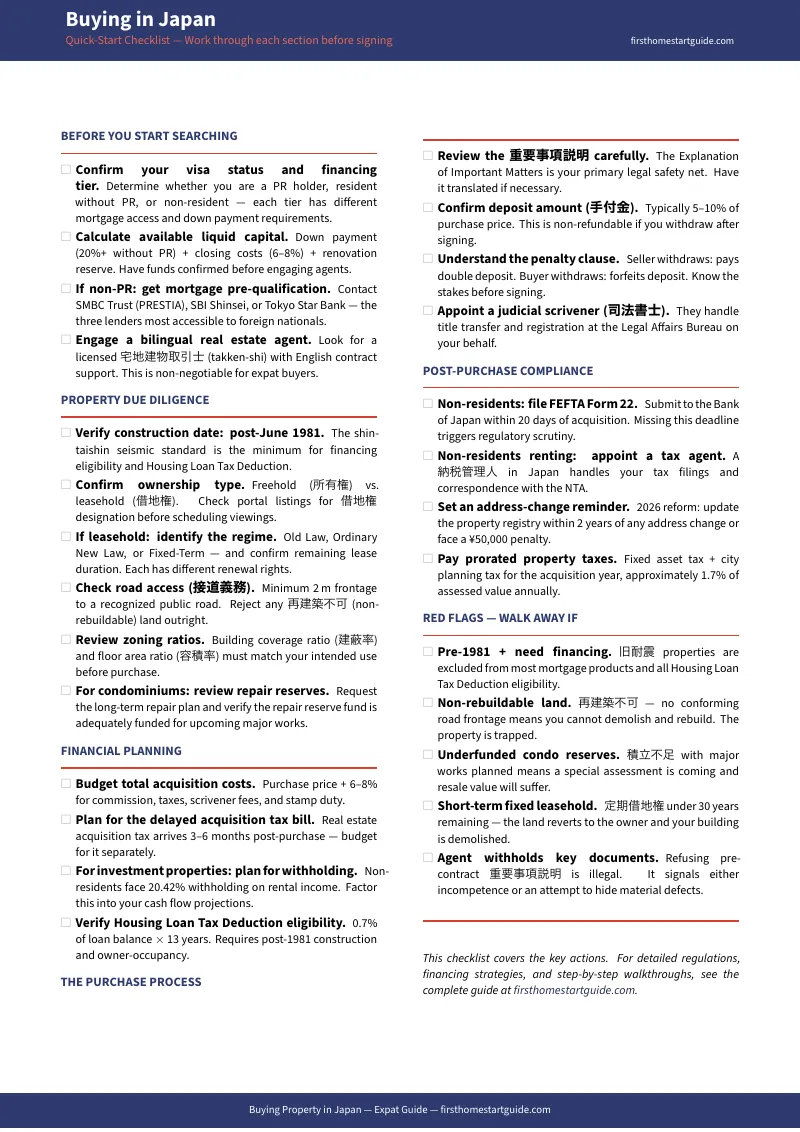
Download the free Quick Checklist to see the step-by-step action plan covering visa-tier financing, seismic code verification, leasehold identification, road access compliance, and the deposit-to-registration timeline. When you're ready for the full Depreciation Decoder — complete with the non-PR mortgage navigator, seismic code decoder, depreciation tax shield calculator, akiya reality check, and 2026 reform compliance guide — the complete guide is here.
You've found the property. Now decode the system that stands between you and the keys.