
You Can Own Freehold Property in Malaysia. But Every State Has Different Rules, and the One You Don't Check Is the One That Traps Your Money.
You've found a high-floor condo in Mont Kiara with a pool deck overlooking KL's skyline, or a sea-view apartment in Penang, or a gated-community terrace in Johor twenty minutes from Singapore. You've checked the price against your home market and realized your money goes three to five times further. You've started imagining the life — the food, the weather, the cost of living that makes early retirement actually work. Then you discover that the RM 1,000,000 minimum purchase rule you read about online isn't a national rule at all. It's a state-by-state patchwork. Selangor requires RM 2,000,000 — and completely bans foreigners from buying standard landed homes. Penang Island charges a 3% state levy on top of the flat 8% stamp duty. Johor waives minimums in Medini, but only for primary sales from developers — buy in the sub-sale market and the standard threshold slams back into place.
You search online for help. PropertyGuru and iProperty publish polished buying guides — written and maintained by listing portals that earn advertising fees from developers who want you to buy their new launches. Malaysian law firm websites publish technically precise articles on the National Land Code and State Authority Consent, but each covers one concept in isolation, functions as an SEO funnel for billable consultations, and never integrates the legal, financial, tax, residency, and compliance tracks into one actionable sequence. Reddit threads in r/malaysia contain genuine stories from expat buyers — alongside advice that confuses Deed of Assignment with Memorandum of Transfer, claims that the old 4% stamp duty still applies, and confidently recommends properties still sitting under Master Title as "normal" purchases.
Here's what no free resource solves: Malaysia's property system runs on a federal-state split where thirteen states and three federal territories each set their own minimum purchase prices, their own property type restrictions, and their own consent fees. The mandatory State Authority Consent process under Section 433B of the National Land Code freezes your transaction for three to six months — no further payments can be released until the state approves. A property still under the developer's Master Title can't be transferred by standard Memorandum of Transfer, can't be refinanced by most banks, and leaves your ownership documented only by a contractual Deed of Assignment that depends on the developer's continued existence. A "released" Bumiputera lot retains its Bumi designation permanently, creating a resale bottleneck that most agents never mention. And the flat 8% stamp duty introduced in January 2026 roughly triples the transfer tax that Malaysian citizens pay on the same property. Every one of these risks is navigable — but only if you know the mechanism, the legislation, and the deadlines before you sign.
The Buying Property in Malaysia — Foreigner's Guide is The State-by-State Decoder. Not a lifestyle article about expat living in KL. It's a structured decision system that decodes every state threshold, every cost layer, every title risk, and every regulatory trap in the Malaysian property purchase — so you make each decision understanding the legal mechanism behind it, the specific section of the National Land Code that governs it, and the financial consequence of getting it wrong.
What's Inside The State-by-State Decoder
A 13-chapter guide, 8 standalone printable tools, and a quick-start checklist — 10 PDFs total — covering every stage from eligibility verification through post-purchase compliance, with the specific legislation, fee scales, and state-level variations that determine whether your transaction succeeds or collapses:
Complete State-by-State Threshold Map
All 13 states and 3 federal territories mapped with strata minimums, landed minimums, consent fees, and restrictions specific to foreign buyers. Selangor's complete ban on individual-title landed homes. Penang Island's 3% state levy stacked on top of the 8% stamp duty — on a RM 1,000,000 condo that's RM 110,000 in transfer taxes alone. Johor's Medini exemption that vanishes on sub-sale transactions. Sabah and Sarawak's separate land codes requiring State Cabinet and LCDA consent. Negeri Sembilan's customary adat lands that are permanently off-limits. The table covers every state so you know exactly what you can buy, where, and what consent costs before you book a viewing.
The 8% Stamp Duty Calculator
Since January 2026, foreigners pay a flat 8% stamp duty on the Memorandum of Transfer for residential properties — doubled from the previous 4%. Malaysian citizens pay tiered rates of 1-4%. On a RM 1,500,000 property, you pay RM 120,000 in stamp duty versus approximately RM 40,000 for a local buyer. The guide includes worked calculations at RM 1M, RM 1.5M, and RM 2M price points, stacks in legal fees under the Solicitors' Remuneration Order scale, state consent fees, valuation fees, and loan-related stamp duty to show the complete upfront cost — typically 10-14% of the purchase price for foreigners. It also explains why commercial property still uses the old tiered rate, preserving a lower entry cost for business investments.
State Authority Consent Playbook
Under Section 433B of the National Land Code, every foreign property acquisition requires prior written approval from the State Authority. This is a legal "condition precedent" in your SPA — meaning your solicitor cannot release any further payment toward the 90% balance until consent is granted. Processing takes three to six months depending on the state, and the fee ranges from RM 1,000 to RM 30,000. The guide explains how to structure the SPA with a proper conditional clause that protects your deposit if consent is denied, what documentation the state requires, how Sabah and Sarawak's separate land codes change the process, and why some states rubber-stamp applications in weeks while others routinely take four months.
Title Risk Decoder — Master Title, Strata Title, and the Deed of Assignment Trap
When a developer builds a multi-unit project, the Land Office issues a single Master Title in the developer's name. The developer must then subdivide it into individual Strata Titles under the Strata Titles Act 1985. But administrative backlogs and developer financial distress can delay strata title issuance for years — sometimes decades. Buying a unit still under Master Title means your ownership is documented by a Deed of Assignment, not registered at the Land Office. Banks are highly reluctant to refinance these properties. Resale requires the developer's formal consent and administrative fees. And if the developer goes insolvent before issuing strata titles, your ownership is trapped in their estate. The guide explains how to run a title status check before signing, how the Perfection of Transfer process works once strata title finally issues, and why a property that's been under Master Title for 10+ years is a liquidity red flag.
The Bumiputera Lot Warning System
State policies mandate that developers reserve 30-70% of residential units for Bumiputera (indigenous Malay) buyers at a 5-15% mandatory discount. If these units go unsold, developers can apply to "release" them for sale to non-Bumiputeras and foreigners. Here's the trap that most agents gloss over: a released Bumi lot does not convert into a standard non-Bumi lot. It remains registered as Bumi in the Land Office records permanently. When you try to resell to another non-Bumi buyer, you must re-apply to the Land Office for consent to transfer — and rejection rates are high. The guide explains how to check a property's Bumi status via a formal land search before signing anything, and why any agent who tells you "the release is permanent" is either uninformed or selling you a problem.
The MM2H Residency Decision Matrix
The Malaysia My Second Home program restructured fundamentally with mandatory property purchase across all federal tiers. Silver tier requires USD 150,000 fixed deposit and RM 600,000 property. Gold requires USD 500,000 and RM 1,000,000. Platinum requires USD 1,000,000 and RM 2,000,000 — but includes full work rights. All federal tiers impose a mandatory 10-year property resale lock-in: sell before 10 years and your visa is cancelled. The guide compares all three federal tiers against Sarawak's S-MM2H (property purchase optional, fixed deposit RM 150,000-300,000, only 30 days/year stay required in Sarawak, and you can reside in Peninsular Malaysia afterward) and Sabah's Sb-MM2H (RM 600,000 property minimum, 10-year visa). Side-by-side tables show total capital commitment, stay obligations, work rights, and exit flexibility for each pathway.
RPGT Exit Tax Strategy
When you sell, the Real Property Gains Tax hits hard for foreigners. The rate is a flat 30% on all net capital gains for disposals within the first five years of ownership. From year six onward, it drops to 10% — but unlike Malaysian citizens and permanent residents who enjoy 0% from year six, foreigners are taxed at 10% in perpetuity. There is no zero-rate bracket for foreign sellers, ever. During the transaction, the buyer's solicitor withholds a 3% retention sum and remits it to LHDN within 60 days. The guide explains the retention mechanism, allowable deduction categories, the early filing provision that can reduce the retention sum, and the holding period strategies that determine whether you're paying 30% or 10% on your gain.
Who This Guide Is For
This guide is for foreign buyers and expats purchasing property in Malaysia who:
- Are expat professionals in KL — you've spent two to five years renting in Mont Kiara, Bangsar, or Damansara Heights, calculated that your rent could cover a mortgage, and need to understand State Authority Consent, the 8% stamp duty, title risks, and exit taxes before converting rent into equity
- Are Singapore-based buyers looking at Johor — tracking the JS-SEZ and RTS Link developments, evaluating the Medini exemption, and needing to understand Johor's state consent fees, the 3% levy, and historical market oversupply before buying across the Causeway
- Are evaluating MM2H for retirement — comparing the federal Silver tier against Sarawak's S-MM2H, calculating total capital commitment, and needing to understand the 10-year property lock-in and what happens if your visa is cancelled early
- Are diaspora Malaysians with foreign passports returning home — the State Authority Consent process applies to you too, local financing is harder without Malaysian tax history, and inheritance rules on restricted land categories create problems your family may not expect
- Are comparing Southeast Asian markets — weighing Malaysia's 8% stamp duty and freehold ownership against Singapore's 60% ABSD, Thailand's no-freehold-land rule, and Indonesia's nominee structures
- Want every state threshold, every cost calculation, every title risk, every legislative reference, and every procedural deadline in one document — so you walk into solicitor meetings, bank appointments, and SPA signings with the same structural understanding as a local buyer
Why Not Free Resources?
Free information on buying property in Malaysia as a foreigner is abundant. Here's what each source actually delivers:
- PropertyGuru and iProperty.com.my publish comprehensive "foreigner buying guides" in clear English — maintained by listing portals that earn advertising fees from developers and agents who pay to reach international buyers. The guides cover transaction steps and provide stamp duty calculators. What they don't cover: the Bumiputera lot resale trap, the master title liquidity risk for properties under DOA, the state-by-state consent fee variations, or a transparent total cost model that includes the flat 8% stamp duty stacked with state levies. The information is real. The structural risks that cost foreign buyers real money are systematically underweighted.
- Malaysian law firm websites (Skrine, Wong & Partners, Low & Partners, ASCO Law) publish technically precise legal updates on the National Land Code, state consent requirements, and RPGT amendments. Each article is accurate in isolation and functions as an SEO lead-generation page for billable consultations. What they don't provide: a single integrated roadmap that connects the legal, financial, tax, residency, and compliance tracks into one cohesive buyer sequence. You get fragments of expertise designed to demonstrate competence, not to replace it.
- Reddit and expat forums (r/malaysia, Facebook "Malaysia Expat Life" and "Malaysia Property Investment" groups, InterNations) contain genuine experiences from foreign buyers — alongside advice that pre-dates the January 2026 stamp duty doubling, confuses released Bumi lots with standard non-Bumi lots, and confidently recommends properties under Master Title as safe purchases. You'll find someone who closed smoothly in three months and someone whose State Authority Consent took six months and nearly collapsed the deal. Both stories are true. Neither tells you which outcome applies to your property, in your state, under current rules.
- MM2H agents and property consultants offer facilitation services — for fees starting at RM 10,000-30,000 plus commission. The good ones navigate the system expertly. But their pitch begins with "the process is too complicated to do alone" — which is true only if you don't understand the process. Understanding the process is what this guide provides.
This guide fills the structural gap — the space between knowing that Malaysia allows foreign property ownership and understanding exactly how the federal-state system works at each stage, what Section 433B requires, what your title status means for resale liquidity, what the 8% stamp duty does to your total cost, and what happens to your money when a state consent application stalls. It's the analysis an independent advisor with no commission to earn would give you, structured as a permanent reference you own.
— Less Than One Hour of a Malaysian Solicitor's Time
A Malaysian solicitor charges RM 3,000-8,000 for a standard property transaction. The State Authority Consent application fee alone ranges from RM 1,000 to RM 30,000 depending on the state. The 10% SPA deposit you're protecting during the three-to-six-month consent period is RM 100,000 to RM 200,000. A single Bumi lot you didn't verify can leave you with an asset that can't be resold without Land Office consent that may never come.
This guide doesn't replace your solicitor. But it gives you the state-by-state threshold map, the full cost calculator, the title risk decoder, the consent process playbook, and the MM2H comparison matrix that ensure you walk into every viewing, every bank meeting, and every SPA signing understanding the mechanism behind each step — instead of discovering how Malaysian property law works by losing money to it.
If it prevents a single Bumi lot purchase you can't resell, catches a single master title risk before you sign the SPA, or identifies the state threshold that saves you from a consent rejection, it pays for itself before you've finished reading it.
Money-back guarantee, no time limit. If the guide doesn't make the Malaysian property transaction clearer and your financial position stronger, you pay nothing.
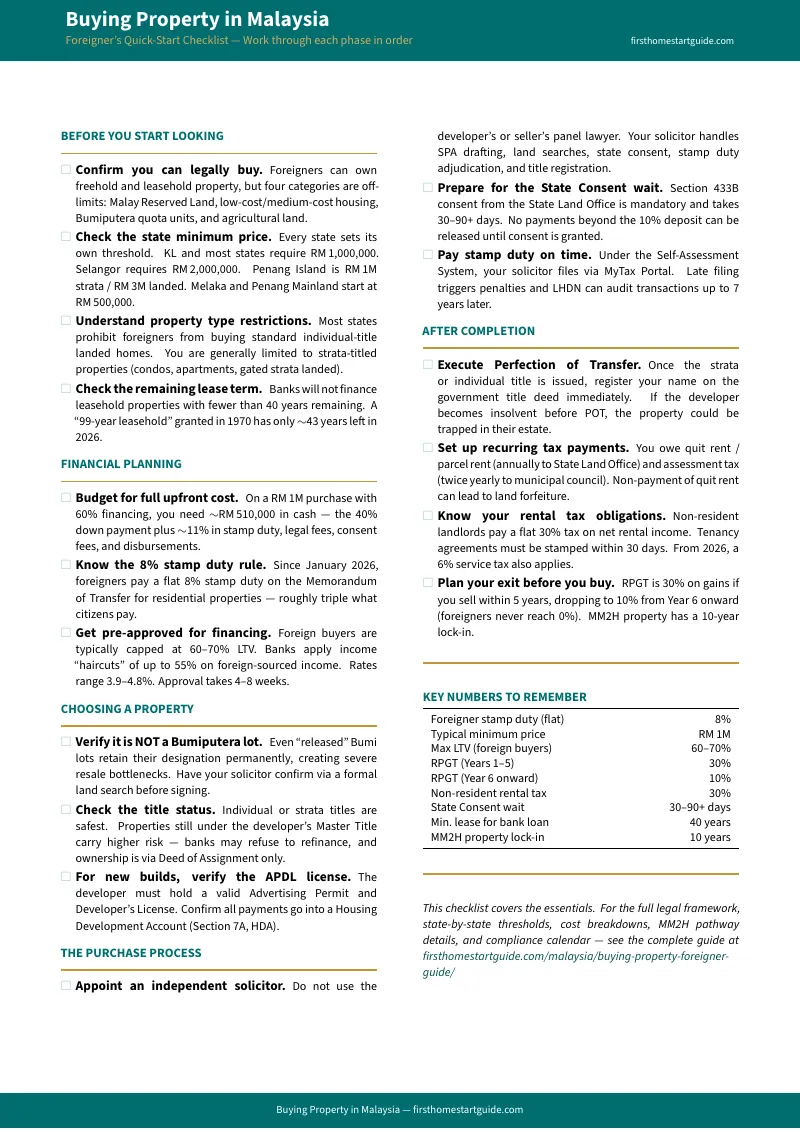
Download the free Quick Checklist to see the 17-item action plan covering eligibility verification, state minimums, title checks, financing, consent process, and post-purchase compliance. When you're ready for the full State-by-State Decoder — the 13-chapter guide plus 8 standalone printable tools (state threshold map, cost calculator worksheet, due diligence checklist, title risk flowchart, MM2H comparison card, Bumi lot checker, RPGT reference card, and consent process timeline) — the complete toolkit is here.
You've found the property. Now decode the state-by-state system that stands between you and the keys.