You Found a Beachfront Condo in Tulum. The Constitutional Restriction, Bank Trust, and Ejido Risk Between You and the Keys Assume You Already Know How They Work.
You've found a sunlit two-bedroom in Playa del Carmen, a rooftop penthouse in Tulum's Aldea Zama, or a colonial townhouse in San Miguel de Allende that costs less than a studio apartment back home. You've checked the exchange rate, confirmed your budget covers the asking price, and started picturing yourself on the terrace watching the sun set over the Caribbean. Within a week you've discovered that Mexico's Constitution explicitly prohibits you from holding direct title to any residential property within 50 kilometers of the coastline or 100 kilometers of any land border — a zone that covers virtually every market foreigners actually want to buy in. The workaround is something called a fideicomiso, a bank trust where a Mexican bank holds the legal title and you become the "beneficiary," which sounds suspiciously like you don't actually own the property. Your US tax advisor isn't sure whether the IRS considers this a foreign trust requiring Form 3520 filings with five-figure penalties for non-compliance. And the developer offering pre-construction condos at 30% below market hasn't mentioned that the land is classified as ejido — communal agrarian territory that cannot be legally sold to you, placed in a bank trust, or owned by any corporate entity, and where your entire investment disappears without legal recourse if the community assembly decides to reclaim it.
You search online for help. MexLaw publishes technically precise articles on fideicomiso mechanics and ejido conversion procedures — dense, academic, and designed to demonstrate the complexity that justifies their billable consultation hours. Real estate brokerages in Puerto Vallarta and Los Cabos publish polished buying guides that walk you through the "simple" process while systematically minimizing ejido risk, glossing over the 25% gross withholding tax on non-resident rental income, and never mentioning that the Notario Public handling your closing represents the Mexican state, not you. Reddit's r/MexicoCity and r/expats contain real stories from buyers who navigated fideicomiso setups and SAT tax registration — alongside advice that confuses state-level ISAI rates, recommends skipping independent legal counsel because "the Notario handles everything," and confidently claims that buying property gets you a residence visa. It does not.
Here's the problem no free resource solves: Mexico's property system runs on constitutional restrictions, agrarian land tenure, and civil law procedures that directly contradict North American real estate assumptions. The Constitution prohibits direct foreign ownership in the zones where foreigners buy. The bank trust that solves this problem carries annual fees, a 50-year renewable term, and estate planning implications that require specific structuring. Half of Mexico's landmass is classified as ejido — communal land that looks like private property on a developer's marketing brochure but cannot be legally transferred to you until a multi-year government conversion process is 100% complete. The Notario who formalizes your closing is a state-appointed official who verifies the transaction but does not advocate for you, review your preliminary contract, or flag unfavorable deposit terms. ISAI acquisition tax rates swing from 2% to 6.5% depending on the state. Non-resident rental income faces a flat 25% gross withholding with zero deductions, while residents who qualify for RESICO pay 1-2.5%. And the capital gains tax on resale is calculated in pesos — meaning currency depreciation alone can generate a six-figure phantom taxable gain on a property that appreciated zero dollars. The system has real protections — the fideicomiso's built-in estate planning, the IRS ruling that eliminates Form 3520 requirements, the deposit refund clauses in the promesa de compraventa — but only if you know they exist, understand the mechanism behind each one, and activate them before you sign.
The Buying Property in Mexico — Foreigner's Guide is The Cross-Border Property Roadmap. Not a lifestyle article about cheap beachfront living. It's a structured decision system that decodes every stage of the Mexican property purchase — from the Constitutional restriction and fideicomiso mechanics through ejido verification, ISAI calculation, Notario procedure, and cross-border tax compliance — so you make each decision understanding the legal mechanism behind it, the constitutional article that governs it, and the financial consequence of getting it wrong.
What's Inside The Cross-Border Property Roadmap
The complete 10-chapter guide, a 16-item printable checklist, and 8 standalone reference sheets — covering every stage from constitutional restriction assessment through post-purchase tax compliance, with the Mexican legal terms, article references, tax rates, and state-level variations that determine whether your purchase builds equity or traps capital:
Fideicomiso Decoder — How the Bank Trust Actually Works
The single biggest source of anxiety for foreign buyers in Mexico isn't the price — it's the ownership structure. Article 27 of the Constitution prohibits direct foreign ownership within the Restricted Zone, which covers Los Cabos, Puerto Vallarta, Cancun, Playa del Carmen, Tulum, and the entire Riviera Maya. The fideicomiso places legal title with a Mexican bank — BBVA, Citibanamex, Scotiabank, Santander, or HSBC — while you hold 100% of the beneficial rights: use, lease, renovate, sell, inherit, mortgage, all at your sole discretion. The bank cannot sell your property, claim it as an asset, or exercise any economic rights over it. The trust is established for 50 years and renewable in perpetuity. Setup costs run $2,000-$3,500 for the SRE permit and bank initiation, with annual trustee fees of $500-$1,000. The guide explains the full trust mechanics, how to designate substitute beneficiaries to bypass Mexican probate entirely, and the critical 2013 IRS Revenue Ruling that definitively established the fideicomiso is not a foreign trust — eliminating Form 3520 filing requirements and the five-figure penalties that kept American buyers awake at night for years.
Ejido Risk Assessment — The Existential Threat to Foreign Capital
Roughly 50% of Mexico's landmass is classified as ejido — communal agrarian territory that cannot be legally sold, leased, mortgaged, or placed in a fideicomiso. In high-growth coastal markets like Tulum, Puerto Escondido, and Sayulita, ejido boundaries frequently overlap with areas where developers are actively marketing pre-construction condominiums to foreign buyers. The danger: sellers offer "possession rights" or a cesion de derechos at 30-50% below comparable private-title properties. These documents look like deeds. They are legally void. If the ejido assembly reclaims the land — which happens routinely when property values appreciate or community leadership changes — you lose your entire investment without compensation and with zero legal recourse. The only path to legal foreign ownership of former ejido land is dominio pleno, a multi-step government conversion process requiring a supermajority assembly vote, National Agrarian Registry verification, and final inscription in the Public Registry of Property. The guide maps the complete conversion timeline, the three risk tiers (established developments with clean chains of title, active conversion in progress, and outright agrarian rights sales), and explains exactly what to verify with a specialized agrarian attorney before releasing any deposit.
ISAI Tax Calculator — State-by-State Acquisition Costs
The largest single closing cost is the Impuesto Sobre Adquisicion de Inmuebles — the property acquisition tax — and it varies dramatically by state. Quintana Roo (Tulum, Playa del Carmen, Cancun): 3%. Baja California Sur (Los Cabos, La Paz): 3%. Jalisco (Puerto Vallarta, Guadalajara): 2-2.5%. Nayarit (Riviera Nayarit): 2%. Mexico City: a progressive scale reaching 6.5-8.7% on high-value properties. Total buyer closing costs run 5-10% of the purchase price, including ISAI, Notario fees (0.75-2%), Public Registry inscription (0.2-0.5%), the fideicomiso setup ($2,000-$3,500), the official appraisal ($300-$600), and certificates of no liens. The guide includes a complete cost breakdown for a $300,000 purchase in the Restricted Zone showing every line item, so you budget accurately instead of discovering the real number at the Notario's office.
Notario vs. Lawyer — Who Protects You and Who Doesn't
The Mexican Notario Publico is not the American notary who stamps documents at a UPS Store. A Notario is an elite attorney appointed by the state governor for life, functioning as a quasi-governmental official who verifies ownership, conducts title searches, calculates and withholds taxes, drafts the final deed, and registers it in the Public Registry. What the Notario does not do: represent you, review your preliminary contract, negotiate terms, inspect the property, flag unfavorable deposit conditions, or advocate for your interests if something goes wrong. The commitment of your capital happens much earlier — when you sign the promesa de compraventa and pay a 10% deposit — and the Notario rarely reviews that document. The guide explains why you need an independent bilingual real estate attorney in addition to the Notario, what the attorney should review in the promesa, how to structure deposit refund clauses that protect you if due diligence uncovers title defects or the SRE permit is denied, and how the Procura Especial works if you can't attend the closing in person.
Cross-Border Tax Navigator — RESICO vs. Non-Resident Withholding
The tax gap between getting this right and getting it wrong is the difference between a profitable investment and a marginal one. Non-resident foreign owners pay a flat 25% income tax on gross rental revenue — no deductions permitted for property management, maintenance, cleaning, platform fees, or marketing. Residents who obtain an RFC and qualify for the Regimen Simplificado de Confianza (RESICO) pay progressive rates between 1% and 2.5% on income up to MXN 3.5 million annually. On resale, capital gains are calculated in pesos — meaning a property that appreciated zero dollars can generate a massive phantom taxable gain purely from peso depreciation against the dollar. The guide covers the complete tax architecture: non-resident vs. resident treatment, how to obtain an RFC without residency under the "Non-Resident With Income in Mexico" classification, the RESICO qualification criteria, the capital gains "currency trap" with a worked example, and why under-declaring the purchase price to save 3% in ISAI at acquisition costs you 35% in inflated capital gains at resale.
Location-Specific Buying Intelligence
Mexico is not one market. The guide covers the regulatory environment, cost structure, and practical considerations for the specific regions where foreigners buy. The Riviera Maya (Tulum, Playa del Carmen, Cancun): the epicenter of ejido risk, pre-construction fraud, and the 3% Quintana Roo ISAI. Los Cabos and Baja California Sur: mature fideicomiso infrastructure with recently increased ISAI rates. Puerto Vallarta and the Riviera Nayarit: split between Jalisco and Nayarit with different ISAI rates across the bay. Mexico City: direct foreign ownership without a fideicomiso, progressive ISAI scales, and the strongest rental yields in the interior. San Miguel de Allende and the Colonial Interior: fee-simple ownership, heritage property regulations, and the retiree-heavy market dynamics. Merida and the Yucatan: rapidly appreciating values with municipality-specific ISAI variations.
Who This Guide Is For
This guide is for foreign buyers and expats purchasing property in Mexico who:
- Are US or Canadian retirees evaluating Mexico as a retirement or snowbird destination and need the fideicomiso mechanics, estate planning options, and IRS treatment explained clearly before committing capital — not by a broker earning a commission on the sale, but by an independent reference they can verify against their own tax advisor
- Are digital nomads or remote workers living in Mexico on a temporary resident visa who want to transition from renting to ownership and need to understand whether they can buy direct title in an interior city like Mexico City or Guadalajara, how to obtain an RFC, and whether RESICO's 1-2.5% tax rate applies to their rental income
- Are short-term rental investors evaluating yield properties in Tulum, Playa del Carmen, or Los Cabos and need the ejido risk assessment, the non-resident 25% gross withholding calculation, the true closing costs by state, and a realistic cap rate model before committing to a pre-construction deposit
- Are Mexican-Americans or dual nationals purchasing property through their Mexican citizenship — bypassing the Restricted Zone entirely — who need to navigate RFC registration, cross-border inheritance scenarios, and the capital gains currency trap on eventual resale
- Are heritage buyers reconnecting with family roots in Mexico and need to understand the difference between direct title in the interior and fideicomiso requirements on the coast, the promesa de compraventa deposit structure, and the Notario's role versus independent legal counsel
- Want every constitutional restriction, every fideicomiso cost, every ejido verification step, every state-level ISAI rate, every tax regime comparison, and every Notario procedure in one document — so they walk into agent meetings, bank appointments, and contract signings with the same structural understanding as a Mexican buyer working with domestic counsel
Why Not Free Resources?
Free information on buying property in Mexico as a foreigner is abundant. Here's what each source actually delivers:
- MexLaw and Mexican law firm websites publish technically precise articles on fideicomiso mechanics, ejido conversion, and capital gains taxation — dense, academic, and designed to demonstrate the complexity that justifies retainer-based consultations. Each article covers one topic in isolation. What they don't provide: a single integrated roadmap that connects the constitutional restriction, fideicomiso structure, ejido verification, closing costs, rental tax regime, and capital gains currency trap into one coherent decision sequence. You get fragments of expertise designed to demonstrate competence, not to replace it.
- Real estate brokerages and listing portals in Puerto Vallarta, Los Cabos, and the Riviera Maya publish polished English-language buying guides that make the process sound straightforward. What they systematically soften: the catastrophic risk of ejido land in pre-construction developments, the 25% gross withholding on non-resident rental income that decimates projected yields, the fact that the Notario is neutral and does not represent you, and the state-level ISAI variations that can double your closing costs. The information is real. The structural risks that cost foreign buyers real money are consistently understated by the parties earning commissions on the transaction.
- Reddit and expat forums (r/MexicoCity, r/expats, Facebook buying groups) contain genuine ground-level experiences from buyers who navigated fideicomiso setups, SAT registrations, and Notario closings — alongside confidently stated advice that confuses ISAI rates across states, recommends skipping independent legal counsel, claims that buying property grants residency rights, and treats "possession rights" on ejido land as equivalent to titled ownership. Both the successes and the disasters are real. Neither tells you which outcome applies to your specific property, municipality, and tax status.
- YouTube and lifestyle content dominates top-of-funnel awareness with romanticized narratives about affordable beachfront living. What's consistently omitted: the 5-10% closing costs, the ongoing fideicomiso fees, the ejido risk in the exact markets being showcased, the 25% non-resident rental tax, and the peso-denominated capital gains trap that turns currency depreciation into a taxable event.
This guide fills the structural gap — the space between knowing that foreigners can buy property in Mexico and understanding exactly how Article 27, the fideicomiso, ejido verification, state-level ISAI rates, the Notario system, and cross-border taxation actually work at each stage of the purchase. It's the analysis an independent advisor with no commission to earn would give you, structured as a permanent reference you own.
— Less Than One Hour With a Bilingual Real Estate Lawyer
An independent bilingual attorney charges $1,000-$3,000 for contract review and due diligence on a single transaction. The fideicomiso setup and SRE permit run $2,000-$3,500. The 10% deposit you're protecting in the promesa de compraventa is $20,000-$60,000 on a standard purchase. A single ejido property that you didn't verify through the National Agrarian Registry can cost you everything you invested.
This guide doesn't replace your attorney or your Notario. But it gives you the fideicomiso decoder, the ejido risk assessment, the ISAI tax calculator, the Notario-vs-lawyer framework, the cross-border tax navigator, and 8 standalone printable reference sheets (closing cost calculator, due diligence checklist, ejido risk card, ISAI rates reference, transaction timeline, location comparison, tax comparison, and Spanish legal glossary) that ensure you walk into every agent meeting, every bank appointment, and every contract signing understanding the mechanism behind each step — instead of discovering how Mexican property law works by losing capital to it.
If it prevents a single ejido deposit on land that can never be legally transferred, catches a single ISAI miscalculation before you close, or identifies the RESICO qualification that drops your rental tax from 25% to 2.5%, it pays for itself before you've finished reading it.
Money-back guarantee, no time limit. If the guide doesn't make the Mexican property transaction clearer and your financial position stronger, you pay nothing.
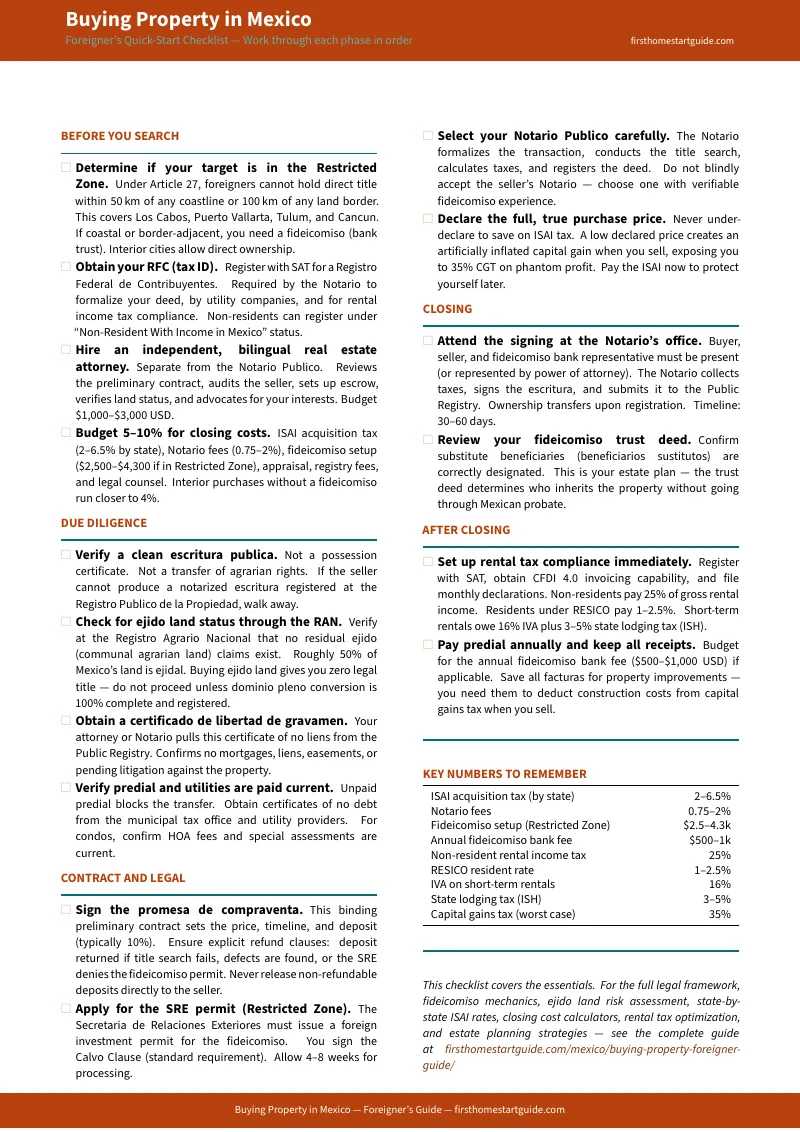
Download the free Quick Checklist to see the 16-item action plan covering constitutional restriction assessment, fideicomiso verification, ejido risk screening, ISAI calculation, and the promesa-to-escritura timeline. When you're ready for the full Cross-Border Property Roadmap — complete with the fideicomiso decoder, ejido risk assessment, state-by-state ISAI calculator, Notario playbook, and cross-border tax navigator — the complete guide is here.
You've found the property. Now decode the system that stands between you and the keys.