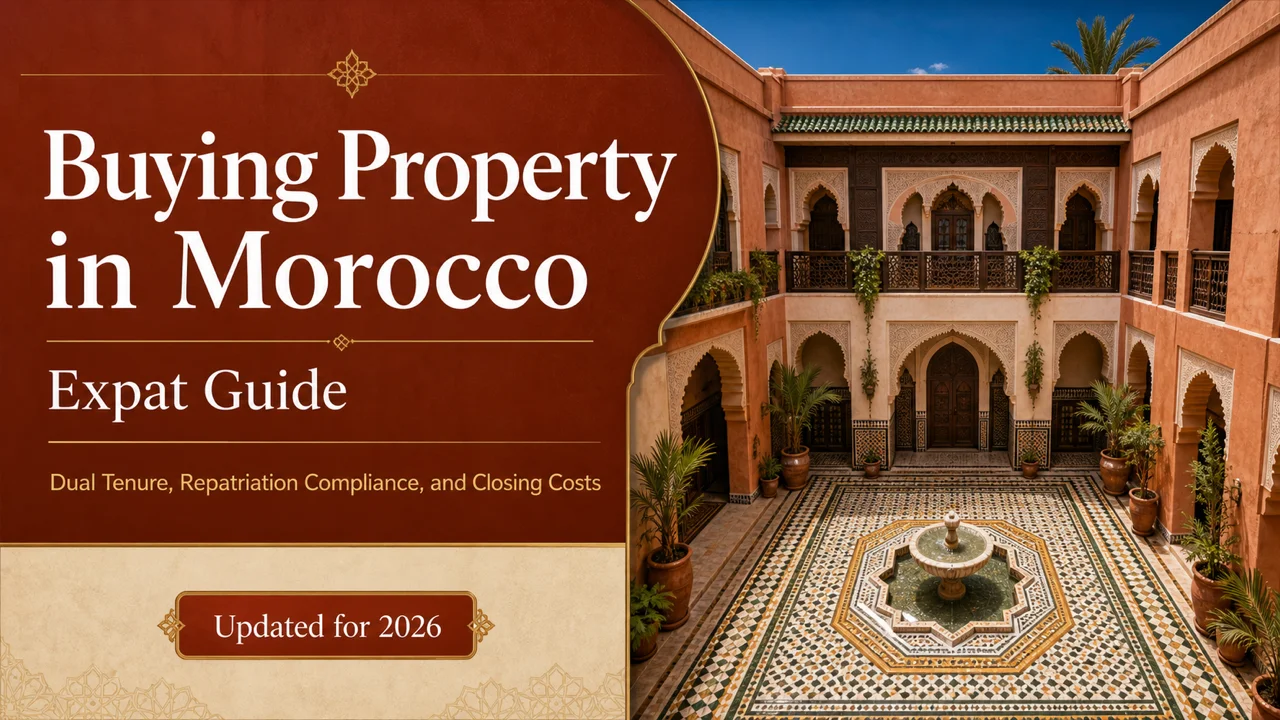
You Found a Beautiful Riad in the Marrakech Medina for EUR 180,000 and Assumed the Purchase Would Work Like Buying Property Back Home
You searched Mubawab, found a three-bedroom riad in the Mouassine quarter with a tiled courtyard and a rooftop terrace. Your agent said foreigners have full ownership rights --- no restrictions, no local partner needed, just sign the deed. You asked about the title. They said it was a Melkia property, which they described as "traditional ownership --- perfectly normal here." Simple.
Except that Melkia classification just placed your entire investment outside the modern legal system. Under Morocco's dual land tenure regime, a Melkia property has no Titre Foncier --- no state-registered title, no centralized mapping, no protection against third-party claims. Ownership is "proven" by a handwritten possession deed based on the oral testimony of twelve witnesses and validated by an Adoul, a traditional Islamic notary with no authority to process modern title transfers. That means any cousin, nephew, or distant heir of the original owner can file an inheritance claim against you --- five, ten, or twenty years after your purchase --- and the courts will hear it. There is no statute of limitations, no title insurance, and no administrative backstop. Your only defense would have been a clean Titre Foncier, and your property does not have one.
Then your agent arranged the closing with an Adoul instead of a Notaire. You assumed they were the same thing. But an Adoul operates under customary Islamic law and the family court system --- they cannot file documents with the Conservation Fonciere, they do not manage escrow through the state-backed Caisse de Depot et de Gestion, and they have no expertise in foreign exchange compliance. By closing through an Adoul, you bypassed every modern civil law protection available to foreign buyers. Your transaction exists only in the customary system.
And nobody mentioned that the riad sits on Habous land --- property held in perpetual religious trust by the Ministry of Habous and Islamic Affairs. Habous land is legally inalienable. It cannot be sold, transferred, or registered under a private buyer's name. Your entire purchase contract is legally void. The capital you deployed has no legal claim behind it, and there is no recourse.
The problem is not that Morocco restricts foreign buyers. The problem is that Morocco operates a dual land tenure system where over 40% of medina properties have no formal title, a religious endowment regime that makes certain purchase contracts void from inception, a foreign exchange compliance loop that can permanently trap your capital in non-convertible dirhams, an architect release requirement that can block you from obtaining occupancy permits on renovated properties, a 2025/2026 Finance Law overhaul that restructured luxury registration duties and introduced a new rental withholding tax, and an agricultural land prohibition that voids any sale of rural property without a completed VNA reclassification --- and the English-language agency blogs, expat forums, and YouTube walk-throughs that foreigners rely on routinely skip or oversimplify every one of these.
The Buying Property in Morocco --- Expat Guide is a Dual Tenure Protection System for Foreign Buyers --- a structured walkthrough of every Moroccan regulatory trap, foreign exchange compliance requirement, title verification step, and hidden cost that determines whether your property purchase protects your investment or silently strips you of your legal rights. It replaces months of cross-referencing Reddit threads, French-language legal blogs, agency marketing pages, and scattered forum advice with a single English-language reference that tells you exactly what each document means, exactly what each filing does, and exactly where foreign buyers lose money they never get back.
What's Inside the Dual Tenure Protection System
A comprehensive 20-chapter guide, 7 standalone printable tools, and a quick-start checklist --- covering every stage from foreign ownership rights through exit strategy, built specifically for the dual legal system and foreign exchange regime that make buying property in Morocco as a foreigner fundamentally different from buying in your home country:
Immatricule vs. Melkia: The Title Verification Framework
This is the single most critical distinction in the entire guide --- and the one that no free English-language resource explains properly. Morocco operates two completely separate property ownership systems. An immatricule property has a Titre Foncier registered at the ANCFCC (Conservation Fonciere), providing state-guaranteed, definitive, unassailable proof of ownership. A Melkia property relies on handwritten possession deeds drafted by Adouls based on oral witness testimony --- no central registry, no mapped boundaries, no protection against inheritance claims. Over 40% of properties in historic medinas like Marrakech and Essaouira remain Melkia. The guide covers the exact verification process at the ANCFCC, how to read a Certificat de Propriete, the 12-to-24-month requisition d'immatriculation conversion process, and the strict escrow conditions you must impose if a seller promises to deliver a clean Titre Foncier before closing.
Habous Land: The Religious Endowment Trap
Habous (Waqf) properties are land or buildings held in perpetual religious trust by the Ministry of Habous and Islamic Affairs. They cannot be sold, privatized, or registered under a private buyer's name --- ever. If you sign a purchase agreement for a riad built on Habous land, the entire contract is legally void and your capital has no legal claim behind it. The guide explains how to identify Habous risk, the mandatory administrative clearance certificate you must obtain from the local Habous commune before proceeding, the limited Zina leasehold rights available for Habous structures, and why this due diligence step is non-negotiable for any property in a historic medina.
Foreign Exchange Compliance and Repatriation Rights
Morocco's Office des Changes administers a strict capital control regime. You have a legal right to repatriate your original capital, capital gains, and declared rental income --- but only if you follow the convertible capital pathway from day one. All purchase funds must enter Morocco as an international wire into a Convertible Dirham Account at a licensed bank, which then issues a Formule 2 (Investment Attestation) with the explicit mention "Real Estate Investment" at the exact moment of transfer. Skip this --- use a standard dirham account, pay in cash, or miss the Formule 2 designation --- and your capital permanently loses its convertible status. Repatriation at resale is then limited to 25% per year over four years via a Convertible Term Account. The guide walks you through the wire transfer mechanics, the Convertible Dirham Account setup, the Formule 2 issuance process, the cash payment trap, the under-declaration scheme, and the exact documents you need at resale to authorize repatriation.
Notaire vs. Adoul: Using the Right Professional
Morocco has two types of legal professionals who handle property transfers, and using the wrong one leaves you completely exposed. A Notaire is a university-educated civil law notary integrated with the Conservation Fonciere who manages escrow through the state-backed CDG, verifies liens, and handles foreign exchange compliance. An Adoul is a traditional Islamic notary operating under the family court system who handles marriages, inheritance, and customary Melkia transfers --- but has no authority to process Titre Foncier transfers and no foreign exchange expertise. The guide explains the exact jurisdictional boundaries, why closing through an Adoul strips your civil law protections, and how to select a Notaire experienced in foreign buyer transactions.
Construction Conformity and the Architect Release
Almost every riad that has been renovated for sale to foreigners includes unauthorized structural work --- terrace enclosures, extra floors, plunge pools, knocked-out interior walls. Without a valid Permis d'Habiter (occupancy permit) and Certificat de Conformite, the property is technically illegal. In Morocco, obtaining these certificates requires the formal involvement of the original architect of record. If the previous owner disputed with that architect, you must obtain a formal written release (desistement) --- often requiring a settlement payment --- before any new permits can be issued. Without the desistement, you cannot legalize the property and risk municipal demolition orders. The guide covers the verification process, the architect release negotiation, and how to budget for conformity remediation.
Regional Market Analysis
Prices, legal risk, and rental returns vary dramatically by city and neighborhood. The guide provides detailed market analysis for six key regions: Casablanca (Ain Diab MAD 25,000-32,000/sqm, Anfa MAD 17,000-24,000/sqm, Maarif MAD 14,000-18,000/sqm --- mature institutional market with virtually no Melkia risk), Rabat (Souissi, Hay Riad --- low-volatility diplomatic market), Marrakech (Hivernage, Gueliz for titled modern apartments, the medina for 12-18% gross yields but concentrated title and Habous risk), Tangier (Malabata coastal developments), Agadir (Founty beachfront tourism), and Essaouira (bohemian medina riads with high Melkia prevalence). Each entry includes price per square meter, gross yield range, title risk level, and the buyer profile it serves.
Transaction Costs and Tax Architecture
Total closing costs run 8% to 11% of the purchase price for standard titled properties --- higher than most buyers expect. The guide breaks down every component: registration duty (droits d'enregistrement) at 4% standard with progressive increases to 7% for luxury properties above MAD 2 million under the 2025 Finance Law, Conservation Fonciere fee at 1.5% plus MAD 200, notary fees at approximately 1% plus 20% VAT, stamp duties at 0.5% to 1%, and agent commission at 2.5% to 3% plus 20% VAT. It includes a worked cost model for a MAD 2,000,000 resale property showing total closing costs of MAD 204,200 (10.2%). Annual property taxes, rental income tax options (progressive scale with 40% abatement, or 20% flat withholding, or 10% on short-term gross receipts), the new 5% withholding from July 2026, and capital gains tax for non-residents (20% of net gain, minimum 3% of gross sale price) are all covered.
The VNA Process for Agricultural Land
Foreigners cannot own agricultural land in Morocco --- period. If you want a rural plot outside the urban perimeter, the seller must first obtain a Vocation Non Agricole (VNA) certificate that permanently reclassifies the land. The guide covers the two-stage VNA process (application through the Provincial Department of Agriculture and Regional Investment Center), the project plan requirements, the multi-month timeline, the strict rule that no funds should leave escrow until the VNA is finalized, and the long-term emphyteutic lease alternative for foreigners who want to use agricultural land without the VNA.
Who This Guide Is For
- Lifestyle buyers drawn to riad renovation in Marrakech or Essaouira who need to understand the dual tenure system, verify Habous clearance, confirm construction conformity, and navigate the architect release requirement before committing capital to a property that may have no formal title, sit on inalienable religious trust land, or contain illegal structural modifications
- Retirees relocating to Morocco who need the full cost-of-ownership picture beyond the purchase price --- registration duties, Conservation Fonciere fees, annual property taxes, municipal services tax, and the ongoing tax treatment options for rental income
- Short-term rental investors targeting Airbnb yields in Marrakech or Agadir who must verify condominium bylaw authorization under Law No. 18-00, obtain municipal operating authorization under Law No. 80-14, and comply with the guest registration and tourist promotion tax requirements before committing to a building that may prohibit commercial stays
- Corporate expats and remote workers on postings in Casablanca or Rabat who need to evaluate the rent-versus-buy calculation and set up the Convertible Dirham Account and Formule 2 correctly before wiring funds
- Anyone wiring money into Morocco for a property purchase who cannot afford to skip the Formule 2 --- the single procedural step that determines whether you can ever get your money back out of the country
Why Not Free Guides and Expat Blogs?
- Real estate agency blogs and property portals (Mubawab, Kensington Morocco, Sotheby's Realty Marrakech) tell you that foreigners have full ownership rights and spotlight lifestyle appeal. They do not explain the Melkia title trap, the Habous clearance requirement, the Formule 2 compliance loop, or the architect release issue. You get a property listing, not a risk assessment.
- English-language expat sites (Wise, International Living, Expat Focus) provide high-level overviews of the buying process. They do not walk you through reading a Certificat de Propriete, they do not cover the 40% abatement versus 20% flat withholding tax decision for rental income, and they do not model the total closing cost difference between a standard resale and a luxury property under the progressive registration duty structure. You get a teaser, not the analysis that protects your money.
- Reddit threads (r/morocco) contain genuine warnings about Melkia risk, Habous land, and repatriation difficulties, but they are mixed with outdated information, anecdotal advice from buyers who purchased under different regulations, and contradictory recommendations about agents and neighborhoods. Sorting current from outdated takes longer than reading a guide verified against the 2026 regulatory environment.
- Comprehensive legal analyses do exist --- in French. The Notaires de France guidance, ANCFCC procedures, and Office des Changes regulations are detailed but almost exclusively available in French or classical Arabic. English-speaking buyers face a severe asymmetric information disadvantage, relying on incomplete translations or informal forum advice that often contains factual errors.
This guide fills the Morocco-specific gap --- the space between knowing that foreigners can buy property and knowing how to protect your capital inside a dual tenure system with strict foreign exchange controls. It is the analysis that would take a bilingual Notaire, an independent real estate attorney, a certified translator, and a tax advisor to assemble --- structured as a reference you own permanently and can bring to every meeting.
--- Less Than Your Notaire's Minimum Fee
A single Notaire consultation in Morocco starts at MAD 2,500 (approximately EUR 230). An independent attorney for riad due diligence runs EUR 500 to EUR 1,500. Buying a Melkia property without understanding the title risk? That can cost you the entire purchase price --- with no legal recourse and no insurance backstop.
This guide does not replace your Notaire, your independent attorney, or your tax advisor. But it gives you the title verification framework, the Formule 2 compliance walkthrough, the Habous clearance protocol, the construction conformity checklist, the transaction cost breakdown, the regional market analysis, and the tax obligation reference --- the complete 20-chapter guide, 7 standalone printable tools you can bring to every meeting, and the quick-start checklist --- so you understand exactly what each document means, exactly what each filing does, and exactly where foreign buyers lose money they never recover, before you sign anything or wire a single dirham.
If it prevents the Melkia title mistake alone --- or catches a missing Formule 2 before your funds lose their convertible status --- it pays for itself before you finish the first chapter.
Money-back guarantee, no time limit. If the guide does not sharpen your Morocco property buying analysis and protect your capital, you pay nothing.
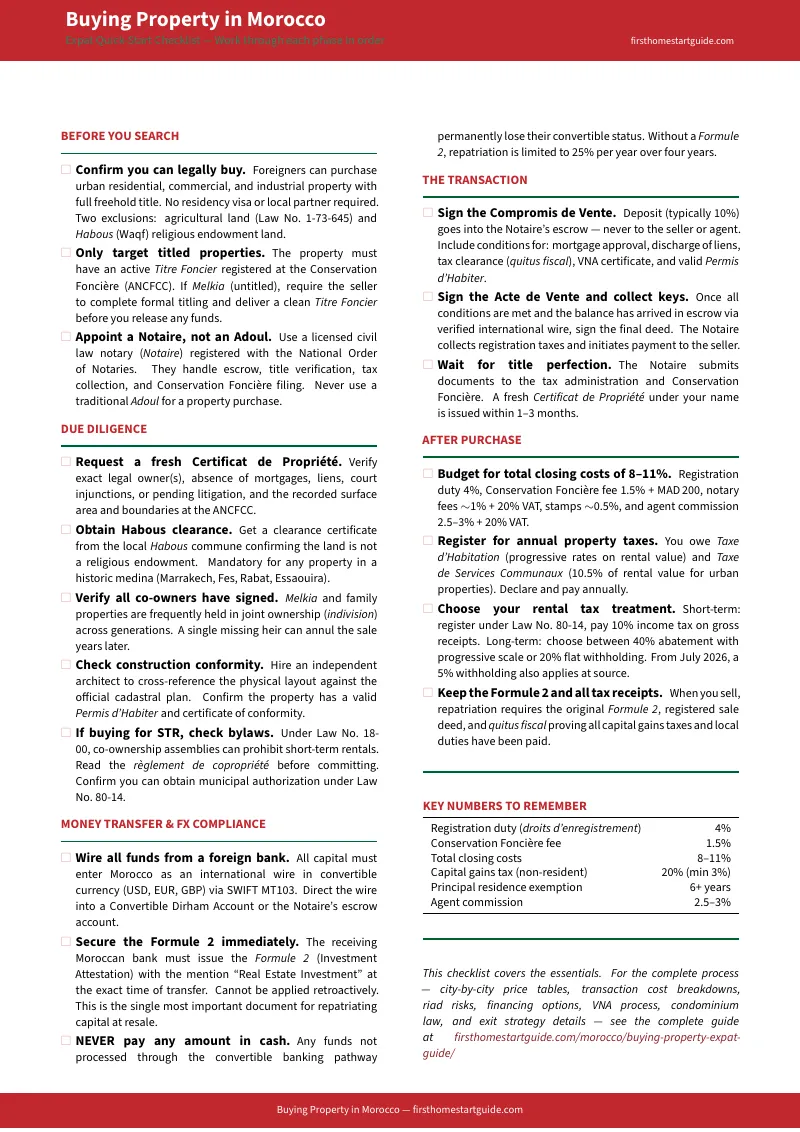
Download the free Buying in Morocco --- Foreigner's Quick Checklist to see the 18-item compliance framework covering title verification, Habous clearance, foreign exchange steps, due diligence, the closing sequence, and post-purchase obligations. When you are ready for the full title verification framework, Formule 2 walkthrough, regional market analysis, and the complete 20-chapter guide, the full toolkit is here.
Morocco's open property market only works if you know how to navigate its dual legal system. This guide makes sure you do.