85% of Bocas del Toro Real Estate Isn't Actually for Sale. It's Right of Possession Land.
You've done the research. The dollarized economy eliminates currency risk. The territorial tax system exempts your pension, your Social Security, your remote work income. The Pensionado visa offers permanent residency with legally mandated discounts on everything from airfare to healthcare. Panama's property market sounds like it was designed by someone who read your retirement wish list.
Then you land in Bocas del Toro. The beachfront lot the agent showed you online is listed at $85,000 — a fraction of what waterfront costs anywhere in North America. The photos are gorgeous. The location is perfect. And the property is not titled. It is Right of Possession land. The Republic of Panama owns it. You would be buying the right to occupy it based on someone's historical claim — a claim that is not centrally registered, not verifiable through the Public Registry, and not mortgageable by any bank in the country. If a competing claim surfaces, you have no centralized record to fall back on. If you leave for six months without a caretaker, squatters who establish sustained, unchallenged presence on your land gain legal protections under Panamanian law.
Nobody in the International Living article mentioned this. The expat blog that ranked Panama "#1 Retirement Destination" didn't cover it. The developer's brochure didn't disclose it. And the real estate agent who showed you the listing works on commission and has no legal obligation to explain the difference between titled property and a possession right that requires constant vigilance to defend.
The buyer who doesn't know this distinction doesn't find out at the research stage. They find out at the registry — or in a courtroom.
Here's the gap that free resources leave wide open: Panama has two entirely separate property systems operating in parallel — titled property registered in the Registro Público, and Right of Possession land that exists outside the registry entirely. Every buying decision you make flows from which system you're in. The tax obligations are different. The financing options are different. The legal protections are different. And the distance between "I own this property" and "I have a claim someone can challenge" is the difference between the two.
The system has internal logic — it works for Panamanians who grew up navigating civil law registries, municipal clearances, and the distinction between titled and untitled land. The friction is that foreign buyers arrive with assumptions from a different legal tradition, and the lifestyle content that attracted them to Panama never flags the gap. It covers the dream. It skips the part where you check the registry.
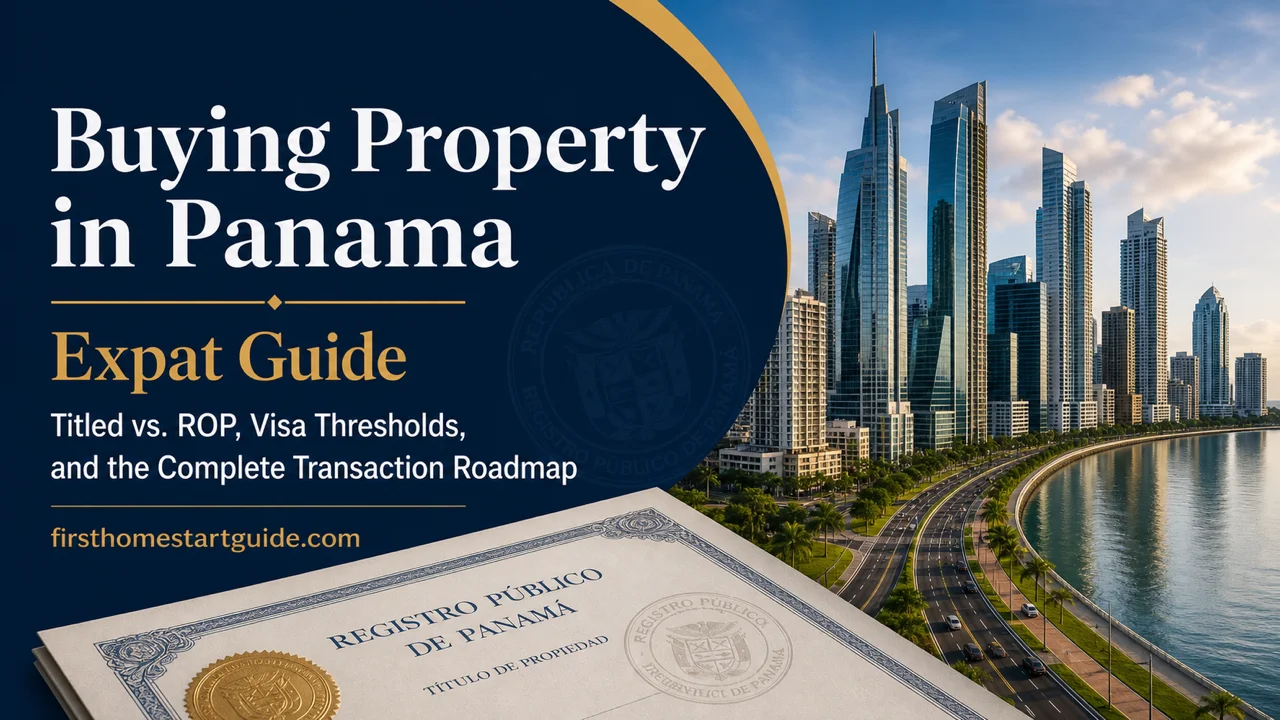
The Buying Property in Panama — Expat Guide is The ROP Reality Playbook. Not a retirement lifestyle overview. Not a neighborhood ranking with sunset photos. It's the analysis an independent advisor with no commission to earn and no listing to push would give you — structured as a 14-chapter reference you own, built around the single most important distinction in Panamanian real estate.
What's Inside The ROP Reality Playbook
The guide is built around one distinction. Everything else follows from it.
A 14-chapter guide plus appendices and a quick-start checklist — covering every decision point from visa qualification through post-closing tax registration:
Titled Property vs. Right of Possession — The Distinction That Determines Everything
The guide opens with a complete breakdown of Panama's dual property system. Titled property (finca titulada) is registered in the Registro Público with a unique finca number, verifiable boundaries, and a traceable chain of ownership. ROP land is technically owned by the state — you buy a customary right to occupy. The guide covers what each system means for financing (banks will not lend against ROP — period), for taxes (ROP owners pay no annual property tax but have no legal certainty), for resale (titled properties transfer through the registry; ROP transfers happen through informal documentation), and for your exposure to boundary disputes, competing claims, and squatter risk. If you're considering ROP, the guide maps the ANATI conversion process — the 6-12 month pathway to converting possession rights into a registered title — including survey requirements, public notice obligations, and the realistic timeline when documentation is imperfect.
The 3% Withholding Trap — Capital Gains Recovery Most Expats Abandon
When you sell property in Panama, the government withholds 3% of the total sale price at closing as an advance against capital gains tax. The actual capital gains rate is 10% of your net profit. On a property you bought for $250,000 and sell for $300,000, your actual tax is $5,000. But the 3% withholding takes $9,000. You are owed $4,000 back. Many sellers — advised by complacent attorneys — accept the 3% as a final tax and walk away from the overpayment. The guide explains the DGI special assessment process to reclaim the difference, when to file, and why you need a competent accountant at sale time.
The Visa-Property Nexus — How Investment Thresholds Trigger Residency
Panama ties its immigration system directly to property investment. The Pensionado visa requires $1,000/month in pension income — but purchasing titled property worth $100,000+ drops that to $750/month. The Friendly Nations Visa requires a $200,000 real estate investment (financeable locally). The Qualified Investor Visa requires $300,000 and grants immediate permanent residency within 30 days — but the threshold is scheduled to jump to $500,000 in October 2026, meaning buyers targeting this visa need to close by approximately August 2026 to lock in the current rate. The guide maps each pathway's requirements, processing timelines, and the interactions between property price and visa eligibility.
Expat Mortgages — The Numbers Your Agent Won't Lead With
Panamanian citizens get 10-20% down payments and 4.5-7% rates over 30 years. Foreigners get 30-50% down, 7-9% interest, 15-20 year terms, a mandatory 1% FECI surcharge on investment properties, and the requirement that age plus loan term cannot exceed 75. Applications require apostilled credit reports, Spanish-translated employer letters, years of tax returns, and approval through a risk committee that can sit on your file for 3-6 months. The guide covers which banks process foreign profiles efficiently vs. which offer better rates with glacial timelines, plus the 2026 preferential interest law subsidies for resident expats.
Pre-Construction Contract Traps — Four Clauses Your Attorney Must Strike
The largest financial losses in Panamanian real estate happen in pre-construction. Developers use one-sided contracts that bury material escalation clauses, offer no recourse for delivery delays measured in years, force buyers to sign defect waivers before handing over keys, and maintain dictatorial HOA control to subsidize ongoing construction costs. The guide identifies each clause type, explains what your attorney should demand instead, and covers the ACODECO consumer protection process for binding dispute resolution.
The Step-by-Step Transaction — Promesa to Registro Público
The full 30-45 day sequence: independent counsel, Promesa de Compraventa, 10% escrow deposit, due diligence (Public Registry verification, ANATI cadastral cross-reference, corporate standing, Paz y Salvo clearances, municipal permits), Escritura Pública at the notary, and registry submission. The guide pinpoints the exact moment you legally own the property — which is not when you sign, but when the Registro Público issues the Entry Number.
Tax Exemptions, Corporate Structures, and Ongoing Costs
The $120,000 primary residence tax exemption that isn't automatic — you must register with the DGI or default to the investment schedule that starts taxing at $30,001. Historical tax exonerations that follow the building, not the buyer, and can expire mid-ownership. When a Sociedad Anónima or Private Foundation makes sense for holding property (estate planning, rental operations, multi-partner syndication) and when it's unnecessary overhead for a retiree buying a primary home. The share-transfer tax trap that catches sellers who think corporate sales bypass the 2% transfer tax.
Regional Guide — Where the Titles Are Clean and Where They're Not
Panama City, Coronado, Boquete, Bocas del Toro, Casco Viejo, and the Azuero Peninsula — each with honest assessments of title security, price ranges, infrastructure quality, and specific warnings. Casco Viejo's 30-year tax exemptions vs. spreading Airbnb bans. Boquete's documented $3,173/month household budget vs. the "$1,500 retirement" narrative. Bocas del Toro's 85% ROP reality.
Who This Guide Is For
This guide is for foreign nationals who are serious about buying property in Panama — not browsing, not dreaming, but ready to commit money:
- You need the entire transaction mapped — from attorney engagement and visa qualification through due diligence, Escritura Pública, and Registro Público registration — with costs, timelines, and consequences at each stage
- You're evaluating a specific property and need to determine whether it is titled or ROP before committing capital — and if ROP, whether the ANATI conversion pathway is realistic
- You want to understand the Pensionado, Friendly Nations, or Qualified Investor visa pathways before choosing a price range — especially with the QIV threshold jumping from $300K to $500K in October 2026
- You're considering financing and need the actual terms before assuming you can replicate your home-country mortgage
- You're buying pre-construction and need your attorney to identify abusive contract clauses before signing
- You plan to sell eventually and need to understand the 3% withholding mechanism before your overpayment becomes the government's windfall
Why Not Free Resources?
Free information about buying property in Panama is abundant. Here's what each source actually delivers:
- International Living and offshore lifestyle publications exist to make you feel that Panama is the answer. Expat forums characterize these outlets as "low signal-to-noise" and "aggressively promotional." They cover the dream. They skip the ROP trap, the mortgage reality, the pre-construction fraud ecosystem, and the procedural friction that defines the actual buying experience.
- Real estate agents and developer websites show you what they're selling. They don't provide an independent framework to verify whether that beachfront lot is titled or ROP, or whether the contract they drafted protects you or the developer.
- Reddit and expat forums contain real experiences — alongside advice that predates current visa thresholds, casually recommends skipping escrow, and assures newcomers that the seller's attorney "handled everything." The good advice and the dangerous advice look identical without baseline knowledge.
- Panamanian attorneys provide the most authoritative guidance — at $200-$350 per hour for basic education. Your attorney's time should go toward protecting your specific transaction, not explaining what ROP land is.
This guide fills that gap — and the cost is trivial relative to the risk it mitigates.
— Less Than One Hour of a Panamanian Attorney's Time
A real estate attorney in Panama charges $200-$350 per hour. A single consultation covering titled vs. ROP, visa pathways, and the transaction process burns through that in 60 minutes — and you leave without a document to reference. The 3% capital gains withholding on a $300,000 sale is $9,000. The escrow deposit you forfeit if a deal collapses is 10% of the purchase price. The gap between the $120,000 primary residence exemption and the $30,000 investment threshold means hundreds in unnecessary property tax every year you own.
This guide doesn't replace your attorney. It means your attorney's hours go toward contract review and due diligence on your specific property — not toward teaching you the system at $300 an hour.
If it prevents a single ROP purchase you didn't realize was ROP, catches a single pre-construction clause your attorney should strike, or recovers a single capital gains overpayment you would have abandoned — it pays for itself before you finish the first chapter.
Money-back guarantee, no time limit. If the guide doesn't make the Panamanian property transaction clearer and your capital safer, email us and we refund you. No forms. No questions.
What You Get
10 PDFs — the full guide, a quick-start checklist, and 8 standalone printable tools:
- guide.pdf — The full 14-chapter guide covering Panama's dual property system, the visa-property nexus, expat mortgage reality, pre-construction contract traps, the step-by-step transaction process, tax exemptions, corporate structures, capital gains recovery, and an honest regional market guide
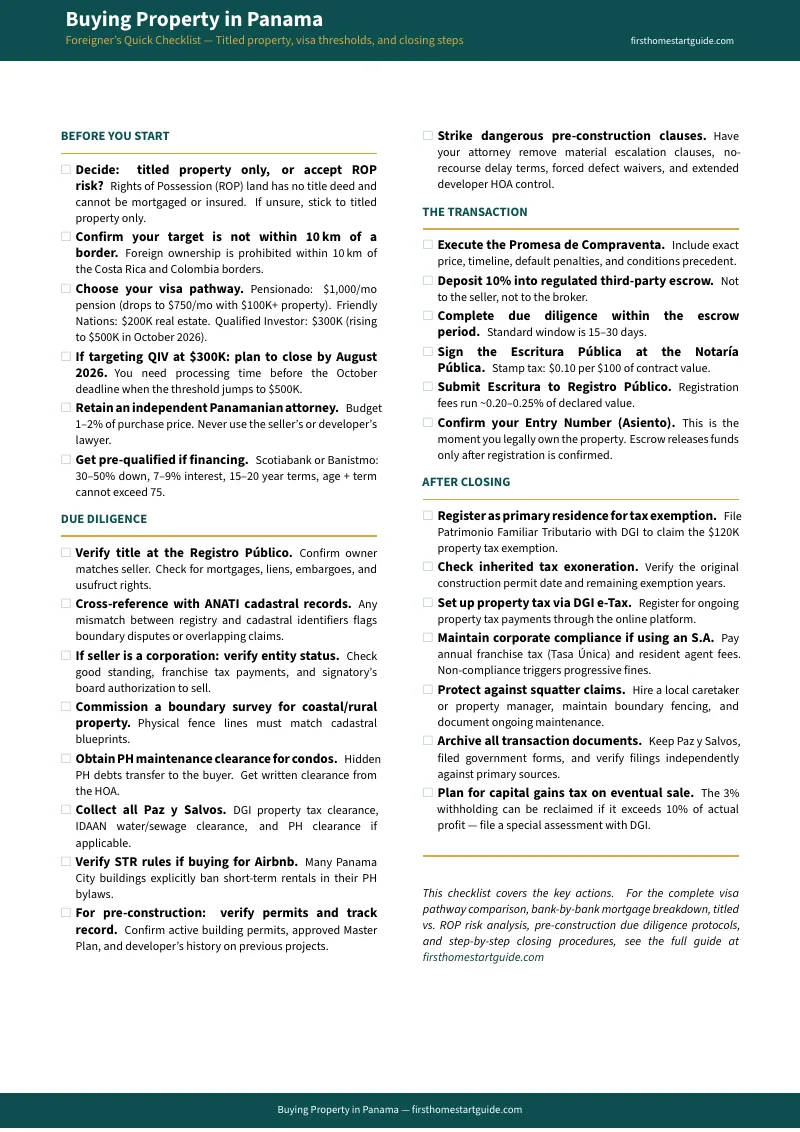
- checklist.pdf — A quick-start checklist covering titled-vs-ROP verification, visa qualification, attorney engagement, escrow setup, due diligence items, and post-closing tax registration
- titled-vs-rop-comparison.pdf — Side-by-side comparison of titled property vs. Right of Possession: financing, taxes, legal protections, and resale implications at a glance
- visa-property-nexus.pdf — Matrix mapping property investment thresholds to visa pathways — Pensionado, Friendly Nations, and Qualified Investor requirements and timelines
- capital-gains-recovery.pdf — Step-by-step checklist for reclaiming the 3% capital gains withholding overpayment through the DGI special assessment process
- expat-mortgage-checklist.pdf — Every document, term, and timeline for securing a Panamanian mortgage as a foreign buyer
- pre-construction-traps.pdf — The four abusive contract clauses developers use and what your attorney should demand instead
- transaction-timeline.pdf — The 30-45 day transaction sequence from Promesa de Compraventa through Registro Público registration, with key milestones
- tax-corporate-decision-aid.pdf — Decision aid for choosing between personal ownership, Sociedad Anónima, and Private Foundation based on your situation
- regional-market-guide.pdf — Quick-reference guide to Panama City, Coronado, Boquete, Bocas del Toro, Casco Viejo, and the Azuero Peninsula
Download the free Buying in Panama — Foreigner's Quick Checklist to see the step-by-step action plan. When you're ready for the full ROP Reality Playbook — the 14-chapter guide plus 8 standalone printable tools that map every friction point between "I want to buy in Panama" and "the title is registered in my name" — the complete kit is here.
The beachfront lot looks perfect. The price looks right. The only question is whether you're buying a titled asset or a possession right — and every decision that follows depends on the answer.
Frequently Asked Questions
What if the rules change after I buy?
We update the guide when the rules change. Email us any time, even years later, and we'll send you the current edition free.