You Found a Condo in BGC. The Philippine Legal System That Governs Your Purchase Just Made Your Filipino Partner's Name on the Title the Only Name That Matters.
You've done the research. You've compared BGC high-rises against Cebu beachfront units, browsed Lamudi listings at midnight, run Wise transfer calculations to model the exchange rate on a 5-million-peso condo. You've read that foreigners can buy condos under the 40% foreign quota. You've seen forum posts on r/phinvest describing the "put it in your wife's name" strategy as a reliable way to buy a house and lot. Three things about that research are going to cost you money -- and the third one can wipe out your entire investment.
First: the developer told you the 40% foreign quota in your building "isn't a problem." You asked for written confirmation. The sales agent changed the subject. You asked again on the developer's Facebook page. They deleted your comment. Here's what they didn't tell you: if the 40% foreign quota is already full when you try to register your Condominium Certificate of Title (CCT), the Register of Deeds will block the transfer. Your contract exists. Your payments are real. Your title does not. Your capital is stranded in a unit you legally cannot own, and the developer has no obligation to refund you because they never guaranteed quota availability in the Contract to Sell.
Second: you're paying monthly equity on a pre-selling condo. The developer missed the turnover date by eighteen months. You stopped paying out of frustration -- why keep sending money to a company that isn't building? That was the single most expensive decision you could have made. By stopping payments without filing a formal written notice under PD 957 (Section 23) with both the developer and the DHSUD, you handed the developer a procedural gift. They immediately reframed your account as "delinquent under the Maceda Law." Instead of owing you a 100% refund with legal interest for their construction delay, they now offer you a 50% cash surrender value -- or nothing at all if you paid for less than two years. This is the Default Trap, and developers execute it routinely against foreign buyers who don't know the difference between two laws that govern the same transaction.
Third: you funded the purchase of a house and lot and put it in your Filipino spouse's name, because the Constitution prohibits foreigners from owning land and your marriage makes it "conjugal property anyway." The Supreme Court has already decided this. In Frenzel v. Catito, an Australian who funded properties in his Filipina partner's name sued to recover them after the relationship ended. The Court ruled he knowingly circumvented the constitutional prohibition, applied the doctrine of pari delicto, and denied him any recovery -- not the properties, not the money. In Matthews v. Taylor, a British national argued his wife couldn't lease Boracay property (bought entirely with his funds) without his marital consent. The Court ruled that because foreigners cannot own land, a foreign spouse possesses zero proprietary interest. Your Filipino spouse can sell, mortgage, or lease the property entirely without your knowledge or consent. This is settled law. Forums that tell you otherwise are dispensing advice the Supreme Court has already rejected.
None of this means the Philippines is the wrong decision. The entry prices, the rental yields in Metro Manila, the retirement lifestyle outside the capital -- the investment case is real. Freehold condominium ownership within the 40% quota remains a fully legal, well-established path. But the gap between what expat forums and developer marketing describe and what Philippine property law actually enforces has never been wider.
You search for help. Lamudi and Property24 have every listing in the Philippines -- and zero guidance on quota verification, no warning about the Default Trap, no mention that your spousal property rights under the Family Code don't override the constitutional land ownership ban. Developer blogs publish lifestyle articles that systematically minimize legal restrictions to avoid losing potential buyers. Philippine law firm websites cover individual topics -- title verification, Maceda Law calculations, SRRV deposit rules -- in precise technical isolation, each article billing THB-equivalent rates for a consultation that covers a single question. And on r/phinvest and Expat.com, someone posted last week that putting land in your wife's name is "fine as long as you trust each other." The Supreme Court says trust is irrelevant -- the arrangement is constitutionally void regardless.
Here's the problem no free resource solves: the Philippines has a property system where foreigners cannot own land under any circumstances, where the only freehold path is a condominium within a hard 40% quota that developers refuse to confirm in writing, where stopping payments during a developer delay without formal notice transforms a 100% refund into a 50% loss, where the "spousal property" workaround has been struck down by the Supreme Court repeatedly, and where protections, verification procedures, and strategic structures exist at every stage -- but only if you know they're there and activate them before you sign.
The Buying Property in the Philippines -- Foreigner's Guide is the Regulatory Shield System. Not a lifestyle article about finding your dream condo in Manila. It's a structured decision system that maps every stage of the Philippine property purchase -- from ownership structure through quota verification, pre-selling risk management, title due diligence, cost calculation, and post-purchase administration -- telling you what developer marketing, property portals, and expat forums deliberately leave out, so you make each decision understanding the law that governs it and the financial consequence of getting it wrong.
What's Inside the Regulatory Shield System
A comprehensive 15-chapter guide, a quick-start checklist, and 8 standalone printable tools -- 10 PDFs total, instant download, ready to use before your next developer showroom visit. Covering every stage from the constitutional ownership restriction through post-purchase administration, organized in the order you'll encounter each decision:
Ownership Structure Navigator
The guide opens with the binary reality every foreign buyer must accept: condominium freehold within the 40% quota, or a long-term lease (up to 99 years under RA 12252 for qualified investments). It dismantles the structures that expat forums still recommend -- the "Filipino spouse's name" workaround (voided by Supreme Court doctrine), the 60/40 corporate structure (criminal offense under the Anti-Dummy Law unless Filipino partners provide genuine capital and control), and the assumption that conjugal property law protects your investment (it doesn't -- Matthews v. Taylor is definitive). For each legal path, the guide maps what you actually own, what your exposure is, and what your exit looks like.
40% Quota Verification System
The Corporate Secretary's Certificate is the single document that determines whether you can register freehold title. The guide covers exactly what to demand, who issues it, what a legitimate certificate looks like, and what happens when the developer refuses to provide it. If the 40% foreign quota is full when you try to register your CCT, the Register of Deeds blocks the transfer -- and your Contract to Sell becomes a piece of paper attached to capital you can't recover. This is what prevents you from paying into a building where your title will never be issued.
The Default Trap Decoder
Two laws govern what happens when a pre-selling condo transaction goes wrong -- PD 957 (developer breach, 100% refund) and the Maceda Law (buyer default, 50% or zero). Developers systematically exploit the information asymmetry between them. The guide explains exactly how the Default Trap works: the developer delays construction, you stop paying out of frustration, and the developer reframes your account as "delinquent" to shift from PD 957 to the Maceda Law. It covers the formal written notice you must send before suspending payments, who to file with at the DHSUD, and the exact PD 957 provisions that entitle you to a full refund. This is what prevents you from losing half your equity to a developer who breached first.
Title Verification and Due Diligence Framework
The Philippines uses the Torrens System, but title fraud is prevalent enough that physical document verification is non-negotiable. The guide covers how to request a Certified True Copy from the LRA eSerbisyo portal, what the authentic security features look like (blue/salmon paper, embedded fibers, watermark, red serial number, dry seal), what to check on the Memorandum of Encumbrances (mortgages, lis pendens, adverse claims, Section 4 Rule 74 estate annotations), and the red flags that require immediate legal intervention -- reconstituted titles without court orders, double titling, suspicious OCT-to-TCT timelines. This is what stands between you and a title that won't survive a legal challenge.
Transaction Cost Calculator
Every tax and fee from the Deed of Absolute Sale to the new CCT in your name: 6% Capital Gains Tax (seller's liability, frequently shifted to buyer via "net" pricing), 1.5% Documentary Stamp Tax, 0.50-0.75% Local Transfer Tax, registration fees, notarial fees. The guide covers who statutorily pays each cost, who customarily pays, the "net of CGT" pricing trap that adds 6% to your effective purchase price, and the BIR Zonal Value rule that can set your tax base above the agreed selling price. Total buyer closing costs: 3% (if seller pays CGT) to 9% (if "net" deal). This is what prevents you from budgeting for the purchase price alone and discovering the real cost at the BIR.
BSP Registration and Capital Repatriation
When foreign funds arrive at a Philippine bank, the receiving bank issues a Certificate of Inward Remittance (CIR). You then apply for a BSP Registration Document (BSRD) with the Bangko Sentral ng Pilipinas. Without these two documents, you cannot convert peso sale proceeds back to foreign currency at the official exchange rate when you sell. The guide covers the exact process, why your wire transfer documentation must match the property transaction, and what happens if you skip this step and try to repatriate capital years later. This is what prevents your investment returns from being trapped in pesos.
SRRV Retirement Visa Integration
For retirees using property as an immigration vehicle, the guide maps the SRRV Classic deposit conversion mechanism -- the $50,000 deposit (or $10,000 with qualifying pension), the requirement that converted funds go only to ready-for-occupancy condos (not pre-selling), the PRA lien on the property, and the capital repatriation rule when you sell. It covers the difference between SRRV Smile (deposit locked, no conversion) and SRRV Classic (convertible to real estate). This is what prevents you from deploying your visa deposit into a property structure that violates PRA regulations.
Location Intelligence: Metro Manila, Cebu, Boracay, Dumaguete, Clark, Davao
The guide covers each major foreign buyer market with the information that developer marketing leaves out: foreign quota saturation risk by area, developer completion track records, rental yield reality versus "guaranteed return" schemes, secondary market liquidity, and location-specific risks (BGC oversupply, Cebu IT Park vacancy rates, Boracay's limited condo stock). This is what helps you choose a location based on legal security and financial fundamentals -- not showroom photography.
Scam Prevention, Complaints, and Enforcement
The DHSUD complaint process, developer License to Sell verification via the VREIS portal, how to spot fake titles, "guaranteed rental return" red flags, and the step-by-step process for filing a formal complaint when a developer refuses to honor your rights under PD 957. This is your enforcement mechanism when everything else fails.
Who This Guide Is For
This guide is for foreign buyers and expats purchasing property in the Philippines who:
- Are buying their first Philippine property and need the entire transaction mapped -- from what you can legally own through quota verification, contract review, tax payments, and title transfer -- so you understand what happens at each stage, what it costs, and where the system diverges from what developer marketing promises
- Have found a condo and need to know, before they sign the reservation agreement, exactly how the 40% foreign quota works -- the Corporate Secretary's Certificate, the Register of Deeds verification, and what happens to your money if the quota is already full
- Are paying equity on a pre-selling condo and the developer has delayed turnover -- and need to understand the exact difference between PD 957 (your weapon) and the Maceda Law (the developer's weapon), and the formal notice that determines which law applies to your refund
- Are married to or in a relationship with a Filipino national and have been told that putting land in their partner's name is safe -- and need to understand what the Supreme Court has actually ruled about foreign spousal property rights before they deploy their savings into a structure the Constitution prohibits
- Are retirees using the SRRV visa pathway and need the deposit conversion rules, the PRA lien, and the capital repatriation mechanism mapped alongside the property transaction -- so the property and the visa work together instead of creating a liquidity trap
- Want every transaction tax, every registration fee, every legal deadline, and every compliance requirement in one document -- so they walk into attorney meetings, BIR appointments, and the Register of Deeds understanding exactly what's happening and why
Why Not Free Resources?
Free information on buying property in the Philippines as a foreigner is everywhere. Here's what each source actually delivers:
- Lamudi and Property24 have every listing in the Philippines -- and zero guidance on quota verification mechanics, no warning about the Default Trap, no explanation of why the "put it in your spouse's name" strategy has been struck down by the Supreme Court. You can find a 5-million-peso condo in BGC in ten minutes. What you can't find on any portal: whether that building's foreign quota is already exhausted, which means you won't be able to register freehold title regardless of what the Contract to Sell says.
- Developer marketing and broker blogs produce polished guides emphasizing lifestyle opportunity and projected rental yields -- maintained by businesses whose revenue depends on closing sales. What they consistently minimize: the 40% quota refusal to confirm in writing, the punitive 12-18% annual rates on in-house financing, the 3-5 month title transfer timeline, and the Default Trap that converts a developer's construction delay into the buyer's financial loss. Their content is designed to accelerate the transaction, not to protect your capital.
- Philippine law firm websites (Respicio & Co., GQ Law) publish technically precise articles on individual topics -- Maceda Law calculations, Anti-Dummy Act exposure, title verification procedures. Each article covers one concept in isolation and functions as a lead-generation page for consultations. What they don't provide: a single integrated roadmap connecting the ownership restriction, quota verification, pre-selling risk, due diligence, tax calculation, and title transfer tracks into one sequence you can follow from first viewing to CCT in hand.
- On r/phinvest, Expat.com, and Facebook groups, you'll find genuine experiences from real buyers alongside threads where someone confidently states that putting land in your wife's name creates a "50/50 conjugal asset," three people agree, and nobody posts the Supreme Court cases that say otherwise. You'll find advice recommending developers' in-house financing without mentioning the 12-18% rates, promoting pre-selling "discounts" without explaining the Maceda Law forfeiture rules, and telling buyers to stop paying when a developer delays without mentioning the PD 957 formal notice requirement. The forums are useful for sentiment. They are dangerous for legal strategy.
This guide fills the structural gap -- the space between knowing that foreigners can buy condos and understanding how the 40% quota verification, the Default Trap, the spousal property doctrine, the BSP registration requirement, and the transaction tax cascade actually interact at each stage of your specific purchase. It's the analysis an independent advisor with no commission to earn would give you, structured as a permanent reference you own.
-- Less Than One Hour of a Philippine Property Attorney's Consultation
An independent Philippine real estate attorney charges PHP 10,000-50,000 for due diligence on a single transaction. The BSP registration process your bank must execute correctly costs nothing -- but skipping it locks your capital in pesos permanently when you sell. The "put it in your spouse's name" strategy that forums recommend carries constitutional exposure and total capital forfeiture under Supreme Court doctrine. The in-house financing that developers offer as a "convenient alternative" to bank loans charges 12-18% annual interest that doubles the effective cost of the unit. The cost of navigating all of this through contradictory forum posts, outdated broker blogs, and developer sales agents trained to minimize legal risk? Months of confusion and decisions made on information the Supreme Court has already invalidated.
This guide doesn't replace your real estate attorney. But it gives you the ownership structure navigator, the quota verification system, the Default Trap decoder, the due diligence framework, and the transaction cost calculator that ensure you walk into every showing, every attorney meeting, and every BIR appointment understanding Philippine property law -- instead of discovering how it works by losing money to it.
If it prevents a single quota verification failure, catches a spousal land purchase before you commit capital, identifies a pre-selling trap before you stop payments without notice, or reveals the real cost of in-house financing before you sign, it pays for itself before you've finished reading it.
Money-back guarantee, no time limit. If the guide doesn't give you a clearer, more confident understanding of the Philippine property transaction, you pay nothing.
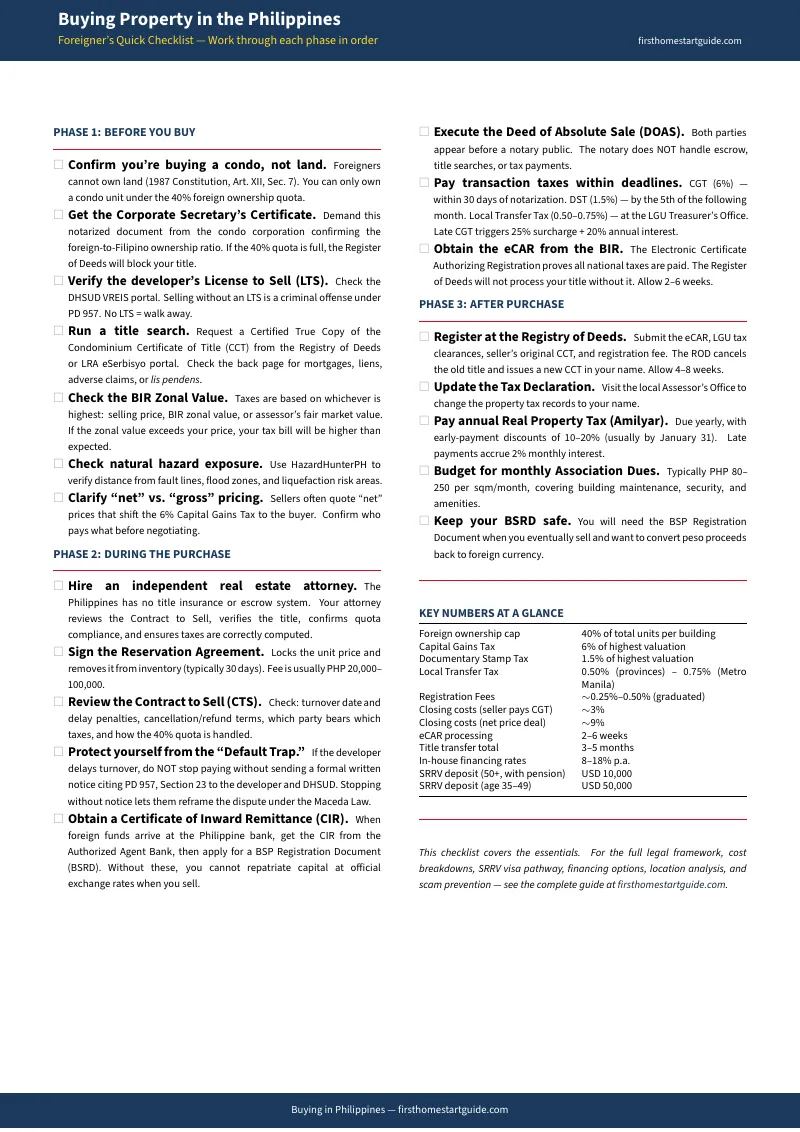
Download the free Quick Checklist to see the step-by-step action plan covering ownership verification, quota confirmation, contract review, tax payments, and the title transfer timeline from reservation to CCT.
When you're ready for the full guide -- the complete Regulatory Shield System with the 15-chapter guide, 8 standalone printable tools (due diligence checklist, transaction cost worksheet, buying process timeline, Default Trap protection, title verification reference, scam red flags, location comparison card, government resources), and the quick-start checklist -- 10 PDFs covering every stage of your Philippine property purchase.
You've found the property. Now understand the legal system that governs your purchase -- before you sign.
Frequently Asked Questions
What if the rules change after I buy?
We update the guide when the rules change. Email us any time, even years later, and we'll send you the current edition free.